GEO & AI Search
Thought Leadership Content That AI Wants to Cite
Quick Answer
AI engines cite thought leadership content because it offers what they can't synthesize elsewhere-original data, unique frameworks, and expert insights. Research shows content with proprietary data gets 30-40% more LLM citations than generic content. To create citable thought leadership: publish original research with specific statistics, develop named frameworks other sources reference, and distribute insights through platforms AI already trusts. The goal is becoming the only source for specific information, making citation mandatory.
Your industry expertise is real. Years of experience, pattern recognition honed through practice, insights most practitioners never articulate. But AI engines don't know about any of it-because you haven't packaged that expertise into formats they can cite.
AI systems are hungry for original insights. They can synthesize generic advice from thousands of sources, but they can't create proprietary data or unique frameworks. That's your opportunity.
Thought leadership for GEO isn't about being famous. It's about creating content so specific and original that AI engines have no choice but to cite you when that topic comes up.
Why AI Engines Prioritize Thought Leadership Content
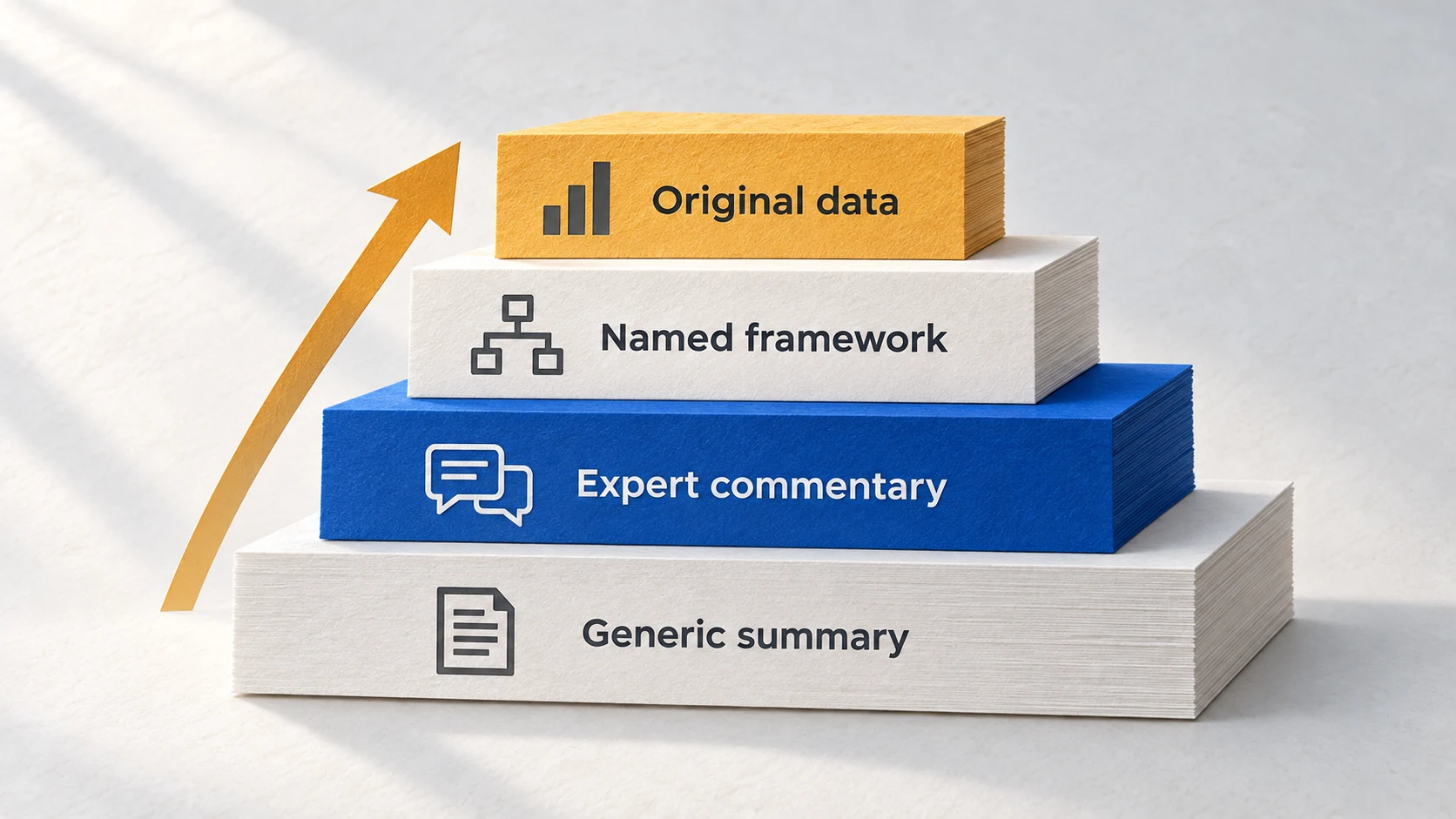
AI models distinguish between two content types: synthesizable and citable. Generic content that restates common knowledge is synthesizable-AI can generate similar text from pattern matching across sources. Original insights with specific data are citable-AI needs to attribute these because they can't be synthesized.
30-40%
more LLM citations for content with unique insights and proprietary data
AI engines actively seek first-party research and expert commentary over recycled summaries.
Source: AITechtonic →34.3%
citation rate for content with original data vs 13.2% without
Original research creates 2.6x the citation rate-making unique data your competitive advantage.
Source: Search Engine Land →The Citation Hierarchy
When AI engines answer user queries, they follow an implicit hierarchy for source selection:
- 1. Unique data sources – Original research, surveys, case studies with specific numbers
- 2. Named frameworks – Methodologies with attribution (e.g., "the XYZ Method" from Source A)
- 3. Expert commentary – Quotable insights with clear author credentials
- 4. Comprehensive explanations – Thorough coverage of topics with structure
- 5. Generic content – Rarely cited directly; synthesized into AI's own phrasing
The fundamental insight: AI engines cite what they cannot replicate. If your content can be generated by combining other sources, AI will generate it rather than cite you. If your content contains unique information, AI must cite you to include it.
Creating Content AI Wants to Quote
Citable thought leadership content has specific structural elements that make AI extraction easy and attribution necessary. These align with the answer-first content framework.
Specific Statistics and Numbers
Replace vague claims with specific data. "Improves results significantly" becomes "improves conversion rates by 23.7%." Specific numbers require attribution; vague claims don't.
Example: "Our analysis of 1,247 websites found that schema implementation increased AI citation rates by 40%."
Named Frameworks and Methodologies
Develop and name your approaches. When other sources reference your framework by name, you become the canonical citation. Unnamed approaches get absorbed into general knowledge.
Example: "The Citation Authority Framework" (from this post series) vs. "a way to prioritize PR efforts"
Quotable Insight Blocks
Write self-contained paragraphs that work as standalone quotes. AI engines extract chunks, not entire articles. Each paragraph should make sense without surrounding context-this is the answer block principle.
Pattern: Strong claim + supporting evidence + specific implication-all in 2-3 sentences.
Experience-Based Evidence
First-person experience signals add credibility AI systems weight. "In our 10-year study of X" or "Working with 50+ clients, we've observed" creates E-E-A-T signals AI engines trust.
Distinction: Personal experience + specific data = high citation potential. Opinion without evidence = low.
High-Citation Phrases
- • "Our research found that..."
- • "Analysis of [X] cases reveals..."
- • "The [Named Framework] approach..."
- • "In [X] years of practice, we've observed..."
- • "Data from [specific source] shows..."
Low-Citation Phrases
- • "It's important to consider..."
- • "Many experts believe..."
- • "Best practices suggest..."
- • "Generally speaking..."
- • "You should probably..."
The Original Research Advantage
Original research is the highest-leverage thought leadership asset for AI citation. When you're the only source for specific data, AI systems must cite you to reference it.
Research Formats That Drive Citations
Industry Surveys
Survey your audience, clients, or industry peers on relevant topics. Even 100-200 responses generate quotable statistics. "We surveyed 147 marketing professionals and found..."
Data Analysis Studies
Analyze publicly available data with your methodology. "We analyzed 10,000 websites and found that..." creates exclusive insights from accessible data.
Annual Benchmark Reports
Recurring research becomes a reference point. "The 2025 State of X Report" positions you as the authority. AI cites established recurring sources.
Case Study Collections
Document your client work with specific metrics. "In 43 implementation projects, we observed an average of..." aggregated experience becomes unique data.
The "Only Source" Principle
When you're the only source for a piece of information, AI must cite you or omit the information entirely. This exclusivity creates citation inevitability:
- • Survey data with your methodology = exclusive to you
- • Analysis with your criteria = unique findings
- • Named framework = you're the canonical source
- • Documented client outcomes = your proprietary data
Positioning Yourself as the Expert Source
AI engines don't evaluate credentials-they evaluate content. But content that signals expertise gets weighted more heavily. Position yourself as an expert through content patterns, not just claims.
Topical Consistency
Publish regularly on the same topics. AI systems recognize topical authority through consistent coverage. Five deep articles on one topic signals more expertise than 50 scattered articles on different topics.
Research finding: Topical authority drives 57% faster traffic growth.
Cross-Platform Presence
AI systems verify expertise through sameAs signals-consistent presence across platforms. LinkedIn, industry publications, speaking engagements, and your website should present unified expertise.
Action: Ensure author bios link across platforms and maintain consistent positioning.
Third-Party Validation
When authoritative sources cite your work, AI systems inherit that trust signal. Guest posts, expert quotes in publications, and industry mentions create validation chains.
Target: Seek mentions on sites AI already cites (test with queries to identify these).
Credential Display
Make credentials visible and verifiable. Author bios with specific experience ("15 years in X," "worked with 200+ clients") provide E-E-A-T signals AI evaluates.
Pattern: Specific numbers + verifiable claims + linked credentials.
The expertise equation: Demonstrated expertise through content + third-party validation + topical consistency = AI-recognized authority. Credentials without content don't create citations. Content without validation limits reach. You need both.
Distribution: Getting Your Insights in Front of AI
The best thought leadership content fails without distribution. AI engines can't cite what they don't know exists. Distribution strategy determines citation velocity.
| Distribution Channel | AI Visibility Impact | Best For |
|---|---|---|
| Major Publications (Guest Posts) | Highest | Getting into AI training data fast; immediate Tier 1 citations |
| Industry Publications | High | Topical authority; niche expertise signals |
| Substack / Newsletters | Medium-High | Editorial voice recognition; thought leadership positioning |
| LinkedIn Articles | Medium | Professional credibility; sameAs validation |
| Own Website Only | Lower (Initially) | Long-term authority; needs external validation to accelerate |
The Distribution Stack
Effective thought leadership distribution follows a pattern:
- 1. Publish original research on owned platform – This is your canonical source
- 2. Pitch key findings to Tier 1 publications – "Our research found X" angle for guest contributions
- 3. Respond to journalist requests citing your data – HARO and similar platforms
- 4. Create derivative content for social/professional platforms – LinkedIn posts, Twitter threads referencing the original
- 5. Track citations and reinforce successful angles – Double down on what AI cites
Platform-Specific Considerations
ChatGPT Preferences
Favors Wikipedia-style authoritative sources, major publications, academic content. Get your insights cited by these sources for ChatGPT visibility.
Perplexity Preferences
Favors real-time sources, Reddit discussions, niche expertise. Participate in Reddit AMAs, engage in relevant community discussions.
FAQ
What makes content qualify as 'thought leadership' for AI citation?
How does original research improve AI citation rates?
Do I need academic credentials to be cited as a thought leader?
How long does it take for thought leadership content to get AI citations?
Ready to Become the Source AI Cites?
Generic content gets ignored. Original insights get cited.
Create the thought leadership AI engines are hungry to quote.
Take the GEO Readiness Quiz →60 seconds · Personalized report · Free
Continue Learning
Dive deeper into AI search with these related articles:
The Digital PR Playbook for GEO: Earned Media as Authority Signals
85% of AI brand mentions come from third-party sources. Learn the Digital PR strategies that build citation authority—from thought leadership to reactive PR to directory listings.
The Content Marketer's Guide to Getting Cited by AI
72.4% of AI-cited content includes answer capsules. Learn the content traits that make AI engines cite your work.
Building Expertise Signals That AI Engines Trust
AI engines evaluate expertise through demonstrated knowledge, topical depth, and verifiable credentials.