GEO & AI Search
E-E-A-T in the AI Era: How to Build Machine Trust
Quick Answer
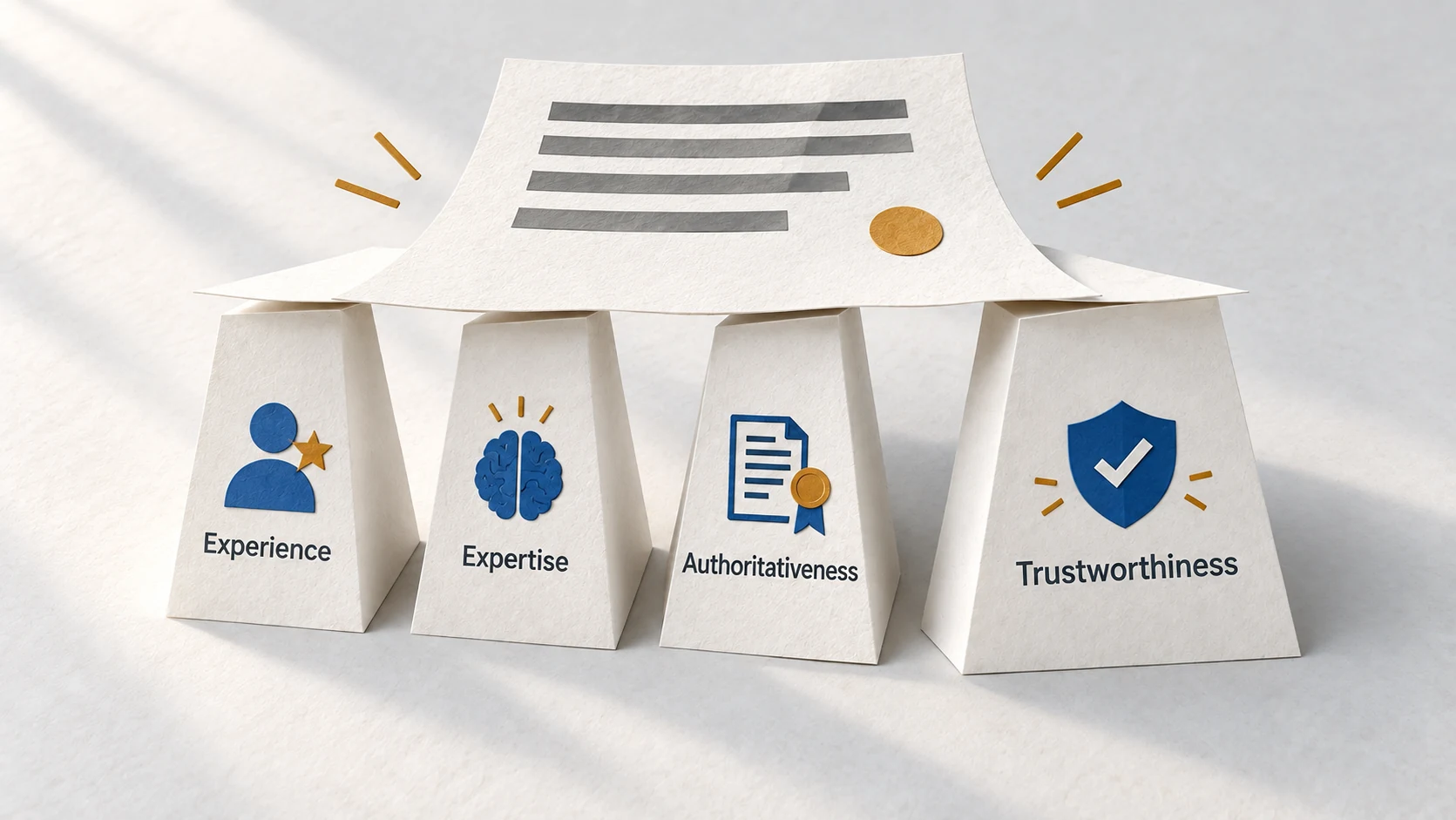
E-E-A-T (Experience, Expertise, Authoritativeness, Trustworthiness) is more critical for AI citations than it ever was for Google rankings. Research shows approximately 85% of sources cited in AI Overviews exhibit at least 3 of 4 strong E-E-A-T signals. Without robust E-E-A-T, your content may rank organically but get systematically excluded from AI-generated answers. Building machine trust requires demonstrable first-hand experience, verifiable credentials, cross-platform authority signals, and transparent sourcing.
You've optimized your content. You've built backlinks. Your page ranks on the first page of Google. But when someone asks ChatGPT a question in your expertise area, your site is invisible.
Here's what most people don't understand. AI engines aren't just looking at your content-they're evaluating whether you're trustworthy enough to recommend. And their standards are higher than Google's ever were.
Think about it from the AI's perspective. When it cites your content, it's vouching for you. It's putting its credibility on the line. Would you stake your reputation on a source you couldn't verify? Neither will AI.
Why E-E-A-T Matters More for AI Than It Ever Did for Google
Google's algorithm always considered E-E-A-T, but content could still rank without perfect signals. You might rank #7 instead of #1, but you'd still appear in results.
AI citation is different. It's more binary. Either you're trustworthy enough to cite, or you're not mentioned at all.
Research Finding
85% of AI-cited sources show strong E-E-A-T
Analysis of AI Overview citations reveals that approximately 85% of cited sources exhibit at least 3 of 4 strong E-E-A-T signals. Sites lacking robust E-E-A-T may rank organically but get systematically excluded from AI-generated answers.
Source: Agenxus GEO Research
And here's what makes this even more complex: different AI models define trust differently. Yext's analysis of over 6.8 million citations reveals striking patterns:
Gemini
52%
citations from brand-owned sites
Trusts what your brand says. Prioritizes structured content with schema markup and Google Business Profiles.
ChatGPT
49%
citations from third-party sites
Trusts what the internet agrees on. Favors directories like Yelp, TripAdvisor, and established authorities like Wikipedia.
Perplexity
24%
citations from niche sources
Trusts industry experts and reviews. Concentrates on industry-specific directories-Zocdoc for healthcare, TripAdvisor for hospitality.
This means you can't optimize for "AI" generically. You need to understand each platform's trust framework and build signals that work across all of them.
Experience: Proving You've Actually Done the Work
The first "E" in E-E-A-T is the newest addition to Google's framework-and it's becoming increasingly important for AI citations. Experience signals demonstrate that you've actually done what you're writing about, not just researched it.
AI engines are getting better at detecting the difference between content written by someone who has hands-on experience versus content that summarizes other sources. Here's how to demonstrate genuine experience:
Include Specific Metrics and Outcomes
Generic claims like "this improved our results" don't signal experience. Specific metrics do.
Weak (no experience signal)
"We saw improvements after implementing this strategy."
Strong (clear experience signal)
"We tested 47 variations over 12 weeks and saw citation frequency increase from 2% to 11%."
Document Your Process with Specifics
Mention the actual tools you used, the timeline you followed, and the challenges you encountered. This level of detail is difficult to fake.
"Using Ahrefs' Content Gap tool alongside manual ChatGPT testing, we identified 23 topic clusters over 6 weeks where our competitors were getting cited but we weren't."
Include "Lessons Learned" Sections
Share what didn't work, what you'd do differently, and what surprised you. These reflections are markers of genuine experience that AI engines recognize.
Expertise: Demonstrating Deep Knowledge
Expertise signals tell AI engines that you have deep, specialized knowledge in your topic area. This goes beyond surface-level familiarity-it's about demonstrating the kind of understanding that only comes from sustained engagement with a subject.
Create Dedicated Author Profile Pages
Every author on your site needs a comprehensive profile page that includes credentials, education, relevant work history, and publication history. This isn't just for human readers-AI systems increasingly parse author bios when assessing source quality.
Key elements: Job title, education, certifications, years of experience, notable publications or projects, professional affiliations.
Build Topical Depth Through Content Clusters
AI engines recognize expertise through topical depth. A single article on a topic signals awareness. A comprehensive content cluster-pillar page plus supporting articles-signals expertise.
This site covers GEO through multiple angles: the fundamentals, specific platform mechanics, career implications, metrics, and implementation strategies. That breadth demonstrates we don't just know about GEO-we understand it deeply.
Link to Professional Profiles
Implement Person schema that links to your LinkedIn, Twitter/X, and other professional profiles. AI engines use these cross-references to verify that you're a real person with verifiable credentials, not a fabricated author bio.
Authoritativeness: Building Recognition Beyond Your Site
Authoritativeness is about what others say about you, not what you say about yourself. For AI citations, this is particularly important because AI engines are designed to look for consensus signals-evidence that the broader web recognizes your authority.
Wikipedia accounts for nearly 48% of ChatGPT's top-cited sources-more than any other source. Why? Because Wikipedia is the ultimate authority signal: it's referenced by millions of other sources, updated constantly, and has built trust over two decades.
You can't become Wikipedia. But you can build the same kinds of signals Wikipedia has: widespread references, entity recognition, and cross-platform presence.
Maintain Entity Consistency Across Platforms
Use consistent NAP (Name, Address, Phone) data, brand names, and entity descriptions across your website, Google Business Profile, social media, and directory listings. AI engines use this consistency to build confidence that you're a real, established entity.
Implement sameAs links in your Organization schema pointing to all your official profiles.
Secure Quality Backlinks (Quality Over Quantity)
Research shows that referring-domain authority is one of the strongest predictors of being cited in ChatGPT answers. One mention from a high-authority domain (DR/DA 60+) is worth more than dozens of directory links.
Focus on earning coverage from industry publications, getting quoted as an expert source, and building relationships that lead to genuine editorial mentions.
Work Toward Knowledge Graph Presence
The ultimate authority signal is appearing in Google's Knowledge Graph. This typically requires Wikipedia entries, verified social profiles, and consistent entity data. While difficult to achieve, it significantly increases your visibility across all AI platforms.
Trustworthiness: The Foundation Everything Else Rests On
Trust is the foundation that makes experience, expertise, and authority meaningful. Without trust signals, AI engines won't cite you regardless of how credentialed you are. Trust is demonstrated through transparency, accuracy, and verifiability.
Implement Transparent Sourcing
Every claim that can be attributed should be attributed. Use inline citations linking to primary sources. This signals to AI engines that your content is verifiable and that you've done the research.
AI engines can follow links and verify claims. Content with proper citations gets treated differently than content making unsupported assertions.
Keep Content Fresh
Content freshness is a major trust signal, especially for Perplexity.
40-60% higher citation rates
Content updated within 90 days gets cited significantly more frequently than identical content last modified 12+ months ago.
Update your dateModified timestamps reliably and ensure they reflect genuine content updates, not just cosmetic changes.
Disclose AI Usage and Editorial Policies
If you use AI in content creation, disclose it. Maintain visible editorial policies, corrections processes, and author attribution. This level of transparency signals that you take accuracy seriously.
Technical Implementation: Schema Markup for E-E-A-T
E-E-A-T signals need to be machine-readable. Schema markup is how you translate your credentials, authority, and trust signals into a format AI engines can parse and verify.
Person Schema
For every author, implement Person schema that includes name, job title, employer (linked to Organization), credentials, and sameAs links to professional profiles.
Use @id to create linkable entities that can be referenced across your site.
Organization Schema
Your Organization schema should include official name, founding date, location, social profiles (sameAs), and any awards or recognitions.
Link Person schemas back to your Organization to create a coherent entity graph.
Article Schema
Every piece of content needs Article or BlogPosting schema with author (linked to Person), datePublished, dateModified, and publisher (linked to Organization).
Accurate dates are crucial-AI engines use freshness as a major trust signal.
FAQ Schema
FAQ schema helps your content appear in featured snippets and provides structured answers that AI engines can easily extract and cite.
Match FAQ content exactly between schema and visible page content.
The Key to Schema: Entity Linking
The power of schema isn't in individual markup-it's in how you connect entities. Use the @id property to link related entities across your site.
Connect an Article's author property to a Person schema on their bio page. Link that Person back to your Organization schema. This builds a knowledge graph that AI models trust because they can verify connections across multiple data points.
E-E-A-T isn't new. What's new is how much it matters. In traditional SEO, weak E-E-A-T might cost you a few ranking positions. In AI search, weak E-E-A-T means you don't get mentioned at all.
The good news: E-E-A-T signals compound over time. Every author bio you optimize, every source you cite, every piece of schema you implement-these build on each other. Start with the fundamentals, measure your citation rates, and keep building. The sites that invest in E-E-A-T now will have a compounding advantage as AI search becomes the dominant discovery channel.
FAQ
What's the difference between E-E-A-T for Google SEO vs AI search?
How do different AI platforms evaluate trust differently?
Does author schema markup actually help with AI citations?
How often should I update content for AI freshness signals?
Ready to Build Machine Trust?
E-E-A-T is the foundation of AI visibility. See how your trust signals measure up.
I've built a system to help brands go from invisible to cited in AI responses. But before I share it with you, I want you to see exactly where you stand.
Take the GEO Readiness Quiz →60 seconds · Personalized report · Free
Continue Learning
Dive deeper into AI search with these related articles:
How ChatGPT Decides What to Cite (And What to Ignore)
Ever wondered why ChatGPT cites some websites and ignores others? Learn the citation mechanics and how to increase your chances of being cited.
How ChatGPT, Claude, and Perplexity Actually Find and Cite Content
Each AI platform works differently. Learn the mechanics behind how ChatGPT, Claude, and Perplexity discover and cite your content.
Why SEO Experience Is Your Competitive Advantage in GEO
Your SEO background gives you a 6-12 month head start in GEO. Here's how to leverage your existing expertise.