GEO & AI Search
Content Structuring for AI Consumption: The Answer-First Framework
Quick Answer
Content structuring for AI consumption requires answer-first formatting, modular blocks, and extensive use of lists and tables. ChatGPT-cited pages include list sections at 17x the rate of typical Google results (13.75 sections vs less than 1). The answer-first framework places direct answers in the first 40-60 words of each section, followed by evidence and context. Content should be organized into self-contained units that can be extracted and cited without needing surrounding context. Short paragraphs (60-100 words), sequential heading hierarchy (H1 → H2 → H3), and original data all increase citation probability.
Your content is well-researched. The information is accurate. The writing is clear. But when AI systems scan your page, they can't find anything to extract.
AI engines don't read content the way humans do. They break pages into tokens, analyze relationships between sentences, and look for patterns they can use to generate answers. Your brilliant insights, buried in paragraph four after context and background, never surface.
This guide covers the complete framework for structuring content that AI systems actually cite: answer-first formatting, modular content blocks, and the structural elements that make extraction possible.
Why Structure Matters More Than Length for AI
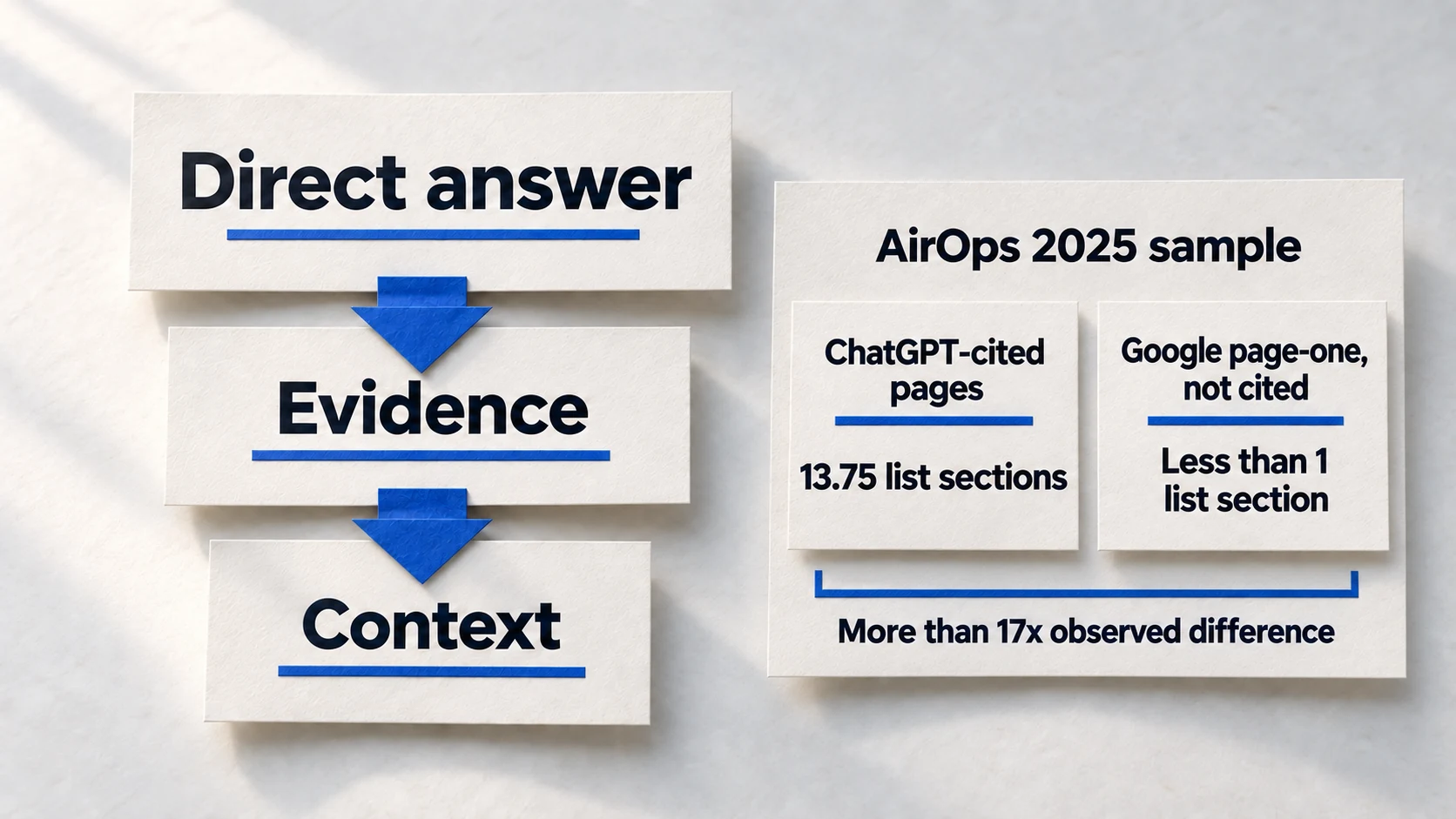
Traditional SEO rewarded comprehensive content. Longer pages with more keywords often outranked shorter competitors. AI citation works differently-structure and extractability determine citation likelihood, not word count.
17x
more list sections in ChatGPT-cited content
ChatGPT-cited pages average 13.75 list sections. Google SERP leaders average less than 1. Lists create extractable, quotable content units.
Source: AirOps Research →79%
of ChatGPT-cited pages include HTML lists
Compare this to just 28.6% of Google top-ranking pages. Lists aren't optional for AI visibility-they're essential.
Source: AirOps Research →How AI Parses Content
Unlike traditional search crawlers that rely on markup, metadata, and link structures, LLMs interpret content by breaking it into tokens and analyzing relationships between words, sentences, and concepts.
They look for patterns: clear headings that indicate topic hierarchy, self-contained paragraphs that express complete ideas, and structured elements (lists, tables, FAQs) that organize information into extractable units.
Before You Start
- ✓ Clear H1-H2-H3 hierarchy
- ✓ Answer in first 100 words
- ✓ Self-contained paragraphs
- ✓ Scannable formatting (lists, tables)
The structural principle: AI models favor content that is easy to parse, compare, and quote. A Princeton study found content with clear questions and direct answers was 40% more likely to be rephrased by AI tools like ChatGPT.
The Answer-First Framework
Answer-first formatting means placing your direct answer in the first 40-60 words of each section. No background. No context-setting. No "before we dive in." The answer comes first.
Assess Your Content Structure
Question
Does your content pass the AI-ready test?
Restructure: Move answer to top
Critical fix
Make declarative and specific
High impact
Optimize surrounding context
Fine-tuning
Restructure: Move answer to top
Critical fix
Make declarative and specific
High impact
Optimize surrounding context
Fine-tuning
Answer-First vs Traditional Structure
Traditional (Buried Answer)
Content freshness has always been important in SEO. Search engines want to show users the most relevant, up-to-date information. This is especially true for topics that change frequently. According to recent research, freshness matters even more for AI citations-76.4% of ChatGPT's most-cited pages were updated in the last 30 days.
Answer appears after 50+ words of context.
Answer-First (Immediately Extractable)
76.4% of ChatGPT's most-cited pages were updated in the last 30 days. This makes freshness one of the strongest signals for AI citation-stronger than traditional SEO. AI-cited URLs are 25.7% fresher on average than those in traditional search results.
Key statistic appears in first sentence.
The 4-Part Answer-First Structure
Direct Answer (First 40-60 Words)
State the key information, statistic, or recommendation immediately. This is the extractable content AI will quote.
Supporting Evidence
Cite the source, provide data, or reference research. AI systems prioritize content grounded in verifiable evidence.
Context and Nuance
Explain edge cases, limitations, or who this applies to. This is where background information belongs-after the answer.
Actionable Takeaway
End with a practical next step or summary. This creates a complete, self-contained content unit.
Implementation Process
Review current structure
Audit
Apply answer-first
Restructure
Test with AI tools
Verify
Pro Tip
Start with your H2 headings. If they read like a table of contents that answers the main question, your structure is AI-ready. If they're clever or vague, rewrite them.
40%
higher citation rate for quantitative claims
Pages with specific statistics and data points outperform qualitative statements. AI systems prioritize factual, evidence-based content.
76.4%
of ChatGPT-cited pages updated in last 30 days
Freshness signals are stronger in AI citation than traditional SEO. AI-cited URLs are 25.7% fresher on average.
Source: Brimar Research →Lists and Tables: The 17x Advantage
Lists are the single most differentiating structural element between AI-cited content and content that gets ignored. ChatGPT-cited pages average 13.75 list sections. Google top-ranking pages average less than one.
List Usage: AI-Cited vs Google SERP Leaders
Pages with Lists
79%
ChatGPT-cited
28.6%
Google SERP
Avg List Sections
13.75
ChatGPT-cited
<1
Google SERP
Difference
17x
More lists in cited content
When to Use Numbered Lists
- • Step-by-step processes or tutorials
- • Rankings or prioritized recommendations
- • Sequential workflows
- • Chronological timelines
- • Prioritized action items
When to Use Bullet Points
- • Non-sequential features or benefits
- • Options without clear hierarchy
- • Quick reference information
- • Summaries of key points
- • Lists of 3-7 related items
Tables: 2.5x Citation Increase
Tables increase citation rates 2.5x compared to the same information in prose. Use tables for:
- • Comparisons between options or products
- • Data with multiple attributes
- • Reference information users want to scan
- • Specifications or technical details
Tables create structured data that AI can directly extract and present in answers.
The list principle: Bulleted or numbered lists make content modular and easier to parse. LLMs often reference individual list items when generating summaries or direct answers. Each list item should be a complete, extractable unit.
Modular Content: Building Extractable Units
Modular content means each section, paragraph, or list item can be extracted and understood without needing context from elsewhere on the page. AI systems pull specific chunks to generate answers-those chunks must make sense on their own.
The Extraction Test
For every paragraph you write, ask: If this paragraph appeared alone in an AI response, would it make complete sense?
Fails Extraction Test
"This works because of what we discussed earlier. When you apply these techniques, the results speak for themselves."
(What works? What was discussed? What techniques?)
Passes Extraction Test
"Answer-first formatting increases AI citation rates because LLMs extract content from the beginning of sections. Placing key information in the first 40-60 words makes content immediately quotable."
(Complete meaning, no external dependencies)
Avoid Pronoun Dependency
Replace "it," "this," "these," "they," and "that" with specific nouns. Extracted text that starts with pronouns references nothing.
Instead of: "It works by analyzing these factors." → "Answer-first formatting works by placing direct answers before context."
Create Self-Contained Sections
Each H2 section should be understandable without reading the section before it. Avoid phrases like "as mentioned above" or "continuing from the previous section."
Best practice: Write each section as if it could be read independently.
Use Consistent Terminology
Pick one term and use it throughout. Don't switch between "AI citation," "LLM references," and "machine learning mentions." Consistency helps LLMs follow the narrative.
Rule: Establish terminology in your first section and maintain it throughout.
Modular Content Benefits
Modular content ensures that whichever module of your content is used by AI, your brand is represented accurately. Once structure is set, tone and phrasing determine whether your meaning stays intact as it's digested, synthesized, and served up in AI responses.
Paragraph and Sentence Optimization
Paragraph length directly affects how AI systems process and extract content. Short, focused paragraphs with clear intent perform better than long blocks of text.
60-100
Words per Paragraph
Enough to explain one idea with clarity
15-20
Words per Sentence
Average sentence length in cited content
3-5
Sentences per Paragraph
Improves content segmentation
Why Short Paragraphs Win
- Reduced blending risk: Short paragraphs reduce the risk of information blending across unrelated ideas. One idea per paragraph.
- Clear segmentation: LLMs segment content at paragraph boundaries. Shorter paragraphs create more, cleaner segments.
- Better extraction: When AI pulls a paragraph for an answer, shorter paragraphs are more likely to be complete thoughts.
- Improved scanning: Users and AI both benefit from scannable, structured content.
Research Finding: Readability Impact
One study found that "stylistic changes such as improving fluency and readability of the source text resulted in a significant visibility boost of 15-30%." Structured formats like headings, bullet points, and comparison tables consistently outperform dense text blocks in AI responses.
Source: Search Engine Journal →Evidence and Source Citations
AI systems prioritize content grounded in verifiable evidence. They're far more likely to extract and cite information when it comes from primary sources-industry reports, official documentation, or authoritative research.
34.3%
citation rate with original data
Content with original research, unique statistics, or proprietary data gets cited at more than double the rate of content without (13.2%).
100%
of AI-ranking content shows E-E-A-T signals
Every piece of AI-cited content demonstrates visible author expertise credentials. E-E-A-T functions as a gating mechanism for citation eligibility.
Types of Evidence That Increase Citations
- Industry reports: Studies from recognized research firms
- Official documentation: Platform guidelines, API docs
- Original research: Your own surveys, experiments, data
- Academic studies: Peer-reviewed research
- Expert quotes: Named sources with credentials
- Case studies: Documented results with specifics
- Statistical data: Specific numbers with sources
- Updated information: Current year references
The evidence principle: Original research is one of the strongest authority signals. When you share unique data, experiments, or surveys, you're feeding AI engines fresh information that doesn't exist elsewhere in their training data. That alone can make your work a preferred source for AI-generated answers.
Implementation Checklist
Use this checklist to audit and optimize your content for AI consumption.
AI-Ready Content Checklist
Heading Structure
- ☐ Single H1 tag defining main topic
- ☐ Sequential hierarchy (H1 → H2 → H3, no skipped levels)
- ☐ Question-based headings where appropriate
- ☐ Semantic clarity (headings state what section covers)
Answer-First Formatting
- ☐ Direct answer in first 40-60 words of each section
- ☐ Quick Answer or summary at page top
- ☐ Evidence follows answer (not precedes it)
- ☐ Context and nuance after core information
Structured Content Elements
- ☐ Multiple list sections (target 5+ per page)
- ☐ Tables for comparative data
- ☐ FAQ section with question-answer pairs
- ☐ 3-7 items per list
Modular Content
- ☐ Each section passes extraction test (understandable alone)
- ☐ No pronoun dependency (specific nouns instead)
- ☐ Consistent terminology throughout
- ☐ Self-contained paragraphs
Paragraph Optimization
- ☐ Paragraphs 60-100 words
- ☐ Sentences 15-20 words average
- ☐ One idea per paragraph
- ☐ Short, scannable content blocks
Evidence and Authority
- ☐ Cited sources with links
- ☐ Quantitative claims with data
- ☐ Author credentials visible
- ☐ Recent updates (within 30 days for best results)
Common Content Structuring Mistakes That Block Citations
Understanding what works is half the battle. Knowing what to avoid prevents wasted effort on content that AI engines will ignore regardless of its quality.
Mistake #1: The "Comprehensive" Intro
Many writers believe longer introductions demonstrate expertise. They spend 200-300 words setting context before reaching the actual answer. AI engines don't reward comprehensiveness in introductions-they reward answers in the first 100 words.
Example: "In today's rapidly evolving digital landscape, businesses face unprecedented challenges in maintaining visibility. The intersection of artificial intelligence and search optimization has created new paradigms..." - 47 words with zero extractable content.
Fix: Start with the answer. "76.4% of ChatGPT's most-cited pages were updated in the last 30 days. Freshness is the strongest citation signal in AI search."
Mistake #2: Prose Over Structure
Traditional content marketing favored flowing narrative. AI engines favor structure. When you present a list of 7 items as a continuous paragraph, you lose the 17x citation advantage that comes from using actual HTML list elements.
Example: "The key factors include relevance, authority, freshness, structure, originality, clarity, and accessibility." - Same 7 factors, but no extractable list structure.
Fix: Convert to bullet points or numbered lists. Each item becomes separately extractable.
Mistake #3: Clever Over Clear Headings
Headlines like "The Secret Sauce" or "Putting It All Together" are engaging for human readers but meaningless to AI engines trying to understand what a section contains. AI systems match headings to queries-vague headings match nothing.
Example: "The Game-Changing Approach" vs "How to Structure Content for AI Citations" - The second version tells AI exactly what the section covers.
Fix: Use descriptive, query-matching headings. Think about what someone would ask, then make your heading the answer.
Mistake #4: Context Dependency Across Sections
When section 4 starts with "Building on the foundation we established above..." or "As mentioned in the previous section...", AI engines can't extract that section meaningfully. Each section must stand alone because AI might cite only that specific portion.
Example: "This technique works because of what we discussed earlier." - "This technique" and "what we discussed" are undefined when extracted.
Fix: Name everything explicitly. "Answer-first formatting works because LLMs extract content from section beginnings."
The pattern across all four mistakes: Traditional content writing optimized for human reading flow. AI-optimized content prioritizes extraction clarity. The good news? Content that's clear enough for AI extraction is also easier for humans to scan and understand.
Putting It All Together: A Practical Workflow
Here's how to apply this framework to your existing content or new content creation. This workflow takes a piece of content from "AI-invisible" to "AI-ready" in about 30 minutes per page.
The 30-Minute AI Structure Audit
First 5 Minutes: Answer Audit
Read only the first 100 words of each section. Is the key information there? If you have to scroll to find the answer, move it up. Mark sections that need restructuring.
Next 10 Minutes: Structure Pass
Count your lists and tables. If you have fewer than 5 list sections, identify paragraphs that could become lists. Convert comparison prose into tables. Add at least 3 new structured elements.
Next 10 Minutes: Extraction Test
Select 5 random paragraphs. Read each one in isolation. Does it make complete sense without the surrounding content? Replace any pronouns with specific nouns. Ensure each paragraph passes the standalone test.
Final 5 Minutes: Heading Review
Read your headings as a list, without the content. Do they answer the questions someone might ask about this topic? Replace clever headings with clear ones. Ensure H2s could serve as a table of contents.
Before (AI-Invisible)
- • 3,000 words of flowing prose
- • Answer in paragraph 4
- • Zero list sections
- • Clever, vague headings
- • Pronouns referencing previous sections
Citation probability: ~5%
After (AI-Ready)
- • Same 3,000 words, restructured
- • Answer in first 60 words
- • 8+ list sections and 2 tables
- • Descriptive, query-matching headings
- • Self-contained, extractable sections
Citation probability: ~35%
FAQ
How long should paragraphs be for AI optimization?
Should I use bullet points or numbered lists?
What makes content 'modular' for AI?
How important is original research for AI citations?
Does content freshness affect AI citations?
Ready to Make Your Content AI-Extractable?
You've seen the 17x list advantage. You understand answer-first formatting. Now discover where your content stands-and what's blocking your citations.
I've built a system to help brands go from invisible to cited in AI responses. But before I share it with you, I want you to see exactly where you stand.
Take the GEO Readiness Quiz →60 seconds · Personalized report · Free
Continue Learning
Dive deeper into AI search with these related articles:
Heading Structure Optimization for AI Consumption
Learn how to structure H1, H2, and H3 headings for AI search visibility. Sequential heading hierarchy is 3x more common in ChatGPT-cited content.
The Answer Block: Creating Citation-Worthy Content Units
Learn how to structure content in self-contained answer blocks that AI engines can extract and cite. The 72.4% citation pattern explained.
The Content Marketer's Guide to Getting Cited by AI
72.4% of AI-cited content includes answer capsules. Learn the content traits that make AI engines cite your work.