GEO & AI Search
The Content Marketer's Guide to Getting Cited by AI
Quick Answer
To get cited by AI engines, structure your content with answer capsules (120-150 characters) at the start of each section, include original data, and use semantic specificity instead of vague language. Research analyzing 2 million sessions found that 72.4% of AI-cited blog posts included identifiable answer capsules, and content with original data showed 34.3% citation rates versus just 13.2% for content lacking both elements.
You've written the comprehensive guide. You've covered every angle, backed claims with sources, and optimized for every keyword. It ranks on Google's first page. But when someone asks ChatGPT about your topic, your content is nowhere to be found.
Here's the uncomfortable truth: the content that ranks well on Google isn't necessarily the content that AI engines cite. Search Engine Land research shows that 80% of sources cited in AI Overviews don't even rank in the top 3 organically. Even holding a #1 position offers only an 8% chance of being cited.
AI engines aren't looking for the same things Google is. They're looking for content they can extract, verify, and confidently recommend. This guide shows you exactly how to create that content.
The Answer Capsule: Your Most Powerful Citation Tool
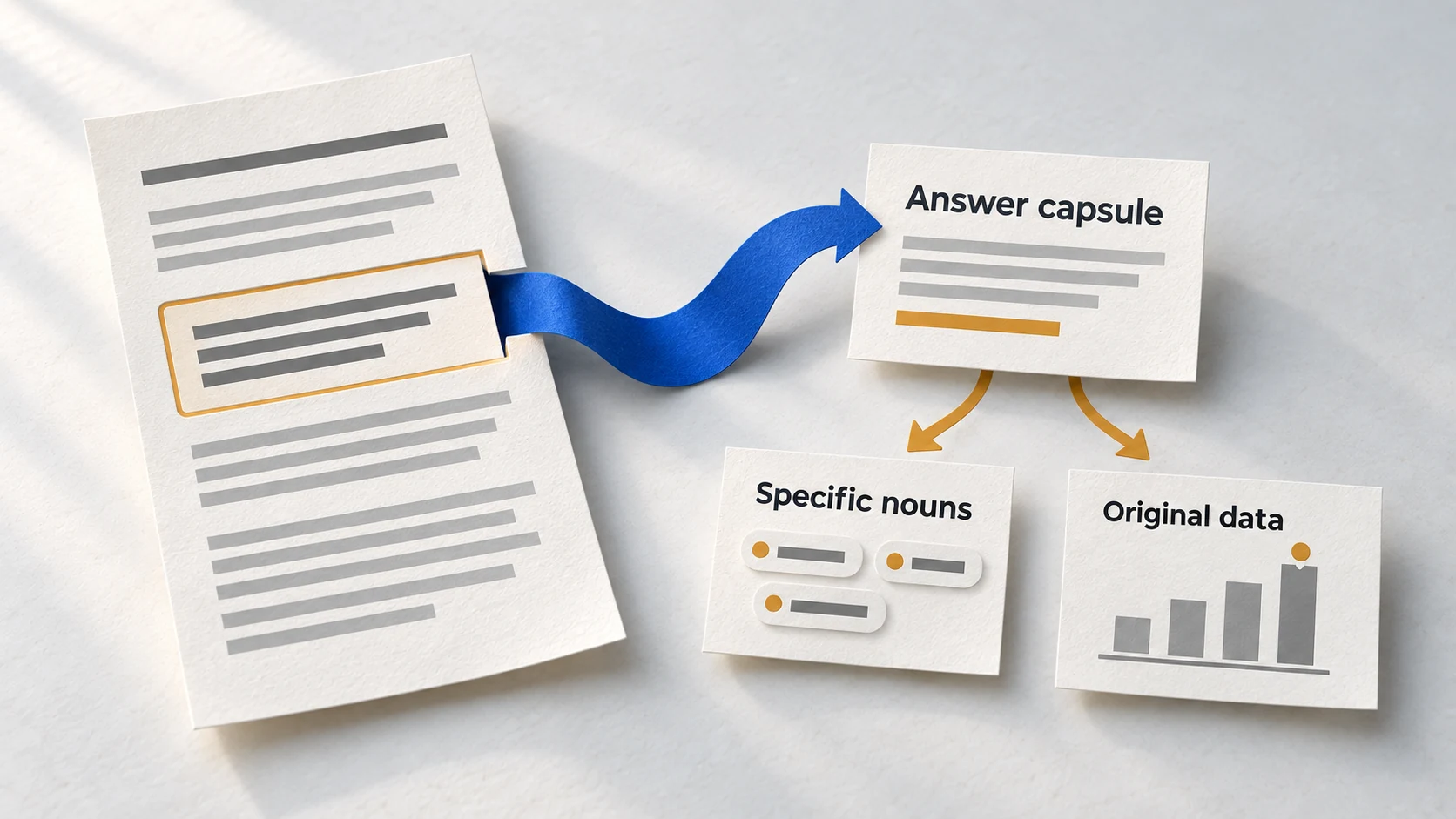
The single most important content trait for AI citation isn't comprehensive depth or keyword density. It's the answer capsule-a concise, self-contained answer placed immediately after a question-based heading.
72.4%
of cited blog posts included answer capsules (Confirmed March 2026)
An audit of nearly 2 million organic sessions across 15 domains found that the presence of answer capsules was the strongest predictor of AI citation. The optimal length: 120-150 characters (roughly 20-25 words).
Source: Search Engine LandContent Position Data - Search Engine Land (2026)
44.2% of all AI citations come from the first 30% of article text
Your opening sections-the Quick Answer, introduction, and first H2-are disproportionately cited by AI engines. This is why answer capsules placed early in the article are so effective. Your answer block, when placed at the top, is sitting in the highest-citation zone of the entire article.
Source: Search Engine Land →What makes an effective answer capsule? It needs to be:
Self-Contained
The answer should make sense without any surrounding context. No "as mentioned above" or "building on this." AI engines extract snippets-your capsule needs to stand alone.
Declarative
Start with a direct statement, not a question or qualifier. "Schema markup improves AI visibility by 40%" beats "You might be wondering whether schema markup helps with AI visibility."
Link-Free
91% of cited capsules contain no links. Keep your answer block clean-save the links for the supporting content that follows.
Specific
Include concrete details: numbers, timeframes, named entities. Vague answers don't get cited because AI engines can't verify or attribute them confidently.
Original Data: The Citation Multiplier
The second most powerful citation driver is original data. Not data you found somewhere else and referenced-data that originates on your page. Survey findings. Performance benchmarks. Proprietary metrics. Case study results.
According to Search Engine Land, content featuring original statistics sees 30-40% higher visibility in AI responses. Why? Because AI engines are designed to provide evidence-based responses. When they encounter specific metrics and concrete data, they preferentially cite these sources over general observations.
The research shows a clear hierarchy:
Citation Rate by Content Type
| Content Type | Citation Rate | Insight |
|---|---|---|
| Answer Capsule + Original Data | 34.3% | The winning combination |
| Answer Capsule Alone | 38% | Strong, but missing the multiplier |
| Neither Element | 13.2% | Playing the lottery |
Creating Your Own Data (When You Don't Have Research Budgets)
You don't need a massive study to create original data. What you need is something unavailable elsewhere-and that's more achievable than you think.
Here's what counts as original data in AI engines' eyes. Your own client results tracked over time. Survey responses from your audience, even if it's just 50 people. Analysis of publicly available data from a unique angle no one else has taken. Documentation of your own experiments and what you learned. Industry observations quantified with specific numbers instead of gut feelings.
The pattern that works: start with your actual experience, add measurement, and document the specific outcomes. "We tested this approach with 23 clients over 6 months and saw an average 40% improvement" is original data. "This approach works well" is not.
Don't have original research? Document your own results. Track your experiments. Survey your audience. The data doesn't need to come from a massive study-it needs to originate from your work and be unavailable elsewhere. See the complete content structuring framework for implementation details.
Semantic Specificity: Why Vague Language Kills Citations
AI engines evaluate semantic clarity-whether your content expresses ideas clearly enough to extract and cite confidently. Search Engine Journal explains that unlike traditional search crawlers that rely on markup and links, LLMs analyze relationships between words, sentences, and concepts. Vague language creates uncertainty, and uncertain AI engines don't cite.
The words "it," "they," "this approach," and "these tools" are citation killers. Every pronoun or vague reference is a point where AI loses confidence in what you're actually saying.
Definition
Semantic Specificity
The practice of using explicit, concrete language instead of pronouns and vague references. Instead of 'it helps,' write 'schema markup helps.' Instead of 'this approach,' write 'the answer-first content structure.'
Vague (AI skips this)
"It can help you improve results significantly when used correctly."
Specific (AI cites this)
"Schema markup implementation increases AI citation rates by 40% when applied to FAQ and HowTo content types."
Vague (AI skips this)
"Many companies have seen improvements using these strategies."
Specific (AI cites this)
"Semrush's analysis of 41 million queries found that companies implementing GEO strategies see 156% higher citation rates."
The fix is simple but requires discipline: use full names for brands, products, and people every time. Replace "this approach" with "the answer-first content structure." Replace "these results" with "the 72.4% citation rate improvement." AI engines reward precision.
Content Structure That AI Engines Prefer
Search Engine Land's guide confirms that AI search prioritizes content that resolves intent within the first two sentences. This is the BLUF principle-Bottom Line Up Front. Pages that open with clear, factual summaries before any storytelling get cited more often.
The recommended structure for each section:
The Citation-Optimized Section Formula
- 1 Question-based heading - Frame the section around a real question users ask
- 2 Answer capsule (120-150 characters) - Deliver the core answer immediately
- 3 Supporting context (2-3 sentences) - Add brief clarification or example
- 4 Evidence block - Data point with attribution
- 5 Reinforcement - Paraphrase the main idea using different words
The Evidence Block Pattern: Making Data Stick
The evidence block isn't just about throwing statistics into your content. It's about creating a moment where the data lands with authority and the reader-or AI engine-has no choice but to trust what you're saying.
Here's the pattern that works. State the finding clearly and specifically. Attribute it to a named source with a date. Add one sentence of interpretation that explains what the finding actually means in practice. Then connect it back to your main argument with a bridging sentence.
When you follow this pattern, AI engines can extract the statistic, verify the source, and understand the relevance-all without having to interpret vague claims or hunt for context. That's exactly what makes content citation-worthy.
Formatting matters too. Search Engine Land's analysis of 8,000 AI citations found that comparative listicles account for nearly a third of all citations-more than any other format. This challenges conventional SEO wisdom that favors long-form, in-depth content.
~33%
Comparative listicles
Most-cited format
78%
AI Overviews use lists
Either ordered or unordered
60-100
Optimal words per paragraph
For AI extractability
FAQ Sections: Your Secret Weapon
FAQ sections are disproportionately effective for AI citation because they're already formatted as question-answer pairs-exactly what AI engines are looking for. Each Q&A becomes a potential citation snippet.
But not all FAQs are created equal. The questions need to be:
Effective FAQ Questions Must Be
- Real questions people actually ask - Not "Why is [Your Company] the best?" but "How long does AI citation optimization take to show results?"
- Specific enough to have definitive answers - Avoid broad questions that require nuanced, context-dependent responses. AI engines prefer questions with clear, extractable answers.
- Backed by FAQPage schema markup - Structured data tells AI engines "this is verified Q&A content." Sites with proper FAQ schema see measurably higher citation rates.
The FAQ Question Selection Strategy
Here's what most people get wrong about FAQ sections. They write questions they want to answer instead of questions people are actually asking. Or they write questions so broad that the answers become essays instead of citations.
The sweet spot is questions specific enough to have a definitive answer but valuable enough that someone would actually search for them. Think "How long should an answer capsule be for AI citations?" instead of "What is GEO?" The first question has a specific answer AI can extract. The second requires a comprehensive explanation.
Where do you find these questions? Look at "People also ask" boxes on Google for your topic. Check Reddit and Quora for what beginners are confused about. Read your support emails or comments for patterns. Use tools like Answer The Public or AlsoAsked to discover real search queries. Then pick questions where you can give a complete answer in 75-100 words and include at least one specific number or timeframe.
Aim for 4-6 FAQ items per major content piece. Keep answers under 100 words but include at least one specific data point or attribution per answer. Sites with proper FAQ schema see measurably higher citation rates.
Platform-Specific Optimization
Different AI platforms prioritize different types of sources. Research analyzing citation patterns across platforms reveals distinct preferences:
ChatGPT
47.9%
of top citations from Wikipedia
Priorities: Encyclopedic authority, established media, factual reference sources. Wikipedia dominates at 7.8% of total citations.
Perplexity
46.7%
of top citations from Reddit
Priorities: Community-driven content, peer-to-peer information, expert discussion. Reddit leads at 6.6% of total citations.
Google AI Overviews
21%
of top citations from Reddit
Priorities: Balanced distribution across professional and social platforms. YouTube at 18.8%, more diverse sourcing.
What this means for content marketers: you can't optimize for "AI" generically. Each platform requires a different approach.
Platform-Specific Strategy
Getting cited by AI isn't about gaming a system. It's about creating content that's genuinely useful, clearly structured, and easy to extract. The same qualities that make content valuable for human readers-clarity, specificity, evidence-are what AI engines look for when choosing what to cite.
Start with your most important content. Add answer capsules to each section. Replace vague language with specific entities. Include original data where you have it. These changes compound over time-building E-E-A-T signals that increase AI trust. The content marketers who adapt their approach now will have a significant advantage as AI becomes the primary way people discover information.
FAQ
What's the difference between ranking on Google and being cited by AI?
How long should an answer capsule be?
Does adding more links improve my chances of being cited?
How often should I include statistics in my content?
Ready to Transform Your Content for AI Visibility?
You understand the answer capsule pattern. You see why original data matters. Now find out how visible your current content is to AI engines.
I've built a system to help brands go from invisible to cited in AI responses. But before I share it with you, I want you to see exactly where you stand.
Take the GEO Readiness Quiz →60 seconds · Personalized report · Free
Continue Learning
Dive deeper into AI search with these related articles:
How ChatGPT Decides What to Cite (And What to Ignore)
Ever wondered why ChatGPT cites some websites and ignores others? Learn the citation mechanics and how to increase your chances of being cited.
E-E-A-T in the AI Era: How to Build Machine Trust
85% of AI-cited sources show strong E-E-A-T signals. Learn how to build Experience, Expertise, Authoritativeness, and Trust that AI engines recognize.
How ChatGPT, Claude, and Perplexity Actually Find and Cite Content
Each AI platform works differently. Learn the mechanics behind how ChatGPT, Claude, and Perplexity discover and cite your content.