GEO & AI Search
Author Bio Optimization for AI Citation: A Complete Guide
Quick Answer
An AI-optimized author bio includes verifiable credentials, specific experience claims, Person schema markup, and consistent information across platforms. AI engines cross-reference author details to assess expertise and trustworthiness before citing content. A well-optimized bio creates a web of verifiable signals that AI can confirm, while vague or inconsistent bios create citation risk.
Your content is solid. Your research is thorough. Your writing is clear. But your author bio says "Content Team" with no photo, no credentials, and no way to verify who actually wrote it.
To AI engines, that's a ghost author-a source that can't be verified, can't be cross-referenced, and can't be trusted. Ghost authors don't get cited.
Author bios aren't vanity elements. They're verification infrastructure. Here's how to optimize yours for AI citation.
Definition
Author Verification Infrastructure
The combination of author bio elements, schema markup, and cross-platform consistency that enables AI engines to confirm an author's identity, credentials, and expertise before citing their content.
Why Author Bios Matter for AI Citations
AI engines don't just evaluate content-they evaluate who created it. The "Expertise" in E-E-A-T depends heavily on whether the author's credentials can be verified and whether their claimed expertise matches the content topic.
Expertise Verification
AI engines assess whether the author has relevant credentials for the topic. A medical article by "Dr. Jane Smith, MD, 15 years in cardiology" carries more weight than "Jane S., health writer."
Cross-Reference Validation
AI engines check if the author exists elsewhere. If "Jane Smith" has a LinkedIn profile, academic publications, or other mentions, those signals reinforce credibility.
Trust Signal Aggregation
Author credibility combines with site credibility. A trusted author on a trusted site is ideal. A credible author can elevate content even on newer sites.
Topical Authority Mapping
AI engines connect authors to topics through their body of work. An author with 50 articles on GEO is more authoritative on GEO than someone writing their first post.
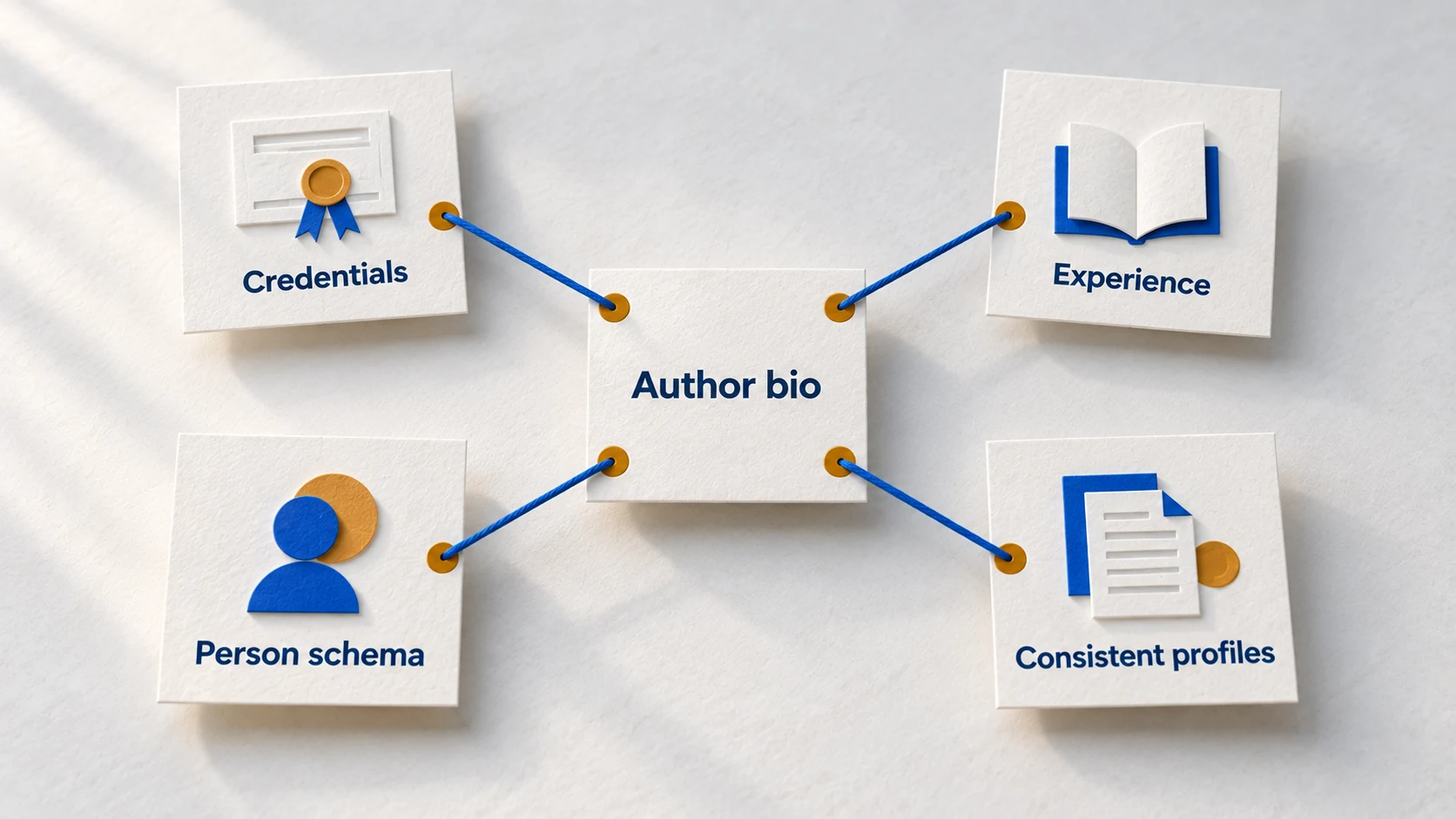
According to AthenaHQ research, establishing "multi-platform authority across Reddit, LinkedIn, YouTube, Quora, and industry forums" builds "composite authority signals that AI systems recognize." Your author bio is the hub that connects these platform presences.
Anatomy of an AI-Optimized Author Bio
An effective author bio contains specific, verifiable information organized for both human readers and machine parsing.
Essential Bio Components
Full Name
Use your actual name as it appears on LinkedIn, publications, and professional credentials. Consistency matters.
Professional Title / Role
Current position with company name. "Senior Marketing Manager at [Company]" not just "Marketing Professional."
Credentials (if applicable)
Degrees, certifications, licenses relevant to your content area. "CPA," "PMP," "PhD in [Field]" - verifiable credentials only.
Experience Quantified
"15 years in digital marketing" or "managed $10M in ad spend" - specific numbers beat vague claims.
Notable Achievements
Published works, speaking engagements, awards, client results. Evidence of impact in your field.
Platform Links
LinkedIn, Twitter, personal website, other professional profiles. Creates cross-referenceable identity web.
❌ Weak Bio
"John is a marketing expert with years of experience helping businesses grow. He's passionate about digital marketing and loves sharing insights."
Problems: No verifiable credentials, vague experience claim, no specific achievements, no way to confirm identity.
✓ Strong Bio
"John Chen is Director of Growth at TechCorp, where he leads a 12-person team managing $5M in annual ad spend. He's a Google Ads certified professional with 8 years of SaaS marketing experience. Previously at HubSpot. Connect on LinkedIn."
Strengths: Specific role, verifiable company, quantified metrics, certification, career history, platform link.
Schema Markup for Authors: The Technical Layer
Person schema provides machine-readable author information that AI engines can parse directly. This removes ambiguity and creates verifiable connections between your identity and your content.
Essential Person Schema Properties
@type: Person
Declares this is a person entity
name
Full name as it appears everywhere
jobTitle
Current professional title
worksFor
Organization entity with name and URL
sameAs
Array of profile URLs (LinkedIn, Twitter, etc.)
url
Link to author's page on your site
image
Professional headshot URL
description
Brief bio summary
Why sameAs Matters
The sameAs property is particularly powerful for AI verification. It explicitly tells AI engines: "This person is the same entity as the LinkedIn profile at [URL] and the Twitter account at [URL]."
Without sameAs, AI engines must infer connections. With it, they can programmatically verify that "John Chen" the author is the same "John Chen" who works at TechCorp on LinkedIn-removing ambiguity and increasing trust.
Multi-Platform Author Consistency
AI engines build author profiles by aggregating signals across platforms. Inconsistencies create confusion and reduce trust.
Name Consistency
Use the same name format everywhere. "John Chen" or "John S. Chen" or "J. Chen"-pick one and stick with it.
Check: Website, LinkedIn, Twitter, article bylines, conference profiles, podcast appearances.
Title/Role Consistency
Your current role should match across platforms. If you've changed jobs, update everything within a week.
Check: LinkedIn headline, website bio, Twitter bio, conference speaker profiles.
Photo Consistency
Use the same professional headshot across platforms. This creates visual recognition that reinforces entity connections.
Check: LinkedIn, Twitter, website About page, Gravatar, industry profiles.
Bio Narrative Consistency
Key facts should align: years of experience, credentials, notable achievements. Adapt length for each platform, but facts must match.
Check: 200-word website bio, 100-word LinkedIn summary, 50-word article bylines.
Platform Priority for AI Visibility
Common Author Bio Mistakes That Kill Citations
These mistakes reduce your chances of being cited by AI engines. Each one creates verification problems or trust gaps.
❌ Generic Team Attribution
"Written by the Marketing Team" or "Content Team" creates a ghost author. No individual to verify, no expertise to assess.
Fix: Assign a real author even for team content. "Written by John Chen, with contributions from the Marketing Team."
❌ Vague Expertise Claims
"Expert in digital marketing" or "passionate about technology" says nothing verifiable.
Fix: Replace with specifics: "8 years in B2B SaaS marketing, Google Ads certified, managed $5M+ in annual spend."
❌ Missing Platform Links
A bio with no links to other profiles can't be cross-referenced. The author exists in isolation.
Fix: Include LinkedIn at minimum. Add Twitter, personal site, or industry profiles where relevant.
❌ Outdated Information
Your website says "Marketing Manager at OldCo" but LinkedIn shows "Director at NewCo." Inconsistency creates doubt.
Fix: Update all platforms within one week of any role change. Set calendar reminders for quarterly bio reviews.
❌ No Schema Implementation
Relying solely on visible text means AI engines must infer author details. Schema provides explicit, machine-readable data.
Fix: Implement Person schema on your About page and Article schema with author property on each post.
Your author bio is verification infrastructure, not a vanity element. AI engines evaluate author credibility before citing content, and a weak bio creates citation risk regardless of content quality.
Start with the essentials: real name, specific credentials, quantified experience, and at least one platform link. Then add Person schema markup to make your identity machine-readable. Finally, audit all platforms for consistency-AI engines notice when your LinkedIn and website tell different stories.
FAQ
Should I use my full name or a pen name for AI visibility?
How detailed should an author bio be?
Do I need social media profiles to be cited by AI?
How often should I update my author bio?
Ready to Build Machine-Verifiable Expertise?
Your author bio is one piece of the E-E-A-T puzzle. Find out if your complete trust architecture is ready for AI.
I've built a system to help brands go from invisible to cited in AI responses. But before I share it with you, I want you to see exactly where you stand.
Take the GEO Readiness Quiz →60 seconds · Personalized report · Free
Continue Learning
Dive deeper into AI search with these related articles:
E-E-A-T in the AI Era: How to Build Machine Trust
85% of AI-cited sources show strong E-E-A-T signals. Learn how to build Experience, Expertise, Authoritativeness, and Trust that AI engines recognize.
Building Expertise Signals That AI Engines Trust
AI engines evaluate expertise through demonstrated knowledge, topical depth, and verifiable credentials.
The Experience Signal: Proving First-Hand Knowledge to AI
AI engines prioritize content from people who've actually done the work. Learn how to demonstrate first-hand experience.