GEO & AI Search
The Answer Block: Creating Citation-Worthy Content Units
Quick Answer
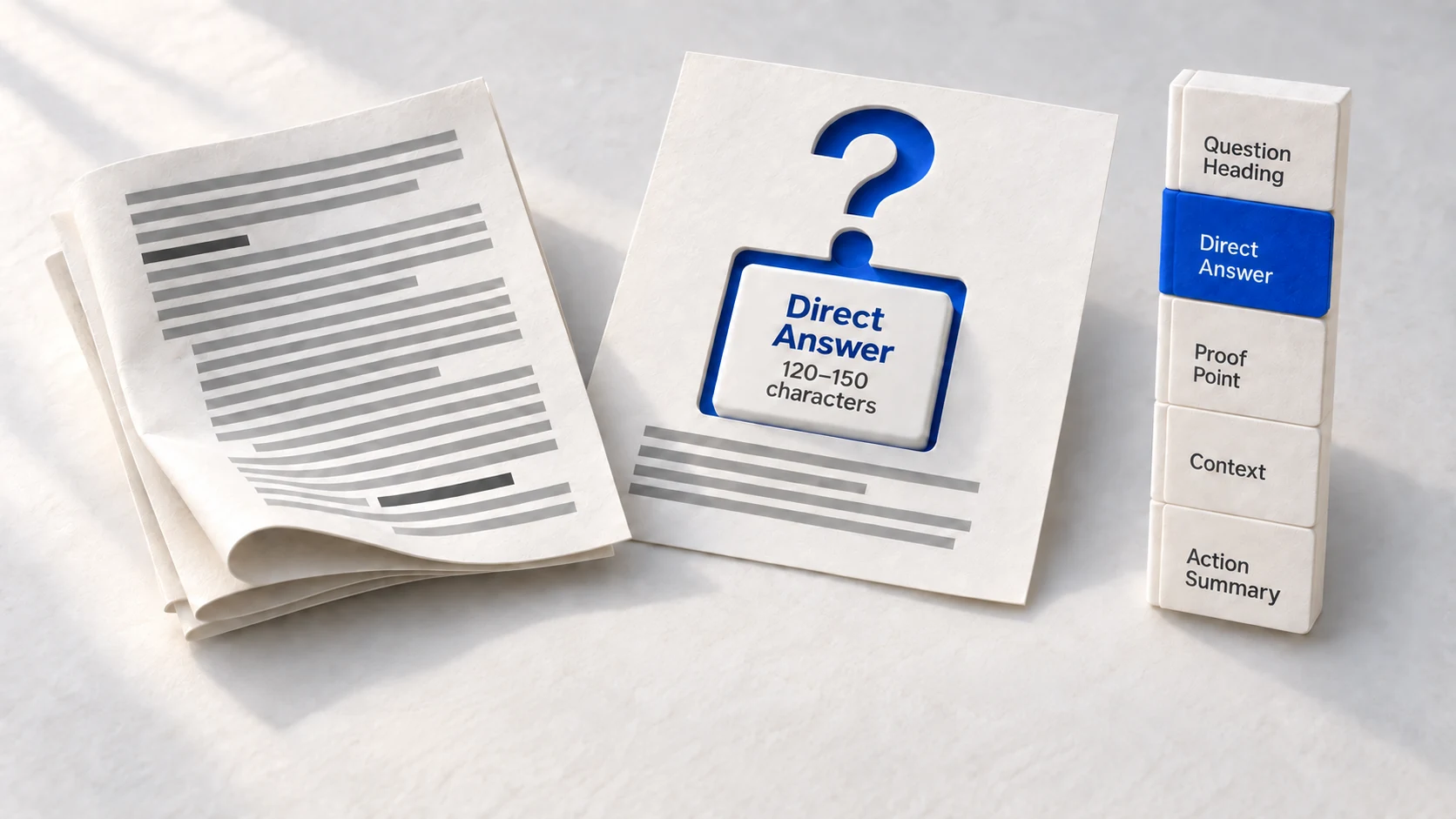
An answer block is a concise, self-contained explanation of 120-150 characters (20-25 words) placed immediately after a question-based heading. Answer blocks are designed for extraction-they make sense when pulled out of context. Research shows 72.4% of AI-cited blog posts include identifiable answer blocks, making them the single strongest predictor of AI citations. The key: no links, no pronouns referring to previous content, complete information in one extractable unit.
Your article answers the question perfectly. Deep research, expert insight, practical advice. But the answer is buried in paragraph four, after a long introduction about why the topic matters.
AI engines scan for extractable content. They need clean, quotable blocks they can lift and attribute. When your best information is tangled in context-dependent paragraphs, AI has nothing to grab.
The solution is structural: answer blocks. Self-contained content units designed specifically for AI extraction. Here's exactly how to create them.
What Is an Answer Block?
An answer block is a concise, self-contained explanation that directly answers a question. It appears immediately after a question-based heading and contains everything needed to understand the answer-no external references required.
The Extraction Test
Can you copy this paragraph, paste it into a different document, and still understand it completely? If yes, you have an answer block. If no, you have context-dependent content.
❌ Not Extractable
"It works by analyzing these factors and applying them to your content strategy."
(What is "it"? What are "these factors"?)
✓ Extractable
"AI citation frequency measures how often ChatGPT, Perplexity, and Claude reference your content in their responses."
(Complete information, no dependencies)
Length
120-150 characters (20-25 words). Concise enough to quote, comprehensive enough to understand.
Placement
Immediately after a question-based heading. No preamble, no throat-clearing, direct answer first.
Structure
No pronouns referring to previous content. No links. Complete meaning in one unit.
Why Answer Blocks Get Cited
AI citation isn't random. Large language models have specific content preferences-and answer blocks match those preferences exactly.
72.4%
of AI-cited posts include answer blocks (Confirmed March 2026)
This is the single strongest predictor of AI citations. An identifiable answer capsule-concise, self-contained, positioned immediately after a question-appears in nearly three-quarters of all cited content.
Source: Search Engine Land →91%
of answer blocks contain zero links
Hyperlinks within answer blocks actually reduce citation likelihood. A clean, self-contained block of text without hyperlinks is easier for AI to extract and attribute.
Source: Search Engine Land →35%
higher AI snippet inclusion
Pages with paragraph-length summaries at the top show significantly higher inclusion in AI-generated snippets. Front-loading answers works.
Source: Search Engine Land →34.3%
citation rate with answer block + original data
The most effective combination: answer blocks paired with proprietary information or original research. Content without either element shows only 13.2% citation rates.
Source: Search Engine Land →The extraction principle: LLMs prefer quotable, standalone text blocks backed by authoritative sourcing over heavily linked content structures. AI citation differs fundamentally from traditional ranking-content appearing in LLM responses isn't necessarily what ranks highest on Google.
Position Data - Search Engine Land (2026)
44.2% of AI citations come from the first 30% of article text
Your answer block, placed immediately after the intro heading, sits in the highest-citation zone of the entire article. When you front-load your best content with a self-contained answer block, you're not just following good structure-you're placing content exactly where AI engines look first.
Anatomy of a Perfect Answer Block
Every effective answer block has five components, structured in a specific sequence.
The 5-Part Structure
Question Heading
Write the question as a subheading using the exact wording your audience uses. Match the search query or conversational phrasing.
Example: "What is AI citation frequency?"
Direct Answer (1-2 Sentences)
Answer immediately in 1-2 sentences. Keep it tight-120-150 characters-so it can be quoted cleanly. No preamble.
Example: "AI citation frequency measures how often ChatGPT, Perplexity, and Claude reference your content in their responses."
Proof Point
Add a data point, example, policy reference, or linked source. This establishes credibility immediately after the answer.
Example: "According to Yext research, brands averaging 50+ monthly citations see 3x higher AI referral traffic."
Context Expansion
Explain edge cases, who this applies to, and when exceptions occur. This is where you add nuance.
Example: "Citation frequency varies by industry-B2B SaaS sees different patterns than local services."
Actionable Summary
Summarize with a checklist, next step, or key takeaway that makes it easy to extract the practical application.
Example: "Start by tracking your current citation frequency using manual queries across ChatGPT, Perplexity, and Claude."
Complete Answer Block Example
What is AI citation frequency?
AI citation frequency measures how often ChatGPT, Perplexity, and Claude reference your content in their responses.
According to Yext research, brands averaging 50+ monthly citations see 3x higher AI referral traffic than those with sporadic citations.
Citation frequency varies by industry-B2B SaaS typically sees 20-40% higher citation rates than local services, likely due to more structured, data-rich content in tech verticals.
To measure your citation frequency: Run 10 relevant queries weekly across ChatGPT, Perplexity, and Claude. Track how often your brand or content appears in responses over a 30-day rolling window.
How to Write Answer Blocks
Writing answer blocks requires a shift from traditional content structure. This process integrates with the broader answer-first content framework.
Step 1: Identify Your Questions
List every question your content needs to answer. Use:
- • "People Also Ask" boxes from Google
- • Actual questions from comments, forums, and social media
- • Questions you see in AI chatbot conversations about your topic
- • Your own FAQ from customer support
Step 2: Write the Answer First
For each question, write the direct answer before anything else. Constraints:
- • 120-150 characters maximum
- • No pronouns referring to other content (avoid "it," "this," "these")
- • Complete meaning without needing the heading
- • Start with the subject, not with a dependent clause
Step 3: Apply the Extraction Test
Copy your answer block. Paste it alone. Ask:
- • Does this make complete sense without any surrounding content?
- • Could this be quoted in an AI response as a standalone statement?
- • Would a reader understand exactly what's being explained?
If any answer is "no," rewrite until all answers are "yes."
Step 4: Add Supporting Structure
After the answer block, add:
- • Proof point with source (this is where links go-outside the block)
- • Context explaining nuance, exceptions, and edge cases
- • Actionable next step or summary checklist
The formatting rule: Keep paragraphs under 120 words. Use bullets, numbered lists, and formatted breaks. AI engines favor lists and structured data-long narrative paragraphs resist extraction.
Common Answer Block Mistakes
These patterns prevent your content from being extracted and cited.
Burying the Answer
Starting with background, context, or why the question matters before actually answering. AI scans for immediate answers.
Fix: Answer in the first sentence. Context comes second.
Using Context-Dependent Pronouns
"It works by..." "These factors include..." "This approach helps..." Without knowing what "it," "these," or "this" refers to, the sentence is meaningless.
Fix: Replace every pronoun with the specific noun it references.
Including Links Within the Block
Hyperlinks interrupt the extractable text. AI systems may skip content with inline links or attribute incorrectly.
Fix: Keep answer blocks link-free. Place supporting links in the paragraph after the block.
Writing Too Long
Answer blocks over 200 characters become harder to quote cleanly. AI prefers concise, extractable units.
Fix: Edit ruthlessly. If your answer is 200+ characters, find what can be moved to the context section.
Answering a Different Question
The heading asks "What is X?" but the content explains "Why X matters." The mismatch confuses AI classification.
Fix: Match the answer type to the question type. What questions get definitions. Why questions get explanations. How questions get steps.
The 53% Opportunity
53% of Gen Z and Millennial users prefer direct answers from AI rather than scrolling through search results. Answer blocks are built for this behavior-immediate, extractable, citable information that resolves intent within the first two sentences.
Source: Search Engine Land →FAQ
How long should an answer block be?
Should I include links within answer blocks?
How many answer blocks should a post have?
Do answer blocks work for all content types?
Ready to Build Citation-Worthy Content?
Answer blocks are the building blocks of AI visibility.
Structure your content for extraction and watch your citation rates climb.
Take the GEO Readiness Quiz →60 seconds · Personalized report · Free
Continue Learning
Dive deeper into AI search with these related articles:
The Content Marketer's Guide to Getting Cited by AI
72.4% of AI-cited content includes answer capsules. Learn the content traits that make AI engines cite your work.
Answer-First Writing: How to Structure Content AI Wants to Cite
72.4% of AI-cited blog posts use answer capsules. Learn the answer-first writing structure.
The Perfect FAQ Section for AI Visibility
Pages with FAQ schema are 3.2x more likely to appear in AI Overviews.