GEO & AI Search
The Digital PR Playbook for GEO: Earned Media as Authority Signals
Quick Answer
Digital PR builds the third-party authority signals that AI engines use to determine citation worthiness. Research shows 85% of AI brand mentions come from external sources, not owned content. The GEO Digital PR playbook focuses on three pillars: thought leadership content that showcases original expertise, reactive PR through journalist request platforms, and strategic directory listings. Together, these tactics create the citation chain that moves brands from AI-invisible to AI-recommended.
You've optimized your website. Schema markup: implemented. Content structure: answer-first. E-E-A-T signals: strong. But when you query AI platforms about your industry, competitors appear while you remain invisible.
The missing piece isn't on-site optimization. It's off-site authority-specifically, the third-party mentions that AI engines weight heavily when determining which sources deserve citation.
Traditional SEO treated digital PR as a link-building tactic. GEO treats digital PR as the primary authority signal. The shift changes everything about how we approach earned media.
Why Digital PR Became Essential for AI Visibility
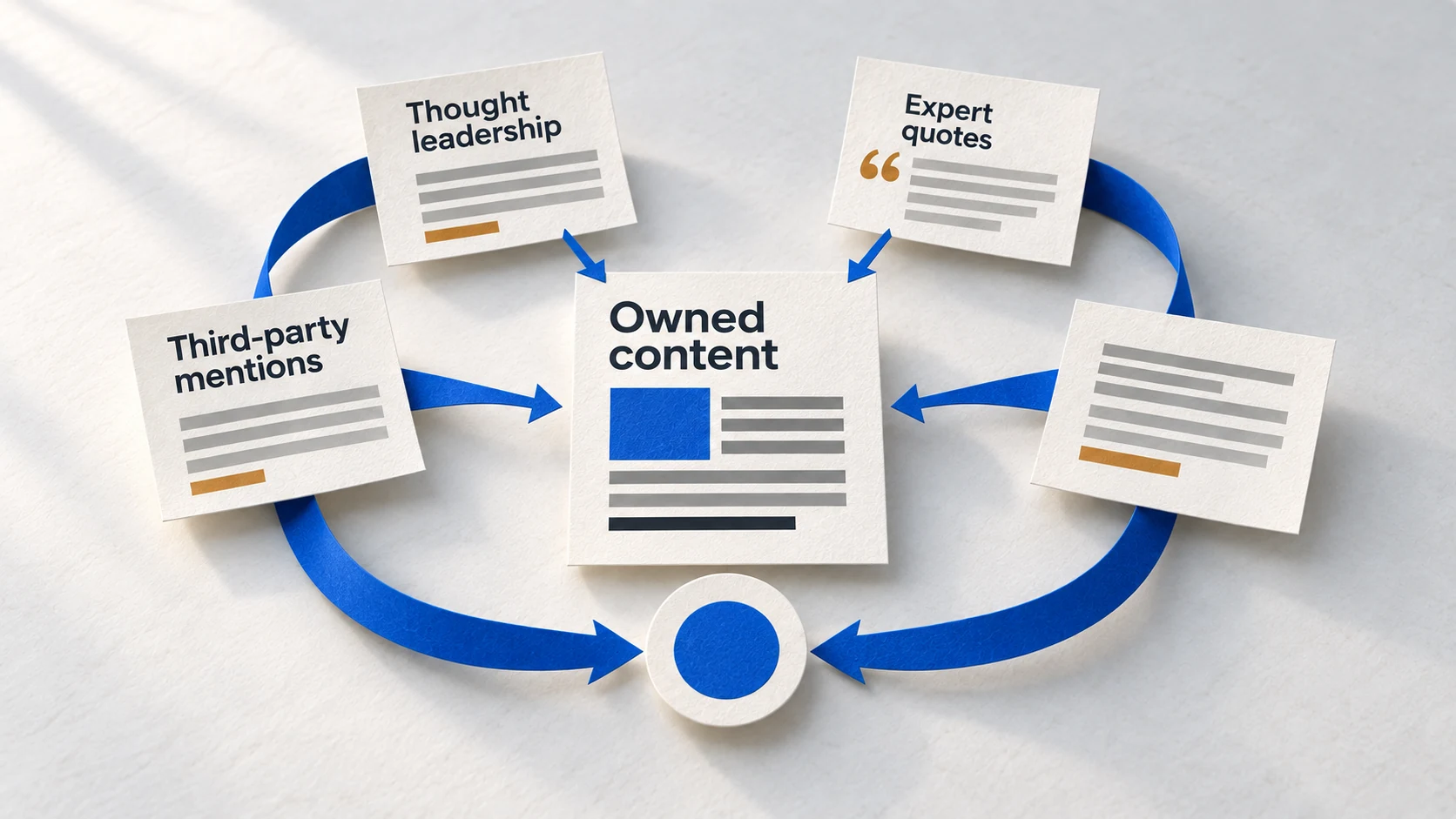
AI engines don't just evaluate what you say about yourself. They evaluate what others say about you-and whether those "others" are sources the AI already trusts.
85%
of brand mentions in AI search come from third-party sources
Your own website provides only 15% of the authority signals AI engines use. The rest comes from external validation.
Source: AirOps →48.6%
of SEO professionals rank digital PR as the most effective tactic for 2025
Survey of 518 SEO professionals shows digital PR outranks guest posting (16%) and linkable assets (12%) by a significant margin.
Source: BuzzStream →The Brand Signal Shift
Ahrefs research identified the three signals most correlated with AI Overview results: branded web mentions, branded anchors, and branded search volume. Notice what's missing from that list-traditional backlinks and domain authority.
Digital PR creates all three of these signals simultaneously. A single mention in an authoritative publication generates branded mention, may include branded anchor text, and contributes to branded search volume as readers search your name. Traditional link building achieves only a fraction of this impact.
The fundamental insight: AI engines use third-party validation as a credibility shortcut. When multiple trusted sources mention your brand, AI systems infer authority without needing to evaluate your content directly. Digital PR builds this external validation layer.
Cross-Platform Research (2026)
Brands on 4+ AI platforms see 2.8x higher citation likelihood
Digital PR accelerates multi-platform presence. When your brand is mentioned in Search Engine Journal (Perplexity trusts it), Wikipedia (ChatGPT trusts it), and LinkedIn articles (Gemini trusts it), you're building multi-source consensus that dramatically amplifies citation likelihood across all platforms simultaneously.
The Citation Authority Framework
Not all mentions are equal. A quote in the New York Times carries different weight than a mention on an obscure blog. The Citation Authority Framework helps prioritize PR efforts based on AI visibility impact.
Citation Authority Tiers
Tier 1: AI-Cited Publications
Publications that already appear in ChatGPT, Perplexity, and Google AI Overviews citations. Mentions here directly enter the citation chain. Examples: major business publications, established industry sites, Wikipedia citations.
Tier 2: Industry Authority Sites
Niche publications with strong topical authority. AI engines may not cite these directly, but they reference sources these sites cite. Your mention creates indirect citation authority.
Tier 3: Validation Signals
Directories, professional associations, and industry listings. These don't drive direct citations but establish entity legitimacy that AI systems use for verification.
Tier 1 Priority
Focus 50% of PR effort here. One Tier 1 mention outweighs 10 Tier 3 listings for AI visibility.
Tier 2 Volume
Build 30% of efforts here. Industry authority compounds over time through topical association.
Tier 3 Foundation
Allocate 20% for foundational listings. These establish entity legitimacy for higher-tier efforts.
The Three Pillars of GEO Digital PR
Effective GEO Digital PR combines three complementary approaches, each targeting different aspects of AI authority building.
Pillar 1: Thought Leadership Content
Original research, expert commentary, and unique perspectives that other publications want to cite. This is proactive PR-creating content so valuable that journalists and publishers seek you out.
Key tactics:
- • Publish original studies with unique data (34.3% higher citation rate)
- • Develop named frameworks other sources reference
- • Contribute expert commentary on industry trends
- • Create quotable insights journalists can extract
Full strategy: Thought Leadership Content That AI Wants to Cite
Pillar 2: Reactive PR
Responding to journalist requests through platforms like HARO, Qwoted, and Featured.com. This is efficient PR-journalists need sources, you provide expertise, both benefit.
Key tactics:
- • Monitor journalist request platforms daily
- • Respond within 60 minutes for highest placement rates
- • Provide specific, quotable answers (4-5 sentences)
- • Target publications in your Citation Authority tier
Full strategy: HARO and Beyond: Reactive PR for GEO
Pillar 3: Strategic Directory Listings
Authoritative directory presence that validates entity existence and provides consistent NAP (Name, Address, Phone) signals. This is foundational PR-establishing the entity legitimacy AI engines verify.
Key tactics:
- • Claim industry-specific directory listings (48.7% of ChatGPT citations reference directories per Yext 2025)
- • Maintain consistent business information across all platforms
- • Prioritize directories AI platforms actively cite
- • Link directories to Entity Home for verification chain
Full strategy: Getting Listed: Authoritative Directories for AI Citation
Integration principle: The three pillars work together. Thought leadership creates citable content. Reactive PR distributes that expertise. Directory listings validate the entity behind both. Missing any pillar weakens the entire authority structure.
Content Formats That Win AI Citations
AI engines cite specific content types more frequently than others. Aligning your digital PR content to these preferences increases citation probability.
| Content Format | AI Citation Rate | Why It Works |
|---|---|---|
| Listicles / "Best X" Posts | 43.8% | Structured, scannable, directly answers comparison queries |
| Original Research / Data Studies | 34.3% | Unique data AI can't find elsewhere; 2.6x citation rate vs. content without original data |
| Comparative Analysis | 32.5% | Answers "X vs Y" queries directly with structured comparison |
| Expert Commentary | 30%+ | Quotable insights with clear attribution |
| Annual / Recurring Reports | High | Becomes go-to reference; AI cites established recurring sources |
The Original Research Advantage
Content with unique insights, benchmarks, or survey results gets 30-40% more citations in LLM responses. AI engines actively seek first-party data and proprietary research because they can't synthesize this information from multiple generic sources.
When you publish original research that gets picked up by authoritative publications, you create a compounding citation effect: the publication cites you, AI cites the publication, and your data becomes part of the AI's knowledge base.
High-Citation Content Traits
- • Specific numbers and percentages
- • Named frameworks and methodologies
- • Self-contained, quotable paragraphs
- • Clear attribution and credentials
- • Structured with headers matching queries
Low-Citation Content Patterns
- • Vague claims without data
- • Generic advice found everywhere
- • Flowing prose without structure
- • No author or source attribution
- • Opinion without expertise signals
Measuring Digital PR's GEO Impact
Traditional PR metrics-media mentions, impressions, backlinks-don't capture GEO value. New metrics track whether PR efforts translate to AI visibility.
Citation Frequency Rate (CFR)
Track how often your brand appears in AI responses to relevant queries. Test 20-30 niche questions across ChatGPT, Perplexity, and Google AI Overviews monthly.
Benchmark: 15-30% CFR for established brands (Avenue Z 2025 benchmark).
Third-Party Mention Velocity
Count new third-party mentions per month on Tier 1 and Tier 2 publications. This leading indicator predicts future citation improvements.
Target: 4-6 quality mentions monthly for measurable GEO impact.
Competitive Share of Voice
Compare your AI citation frequency against competitors for the same query set. Track share changes over time.
Benchmark: 25%+ share of voice in category (Avenue Z 2025 benchmark).
Citation Attribution Tracking
When you gain a new AI citation, trace it back to the PR activity that likely caused it. Map mentions to citations for ROI analysis.
Pattern: Tier 1 mentions typically surface in AI citations within 30-60 days.
The Citation Volatility Factor
Profound research shows 40-60% of AI citations change within a single month. This volatility means:
- • Digital PR must be continuous, not one-time campaigns
- • Monthly measurement captures real patterns
- • Consistent presence matters more than occasional spikes
- • Citation authority compounds with sustained effort
Building Your Digital PR Pipeline
Effective digital PR for GEO isn't about occasional press releases or sporadic guest posts. It's about building a sustainable pipeline that generates third-party mentions consistently over time. Here's how to structure your PR activities for maximum citation authority.
The Weekly PR Rhythm
Monday: HARO and Journalist Outreach (30 min)
Check HARO/Featured.com for relevant queries. Scan Twitter/X for journalists seeking sources in your industry. Aim to respond to 2-3 opportunities per week. Quality over quantity-thoughtful responses that demonstrate expertise beat rushed replies.
Wednesday: Content Distribution (45 min)
Share your latest thought leadership piece across platforms. Engage in relevant industry discussions on LinkedIn. Comment thoughtfully on others' content-genuine engagement builds relationships that lead to mentions.
Friday: Directory and Profile Maintenance (20 min)
Audit one directory profile per week for NAP consistency. Respond to any new reviews. Update business information if anything has changed. Consistency across platforms reinforces entity recognition.
Time Investment: ~2 hours per week for maintenance. Add 4-6 hours monthly for creating new thought leadership content. Total monthly investment: 12-14 hours for a sustainable PR pipeline.
Monthly PR Priorities by Stage
Stage 1: Foundation (Months 1-2)
- • Focus: Directory listings and profile completeness
- • Goal: Establish consistent entity signals across 10+ authoritative directories
- • Output: Google Business Profile optimized, Yelp claimed, industry-specific directories completed
- • Success metric: NAP consistency score 95%+ across all listings
Stage 2: Validation (Months 3-4)
- • Focus: Reactive PR and expert positioning
- • Goal: Get quoted in 3-5 publications that AI engines trust
- • Output: HARO responses, journalist relationships, expert commentary placements
- • Success metric: Brand mentions on 3+ high-authority domains
Stage 3: Authority (Months 5+)
- • Focus: Original research and thought leadership
- • Goal: Become a citable source with unique data
- • Output: Industry reports, proprietary research, named frameworks
- • Success metric: Content cited as primary source by other publications
PR Activities That Build AI Authority
- ✓ Expert quotes in industry publications
- ✓ Original research with proprietary data
- ✓ Guest posts on AI-trusted sites
- ✓ Podcast appearances with transcripts
- ✓ Speaking at industry events (recap coverage)
- ✓ Awards and industry recognition
- ✓ Case studies featured by partners/clients
PR Activities That Don't Move the Needle
- ✗ Press releases on newswire services
- ✗ Paid placements without editorial value
- ✗ Low-authority guest post farms
- ✗ Social media posts without external pickup
- ✗ Directory listings on spammy sites
- ✗ Self-published content without distribution
- ✗ Link exchanges and reciprocal partnerships
Common Digital PR Mistakes That Waste Effort
Digital PR for GEO requires different thinking than traditional PR or link building. These mistakes drain resources without building citation authority.
Mistake #1: Treating Press Releases as PR
Press releases distributed through newswire services rarely get picked up by publications AI engines trust. They create duplicate content across low-authority sites, diluting your brand signal rather than strengthening it. The 85% third-party authority comes from editorial mentions, not self-distributed announcements.
Instead: Pitch specific stories to individual journalists. One editorial mention in a trusted publication outweighs 100 press release pickups.
Mistake #2: Prioritizing Domain Authority Over AI Trust
Traditional SEO valued high-DA sites for link juice. GEO values sites that AI engines actually cite. A DA 50 industry blog that appears frequently in ChatGPT citations is worth more than a DA 80 site that AI never references. Check which sites AI platforms cite in your industry before prioritizing PR targets.
Instead: Use tools like Otterly or manual testing to identify which publications AI engines cite for your target topics. Prioritize those sites regardless of traditional metrics.
Mistake #3: One-and-Done PR Campaigns
AI citation patterns shift 40-60% within a single month. A single media placement, no matter how impressive, fades quickly as AI engines update their source preferences. Building citation authority requires consistent third-party mentions over time-not occasional PR bursts followed by silence.
Instead: Build a sustainable weekly PR rhythm. Small, consistent efforts compound faster than sporadic big pushes.
Mistake #4: Chasing Backlinks Instead of Brand Mentions
For AI visibility, an unlinked brand mention on an authoritative site often carries more weight than a linked mention on a mediocre one. AI engines evaluate authority through reference patterns, not just link graphs. Stop negotiating for dofollow links and start focusing on getting mentioned in contexts where AI engines look for expertise.
Instead: Track brand mentions across the web, not just backlinks. Use Google Alerts, Mention.com, or similar tools to monitor when your brand appears-linked or not.
Mistake #5: Ignoring Directory Listings as "Old School"
Directory listings account for 48.7% of ChatGPT citations according to Yext's 2025 research. While SEO professionals moved away from directories after Google algorithm updates, AI engines still rely heavily on directory data for local and industry-specific queries. Ignoring directories leaves significant citation authority on the table.
Instead: Identify the authoritative directories in your industry. Prioritize Google Business Profile, Yelp, and vertical-specific directories AI engines reference.
The common thread: Traditional PR metrics (impressions, reach, backlinks) don't map directly to AI visibility. GEO-focused PR optimizes for third-party authority signals on sites AI engines trust-which requires different target selection, different success metrics, and different ongoing investment.
FAQ
Does digital PR really help with AI visibility?
Which is more important for GEO: backlinks or brand mentions?
How quickly does digital PR impact AI citations?
What types of digital PR work best for GEO?
Where Does Your Brand Stand in AI Search?
You've seen the 85% third-party authority stat. Your on-site optimization might be perfect-but if AI engines don't see external validation, you're invisible. Find out where you stand.
I've built a system to help brands go from invisible to cited in AI responses. But before I share it with you, I want you to see exactly where you stand.
Take the GEO Readiness Quiz →60 seconds · Personalized report · Free
Continue Learning
Dive deeper into AI search with these related articles:
Guest Posting for GEO: Choosing High-Impact Opportunities
Not all guest posts boost AI visibility. Learn how to identify AI-trusted publications, structure content for citation, and avoid the 85% of sites that waste your effort.
Getting Listed: Authoritative Directories for AI Citation
Directory listings account for 48.7% of ChatGPT citations. Learn which directories AI actually cites, how NAP consistency builds AI trust, and which listings to prioritize.
Authority Building in the AI Era: Beyond Backlinks
Backlinks aren't enough anymore. Learn the authority signals AI engines actually prioritize.