GEO & AI Search
The Experience Signal: Proving First-Hand Knowledge to AI
Quick Answer
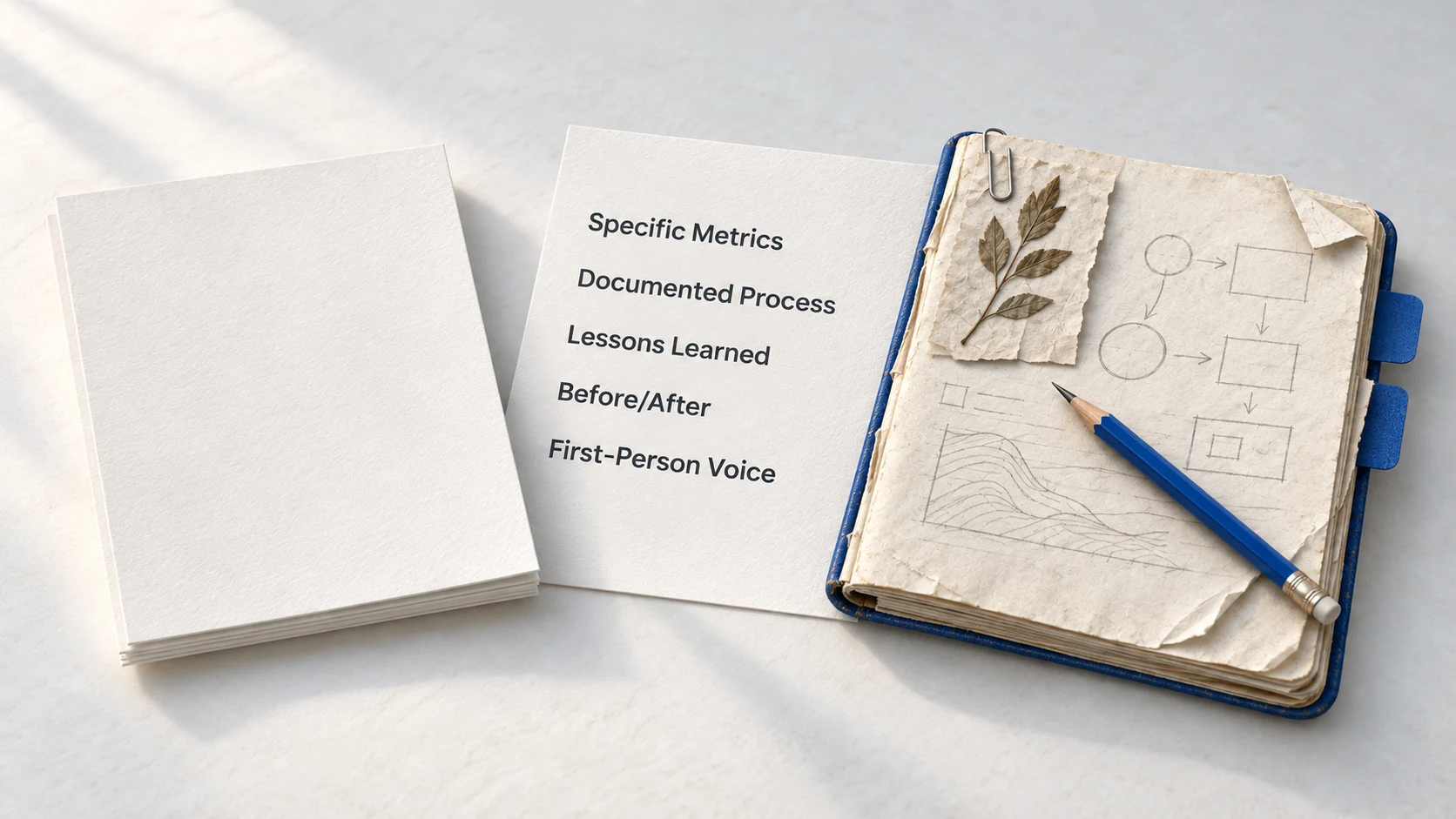
The experience signal is AI's way of distinguishing between content written by someone who has actually done something versus someone who just researched it. First-hand experience matters because AI engines can detect patterns that separate genuine practitioners from content aggregators. Demonstrating experience requires specific metrics, documented processes, lessons learned, and the kind of nuanced insights that only come from direct involvement.
Read your own content. Then ask yourself: could someone who's never actually done this work have written the same thing?
If the answer is yes, you have an experience signal problem. And that problem is costing you AI citations.
Here's what most content creators miss: AI engines aren't just evaluating whether your information is accurate. They're evaluating whether you have direct, first-hand knowledge of what you're writing about. Google added "Experience" to E-E-A-T in 2022 for exactly this reason. And AI models have only gotten better at detecting it.
What Is the Experience Signal?
The experience signal is the first "E" in Google's E-E-A-T framework. It represents demonstrable first-hand involvement with a topic-evidence that you've actually used the product, visited the place, implemented the strategy, or lived through the situation you're writing about.
Think about the difference between a product review written by someone who read the spec sheet versus someone who used the product for three months. The second reviewer knows which features matter in daily use, what the manual doesn't tell you, and where the marketing claims fall short.
Key Definition
Experience = Proof of Direct Involvement
According to Search Engine Journal, Google's quality raters specifically look for content that shows first-hand expertise through "actual product usage or location visits." This isn't about credentials-it's about having been there and done that.
For AI engines, experience signals help solve a critical problem: with AI-generated content flooding the internet, how do you identify the sources worth citing? Experience is the answer. It's much harder to fake than expertise because it requires specific details that generic research can't produce.
Why AI Engines Prioritize First-Hand Experience
AI models don't trust content randomly. They're trained to recognize patterns that indicate reliability. First-hand experience creates patterns that AI systems can detect and prioritize.
Specificity Patterns
Content with specific metrics, timelines, and results follows different linguistic patterns than content that summarizes external sources. AI models learn to recognize these patterns.
Citation Verification
When you describe your own experience, you're the primary source. AI engines don't need to verify claims against external data-your specificity becomes its own verification.
Unique Value
Experience-based content provides information that can't be found by aggregating other sources. This uniqueness makes it more valuable for AI to cite.
BrightEdge research indicates that AI-generated content lacking real-world examples, case studies, or personal insights is increasingly treated as "shallow and untrustworthy" by search algorithms and AI systems.
The 2025 E-E-A-T update made this explicit: AI-generated content must be "experience-driven and factually sound" to earn trust. The era of mass-producing AI articles with no human oversight is over. What matters now is demonstrable experience that AI-written content can't replicate.
5 Ways to Demonstrate First-Hand Experience
Experience signals aren't about claiming experience-they're about showing it through specific content patterns that AI engines recognize.
1. Include Specific Metrics and Outcomes
Vague results signal research. Specific metrics signal experience. The more precise your numbers, the more credible your experience.
Weak (sounds researched)
"This strategy improved our results significantly over several months."
Strong (sounds experienced)
"Over 14 weeks, we tested 38 variations. Citation frequency increased from 2.3% to 11.7%, with the biggest gains in weeks 6-9."
2. Document Your Process With Tool-Level Detail
Generic processes can be copied from documentation. Specific tool usage, workarounds, and integration details demonstrate you've actually done the work.
Example of tool-level detail:
"Using Ahrefs' Content Gap tool alongside manual ChatGPT testing, we identified 23 topic clusters over 6 weeks where our competitors were getting cited but we weren't. The Ahrefs data was directional-the real insights came from testing actual queries in ChatGPT and documenting which sources it cited."
3. Include "What We Learned" Sections
Lessons learned are experience markers that AI engines recognize. They require reflection that only comes from direct involvement-you can't learn lessons from something you didn't do.
- What surprised us: Unexpected outcomes that challenged assumptions
- What we'd do differently: Retrospective improvements based on hindsight
- What didn't work: Failures and dead ends (high experience signal)
4. Add Before/After Comparisons
Before/after snapshots prove you were there at both points. Screenshots, data comparisons, and visual evidence create experience signals that text alone can't match.
The more specific your "before" state, the more credible your "after" results. Generic starting points ("we had low visibility") signal less experience than specific ones ("our citation frequency was 1.2% across 50 tracked queries").
5. Use First-Person Practitioner Language
Third-person objectivity signals research. First-person practitioner language signals experience. The difference is subtle but AI models detect it.
Research voice
"Studies suggest that schema markup improves AI visibility."
Practitioner voice
"After implementing Person and Organization schema across 47 pages, we saw citation frequency increase within 3 weeks. The Person schema had the biggest impact."
The Experience Signal Audit: Evaluating Your Content
Run this audit on your existing content to identify experience signal gaps. Score each question 0-2 (0 = absent, 1 = partial, 2 = strong).
Experience Signal Checklist
Does the content include specific metrics from your own work?
Not industry benchmarks-your actual results.
Are the tools and processes described at implementation level?
Could someone replicate your exact approach from the description?
Does the content describe what didn't work or what you'd change?
Failures and lessons learned signal direct experience.
Is there visual evidence (screenshots, data, before/after)?
Visual proof is harder to fabricate than text claims.
Is the language first-person practitioner rather than third-person observer?
"We found" vs "Research suggests."
Score Interpretation:
- 8-10: Strong experience signals. Content is well-positioned for AI citation.
- 5-7: Moderate signals. Identify gaps and add specific experience markers.
- 0-4: Weak signals. Content reads as research, not experience. Significant revision needed.
Common Mistakes That Kill Experience Signals
Mistake 1: Claiming Experience Without Showing It
Saying "In my 10 years of experience..." means nothing without specifics. AI engines look for evidence patterns, not claims. The phrase "In my experience" followed by generic advice actually weakens experience signals because it creates expectation without delivery.
Mistake 2: Using Industry Benchmarks Instead of Your Data
Citing "industry average CTR of 2.3%" is research. Showing "our CTR went from 1.7% to 4.2% over 12 weeks" is experience. When you have your own data, use it. Industry benchmarks signal you're aggregating external information, not sharing direct knowledge.
Mistake 3: Only Sharing Successes
Content that only describes wins reads like marketing, not experience. Real experience includes failures, surprises, and adjustments. The absence of "what went wrong" sections signals content that's been polished for persuasion rather than documented from real work.
Mistake 4: Generic Tool Descriptions
"We used SEO tools to analyze performance" could be written by anyone. "We ran Screaming Frog across 2,847 URLs and found 147 pages with missing schema" signals direct experience. Tool-level specificity is an experience marker that generic content lacks.
Before/After: What an Experience Signal Upgrade Looks Like
Theory only takes you so far. Let me show you what happens when you take a piece of content that reads as "researched" and transform it into something that reads as "experienced." Same topic, completely different signal strength.
Topic: Setting Up AI Referral Tracking in GA4
Before (Research Voice)
"To track AI referral traffic in Google Analytics 4, you need to set up a custom channel group. This allows you to filter traffic from AI platforms like ChatGPT and Perplexity. The process involves modifying your channel settings and adding regex patterns for AI referral sources. This is important for measuring the effectiveness of your GEO efforts."
Score: 2/10 - Could have been written by anyone who read GA4 documentation
After (Experience Voice)
"When we first set up AI tracking in GA4, we made a mistake that cost us three months of data. We put the AI channel group below organic in the priority order, which meant sessions from ChatGPT were getting misattributed to organic search. The fix took 30 seconds-we moved the AI channel to position 2, right below Direct-but by then we'd already presented incorrect numbers to stakeholders twice.
What we learned: test your regex patterns before deploying. We use a staging property now where we verify the patterns catch actual AI referral URLs before pushing to production. The exact pattern that works for us is chatgpt\.com|perplexity\.ai|claude\.ai-simpler patterns missed edge cases like perplexity.ai/search URLs."
Score: 9/10 - Specific mistake, exact fix, lessons learned, actual regex pattern
Notice what changed. The "before" content is accurate-there's nothing wrong with it. But it could have been assembled by anyone with access to GA4 help documentation. The "after" content couldn't have been written without actually making that mistake and fixing it.
AI engines detect this difference because the "after" version contains patterns that aggregated research simply can't produce: specific errors ("cost us three months of data"), exact solutions ("position 2, right below Direct"), and operational details ("staging property," "actual regex pattern"). These are experience fingerprints.
The transformation secret: You don't need more information-you need more specificity. Turn "set up tracking" into "made this exact mistake and fixed it this way." Turn "it's important" into "here's what happened when we didn't do it." Every piece of generic advice can be upgraded to experienced advice by adding the story of how you actually implemented it.
The experience signal isn't just one component of E-E-A-T-it's the hardest to fake and the most valuable for differentiation. In an era where AI can generate passable expert-sounding content in seconds, genuine first-hand experience becomes your competitive moat.
Start with the audit above. Identify which of your key pages score below 5. Then systematically add specific metrics, documented processes, and lessons learned. The goal isn't to sound experienced-it's to show evidence that AI engines can recognize and trust.
FAQ
Can AI really tell the difference between researched and experienced content?
How do I demonstrate experience if I'm new to a field?
Does experience matter more than expertise for AI citations?
How often should I update content to maintain experience signals?
Ready to Strengthen Your E-E-A-T Signals?
Experience is the foundation. Now build the full picture.
Discover how expertise, authority, and trust work together for AI visibility.
Take the GEO Readiness Quiz →60 seconds · Personalized report · Free
Continue Learning
Dive deeper into AI search with these related articles:
E-E-A-T in the AI Era: How to Build Machine Trust
85% of AI-cited sources show strong E-E-A-T signals. Learn how to build Experience, Expertise, Authoritativeness, and Trust that AI engines recognize.
The Content Marketer's Guide to Getting Cited by AI
72.4% of AI-cited content includes answer capsules. Learn the content traits that make AI engines cite your work.
How ChatGPT Decides What to Cite (And What to Ignore)
Ever wondered why ChatGPT cites some websites and ignores others? Learn the citation mechanics and how to increase your chances of being cited.