Career & Skills
The SEO Professional's Career Survival Guide for 2025
Quick Answer
SEO jobs aren't disappearing-they're evolving. 69% of SEO specialists are already adapting to AI, and job postings now require GEO (Generative Engine Optimization) skills alongside traditional SEO. The professionals who survive and thrive are those who expand from "ranking on Google" to "visibility across all AI search platforms." Your SEO foundation is an advantage, not obsolete-but you need to add new skills now.
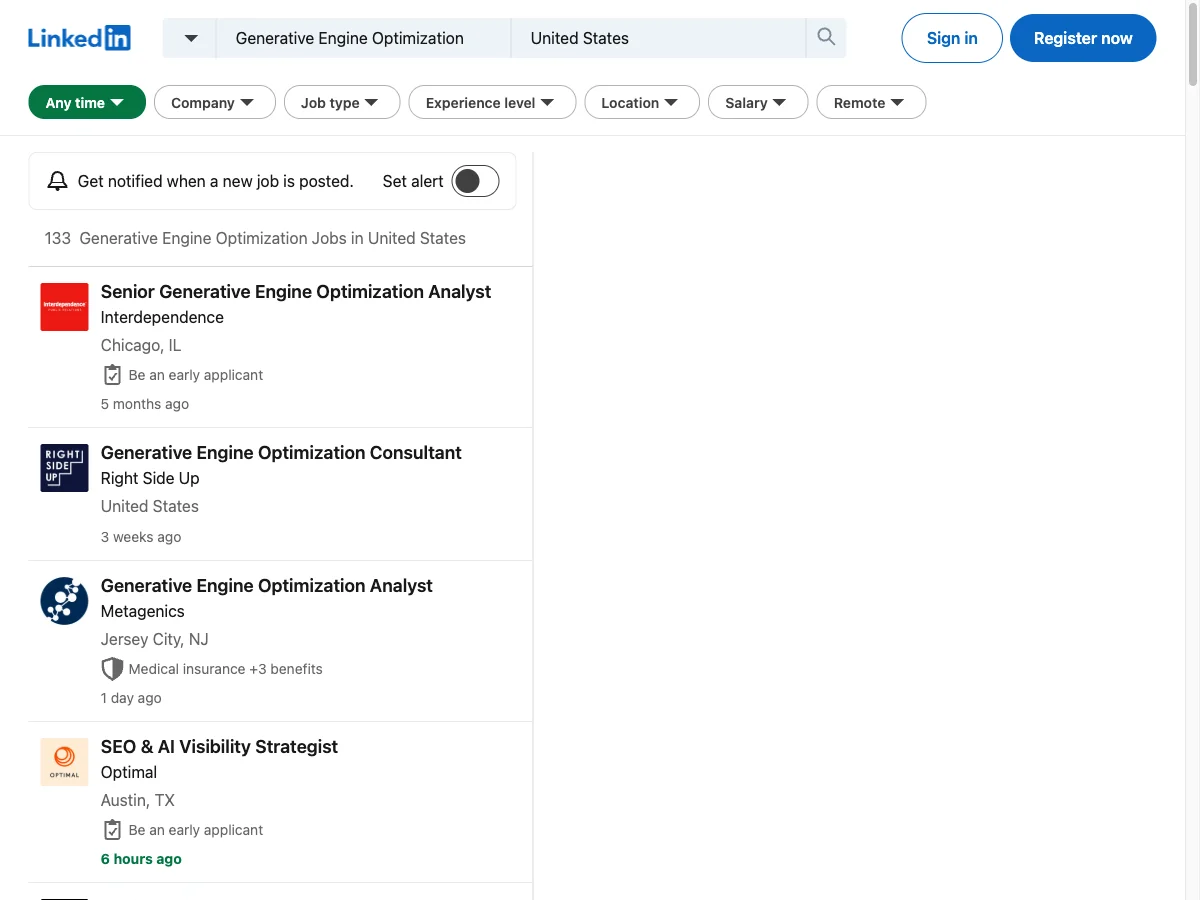
You check LinkedIn. Another SEO job posting requiring "AI prompt engineering." Another role asking for "GEO experience."
You scan the description. Same responsibilities you've been doing for years-keyword research, content optimization, technical audits. But now there's a twist:
"Must demonstrate experience optimizing for AI search engines including ChatGPT, Claude, and Perplexity."
Your stomach drops. You've been doing SEO for 5 years. 10 years. Maybe more.
And now the job market is asking for skills you don't have.
The Reality: SEO Jobs Are Changing, Not Disappearing
Let's address the anxiety directly. Here's what the data actually shows:
69%
SEO Specialists Impacted
SEO professionals report AI has changed their work in 2025
Source: DemandSage85.56%
Believe Jobs Will Change
SEO professionals believe AI will significantly transform their roles
Source: SeoProfyThe Key Insight
Jobs aren't disappearing. Job descriptions are evolving.
The demand for search visibility expertise is higher than ever-it's just expanding beyond Google.
Think about it: businesses still need to be found. They still need traffic. They still need conversions. The platforms where that happens have multiplied-and so has the complexity.
You're not being replaced. You're being asked to expand your toolkit.
What's Actually Changing in SEO Roles
When you look at job postings from 2023 vs 2025, here's what's different:
2023 SEO Job Requirements
• Keyword research and optimization
• On-page and technical SEO
• Link building strategies
• Google Analytics proficiency
• Content optimization
• SERP analysis
Focus: Ranking on Google
2025 SEO Job Requirements
• Everything from 2023, PLUS:
• GEO (Generative Engine Optimization)
• AI tool proficiency (ChatGPT, Claude, Perplexity)
• Schema markup and structured data
• Multi-platform search strategy
• AI citation tracking
• Conversion optimization
Focus: Visibility across all search platforms
Notice something important: the 2023 skills aren't gone. They're the foundation. The 2025 requirements are additions, not replacements.
Translation: If you've been doing SEO for years, you already have 60-70% of what employers want. You need to add the other 30-40%.
The Skills Gap You Need to Close
Based on current job postings and industry trends, here are the four critical skill areas SEO professionals need to add:
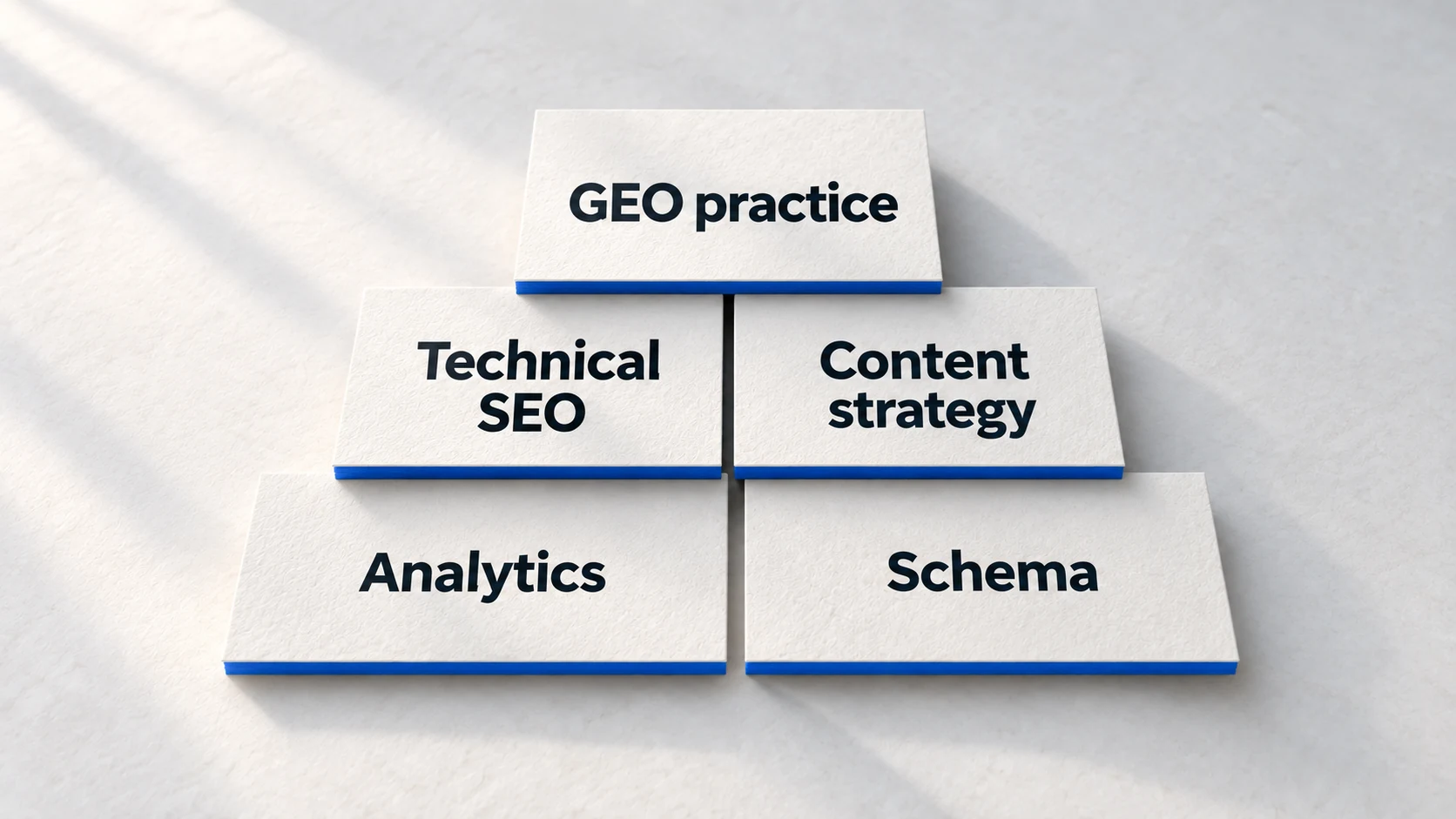
GEO (Generative Engine Optimization)
What it is: Optimizing content to be cited and recommended by AI search engines like ChatGPT, Claude, Perplexity, and Google AI Overviews.
Why it matters: 47% of Google searches now show AI Overviews. Users are getting answers without clicking through to websites.
How to learn: Study how AI engines cite sources. Experiment with answer-first content formatting. Learn entity optimization and schema markup.
AI Tool Proficiency
What it is: Using AI tools like ChatGPT, Claude, and Perplexity for keyword research, content ideation, competitor analysis, and workflow automation.
Why it matters: Employers expect SEO professionals to work 3-5x faster using AI assistance. Manual competitor research that took 8 hours now takes 30 minutes with the right AI prompts.
How to learn: Build a library of effective prompts. Document your AI-assisted workflow. Test different AI platforms for specific SEO tasks.
Schema Markup & Structured Data
What it is: Adding JSON-LD structured data to help AI engines understand and extract information from your content.
Why it matters: AI engines rely heavily on structured data to identify authoritative sources. Sites with proper schema markup have a significant advantage in AI citations.
How to learn: Master 5-7 core schema types (Organization, Person, Article, FAQPage, HowTo). Use Google's Rich Results Test for validation.
Analytics & Conversion Focus
What it is: Shifting from traffic metrics to business outcomes-tracking conversion rates, revenue attribution, and AI referral performance.
Why it matters: Stakeholders care about revenue, not pageviews. AI-referred traffic converts 4.4x better than traditional organic-you need to prove that value.
How to learn: Set up GA4 conversion tracking. Create dashboards showing business outcomes, not just traffic. Learn to communicate ROI to stakeholders.

Your 90-Day SEO Career Upgrade Plan
You don't have to master everything at once. Here's a practical 90-day roadmap to make yourself competitive for 2025 SEO roles:
Month 1: Foundation
Learn GEO Fundamentals + AI Tools
Week 1-2: Understand how AI search works. Test ChatGPT, Claude, Perplexity with queries in your industry. Observe what gets cited.
Week 3: Learn answer-first content formatting. Rewrite 3 existing blog posts to be citation-worthy.
Week 4: Build your AI prompt library. Document 10-15 prompts that accelerate your SEO workflow.
Month 2: Technical Skills
Master Schema Markup + Entity Optimization
Week 5-6: Implement Organization and Person schema on your site or a test project. Validate with Google's Rich Results Test.
Week 7: Add Article and FAQPage schema to 5 key pages. Track if AI citations increase.
Week 8: Optimize your Entity Home (About page). Add credentials, expertise signals, linked profiles.
Month 3: Portfolio + Positioning
Document Results + Rebrand Yourself
Week 9-10: Track AI citations. Can you get your content cited in ChatGPT or Perplexity? Document the process.
Week 11: Create a case study or portfolio page showing: "Traditional SEO" results vs "GEO + SEO" results.
Week 12: Update your LinkedIn profile and resume. Add "GEO" and "AI Search Optimization" to your headline. Write 2-3 LinkedIn posts sharing what you learned.
After 90 days: You'll have more GEO experience than 80% of SEO professionals-because most are still waiting to see if this is "real."
How to Position Your AI Search Skills in Interviews
When interviewers ask about AI and GEO experience, here's how to frame your expertise:
Instead of:
"I've been doing SEO for 7 years, but I'm still learning about AI search."
Say this:
"I've been doing SEO for 7 years, which gives me a strong foundation in search intent, content optimization, and technical implementation. Over the past 90 days, I've expanded into GEO-optimizing for AI citations across ChatGPT, Claude, and Perplexity. I implemented schema markup on [project], restructured content using answer-first formatting, and tracked a [X%] increase in AI referral traffic. My SEO background is an advantage because I understand search behavior-I'm just applying it across more platforms now."
When they ask: "Do you have GEO experience?"
"Yes. I've optimized [X] pieces of content for AI visibility, implemented structured data to improve entity recognition, and tracked AI citation frequency using [method]. I can show you a case study where we increased AI referrals by [X%]."
When they ask: "How do you use AI in your workflow?"
"I use ChatGPT for keyword clustering and content gap analysis, Claude for competitor research synthesis, and Perplexity to understand how AI surfaces authoritative content. This cuts my research time by 60% and lets me focus on strategy and implementation."
When they ask: "Is SEO dying because of AI?"
"No-it's expanding. Businesses still need to be found, it's just happening across more platforms. Traditional Google SEO is still critical, but now we optimize for AI Overviews, ChatGPT citations, and Perplexity recommendations too. The principles are the same: provide value, be authoritative, structure content for extraction. The implementation is broader."
The key is to show you're expanding, not replacing your SEO expertise. Your years of experience are valuable-you're just adding new tools to the toolkit.
The Bigger Picture: Why This Is an Opportunity
Here's the truth most SEO professionals don't realize yet:
This is one of the biggest career opportunities in a decade.
Why? Because demand for search visibility expertise is skyrocketing while supply of qualified professionals is still low.
- → Every business that relied on Google organic traffic now needs multi-platform visibility.
- → Most marketers are still learning what GEO even means.
- → SEO professionals who upskill now will be ahead of 90% of the industry.
Think about it: How many people have 5-10 years of SEO experience AND active GEO implementation skills AND can demonstrate AI tool proficiency?
Not many. Which means you can become rare in 90 days.
The professionals panicking right now are those who resist change. The professionals thriving are those who see this as expansion, not replacement.
Your SEO foundation is valuable. Your willingness to adapt makes you unstoppable.
FAQ
Will AI replace SEO professionals?
What new skills should SEO professionals learn for the AI search era?
How can I stay competitive as an SEO professional?
How long does it take to become proficient in GEO?
Should I stop doing traditional SEO?
Ready to Future-Proof Your SEO Career?
The job market is evolving. Are you?
Discover exactly where your skills stand and what you need to add. In 60 seconds, you'll know your GEO readiness level and get a personalized action plan.
Take the GEO Readiness Quiz →60 seconds · Personalized report · Free
Continue Learning
Dive deeper into AI search with these related articles:
SEO Is Not Dead: How Your Skills Transfer to AI Search
Already skilled in SEO? Good news: about 60% of your skills transfer to GEO. Learn which tactics still work and which to leave behind.
From Keyword Research to Intent Optimization: The Complete Translation
Transform your keyword research skills into powerful intent optimization. A practical guide for SEO professionals moving to GEO.
Why SEO Experience Is Your Competitive Advantage in GEO
Your SEO background gives you a 6-12 month head start in GEO. Here's how to leverage your existing expertise.