GEO & AI Search
Why SEO Experience Is Your Competitive Advantage in GEO
Quick Answer
Your SEO background isn't a liability-it's a competitive advantage. While others are learning basic concepts like "content quality matters" and "structure helps discoverability," you already know these things. GEO is SEO evolved, not SEO replaced. You're not starting over; you're leveling up.
There's a narrative in marketing circles that AI search makes SEO skills obsolete.
You've probably heard it. Maybe you've even worried about it.
That narrative is wrong-and here's why.
Why SEO Professionals Are Starting Ahead
AI search didn't erase the fundamentals. It expanded them.
The core principles that made you successful in SEO-understanding how search engines think, what makes content valuable, how to build authority-these didn't disappear. They became even more important.
GEO requires understanding:
- → How search engines think - You've spent years learning this
- → What makes content valuable - This is your bread and butter
- → How to build authority - E-E-A-T is second nature to you
- → Technical optimization - Schema, structure, crawlability
- → Data-driven decision making - Analytics mindset is transferable
Someone starting GEO from scratch has to learn all of this. You already know it.
While a complete beginner is Googling "What is schema markup?" and "How do I check if my site is indexed?"-you're already implementing entity optimization and tracking citation metrics.
That's not a small advantage. That's a 3-6 month head start.
The Learning Curve: SEO Pro vs. Complete Beginner
Let's be concrete about your advantage. Here's what mastering GEO requires:
The Learning Gap: SEO Professional vs. Complete Beginner
| Required Knowledge | SEO Professional | Complete Beginner |
|---|---|---|
| Content quality fundamentals | Already know | Must learn from scratch |
| Search intent understanding | Already know | Must learn from scratch |
| Technical SEO basics | Already know | Must learn from scratch |
| E-E-A-T framework | Already know | Must learn from scratch |
| Structured data (schema) | Already know | Must learn from scratch |
| Analytics interpretation | Already know | Must learn from scratch |
| GEO-specific tactics | Need to learn | Need to learn |
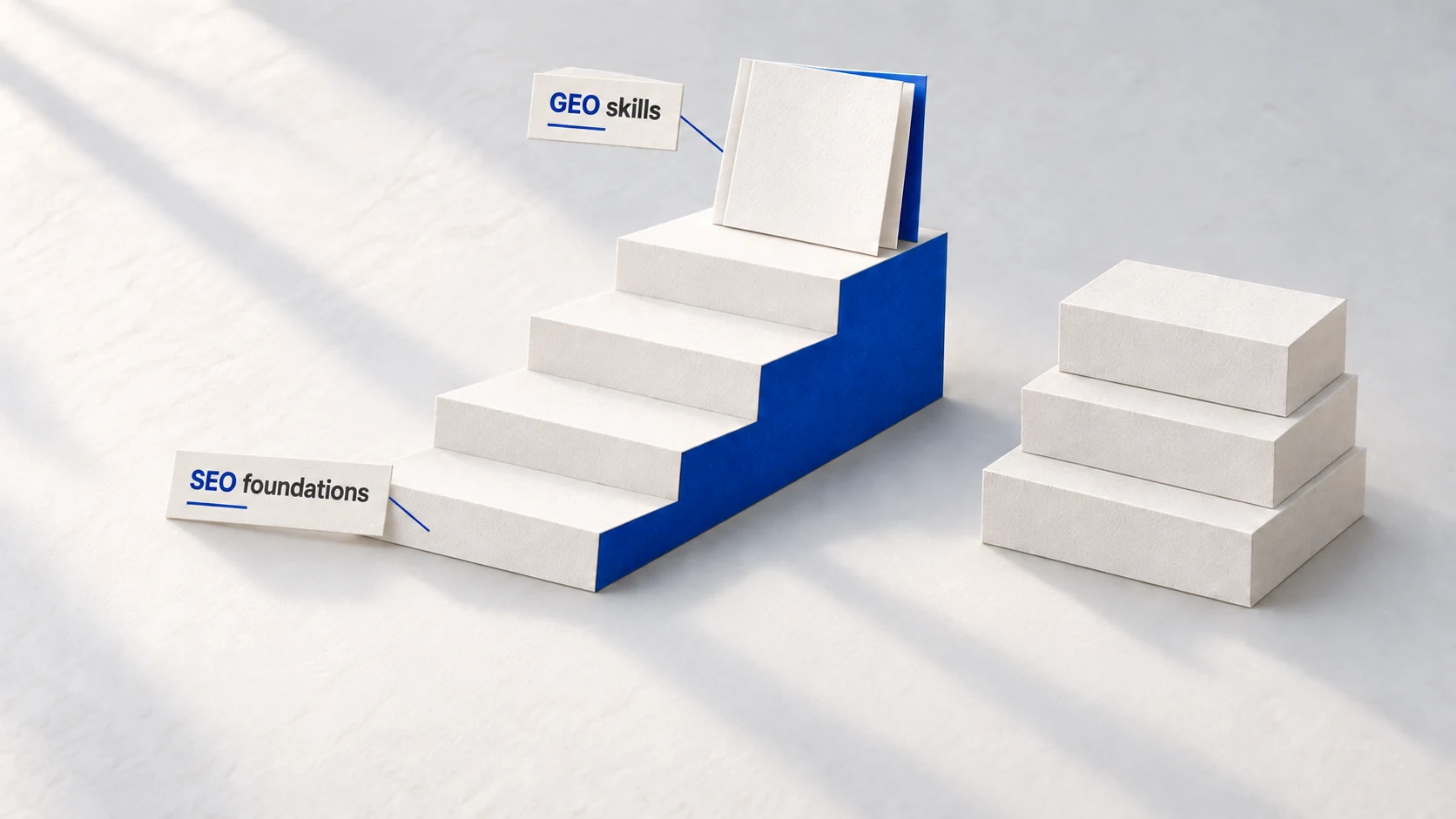
Time to GEO proficiency:
SEO Professional: 4-8 weeks
Complete Beginner: 6-12 months
The gap isn't small. While a beginner is spending 5 months learning SEO fundamentals, you're spending that time mastering entity establishment, optimizing for multi-platform citations, and building AI search authority.
You have a 3-6 month head start over anyone entering GEO without SEO experience.
5 Specific Advantages You Already Have
Beyond the time savings, your SEO background gives you these specific competitive edges:
These aren't just nice-to-haves. Each advantage compounds over time.
An SEO professional who starts GEO today will be months ahead of a beginner by next quarter-and years ahead by next year.
The Only Mindset Shift You Need
Your skills are solid. Your experience is valuable. The only thing that needs to change is how you measure success.
The Measurement Framework Shift
Old Success Metrics (SEO)
- • Rankings: "We rank #1 for our target keyword"
- • Traffic: "We get 50,000 visits/month"
- • Click-through rate: "Our CTR is 8%"
- • Domain authority: "We have a DA of 65"
New Success Metrics (GEO)
- • Citations: "We're cited in 30% of ChatGPT responses"
- • AI referral traffic: "527% YoY growth from LLMs"
- • Conversion quality: "AI visitors convert at 3x"
- • Entity authority: "Knowledge Panel established"
The tactical work is similar. The measurement framework is different. That's the evolution-not a revolution.
You still create quality content. You still optimize structure. You still build authority. You're just measuring impact differently-citations instead of rankings.
This is like when Google switched from PageRank to machine learning signals. The principles stayed the same. The measurement shifted.
SEO professionals who adapted thrived. Those who clung to old metrics struggled.
History is repeating. The winners will be those who adapt measurement frameworks while keeping their foundational skills.
Your Career Is Not At Risk-It's Evolving
If you're worried about job security, consider this:
- → GEO is a new specialization, not a replacement for SEO
- → Companies need people who understand both traditional and AI search
- → SEO professionals who add GEO skills become more valuable, not less
- → The demand for AI search optimization expertise is growing faster than the supply
The SEO professionals who learn GEO first will lead the industry for the next decade.
Think about it: right now, in January 2026, how many people in your company understand both SEO and GEO?
Probably zero. Maybe one or two if you're lucky.
That knowledge gap is your opportunity. While others are still debating whether AI search matters, you can become the bridge between old and new-the person who understands how traditional SEO and AI search work together.
That person is extremely valuable.
What to Do Right Now
You have the advantage. Here's how to capitalize on it:
Your 3-Step GEO Quick Start
1. Audit your existing SEO work through a GEO lens
Take your top-performing content. Check if ChatGPT, Perplexity, and Claude cite it. If not, you've found your first GEO opportunity.
2. Learn the 3 core GEO differences from SEO
Entity establishment (not just keywords), answer capsule optimization (not just meta descriptions), and multi-platform visibility (not just Google). Master these three and you're 80% there.
3. Start tracking AI citations alongside rankings
Add "mentioned in ChatGPT" to your success metrics. Track it weekly. What gets measured gets optimized-and you already know how to optimize.
Your SEO foundation makes this faster. Where a beginner would spend weeks understanding why entity establishment matters, you already know-it's the AI equivalent of building domain authority.
Where a beginner would struggle to write citation-worthy content, you already have the instincts-it's the same content that earns featured snippets.
You're not learning from zero. You're adding to a foundation you've spent years building.
That's not just an advantage. That's a competitive moat.
FAQ
How much of my SEO knowledge transfers to GEO?
How long does it take an SEO professional to learn GEO?
Will my SEO job be replaced by AI?
Ready to Level Up Your SEO Skills?
Your SEO foundation is solid. See exactly what to add for GEO mastery.
I've built a system to help brands go from invisible to cited in AI responses. But before I share it with you, I want you to see exactly where you stand.
Take the GEO Readiness Quiz →60 seconds · Personalized report · Free
Continue Learning
Dive deeper into AI search with these related articles:
SEO Is Not Dead: How Your Skills Transfer to AI Search
Already skilled in SEO? Good news: about 60% of your skills transfer to GEO. Learn which tactics still work and which to leave behind.
From Keyword Research to Intent Optimization: The Complete Translation
Transform your keyword research skills into powerful intent optimization. A practical guide for SEO professionals moving to GEO.
The SEO Professional's Career Survival Guide for 2025
AI is transforming SEO jobs. Learn which skills to develop, which to abandon, and how to position yourself for the GEO era.