GEO & AI Search
Entity Optimization Masterclass: AI Brand Recognition
Quick Answer
Entity optimization is the process of making your brand recognizable as a distinct, verified entity in AI systems and knowledge graphs. It involves creating an authoritative Entity Home (typically your About page), implementing Organization schema, establishing presence in Wikidata, and building consistent third-party corroboration. When AI platforms like ChatGPT, Perplexity, and Google AI Overviews can verify your entity, they're more likely to cite and recommend your content.
Your competitors have knowledge panels. When someone searches their brand name, Google displays a rich sidebar with their logo, founding date, social links, and key facts. When someone asks ChatGPT about your industry, their names come up while yours stays invisible.
The difference isn't just brand size or marketing budget. It's entity recognition. Search engines and AI platforms have determined that your competitors exist as verifiable entities in the world-while your brand is just another website with content.
This guide shows you exactly how to close that gap. Not through tricks or shortcuts, but through the systematic process of establishing your brand as a recognized entity that machines can verify and trust.
Entity Optimization Evolution
2012
Knowledge Graph Launch
Google introduces the Knowledge Graph with 500M entities, shifting from strings to things
2018
Schema.org Expansion
Organization and Person schema become critical for entity verification and rich results
2022
Entity-First SEO
Entity recognition emerges as ranking factor - verified entities get preference in search results
2024
AI Citation Era
ChatGPT, Perplexity, Claude rely on entity verification to decide which sources to cite and recommend
What Is Entity Optimization?
Entity optimization means making your brand, products, and key people recognizable as distinct entities in knowledge graphs and AI systems. It's different from traditional SEO in a fundamental way: instead of optimizing pages for keywords, you're establishing your organization as a verified node in the web of machine knowledge.
The Entity Optimization Framework
1. Entity Home
A dedicated page on your website (usually About page) that serves as the primary source of truth for who you are. This is where machines go to understand your identity.
2. Structured Data
Organization schema, Person schema, and sameAs links that explicitly declare your entity properties in machine-readable format.
3. External Validation
Presence in Wikidata, Wikipedia (if notable enough), industry databases, and authoritative directories that corroborate your entity's existence.
4. Consistency
Identical information (name, founding date, location, leadership) across all sources-your website, business profiles, third-party mentions.
When these elements align, search engines and AI platforms gain confidence that your organization is a real, verifiable entity. That confidence translates into knowledge panels, AI citations, and visibility in places where unverified websites don't appear.
Why Entities Matter for AI Search
AI platforms don't just index content-they build relationships between entities. When ChatGPT answers "What CRM should a small business use?", it's not searching for keyword matches. It's connecting entity relationships: small business (entity type) → CRM software (product category) → specific products with verified entity status.
86%
of AI citations from brand-managed sources
AI platforms prefer citing verified entities over anonymous websites. Sources you control-website, profiles, listings-are where citations come from.
Source: Yext →54B+
entities in Google's Knowledge Graph
Google's Knowledge Graph manages over 54 billion entities. To get cited by AI, your brand needs to become one of them.
Source: Search Engine Land →Source: Kalicube analysis of 1,200+ businesses
Why 2026 Makes Entity Optimization Non-Negotiable
The Knowledge Graph isn't just a Google feature anymore. It's become the factual foundation that all major AI systems rely on:
- • Wikidata is the backbone of AI reasoning. Every major AI system-ChatGPT, Gemini, Claude, Apple Intelligence-uses Wikidata for factual grounding. Your Wikidata entry (or lack of one) directly influences how AI systems understand your brand.
- • "Truth Nodes" drive citations. Google and OpenAI reference what experts call "Truth Nodes"-Wikidata (the database behind Wikipedia) and Schema.org (the language of structured data). If you're not represented in these systems, you're invisible to AI.
- • Knowledge Graph = AI grounding. In 2026, as Google integrates with multimodal inputs (images, video, voice), the Knowledge Graph provides the stable, factual core that ensures consistency and trust in AI-driven experiences.
Source: ClickRank - How to get your Brand into Google & OpenAI Knowledge Graph
The AI Citation Reality: Why Most Brands Stay Invisible
Here's the uncomfortable truth about AI visibility: most AI platforms cite sources far less often than people assume. Understanding these citation patterns reveals why entity optimization isn't optional-it's the difference between being visible and being ignored.
AI Platform Citation Behavior (2026)
| Platform | Citation Rate | What This Means |
|---|---|---|
| ChatGPT | 24% of responses generated without fetching any web content | When ChatGPT doesn't search, it relies entirely on parametric knowledge-what it already 'knows' about entities |
| Gemini | 92% of answers provide no clickable citations | Entity recognition happens in the model's training data, not real-time search |
| Perplexity | Visits ~10 pages per query, cites only 3-4 | Even with RAG, only verified entities earn citations |
Source: Kevin Indig - State of AI Search Optimization 2026
The implication is clear: 60% of ChatGPT queries are answered purely from parametric knowledge-the information baked into the model during training. If your brand isn't established as an entity in training data, knowledge graphs, and Wikidata, you simply don't exist in that 60% of conversations.
2.8x
Higher citation likelihood
Brands with entity presence on Wikidata, Wikipedia, and 4+ third-party platforms see 2.8x more AI citations than those without verified entity status.
Source: Digital Bloom AI Visibility ReportWhat Actually Drives AI Citations
Research across multiple AI platforms reveals three factors that consistently predict whether a brand gets cited in AI-generated responses. These aren't ranking factors in the traditional SEO sense-they're trust signals that AI systems use to decide which entities are worth mentioning.
1. Entity Clarity
AI systems need to understand exactly what your brand is before they'll mention it. This means having clear, consistent information across your Entity Home, schema markup, and external sources. Vague positioning or inconsistent facts create uncertainty-and AI systems default to entities they're confident about.
Action: Audit your About page and schema for factual consistency. Every platform should state the same founding date, location, and official name.
2. Third-Party Validation
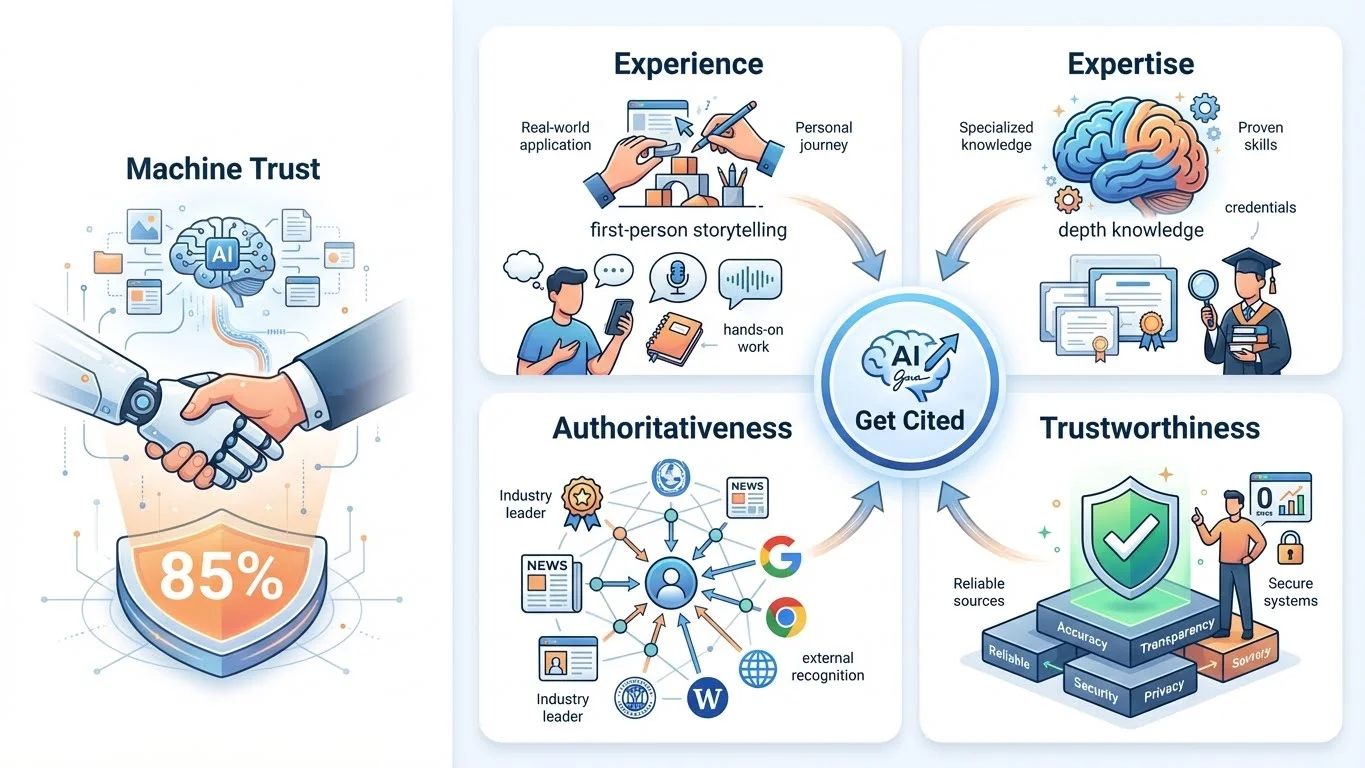
85% of brand mentions in AI search for purchase-intent queries come from external sources, not owned properties. LLMs weigh third-party validation more heavily than self-promotion because independent mentions provide verification that the entity actually exists and operates as claimed.
Action: Focus on earning mentions in industry publications, review sites, and authoritative directories-not just creating more content on your own domain.
3. Content Freshness
LLMs parse last-updated metadata to assess source recency. Over 70% of pages cited by ChatGPT were updated within 12 months, with content refreshed in the past 3 months performing best across all intent types. Stale content signals an inactive or abandoned entity.
Action: Update your Entity Home and key pages quarterly. Add recent developments, current team members, and fresh third-party mentions.
These three factors explain why established brands with knowledge panels consistently outperform competitors in AI visibility-even when those competitors produce more content. Entity recognition is prerequisite to citation consideration.
Wikidata: The AI World's Source of Truth
In October 2025, Wikimedia Deutschland launched the Wikidata Embedding Project, making Wikidata's structured knowledge directly accessible to AI applications through vector search. This project crystallized what was already true: Wikidata is the factual backbone that major AI systems use for entity grounding.
119M+
Entities in Wikidata
Growing daily with 24,000+ volunteer curators
500B
Facts in Google's Knowledge Graph
About 5 billion entities, fed by Wikidata
22%
Of AI training data from Wikipedia
Wikidata provides the structured layer
The embedding project supports applications including fact-checking, named entity disambiguation, zero-shot classification, and-critically-reference linking to provide sources in generated content. When AI needs to cite a source about your industry, it looks for entities with Wikidata presence first.
Pro Tip
Wikidata entries don't require fame or notability the way Wikipedia does. If you have verifiable information from independent sources-news coverage, industry databases, government registries-you likely qualify. The bar is much lower than most businesses assume.
The key insight: Entity optimization isn't about tricking algorithms. It's about making your brand legible to machines. When AI can verify who you are, it trusts what you say.
Warning
The #1 entity mistake: inconsistent naming across platforms. Use your exact legal entity name everywhere - Google's Knowledge Graph connects the dots by matching identical names, dates, and locations.
The Entity Home: Your Foundation
Your Entity Home is the single page that defines who you are to machines. It's where Google's algorithms go to understand your organization, and it's the reference point for reconciling information from across the web.
For most organizations, the About page is the natural Entity Home-it's already designed to explain who you are. But to function as an effective Entity Home, it needs to focus on verifiable facts rather than marketing language.
Entity Home Requirements
- ✓ Official entity name (legal name, used consistently across all platforms)
- ✓ Founding date (month and year minimum)
- ✓ Founder names with links to their profiles
- ✓ HQ location (city, state/country)
- ✓ Official website (primary domain that all sources point back to)
- ✓ Social profile links (LinkedIn, Wikipedia, Twitter, Facebook)
Deep dive: The Entity Home Concept: Your About Page as GEO Foundation covers the complete methodology for transforming your About page into an effective Entity Home.
Wikidata and Wikipedia: Building External Validation
Your Entity Home establishes your identity on your own domain. But AI systems need external validation-third-party sources that confirm your existence independent of your own claims.
Wikidata is the structured, machine-readable sibling of Wikipedia. While Wikipedia has strict notability requirements that most businesses can't meet, Wikidata is more accessible. If you have verifiable information from independent sources (news coverage, industry databases, government registries), you likely qualify for a Wikidata entry.
Wikidata
- • Machine-readable structured data
- • Lower notability bar than Wikipedia
- • Directly feeds Google's Knowledge Graph
- • Most legitimate businesses can qualify
- • Achievable in weeks/months
Wikipedia
- • Human-readable encyclopedia articles
- • Strict notability requirements
- • Strong E-E-A-T signal when achieved
- • Most small/medium businesses don't qualify
- • Can take years of coverage to achieve
Choose Your Path
Question
Which path should you pursue?
Start with Wikidata
Recommended for most businesses - achievable and effective for entity recognition
Pursue Wikipedia
Higher barrier, bigger E-E-A-T payoff - requires strict notability guidelines
Start with Wikidata
Recommended for most businesses - achievable and effective for entity recognition
Pursue Wikipedia
Higher barrier, bigger E-E-A-T payoff - requires strict notability guidelines
Deep dive: Wikidata for Business: Is Your Brand Notable Enough? covers the complete process of creating a Wikidata entry and the notability requirements you need to meet.
Getting Into Google's Knowledge Graph
Google's Knowledge Graph is the database of verified entities that powers knowledge panels, AI Overviews, and entity-based search features. Getting your organization into the Knowledge Graph requires consistent signals from multiple sources.
The Kalicube 3-Step Process
Foundation
Entity Home
Create a dedicated page defining who you are with consistent, verifiable facts and proper schema markup
Validation
Corroborating Sources
Get the same facts stated on authoritative third-party sources: Wikidata, LinkedIn, industry directories, news coverage
Recognition
Self-Confirming Loop
Link from your Entity Home to corroborating sources (sameAs), and ensure those sources link back to you
When Google's algorithms see the same facts about your organization confirmed across multiple authoritative sources-all pointing back to a consistent Entity Home-they gain confidence in your entity's legitimacy. That confidence triggers knowledge panel elements and increases AI citation trust.
Realistic Timeline: What to Expect
Based on documented case studies from Kalicube and Search Engine Land, here's a realistic timeline for entity establishment:
Month 1-2
Foundation Phase: Entity Home creation, Organization schema implementation, consistency audit across existing profiles, NAP standardization.
Month 3-4
External Validation: Wikidata entry creation (if eligible), LinkedIn company page optimization, industry directory submissions, initial third-party mentions.
Month 5-6
Recognition Phase: Knowledge panel elements may start appearing. Continue building corroborating sources. Monitor AI citation patterns across platforms.
Expectation setting: It typically takes 3 to 6 months of consistent entity signal building (Schema, Wikidata, PR) to trigger a Knowledge Panel. Starting from zero requires building that foundation first-plan for 6-12 months of consistent effort.
Entity-Related Schema Markup
Schema markup is how you explicitly declare entity properties to machines. While your visible content tells humans who you are, schema tells machines in a language they can parse directly.
Organization Schema
Defines your organization with properties like name, url, logo, foundingDate, founder, address, and sameAs links to all your official profiles.
Read the guide →Person Schema
Establishes individual entity recognition for founders, authors, and key team members-connecting their credentials to your organization.
Read the guide →sameAs Property
Critical for entity recognition-links your schema to your Wikipedia, Wikidata, LinkedIn, and other official profiles, creating a verified identity network.
Entity schema isn't about SEO tricks or rich snippets. It's about making your identity machine-readable so AI systems can verify who you are before deciding whether to cite you.
FAQ
Do I need to be famous to become an entity?
How long does entity establishment take?
Can I work on entity optimization and content optimization simultaneously?
What's the minimum I need for entity recognition?
Ready to Become a Recognized Entity?
Entity optimization is the foundation of AI visibility. You've seen the framework-now find out where your brand stands.
I've built a system to help brands go from invisible to cited in AI responses. But before I share it with you, I want you to see exactly where you stand.
Take the GEO Readiness Quiz →60 seconds · Personalized report · Free
Continue Learning
Dive deeper into AI search with these related articles:
The Entity Home Concept: Your About Page as GEO Foundation
Your Entity Home is the single page Google trusts most for understanding who you are. Learn why your About page should become your GEO foundation.
Wikidata for Business: Is Your Brand Notable Enough?
Wikidata feeds Google's Knowledge Graph and AI systems. Learn what notability requirements your brand needs to meet and how to create an entry.
Organization Schema: The Foundation of Entity Establishment
Learn how Organization schema creates machine-readable entity profiles that AI engines use when deciding which brands to cite and recommend.