GEO & AI Search
From Keyword Research to Intent Optimization: The SEO-to-GEO Translation
Quick Answer
Keyword research evolves into intent optimization for GEO. Instead of targeting "best CRM software" with exact-match optimization, you target the underlying question: "What CRM should I choose for my specific situation?" AI understands natural language-optimize for the conversation, not the keyword.
You've spent years mastering keyword research. You know how to find search volume, assess competition, and map keywords to content. And now you're wondering: does any of that still matter in the age of AI search?
The short answer is yes-but the application has changed fundamentally. What used to be about matching exact phrases is now about understanding and answering the questions behind those phrases.
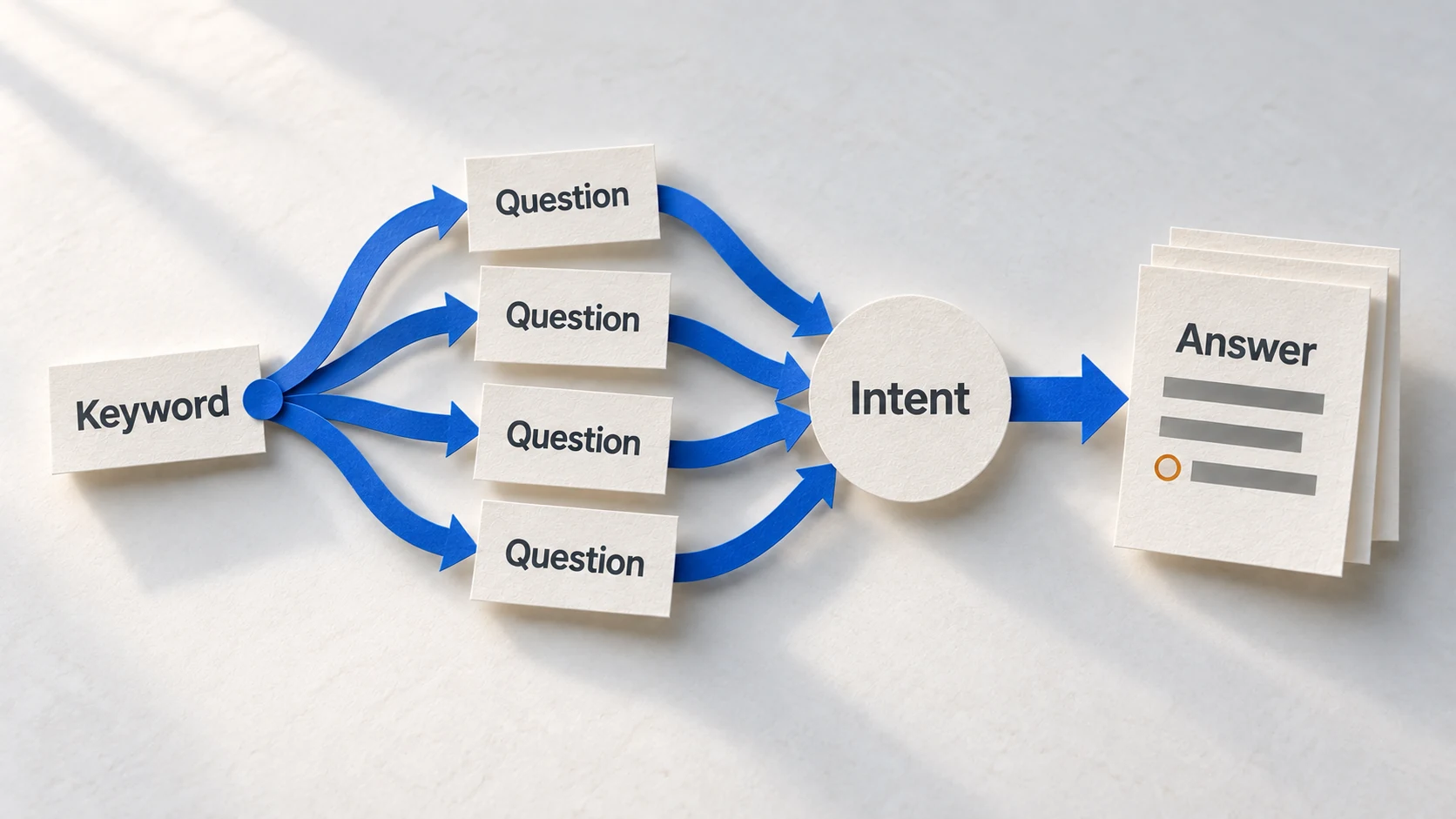
The Fundamental Shift: Keywords → Questions → Intent
In traditional SEO, you found keywords with search volume, then created content targeting those exact phrases. Success meant ranking for "best CRM software" by including that phrase strategically throughout your content.
In GEO, AI doesn't search for keywords-it answers questions. When someone asks ChatGPT "What CRM should I use for my 10-person marketing agency?", the AI doesn't look for pages optimized for "best CRM software." It looks for content that actually answers that specific question comprehensively.
How to Read This Comparison: The left shows traditional keyword-focused thinking. The right shows how that same energy translates to intent-focused optimization.
The Mindset Transformation
This isn't about abandoning keywords-it's about using them as windows into what people actually want to know. The keyword "best CRM software" reveals that people want guidance on choosing a CRM. Your job is to provide that guidance so thoroughly that AI engines cite you as the authoritative answer.
Why Intent Matters More Than Keywords in 2025
Key Insight: The data shows AI is rapidly moving beyond informational queries into commercial and transactional territory.
57%
of AI Overview queries are now informational (down from 91% in January 2025)
Source: Semrush AI Overviews StudyAccording to Semrush's research, the composition of AI Overviews has shifted dramatically in 2025:
- Commercial queries increased from 8% to nearly 19%
- Transactional queries rose from 2% to 14%
- Navigational queries surged from under 1% to over 10%
This means AI is no longer just answering "what is X?"-it's actively helping people decide what to buy, which service to choose, and where to go. If your content only targets informational keywords, you're missing the growing commercial intent that AI now serves.
What makes this shift even more significant is the quality of AI traffic. According to Exposure Ninja's research, AI search traffic converts at 14.2% compared to Google's 2.8%-that's a 5x difference. The users who find you through AI are more ready to act.
The Intent Mapping Framework
How to Use This Framework: Each step builds on the previous one. Start with questions, then dig into intent layers, structure your content accordingly, and finally cover the full question ecosystem.
4-Step Intent Mapping Process
- 1
Questions First
Identify questions people ask AI about your topic-not just keywords with search volume
- 2
Map Intent Layers
For each question, identify surface intent, deeper intent, and ultimate intent
- 3
Create Answer Blocks
Structure content so AI can extract clean, direct answers immediately
- 4
Cover the Ecosystem
One comprehensive piece answering 15-20 related questions outperforms 15 thin posts
Following this framework means your content addresses not just what people ask, but why they're asking and what they'll do with the answer. AI engines recognize this depth and cite sources that provide complete answers.
Understanding Intent Layers
Each question has layers of intent. Someone asking about "best CRM for small teams" might actually want:
- Surface intent: A list of CRM options
- Deeper intent: Guidance on what matters for small teams specifically
- Ultimate intent: Confidence to make a decision without second-guessing
Great GEO content addresses all three layers. That's what gets cited.

Practical Translation: Old Process → New Process
The good news: you're not starting from scratch. Your existing skills translate directly-you just need to update the application.
| SEO Process | → | GEO Evolution |
|---|---|---|
| Keyword research tools | → | Question research (AI queries, forums, support tickets) |
| Search volume metrics | → | Question frequency + intent depth |
| Keyword density checks | → | Answer completeness assessment |
| SERP analysis | → | AI response analysis (who gets cited and why?) |
| Competitor keyword gaps | → | Unanswered question opportunities |
| Title tag optimization | → | First-paragraph answer optimization |
The fundamental skill-understanding what people are looking for-remains valuable. What's changing is how you apply that understanding. Instead of optimizing for crawlers parsing keywords, you're optimizing for AI engines synthesizing answers.
The Big Insight
Your keyword research skills trained you to understand what people are looking for. That's the valuable part-and it transfers directly. The mechanical aspects like keyword density and exact-match targeting are what's becoming obsolete. Keep the strategic thinking, update the tactics.
FAQ
Is keyword research still important for GEO?
How do I find what questions people ask AI?
What's the difference between search intent and AI intent?
How long does it take to see results from intent optimization?
Ready to Evolve Your Skills?
See how your current keyword research approach translates to GEO-and what to update.
Get your personalized roadmap for the transition.
Take the GEO Readiness Quiz →60 seconds · Personalized report · Free
Continue Learning
Dive deeper into AI search with these related articles:
SEO Is Not Dead: How Your Skills Transfer to AI Search
Already skilled in SEO? Good news: about 60% of your skills transfer to GEO. Learn which tactics still work and which to leave behind.
Why SEO Experience Is Your Competitive Advantage in GEO
Your SEO background gives you a 6-12 month head start in GEO. Here's how to leverage your existing expertise.
GEO Explained in Plain English: What It Is and Why It Matters
Generative Engine Optimization (GEO) explained without jargon. Learn what GEO is, how it differs from SEO, and why it matters for your website.