GEO & AI Search
The Entity Home Concept: Your About Page as GEO Foundation
Quick Answer
Your Entity Home is the single authoritative page that defines who you are to search engines and AI platforms. For most businesses, this should be your About page-a dedicated space for factual, verifiable information about your organization, leadership, founding story, and credentials. Google's Knowledge Graph uses your Entity Home as the primary reference point for understanding and verifying your brand. Without a clear Entity Home, AI systems treat your website as a collection of pages rather than a recognized entity worthy of citation.
Your About page exists. It has a company description, maybe a team photo, some history. But when you search your brand name on Google, there's no knowledge panel. When you ask ChatGPT about your industry, competitors get mentioned while you remain invisible. Your organization exists online, but it doesn't exist as an entity.
The problem isn't that you're missing information. It's that you're missing a foundation. Search engines and AI platforms don't just crawl your website-they're trying to understand who you are as a verifiable entity in the world. And they need a single, authoritative page to anchor that understanding.
That page is your Entity Home. And for most organizations, your About page is the natural place for it.
What Is an Entity Home?
According to Jason Barnard of Kalicube, the Entity Home is "the single, authoritative page on the web that defines an entity, acting as the primary source of truth for algorithms." It's also called the Entity Canonical or Point of Reconciliation.
Entity Home Defined
What It Is
A dedicated webpage on your domain that describes who you are, what you do, and where you operate-using factual, verifiable language.
What It Does
Serves as Google's reference point for reconciling scattered information about your entity across the web. When facts from third-party sources match your Entity Home, Google gains confidence in your identity.
Why It Matters for AI
AI platforms like ChatGPT and Perplexity rely on entity recognition to determine citation trustworthiness. Without a clear Entity Home, AI treats you as just another website rather than a verified organization.
The concept comes from Google's Knowledge Graph methodology. When you search for a well-known brand, Google shows a knowledge panel with verified facts: founding date, headquarters, social profiles, key people. That panel exists because Google has identified an Entity Home and verified its facts against authoritative third-party sources.
The key insight: Your Entity Home isn't about marketing your brand. It's about defining your brand in terms algorithms can verify. Think Wikipedia-style facts, not sales copy.
Why Your About Page Is the Natural Entity Home
Your homepage serves too many purposes: hero sections, CTAs, product showcases, social proof. It's designed to convert visitors, not to establish identity. Your About page, by contrast, exists for one reason: to explain who you are.
86%
of AI citations from brand-managed sources
AI platforms prefer citing verified, structured content from sources you control-like your About page with proper schema markup.
Source: Yext →54B+
entities in Google's Knowledge Graph
Google's Knowledge Graph manages over 54 billion entities and 1.6 trillion facts. Your Entity Home helps your brand become one of them.
Source: Search Engine Land →What makes an About page suitable for Entity Home status? It naturally answers the questions algorithms need answered:
Who you are
Organization name, founders, key leadership
What you do
Industry, services, products, mission
Where you're located
Headquarters, service areas, contact information
When you started
Founding date, key milestones, company history
Where else you exist online
Social profiles, Wikipedia, professional networks
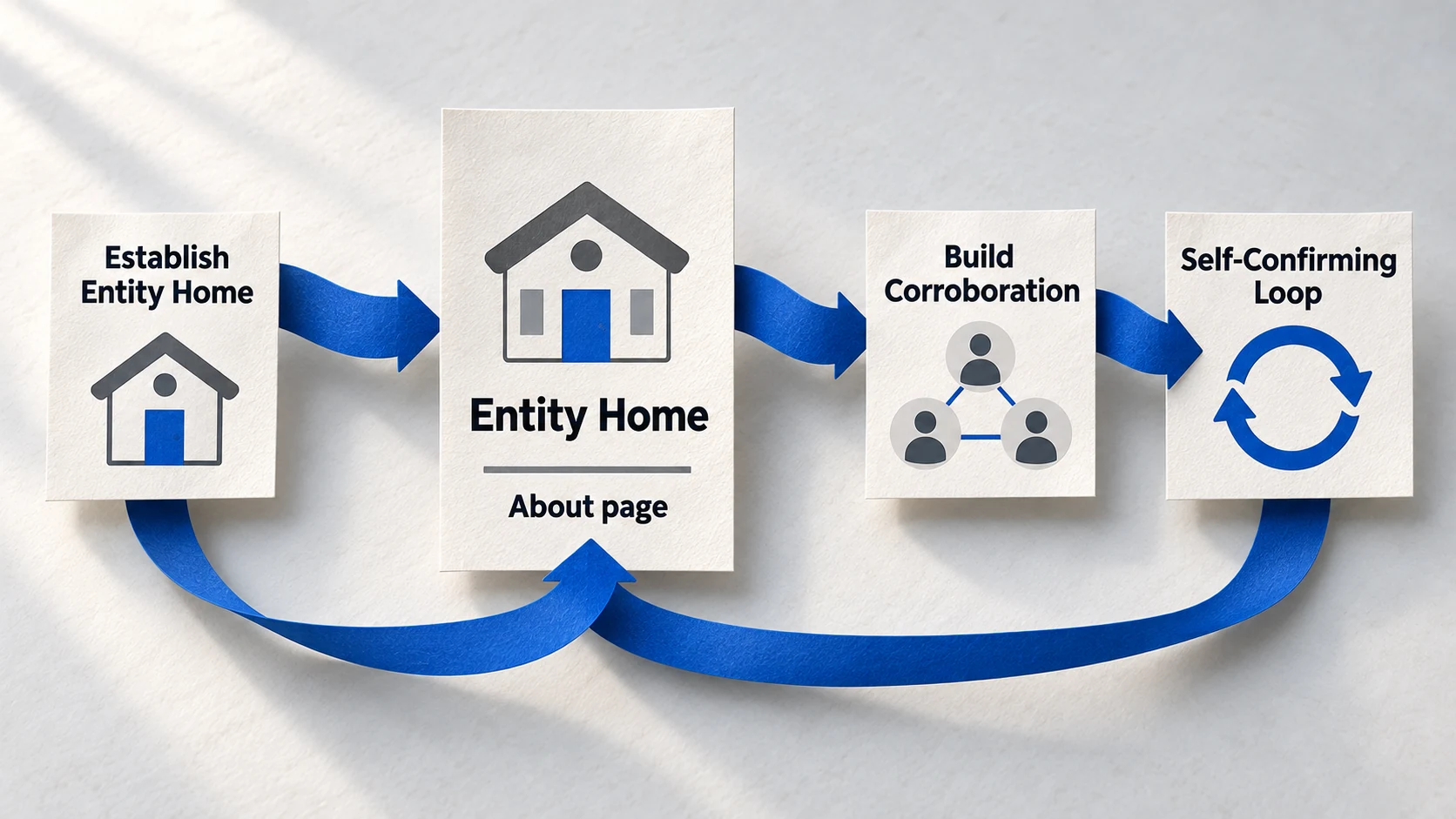
The Kalicube Process: 3 Steps to Entity Recognition
Jason Barnard's Kalicube Process provides a proven methodology for establishing entity recognition. The approach works for individuals, companies, and products alike.
The 3-Step Process
Establish Your Entity Home
Create a dedicated page on a website you control that clearly describes who you are, what you do, and where you operate. This becomes Google's primary reference point.
For most organizations, this is your About page with comprehensive Organization schema.
Build Corroborating Sources
Get the same facts about your entity stated on multiple authoritative third-party sources: Wikipedia, Wikidata, LinkedIn, industry directories, news mentions, professional associations.
Consistency is critical-your founding date, location, and leadership must match exactly across all sources.
Create a Self-Confirming Loop
Link from your Entity Home to corroborating sources (using sameAs schema), and ensure those sources link back to your Entity Home. This creates a verification loop that builds Google's confidence.
The goal: KGMID (Knowledge Graph Machine ID)-proof your entity is officially in Google's knowledge base.
The goal isn't just having an About page. It's having an About page that Google recognizes as the definitive source for your entity-because multiple authoritative sources confirm the same facts.
Entity Home Optimization Checklist
Transform your About page into a proper Entity Home with these essential elements:
Essential Element #1
Complete Organization Schema
Add JSON-LD schema markup with: name, url, logo, description, foundingDate, founder, address, sameAs (linking to all official profiles). This is the structured data foundation AI uses to understand your entity.
Use Google's Rich Results Test to validate your schema before publishing.
Essential Element #2
Factual, Verifiable Content
Write in factual, Wikipedia-style language. Include specific dates, locations, and credentials that third-party sources can corroborate. Avoid marketing superlatives like "industry-leading" or "best-in-class."
If a fact can't be verified elsewhere, Google can't use it for entity recognition.
Essential Element #3
Consistent Naming Convention
Use your exact legal entity name throughout the page and schema. If you're "Acme Corporation," don't switch between "Acme Corp," "ACME," and "Acme Inc." AI sees these as potentially different entities.
Name consistency must extend to all third-party profiles: LinkedIn, Wikipedia, Google Business Profile.
Essential Element #4
High-Quality Visual Assets
Include a square logo (minimum 112x112px, recommend 512x512px), professional founder/team photos, and headquarters imagery. These visuals appear in knowledge panels and AI-generated summaries.
Consistent visual identity across platforms reinforces entity recognition.
Essential Element #5
sameAs Links to Authoritative Profiles
Link to all your verified profiles: LinkedIn company page, Wikipedia entry (if you have one), Wikidata, Twitter/X, Facebook, Crunchbase, industry-specific directories. These links should be both visible on the page and in your schema markup.
Each sameAs link is a corroboration signal telling Google these profiles represent the same entity.
Common Entity Home Mistakes
Marketing Copy Instead of Entity Facts
Your About page says "We're the leading provider of innovative solutions" but never states when you were founded, who founded you, or where you're headquartered. AI can't verify superlatives-it needs facts.
Homepage as Entity Home
Using your homepage for entity establishment dilutes the signal. Homepages have too many competing elements. A dedicated About page provides clear, focused entity information.
Missing or Incomplete Schema
Your About page looks great to humans but has no Organization schema-or schema with only name and URL. AI needs structured data to confidently parse entity information.
No Third-Party Corroboration
Your Entity Home exists but nothing else online confirms your facts. Without corroborating sources, Google can't verify your self-reported information and won't establish entity recognition.
Inconsistent Information Across Sources
Your About page says founded in 2019, LinkedIn says 2020, and your press release says 2018. AI sees conflicting information and loses confidence in your entity accuracy.
FAQ
Does my Entity Home need to be my About page?
How long before Google recognizes my Entity Home?
Can I have multiple Entity Homes for different entities?
What's the difference between Entity Home and homepage?
Ready to Establish Your Entity Home?
Your About page is the foundation of AI visibility.
Learn how to transform your About page into a verified Entity Home that AI platforms recognize and trust.
Take the GEO Readiness Quiz →60 seconds · Personalized report · Free
Continue Learning
Dive deeper into AI search with these related articles:
Organization Schema: The Foundation of Entity Establishment
Learn how Organization schema creates machine-readable entity profiles that AI engines use when deciding which brands to cite and recommend.
Person Schema: Building Author Authority for AI Citations
Discover how Person schema helps AI engines verify author credibility and connect expertise signals across the web for higher citation rates.
The Complete Schema Markup Guide for GEO
Master schema markup for AI visibility. Essential types, implementation strategy, and common mistakes.