GEO & AI Search
The Complete Schema Markup Guide for GEO
Quick Answer
Schema markup is your direct line of communication with AI systems. The essential schemas for GEO are FAQPage (3.2x more likely to appear in AI Overviews), Article (establishes E-E-A-T), Organization (builds entity recognition), Person (author authority), and HowTo (step-by-step visibility). Implementation follows the "visible content rule": whatever you mark up in schema must appear on the page.
Only 12.4% of websites currently use structured data-early implementation is a competitive advantage.
Your content is well-written. Your research is solid. Your expertise is real. But when AI systems evaluate your page, they're not just reading your words-they're looking for structured signals that confirm who you are, what you're saying, and why it should be trusted.
That's where schema markup comes in. It's the metadata layer that tells AI systems: this is an article by this expert, published by this organization, answering these specific questions.
Without it, you're asking AI to figure out your credibility on its own. With it, you're giving AI exactly what it needs to trust and cite you.
Why Schema Markup Matters for GEO
Schema markup has always mattered for SEO-rich snippets, knowledge panels, enhanced search results. But for GEO, schema serves a different purpose: it helps AI systems understand context that isn't always obvious from content alone.
What Schema Tells AI Systems
- Who wrote this? Person schema with credentials, experience, and verifiable identity
- Who published it? Organization schema establishing the publisher's authority and trustworthiness
- When was it published? Article schema with datePublished and dateModified for freshness signals
- What questions does it answer? FAQPage schema with extractable question-answer pairs
- What entities are connected? sameAs properties linking to verified profiles across platforms
The Data Case for Schema
- • Pages with structured data get 30% more clicks in traditional search (BrightEdge)
- • FAQ schema pages are 3.2x more likely to appear in AI Overviews (Frase.io)
- • Only 12.4% of websites currently use structured data (Frase.io)
- • AI-cited sources show 85%+ E-E-A-T signal correlation-schema is how you prove E-E-A-T to machines
81%
of web pages cited by AI platforms include schema markup
AccuraCast study of 2,000+ prompts across ChatGPT, Google AI Overviews, and Perplexity
Source: WPRidersThat's not a minor correlation. When AI systems need to cite sources, they overwhelmingly choose pages with structured data. Schema doesn't guarantee citations, but its absence significantly reduces your chances.
Definition
JSON-LD (JavaScript Object Notation for Linked Data)
The recommended format for schema markup. It's a script tag you add to your page's head section containing structured data about your content. Unlike Microdata (which embeds schema in HTML elements), JSON-LD keeps your schema separate and maintainable.
2026 Schema Update: What's Changing
In November 2025, Google announced it would deprecate support for seven structured data types starting January 2026. Here's what's affected:
- • Being deprecated: Practice Problem, Dataset, Sitelinks Search Box, SpecialAnnouncement, and Q&A schemas
- • Not affected: FAQPage, Article, Organization, Person, HowTo-the five essential GEO schemas remain fully supported
- • Impact: Sites using deprecated schema types won't see ranking drops-they simply won't receive rich results for those implementations
The good news: the schema types that matter most for AI visibility (FAQPage, Article, Organization, Person, HowTo) are unaffected. Focus your efforts there.
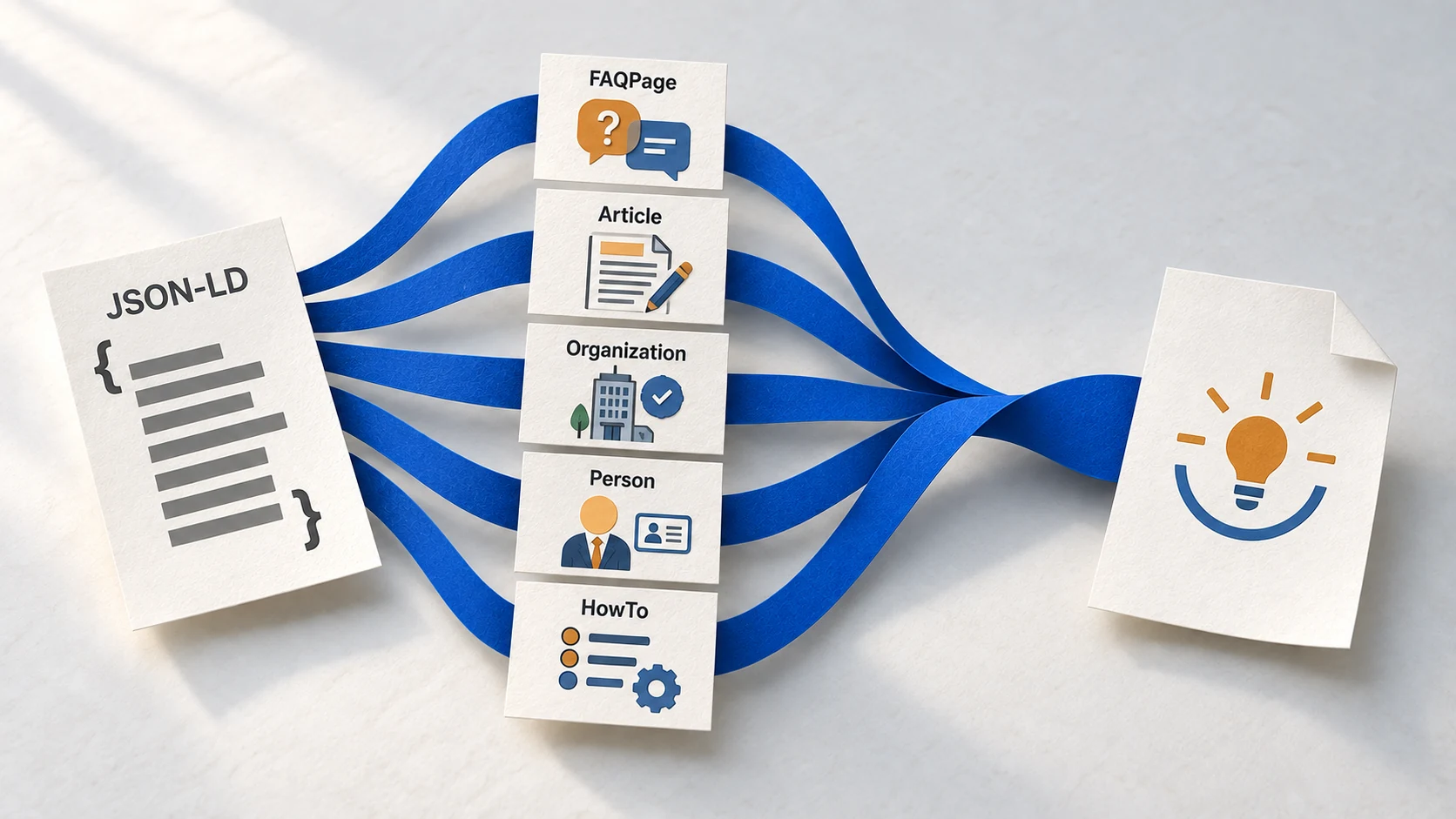
Essential Schema Types for AI Visibility
Not all schema types matter equally for GEO. Focus on these five first.
1. FAQPage Schema
Why it matters: FAQ schema provides direct question-answer pairs that AI systems can easily extract and cite. The format aligns perfectly with how users interact with AI assistants through natural language queries.
Key properties:
- •
mainEntity: Array of Question objects - •
name: The actual question text - •
acceptedAnswer: The answer with full text
Best practice: Align questions with natural user language. Make answers self-contained-AI may extract just the answer without surrounding context.
2. Article Schema
Why it matters: Article schema establishes the E-A-T signals that AI systems heavily weight: who wrote it, when, and for what organization.
Key properties:
- •
headline: Article title - •
author: Person reference with credentials - •
datePublished: Original publication date - •
dateModified: Last update date (freshness signal) - •
publisher: Organization reference - •
articleSection: Topic categorization
Best practice: Always include both datePublished and dateModified. Update dateModified whenever you revise content-freshness matters for AI citations.
3. Organization Schema
Why it matters: Organization schema builds entity recognition-helping AI systems understand who your company is and connect your content to your brand identity.
Key properties:
- •
name: Official organization name (use consistently) - •
url: Canonical website URL - •
logo: Organization logo image - •
sameAs: Array of social profiles and verified listings - •
foundingDate: Establishes longevity - •
areaServed: Geographic service areas
Best practice: Include as many sameAs links as possible-LinkedIn, Twitter, Wikipedia, Crunchbase, industry directories. More connections strengthen entity recognition.
4. Person Schema
Why it matters: Person schema creates author authority-proving the human behind your content has real expertise.
Key properties:
- •
name: Full author name - •
jobTitle: Current professional role - •
worksFor: Organization reference - •
sameAs: LinkedIn, personal website, professional profiles - •
alumniOf: Educational credentials - •
knowsAbout: Areas of expertise
Best practice: Person schema should link to an author page on your site with expanded bio, credentials, and publication history.
5. HowTo Schema
Why it matters: HowTo schema structures step-by-step content in a format AI systems prefer for instructional queries.
Key properties:
- •
name: Task being accomplished - •
step: Array of HowToStep objects with name and text - •
tool: Tools needed (optional) - •
supply: Materials needed (optional) - •
totalTime: Estimated completion time
Best practice: Use HowTo for genuinely procedural content-tutorials, guides, instructions. Don't force it onto content that isn't actually step-by-step.
Schema Types: AI Citation Impact
| Schema Type | AI Citation Impact | Difficulty | Priority |
|---|---|---|---|
| FAQPage | 3.2x more likely in AI Overviews | Easy | Highest |
| Article | Establishes E-E-A-T signals | Easy | High |
| Organization | Builds entity recognition | Medium | High |
| Person | Creates author authority | Medium | High |
| HowTo | Preferred for instructions | Easy | Medium |
The priority order matters. FAQPage provides the highest immediate impact with the lowest effort. Start there, then layer in Article and Organization schema. Person schema becomes crucial when you're building thought leadership. HowTo applies only to procedural content.
Implementation Strategy
The right implementation approach depends on your technical resources and site architecture.
The Entity-First Approach
Before implementing page-level schema, establish your core entities:
- 1. Map key entities: Organization, key people, products/services, locations
- 2. Create entity pages: About page for Organization, author pages for Person schemas
- 3. Implement sameAs connections: Link to all verified external profiles
- 4. Build hierarchical relationships: Connect authors to organization, articles to authors
- 5. Ensure consistency: Same entity names, descriptions, and identifiers across all pages
Why this works: AI systems look for comprehensive entity coverage. When you discuss one entity, they expect to see connected entities properly linked.
Implementation Formats
JSON-LD (Recommended): Cleanest format. Add a script tag in your page head with all schema data. Easy to manage separately from HTML content.
Microdata: Inline attributes within HTML elements. More complex to maintain but keeps schema close to visible content.
RDFa: Similar to Microdata. Less commonly used but fully supported.
For GEO purposes, JSON-LD is preferred because it's easier to ensure comprehensive coverage without cluttering your HTML.
The Golden Rule: Visible Content Match
Whatever is marked up in schema must exist visibly on the page. No exceptions.
AI systems cross-reference schema claims against visible content. If your schema says you have 10 FAQs but only 5 appear on the page, that inconsistency damages trust. Schema annotates existing content-it doesn't replace it.
Validation and Testing
Broken or invalid schema is worse than no schema-it signals technical incompetence.
Essential Validation Tools
- Google Rich Results Test: Tests whether your page is eligible for rich results and identifies schema errors. URL: search.google.com/test/rich-results
- Schema.org Validator: Checks compliance with Schema.org standards, catching formatting and syntax errors. URL: validator.schema.org
- Merkle Schema Generator: Creates JSON-LD without technical expertise-useful for generating initial markup. Free tool for common schema types
Validation Checklist
- ✓ No syntax errors in JSON-LD
- ✓ All required properties present for each schema type
- ✓ Schema content matches visible page content exactly
- ✓ Dates are in ISO 8601 format (YYYY-MM-DD)
- ✓ URLs are absolute, not relative
- ✓ Entity references link to valid pages
- ✓ sameAs URLs are accessible and verify your identity
Common Schema Mistakes That Hurt GEO
Mistake 1: Outdated Schema
The problem: Article schema shows dateModified from 2022, but the page content references 2024 statistics.
The fix: Update schema dates every time you update content. Treat schema maintenance as part of your content refresh workflow.
Mistake 2: Schema-Content Mismatch
The problem: FAQ schema includes questions that don't appear on the visible page.
The fix: Audit every schema element against page content. If it's in the schema, it must be visible.
Mistake 3: Missing Entity Connections
The problem: Article schema has an author name but no link to a Person schema or author page.
The fix: Build complete entity graphs. Authors should link to Person schemas, which link to Organizations, which have sameAs connections.
Mistake 4: Generic Over Specific
The problem: Using generic "Thing" or "CreativeWork" when specific types exist.
The fix: Always use the most specific schema type available. "Article" over "CreativeWork." "FAQPage" over "WebPage." Specificity helps AI understanding.
Schema markup isn't about gaming algorithms or getting rich snippets anymore. It's about speaking the language machines understand. When AI platforms need to evaluate whether your content is trustworthy, accurate, and authoritative-schema provides the structured evidence they need. The 12.4% of websites currently using schema have a head start. The question is how quickly you can close that gap.
FAQ
Does schema markup directly affect AI citations?
What schema types are most important for GEO?
Should schema content match visible page content?
How often should I update schema markup?
Ready to Implement Schema for AI Visibility?
Schema is the foundation of AI visibility. Now discover what else you need to get cited by ChatGPT, Perplexity, and Google AI Overviews.
I've built a system to help brands go from invisible to cited in AI responses. But before I share it with you, I want you to see exactly where you stand.
Take the GEO Readiness Quiz →60 seconds · Personalized report · Free
Continue Learning
Dive deeper into AI search with these related articles:
E-E-A-T in the AI Era: How to Build Machine Trust
85% of AI-cited sources show strong E-E-A-T signals. Learn how to build Experience, Expertise, Authoritativeness, and Trust that AI engines recognize.
How ChatGPT, Claude, and Perplexity Actually Find and Cite Content
Each AI platform works differently. Learn the mechanics behind how ChatGPT, Claude, and Perplexity discover and cite your content.
Author Bio Optimization for AI Citation: A Complete Guide
AI engines verify author credibility before citing content. Learn how to optimize your author bio.