GEO & AI Search
Timeline: How Search Changed from 2020 to 2025
Quick Answer
From 2020 to 2025, search transformed from a link-based discovery system to an AI-powered answer engine. Key milestones: Google's passage indexing (2020), ChatGPT's launch (2022), AI Overviews rollout (2024), and the emergence of GEO as a discipline (2024-2025). Understanding this timeline helps you see where search is heading next.
Five years doesn't sound like a long time.
But search today is almost unrecognizable from search in 2020.
If you walked away from SEO in 2020 and came back today, you'd barely recognize the landscape.
Here's exactly how we got here, year by year.
Search Evolution at a Glance
Peak Traditional SEO
Passage indexing • Core Web Vitals • GPT-3 released (research only)
AI Foundations
MUM announced • Entity optimization grows • Zero-click hits 65%
ChatGPT Launches
100M users in 60 days • Fastest consumer adoption ever • Industry dismisses it
The AI Race Begins
Bing + AI • Google SGE • GPT-4 • Perplexity gains traction
Mass Adoption
AI Overviews rollout • Gartner predicts 25% drop • GEO emerges as discipline
The New Normal
AI search is mainstream • Multi-platform optimization required • GEO is essential
The Present
AI search continues growth • GEO becomes standard practice • Multi-engine visibility critical
- 2020
Peak Traditional SEO
Passage indexing • Core Web Vitals • GPT-3 released (research only)
- 2021
AI Foundations
MUM announced • Entity optimization grows • Zero-click hits 65%
- 2022
ChatGPT Launches
100M users in 60 days • Fastest consumer adoption ever • Industry dismisses it
- 2023
The AI Race Begins
Bing + AI • Google SGE • GPT-4 • Perplexity gains traction
- 2024
Mass Adoption
AI Overviews rollout • Gartner predicts 25% drop • GEO emerges as discipline
- 2025
The New Normal
AI search is mainstream • Multi-platform optimization required • GEO is essential
- 2026
The Present
AI search continues growth • GEO becomes standard practice • Multi-engine visibility critical
2020
The Before
The Peak of Traditional SEO
The world: COVID-19 drives massive online adoption. Businesses rush to digital.
Key Developments:
- • Google Passage Indexing - Google starts ranking specific passages, not just pages
- • Core Web Vitals announced - Page experience becomes official ranking factor
- • Featured snippets mature - Position #0 becomes highly coveted
- • GPT-3 released - OpenAI's model shows language AI potential (but no consumer product yet)
SEO focus: Content quality, backlinks, technical optimization. The 10-blue-links era is strong but showing cracks.
What you should have done: Started experimenting with featured snippet optimization and structured data. The passage indexing announcement was a signal that Google was moving toward understanding content at a more granular level-a precursor to AI search.
2021
Foundations
Google Strengthens AI Foundations
The world: Pandemic continues. Digital becomes permanent, not temporary.
Key Developments:
- • MUM (Multitask Unified Model) - Google announces 1000x more powerful than BERT
- • Core Web Vitals go live - Page experience officially affects rankings
- • Google Knowledge Panels expand - Entity-based search grows
- • Zero-click searches hit 65% - Most searches don't result in website clicks
SEO focus: Entity optimization gains attention. Some forward-thinking SEOs start discussing "entity-first" strategies.
The warning sign: Zero-click reaching 65% should have been a wake-up call. Google was already answering questions without sending traffic. This was the trend that would accelerate with AI search.
2022
The Shift
ChatGPT Changes Everything
The world: OpenAI releases ChatGPT on November 30, 2022. Everything changes.
Key Developments:
- • ChatGPT launches (Nov 30) - Reaches 1 million users in 5 days, 100 million in 2 months
- • Google Helpful Content Update - Targets AI-generated spam (ironic timing)
- • E-E-A-T emphasis - Google adds "Experience" to E-A-T framework
- • First "AI search" conversations - Industry starts discussing AI impact on SEO
The turning point: For the first time, users could ask natural questions and get coherent, helpful answers without clicking through to websites.
SEO focus: Most SEOs dismiss ChatGPT as novelty. "It makes things up." "Users want real sources." This dismissal costs 12+ months of preparation time.
The costly mistake: The SEO industry's dismissal of ChatGPT in late 2022 meant they didn't start adapting until mid-2023 or later. Those who took it seriously immediately had a full year to experiment, build authority in AI engines, and develop GEO strategies before it became urgent.
2023
The Race
The AI Search Arms Race Begins
The world: Google declares "Code Red" internally. The search industry realizes AI is not a fad.
Key Developments:
- • Microsoft Bing + ChatGPT (Feb) - First major search engine with AI chat integration
- • Google Bard launches (March) - Google's rushed AI response
- • SGE (Search Generative Experience) announced (May) - Google's AI-powered search results in testing
- • GPT-4 released (March) - Major accuracy improvement over GPT-3.5
- • Perplexity gains traction - AI-first search engine starts attracting users
- • Claude released - Anthropic enters the chat
SEO focus: "Answer Engine Optimization" (AEO) term gains traction. Some SEOs start optimizing for featured snippets more aggressively.
The strategic window: 2023 was the year to get ahead. Competitive intensity was still low. Early movers started building entity authority, testing what AI engines cited, and developing frameworks. By late 2024, everyone was scrambling-but the early movers were already established.
2024
Mass Adoption
AI Search Goes Mainstream
The world: AI search stops being experimental. It becomes the default experience.
Key Developments:
- • Google AI Overviews (May) - SGE rebranded and rolled out to all US users
- • Gartner predicts 25% search decline by 2026 (Feb) - Major analyst firm validates the shift
- • ChatGPT hits 200M weekly users - Larger than many countries' populations
- • Perplexity valued at $9B - AI-first search is a real category
- • "GEO" term emerges - Generative Engine Optimization becomes distinct from AEO (see our complete comparison)
- • Organic traffic declines measured - 15-25% drops documented across industries
The wake-up call: SEO professionals finally see traffic declines in their own data. Denial becomes impossible.
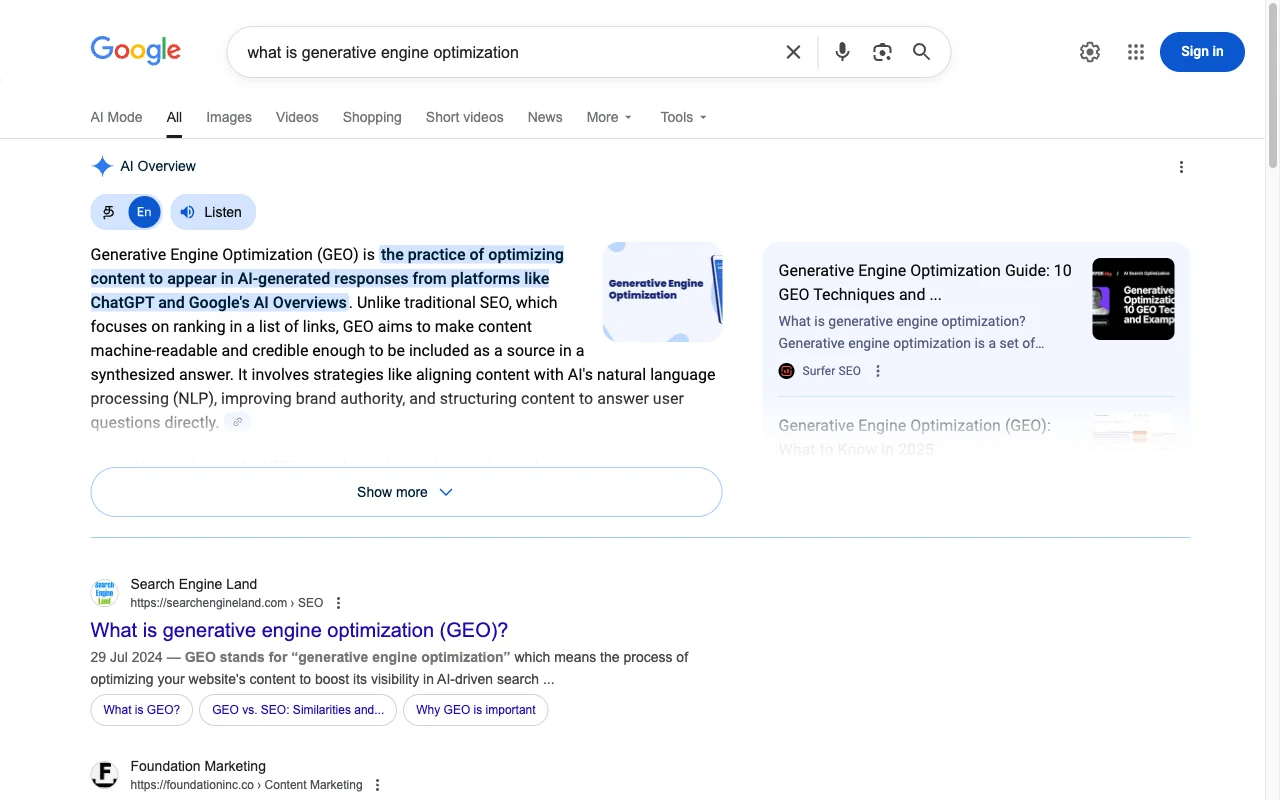
SEO focus: Panic gives way to adaptation. First GEO frameworks emerge. Entity optimization becomes urgent.
2025
The Present
The New Normal
The world: AI search is no longer "the future." It's the present reality.
Current State:
- • AI Overviews in 47%+ of Google searches - Nearly half of all searches show AI answers
- • LLM referral traffic up 527% YoY - New traffic source is significant
- • GEO established as discipline - Distinct from SEO and AEO
- • Multi-platform optimization required - Google, ChatGPT, Perplexity, Claude all matter
- • Entity establishment is critical - Wikidata, Knowledge Graph, schema essential

SEO focus: Integration of traditional SEO with GEO. Focus on being cited, not just ranked. Quality over quantity becomes essential, not optional.
Where we are now: The question is no longer "Should we do GEO?" but "How fast can we implement it?" Businesses that adapted early are seeing results. Those starting now face steeper competition but still have opportunity-AI search is still evolving, and citation patterns aren't locked in yet.
What This Timeline Teaches Us
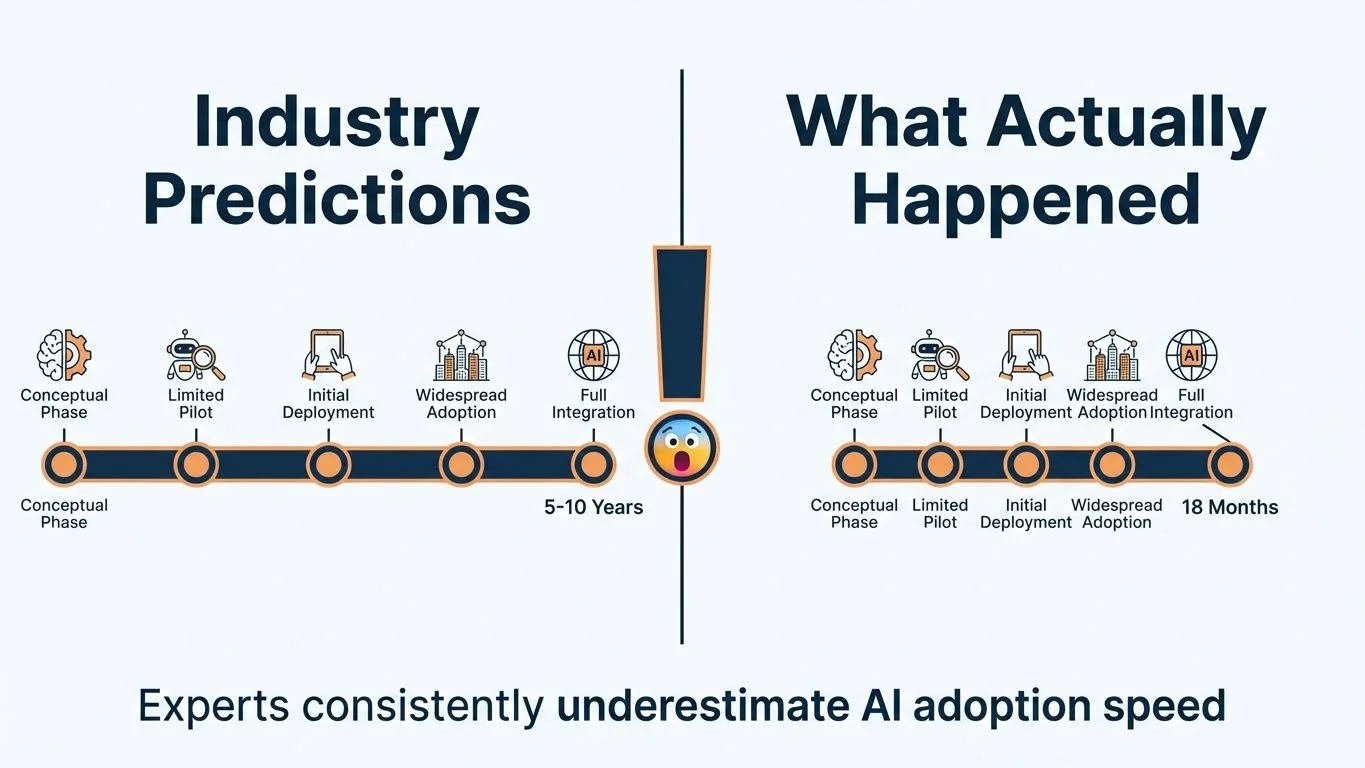
Looking at this timeline, one pattern becomes clear: the industry consistently underestimated the speed of change.
In 2022, most experts predicted AI search would take 5-10 years to mature. It took 18 months.
In 2023, many thought AI search would remain a niche. By 2024, it was serving nearly half of all Google searches.
If the next 5 years follow the same acceleration pattern, those who wait will be left behind.
AI Search Adoption Trajectory
| Category | % of Searches with AI Answers |
|---|---|
| 2020 | 0 |
| 2021 | 0 |
| 2022 | 5 |
| 2023 | 25 |
| 2024 | 47 |
| 2025 | 65 |
| 2026 | 75 |
Source: Industry estimates based on Gartner, SEJ, and Semrush data
FAQ
When did AI search become mainstream?
What was the most important turning point in the search evolution timeline?
How fast did the shift from traditional to AI search happen?
Ready to Adapt to the New Reality?
Understanding the timeline is step one. Learning how to thrive in this new era is step two. See exactly where you stand.
I've built a system to help brands go from invisible to cited in AI responses. But before I share it with you, I want you to see exactly where you stand.
Take the GEO Readiness Quiz →60 seconds · Personalized report · Free
Continue Learning
Dive deeper into AI search with these related articles:
The AI Search Revolution: Why 2025 Changes Everything for SEO
Google predicts 25% less search traffic by 2026. Here's what's actually happening and how to prepare your content for the AI-first era.
Google AI Overviews: Nearly Half of Searches Now Show AI Answers
Google AI Overviews now appear at the top of most searches. Learn what they are, how they work, and why they're changing how people find information.
10 Statistics That Prove AI Search Is Here to Stay (2025 Data)
Hard data on AI search adoption: from 527% traffic increases to 25% search decline predictions. The numbers don't lie.