GEO & AI Search
The AI Search Revolution: Why 2025 Changes Everything for SEO
Quick Answer
The way people find information online has fundamentally changed. AI tools like ChatGPT and Perplexity now answer questions directly instead of showing lists of links, and this shift is causing organic traffic to decline even for websites with stable rankings. If your traffic is down but your rankings haven't changed, you're experiencing the AI search revolution firsthand.
Your rankings are stable. Your keywords haven't moved. Your content still sits on page one.
But your traffic is down 40%.
You've checked your analytics three times. You've run technical audits. You've asked colleagues if they're seeing the same thing.
They are.
This isn't a Google algorithm update. This isn't a technical issue with your site. This is something far more significant.
The fundamental architecture of how people find information online has changed. And most SEO professionals are still optimizing for a game that's already being replaced.
The Numbers That Should Alarm You
527%
YoY Increase
in LLM referral traffic (Jan–May 2025 data). Gemini referrals grew +388% YoY in 2025–2026, confirming the trend continues.
Source: Previsible Study →That's not a minor fluctuation. That's a quarter of all search traffic moving somewhere else within the next 12-18 months.
Where is it going?
To AI-powered answer engines like ChatGPT, Perplexity, Claude, and Google's own AI Overviews.
The result? Organic web traffic is declining by an estimated 15-25% across industries, even for sites that haven't lost a single ranking position.
Case Study
Stack Overflow experienced a 14% drop in March 2023 alone after ChatGPT became widely adopted. Developers stopped visiting the site because they could get code answers directly from AI.
This is not a future prediction. This is happening right now.
The AI Search Trajectory: Where It's Heading
| Category | % of Searches Influenced by AI |
|---|---|
| 2022 | 5 |
| 2023 | 15 |
| 2024 | 35 |
| 2025 | 50 |
| 2026 (Est.) | 75 |
Source: Projected from Gartner, Semrush, and SEJ data
What's Actually Happening: The Shift from Links to Answers
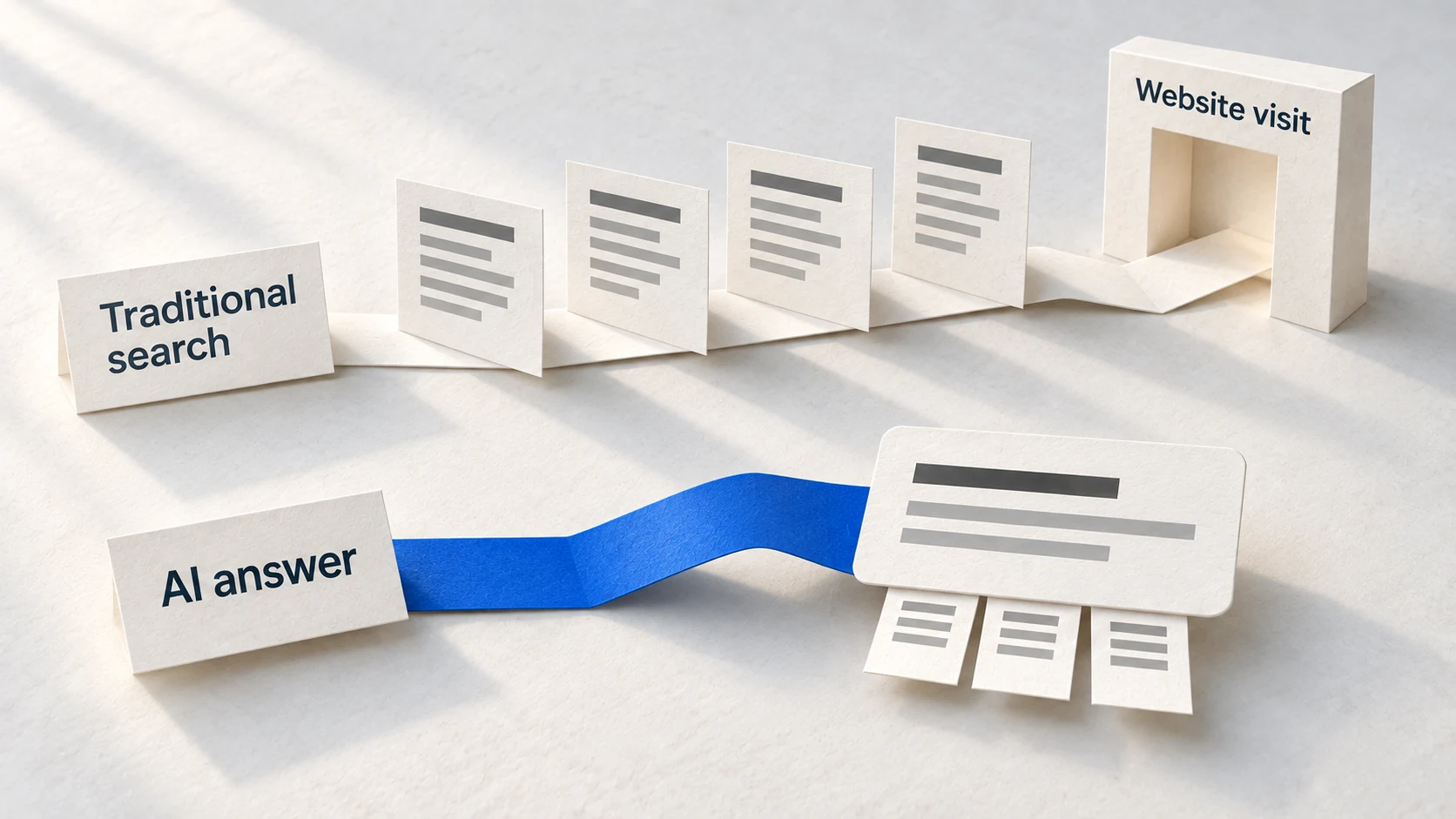
For over two decades, search worked the same way.
The Old Way (2000-2023)
1. You typed a query
2. Google showed blue links
3. You clicked through
4. Website got traffic
The ecosystem worked.
The New Way (2024+)
1. You ask a question
2. AI gives direct answer
3. Question answered
4. No click needed
The model is being replaced.
Today, when someone asks ChatGPT "What's the best CRM for small businesses?", they don't get a list of links. They get a direct answer with specific recommendations.
Here's what this looks like in practice:

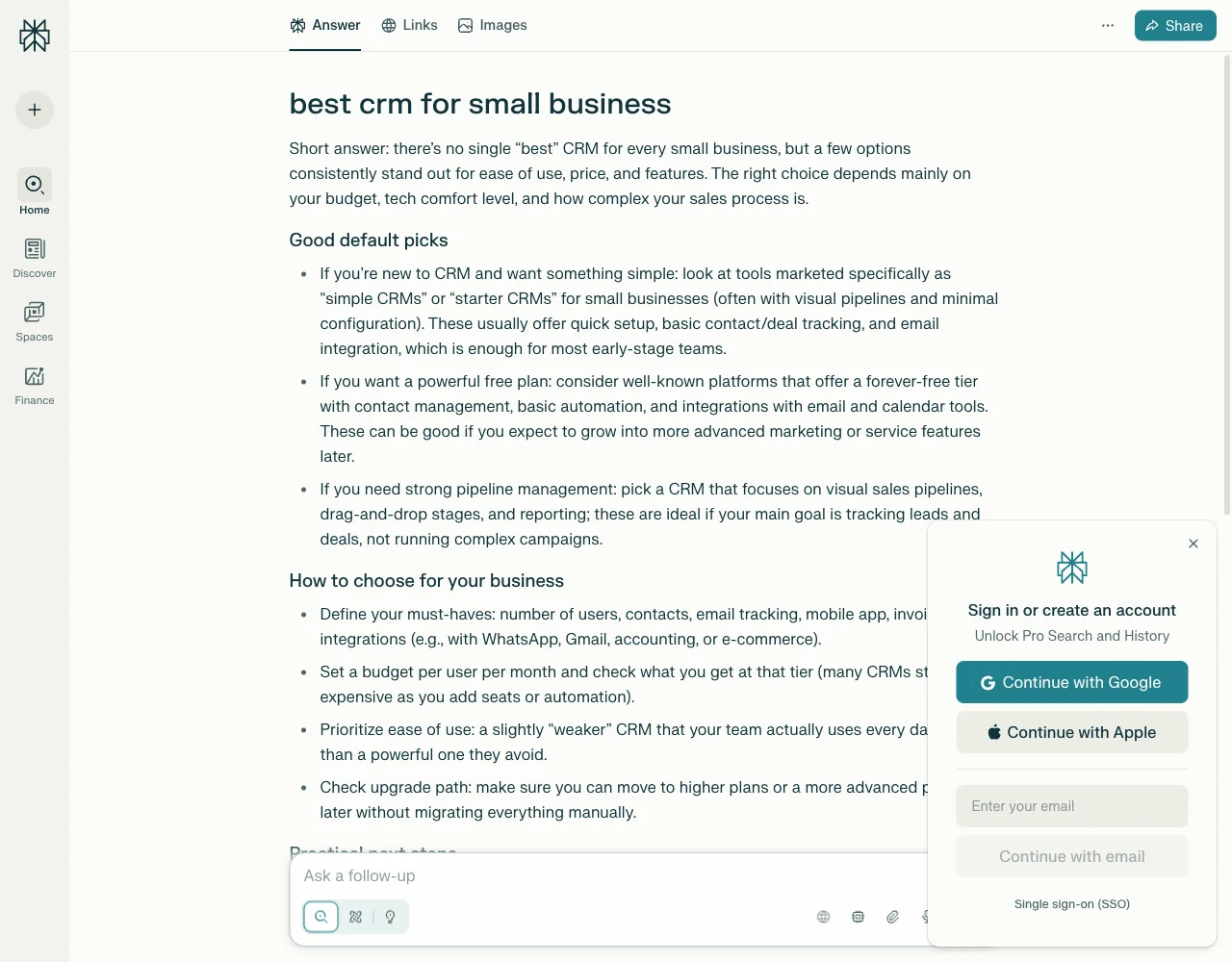
Both platforms provide complete answers to the CRM question - users rarely need to click through to websites.
How AI Search Actually Works
- 1
User Asks Question
Natural language query to ChatGPT, Perplexity, or Google
- 2
AI Searches Sources
Scans web, databases, and knowledge bases
- 3
Synthesizes Answer
Combines information from multiple sources
- 4
Delivers Response
User gets answer without clicking any links
Think of it this way: This is the difference between a librarian who hands you a stack of books and says "the answer is somewhere in here" versus a librarian who reads all the books, synthesizes the information, and gives you a direct answer.
The second librarian is more helpful. But the authors of those books no longer get the same visibility.
Google AI Overviews now appear in nearly half of all Google searches.
Perplexity processes millions of queries daily, providing cited answers.
ChatGPT with browsing can search the web in real-time and synthesize answers in seconds.
The common thread? Users are getting answers without clicking through to websites.
Why Your Rankings No Longer Guarantee Traffic
This is the part that confuses most SEO professionals.
You did everything right:
- Your page ranks #3 for a valuable keyword
- Traditional SEO says you should get 10-12% of clicks
But you're getting 4%. Or 2%. Or sometimes none.
Here's what's happening:
When someone searches "how to improve website loading speed," Google's AI Overview generates a comprehensive answer with specific steps, tool recommendations, and technical explanations.
The user reads this answer. Their question is answered. They never scroll down to see your perfectly optimized blog post sitting in position #3.
Your ranking
didn't change
Your traffic
did
This doesn't mean SEO is dead.
But it does mean that ranking is no longer the finish line. It's now the starting point for a different kind of optimization.
AI Citations: The New Backlinks (And Why They Matter More)
When ChatGPT answers a question, it often includes small numbered links or references. These are citations, showing which sources the AI used. (Learn how ChatGPT decides what to cite.)
These citations are the new backlinks.
Traditional SEO:
Backlinks from authoritative websites signaled trust to Google's algorithm.
AI Search Era:
Citations from AI engines signal authority when ChatGPT consistently cites you.
But there's a crucial difference:
Backlinks
Relatively stable. Once earned, they usually stay. Build over years.
AI Citations
Dynamic. AI decides in real-time which sources to cite. Yesterday's citation doesn't guarantee today's.
This creates both challenge and opportunity:
Challenge
You can't rest on past success. Your content needs to continuously earn citation.
Opportunity
You can earn citations much faster than backlinks. Weeks, not years.
The metric that matters now isn't just "Do I rank?"
"Does AI cite me when people ask about my topic?"
Backlinks vs AI Citations: Key Differences
| Aspect | Traditional Backlinks | AI Citations |
|---|---|---|
| How Earned | Outreach, content marketing, PR | Content quality, structure, authority signals |
| Stability | Relatively permanent once earned | Dynamic, re-evaluated per query |
| Time to Earn | Months to years | Weeks to months |
| Measurement | Domain authority, link count | Citation frequency, share of voice |
| Control | High (you build them) | Lower (AI decides) |
Who's Already Adapting (And Who's Getting Left Behind)
A clear divide is emerging in the SEO industry.
The Adapters
- "How do I structure content so AI can extract and cite it?"
- "What signals make AI engines trust my brand?"
- "How do I measure visibility in AI-generated answers?"
The Resisters
- "How do I get more backlinks?"
- "What's the optimal keyword density?"
- "How do I outrank my competitor?"
The resisters aren't wrong exactly. Those questions still matter. But they're incomplete.
Success Stories
NerdWallet
37% revenue growth despite 20% decrease in site traffic. They ensured their expertise showed up in AI-generated answers.
Stack Overflow
Lost 14%+ traffic per month but now investing heavily in AI integration to remain the source AI models cite.
The winners aren't abandoning SEO. They're expanding it with a new discipline called Generative Engine Optimization (GEO).
What This Means for Your SEO Strategy
Your SEO skills aren't worthless. Research suggests 60% of traditional SEO skills transfer directly to the AI search era.
But they're no longer sufficient on their own. Here's what needs to change:
Problem #1
Why AI Skips Your Content (The Structure Problem)
AI engines scan for clear, direct answers that can be extracted and cited.
If your answer is buried in paragraph six, AI will find a competitor's content that provides the answer in the first 100 words.
Answer-first content structure isn't just good for users. It's essential for AI citation.
Problem #2
The Identity Problem: AI Doesn't Know Who You Are
AI engines need to understand who you are before they trust what you say.
Your company name, expertise areas, credentials, location - these details need to be structured in ways AI can verify.
When AI encounters your content, it asks: "Is this source credible enough to cite?"
Problem #3
Schema Markup: From "Nice to Have" to "Must Have"
Schema markup is how you explicitly tell AI engines what your content is about, who wrote it, and why it's credible.
Wikipedia dominates AI citations, appearing in nearly 48% of ChatGPT's top references. Why? Meticulously structured, fact-checked, machine-readable content.
It's the difference between hoping AI understands your page and ensuring it does.
Problem #4
Beyond Traffic and Rankings: The Metrics That Matter Now
"Organic traffic" and "keyword rankings" no longer tell the complete story. You need to track:
AI Citation Frequency
How often does AI cite your content?
Share of Model Visibility
How often does your brand appear in responses?
AI Referral Traffic
What % of traffic comes from AI platforms?
How often do you appear in AI summaries?
The Three Questions You Need to Answer Today
Does AI Know You Exist?
Open ChatGPT right now. Ask it about your industry or product category.
- If you sell project management software, ask "What are the best project management tools?"
- If you run a marketing agency, ask "Who are the top digital marketing agencies in [your city]?"
Did your brand appear? Were you cited?
If not, you're currently invisible to AI search.
Is Your Content Structured for Extraction?
Look at your top-performing pages and ask:
- Is the main answer in the first 100 words?
- Are there clear headings a machine can parse?
- Is there structured data (schema markup)?
- Could AI easily extract a citable quote or statistic?
Can AI Verify Your Authority?
AI engines look at what the rest of the internet says about you.
Search this on Google. What comes up?
If there's almost nothing, AI won't trust you enough to cite you.
What Comes Next
The AI search revolution isn't coming. It's here.
The question isn't whether to adapt. It's how quickly you can adapt before your competitors do.
The good news: you're earlier than you think.
Despite the statistics, the vast majority of businesses haven't started optimizing for AI search. They're still running the old playbook.
There's a window where early adopters can establish themselves as trusted entities, build citation authority, and capture visibility before the space becomes crowded.
The SEO professionals who recognize this shift will thrive. They'll add GEO to their skillset and help clients navigate a landscape most marketers don't yet understand.
The ones who wait will find themselves optimizing for a game that no longer exists.
Which will you be?
FAQ
Is SEO dead because of AI search?
What is the difference between SEO, AEO, and GEO?
How long does it take to start appearing in AI citations?
Where Do You Stand in the AI Search Revolution?
You've seen the data. You understand the shift. Now find out how visible your content is to AI engines-and what's blocking you from getting cited.
I've built a system to help brands go from invisible to cited in AI responses. But before I share it with you, I want you to see exactly where you stand.
Take the GEO Readiness Quiz →60 seconds · Personalized report · Free
Continue Learning
Dive deeper into AI search with these related articles:
Google AI Overviews: Nearly Half of Searches Now Show AI Answers
Google AI Overviews now appear at the top of most searches. Learn what they are, how they work, and why they're changing how people find information.
10 Statistics That Prove AI Search Is Here to Stay (2025 Data)
Hard data on AI search adoption: from 527% traffic increases to 25% search decline predictions. The numbers don't lie.
What the SEO Industry Got Wrong About AI Search
The SEO industry dismissed AI search as hype. They were wrong. Here's what the conventional wisdom missed.