GEO & AI Search
AI Overviews: What They Are and Why They're Appearing in More Google Searches
Quick Answer
Google AI Overviews are AI-generated summaries that appear at the top of search results, providing direct answers by synthesizing information from multiple web sources. They now appear in nearly half of all Google searches, fundamentally changing how users consume information and how websites earn traffic.
You search for "best laptop for video editing" on Google.
But instead of the familiar blue links, you see something different at the top.
A large box with a synthesized answer. Specific laptop recommendations. Specs comparison. All generated by AI, sitting above the traditional search results.
This is an AI Overview. And it's changing everything about how search works.
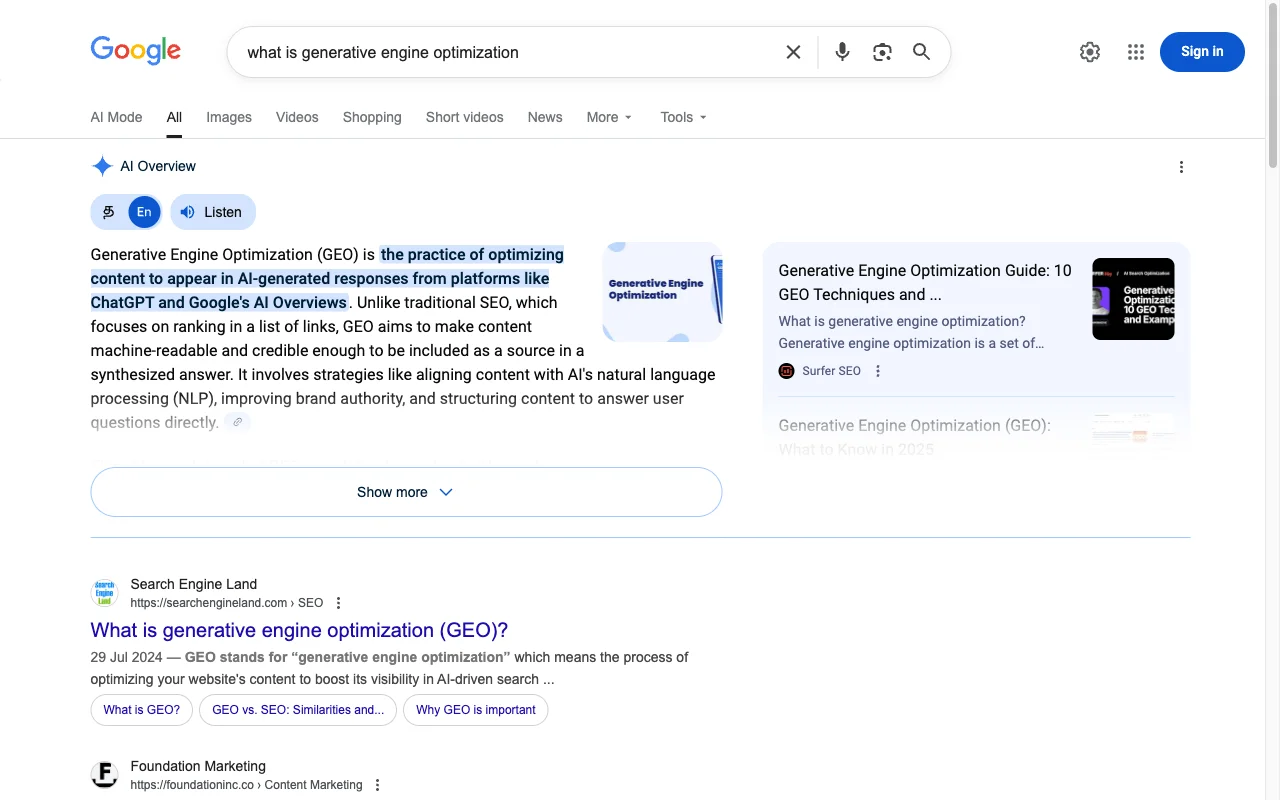
What Are Google AI Overviews?
Google AI Overviews (previously called Search Generative Experience or SGE) are AI-generated responses that appear at the top of Google search results.
Unlike traditional featured snippets that pull a direct quote from a single source, AI Overviews:
- 1. Synthesize information from multiple sources across the web
- 2. Generate original text that summarizes and answers the query
- 3. Include source citations as small links users can click
- 4. Push traditional results further down the page
Think of it this way: Traditional search showed you 10 doors and said "the answer is behind one of these." AI Overviews read what's behind all the doors and summarize the answer for you.
How Common Are AI Overviews? (The Data)
25.11%
of All Google Searches
show AI Overviews (doubled since March 2025)
Source: Authoritas / BrightEdge, March 2026
85%+
"How To" Queries
trigger AI Overviews
Highest trigger rate category
The rollout has been aggressive. Google started testing AI Overviews in May 2023, expanded to all US users by May 2024, and has been rolling out globally since.
Query types most likely to trigger AI Overviews:
- • "How to" questions (85%+ trigger rate)
- • "What is" definitions (75%+ trigger rate)
- • Product comparisons (60%+ trigger rate)
- • Health and medical queries (70%+ trigger rate)
- • Technical explanations (80%+ trigger rate)
If your content targets informational queries, AI Overviews are almost certainly affecting your traffic.
How Do AI Overviews Actually Work?
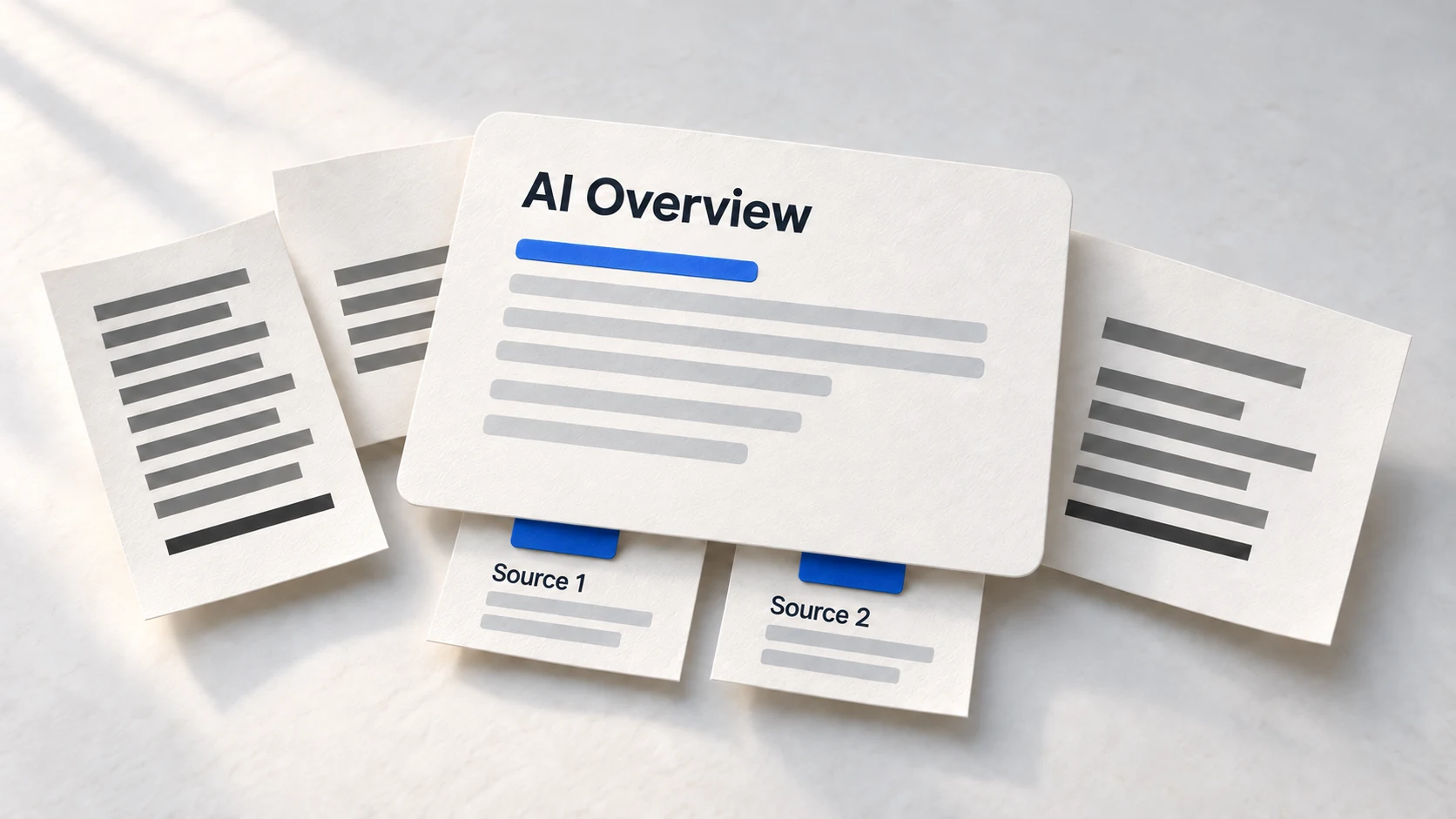
Understanding the mechanics helps you optimize for them.
How AI Overviews Generate Answers
- 1
Query Analysis
Google's AI interprets your search intent
- 2
Source Retrieval
AI pulls from top-ranking pages and authoritative sources
- 3
Synthesis
Information is combined into a coherent answer
- 4
Citation
Source links are added for users who want more detail
The key insight: AI Overviews don't just quote your content. They understand it, extract the relevant parts, and weave them into a larger answer alongside other sources.
This means the old SEO goal of "rank #1 and get 30% of clicks" is outdated. Even position #1 can get bypassed if the AI Overview answers the query completely.
Why Source Selection Matters More Than Ranking
Here's what many SEO professionals miss: Google's AI doesn't simply pull from the #1 result. It evaluates content based on:
Content Completeness
Does the page address multiple facets of the query? Comprehensive content gets synthesized more often than thin pages.
Structural Clarity
Can the AI easily parse your content? Clear headings, lists, and tables make extraction easier.
Authority Signals
Is the source recognized as authoritative? E-E-A-T signals influence which sources get cited.
Answer Positioning
Where's your answer located? Content that answers upfront gets extracted more than buried conclusions.
The AI synthesizes from multiple sources because no single page is perfect for every query. Your goal isn't to be the only source-it's to be a consistently cited source.
What Gets Cited vs What Gets Bypassed
After analyzing thousands of AI Overview results, clear patterns emerge. Some content gets cited repeatedly. Other content-even ranking #1-gets completely ignored.
✓ Content That Gets Cited
- • Direct answers in the first 100 words
- • Specific numbers, data, and statistics
- • Step-by-step instructions with clear sequence
- • Definitions followed by examples
- • Expert quotes with attribution
- • Comparison tables and lists
✗ Content That Gets Bypassed
- • Long introductions before the answer
- • Vague, generic statements
- • Opinions without supporting evidence
- • Dense paragraphs without structure
- • Clickbait that doesn't deliver
- • Thin content with no unique value
The pattern is clear: AI Overviews reward content that respects the user's time. If someone asks "how to tie a tie," they want the steps-not your life story about learning to tie ties from your grandfather.
Why some #1 rankings still get bypassed: A page might rank #1 because it has strong backlinks and domain authority-traditional SEO signals. But if the content itself is poorly structured or buries the answer, Google's AI will pull from a page ranking #4 or #7 that has clearer, more extractable content.
This is the fundamental difference between SEO and Generative Engine Optimization (GEO). SEO gets you to page one. GEO gets you cited once you're there.
The Impact on Website Traffic
Here's what website owners are experiencing:
-34.5%
CTR decline when AI Overviews appear (Ahrefs)
76%
of citations from top 10 rankings (Ahrefs)
3x–5x
higher conversion from AI traffic for services/B2B (Semrush)
The silver lining: While total click volume drops, users who do click through from AI Overviews are more qualified. They've already read a summary and want more depth. That's why the conversion rates are higher.
The challenge is getting cited in the first place. And that requires a new optimization approach called Generative Engine Optimization (GEO). (See our complete guide to GEO vs AEO vs SEO.)
Industry-Specific Impact
Not all industries feel the impact equally. Here's how different sectors are experiencing AI Overviews:
Information & Education
Highest impact. "How to" and "what is" queries trigger AI Overviews 85%+ of the time. Tutorial sites see significant traffic shifts.
E-commerce & Product Reviews
Moderate impact. Product comparison queries trigger AI Overviews, but transactional queries ("buy X") still go to traditional results.
Local Services
Lower impact for now. "Near me" and location-specific queries still favor Google Business Profile and Maps. But this is changing.
B2B & Professional Services
Growing impact. Research-phase queries like "best CRM for small business" increasingly trigger AI Overviews with multiple vendor citations.
47%
of Google Searches Now Show AI Overviews
Nearly half of all Google searches now display an AI-generated summary at the top of results, fundamentally changing how users find information
Source: Search Engine Journal 2025 StudyThe quality vs. quantity tradeoff: Yes, you'll likely get fewer total clicks. But the clicks you do get are more valuable. Users who click through after reading an AI Overview are further along the buyer's journey-they've already gotten the basic answer and want depth. This is why conversion rates from AI-referred traffic are higher.
The businesses adapting fastest are reframing their goals: instead of "maximize organic traffic," they're targeting "maximize high-intent visitors from all AI sources."
How to Optimize for AI Overviews
You can't guarantee placement in AI Overviews. But you can significantly increase your chances.
1. Answer-First Content Structure
Put your answer in the first 2-3 sentences. Don't bury the lead. AI extracts from the top.
2. Comprehensive Coverage
Cover the topic thoroughly. AI prefers sources that address multiple aspects of a query.
Use clear headings, lists, and tables. AI can parse structured content more easily.
Demonstrate expertise, experience, and authority. AI prioritizes trustworthy sources.
5. Cite Your Sources
Link to authoritative references. It signals credibility to both users and AI systems.
Key Insight: Traditional SEO focused on ranking. GEO focuses on being cited. The skills overlap but the tactics differ.
FAQ
What are Google AI Overviews?
How often do AI Overviews appear in Google searches?
Can I control whether my content appears in AI Overviews?
Ready to Optimize for AI Search?
AI Overviews are just one piece of the AI search puzzle. Learn how to get your content cited by ChatGPT, Perplexity, and other AI tools.
Discover where you stand and get personalized recommendations.
Take the GEO Readiness Quiz →60 seconds · Personalized report · Free
Continue Learning
Dive deeper into AI search with these related articles:
The AI Search Revolution: Why 2025 Changes Everything for SEO
Google predicts 25% less search traffic by 2026. Here's what's actually happening and how to prepare your content for the AI-first era.
10 Statistics That Prove AI Search Is Here to Stay (2025 Data)
Hard data on AI search adoption: from 527% traffic increases to 25% search decline predictions. The numbers don't lie.
What the SEO Industry Got Wrong About AI Search
The SEO industry dismissed AI search as hype. They were wrong. Here's what the conventional wisdom missed.