GEO & AI Search
GEO vs AEO vs SEO: The Complete Guide to AI Search Optimization in 2025
Quick Answer
SEO optimizes for traditional search rankings (blue links on Google). AEO optimizes for featured snippets and Google's AI Overviews. GEO optimizes for citations in AI chatbots like ChatGPT, Perplexity, and Claude. They're not competing strategies-they're complementary layers of a complete search visibility approach.
Three acronyms. A lot of confusion.
If you've tried to understand the difference between SEO, AEO, and GEO, you've probably encountered conflicting definitions, overlapping concepts, and marketing jargon designed to sell you something. One article says GEO is the future. Another says it's just SEO with a new name. A third claims AEO and GEO are the same thing.
Let's fix that.
By the end of this guide, you'll understand exactly what each optimization type does, when to use each, and how they work together to give you complete visibility in both traditional search and AI-powered platforms.
The Simple Explanation (No Jargon)
Think of search like asking three different types of librarians for help:
SEO
Like optimizing your book's cover and title so it appears on the "recommended" shelf.
Goal: Rank in search results
AEO
Like writing your key insight on the book's back cover so the librarian can quote it directly.
Goal: Get featured as the answer
GEO
Like making sure the AI assistant has read your book and recommends it when asked.
Goal: Get cited by AI tools
SEO = be found. AEO = be quoted. GEO = be recommended.
And here's what most guides miss: these aren't competing strategies. They're layers that build on each other. Get SEO right, and AEO becomes easier. Get AEO right, and GEO becomes more likely. Each layer amplifies the others.
What Each Actually Means
Foundation Layer
SEO: Search Engine Optimization
What it is: Optimizing your website to rank higher in traditional search engine results (the blue links on Google).
Been around since: Late 1990s
Core tactics:
- Keyword research and targeting
- On-page optimization (titles, meta descriptions, headers)
- Technical optimization (site speed, mobile-friendly, crawlability)
- Link building and authority development
- Content creation and optimization
Still relevant? Absolutely. SEO remains the foundation. 68% of online experiences begin with a search engine, making SEO essential for discovery.
Answer Layer
AEO: Answer Engine Optimization
What it is: Optimizing content to appear in featured snippets, knowledge panels, and Google's AI Overviews.
Been around since: 2016 (when featured snippets became prominent)
Core tactics:
- Answer-first content structure
- Question-based headings (What, How, Why)
- Concise, extractable paragraphs
- Schema markup for rich results
- FAQ sections
Still relevant? More than ever. AI Overviews now appear in 47% of Google searches.
Citation Layer
GEO: Generative Engine Optimization
What it is: Optimizing content to be cited and recommended by AI chatbots like ChatGPT, Perplexity, Claude, and Gemini.
Been around since: 2023 (emerged after ChatGPT's mainstream adoption)
Core tactics:
- Entity establishment (making AI "know" your brand)
- Authoritative content structure
- E-E-A-T signals throughout content
- Machine-readable formatting
- Cross-platform authority building
Still emerging? Yes, but growing fast. AI referral traffic grew 527% year-over-year according to the 2025 Previsible AI Data Study.
527%
Year-over-year growth in AI referral traffic
This isn't a future trend-it's happening now. Sites optimized for AI citations are already seeing dramatic traffic shifts.
Source: Previsible 2025 AI Data Study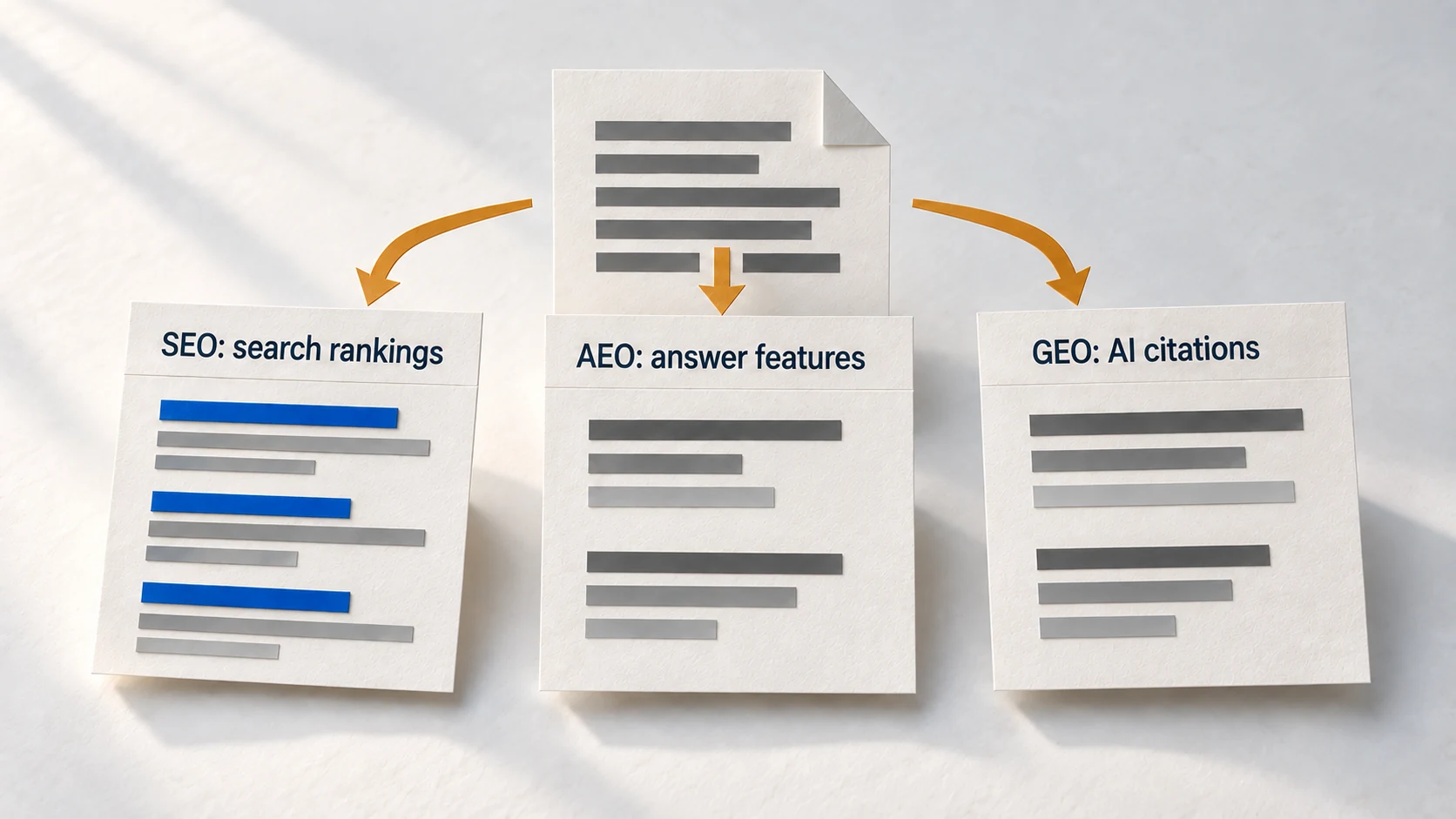
Side-by-Side Comparison
SEO vs AEO vs GEO: Key Differences
| Aspect | SEO | AEO | GEO |
|---|---|---|---|
| Primary Goal | Rank in search results | Appear in featured answers | Get cited by AI chatbots |
| Target Platform | Google, Bing (organic results) | Google (answer boxes, AI Overviews) | ChatGPT, Perplexity, Claude, Gemini |
| Success Metric | Rankings, organic traffic | Featured snippet capture rate | AI citation frequency |
| Time to Results | 3-6 months typical | 1-3 months if ranking | 2-6 weeks for initial citations |
| Skills Transfer | Foundation for all others | Builds on SEO foundation | 60% overlap with SEO |
| Current Importance | Essential (68% of experiences start here) | Growing (47% of searches) | Emerging (527% YoY growth) |
Note: These aren't competing strategies. They're complementary layers of a complete search visibility approach.
See the Difference: Same Query, Three Experiences
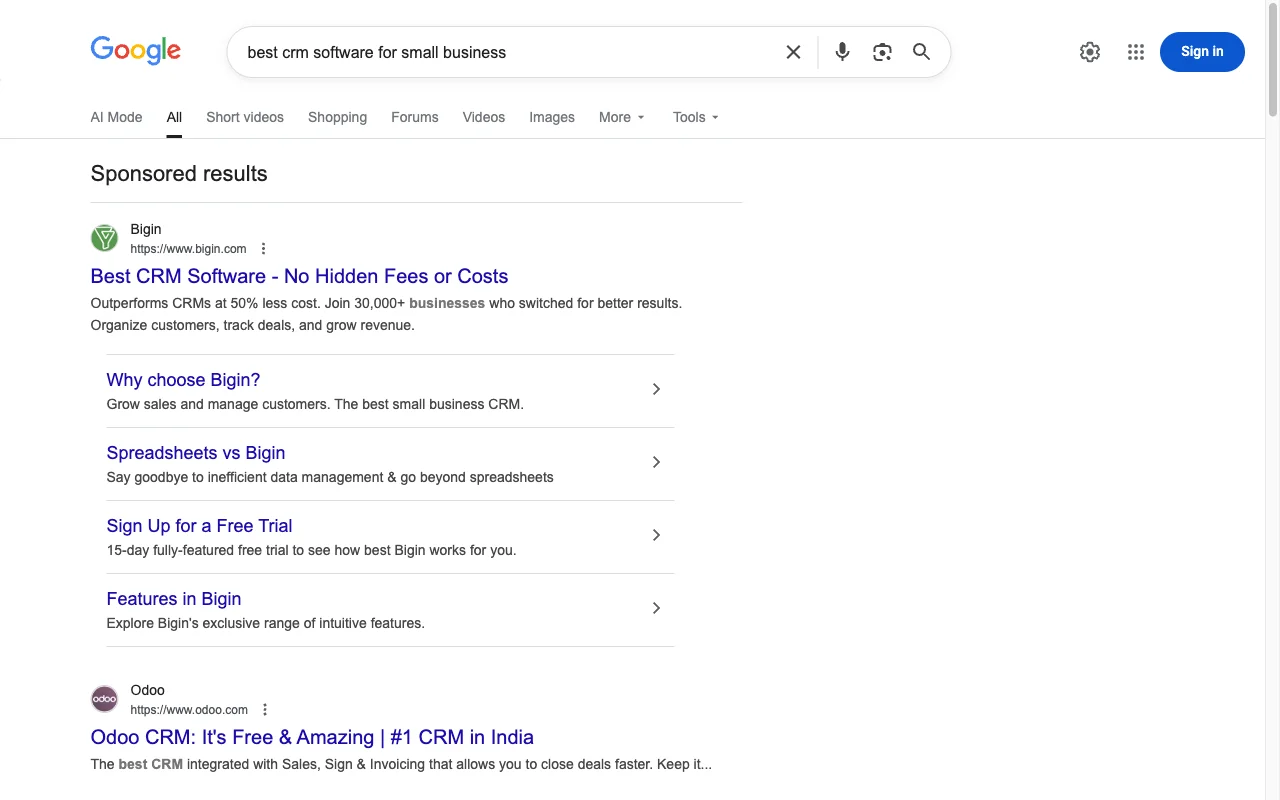
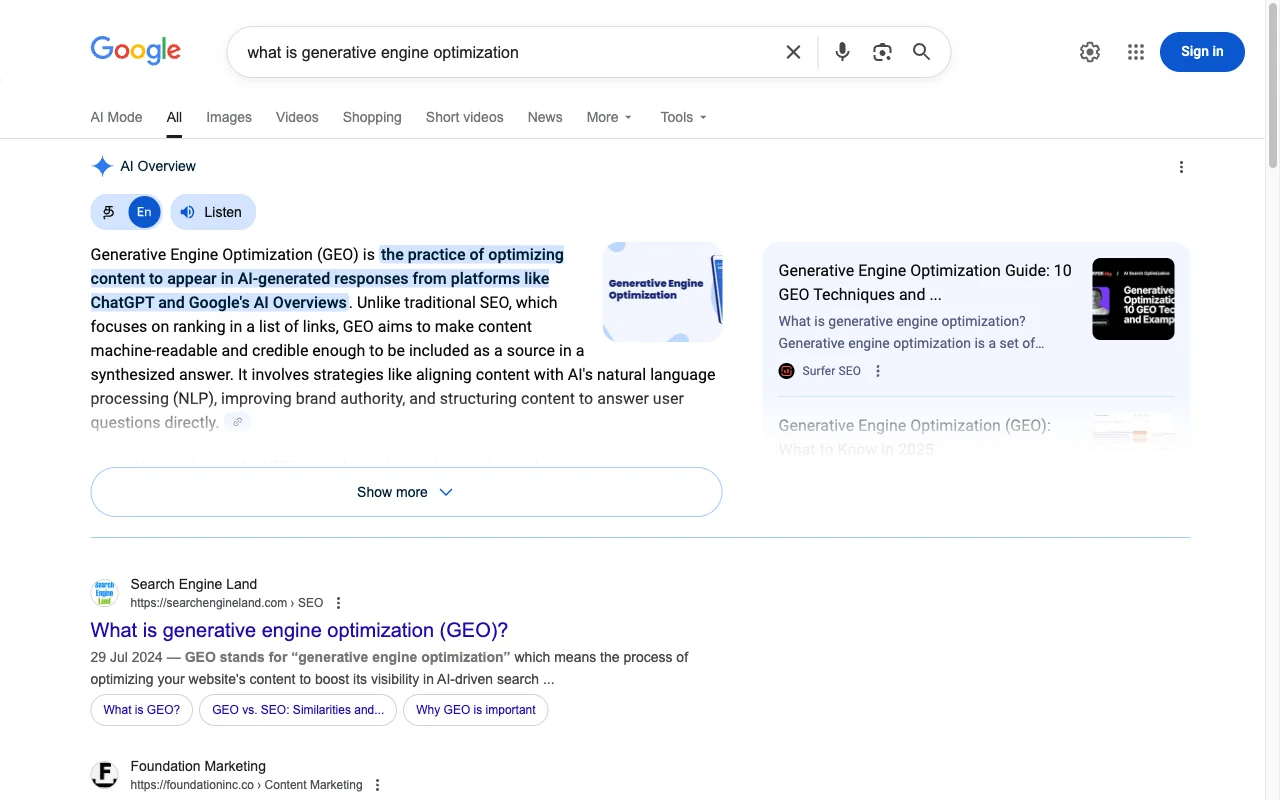
Here's what happens when someone searches "best CRM for small business" across different platforms:
SEO: Traditional Results
AEO: Featured Answer
GEO: AI Citation
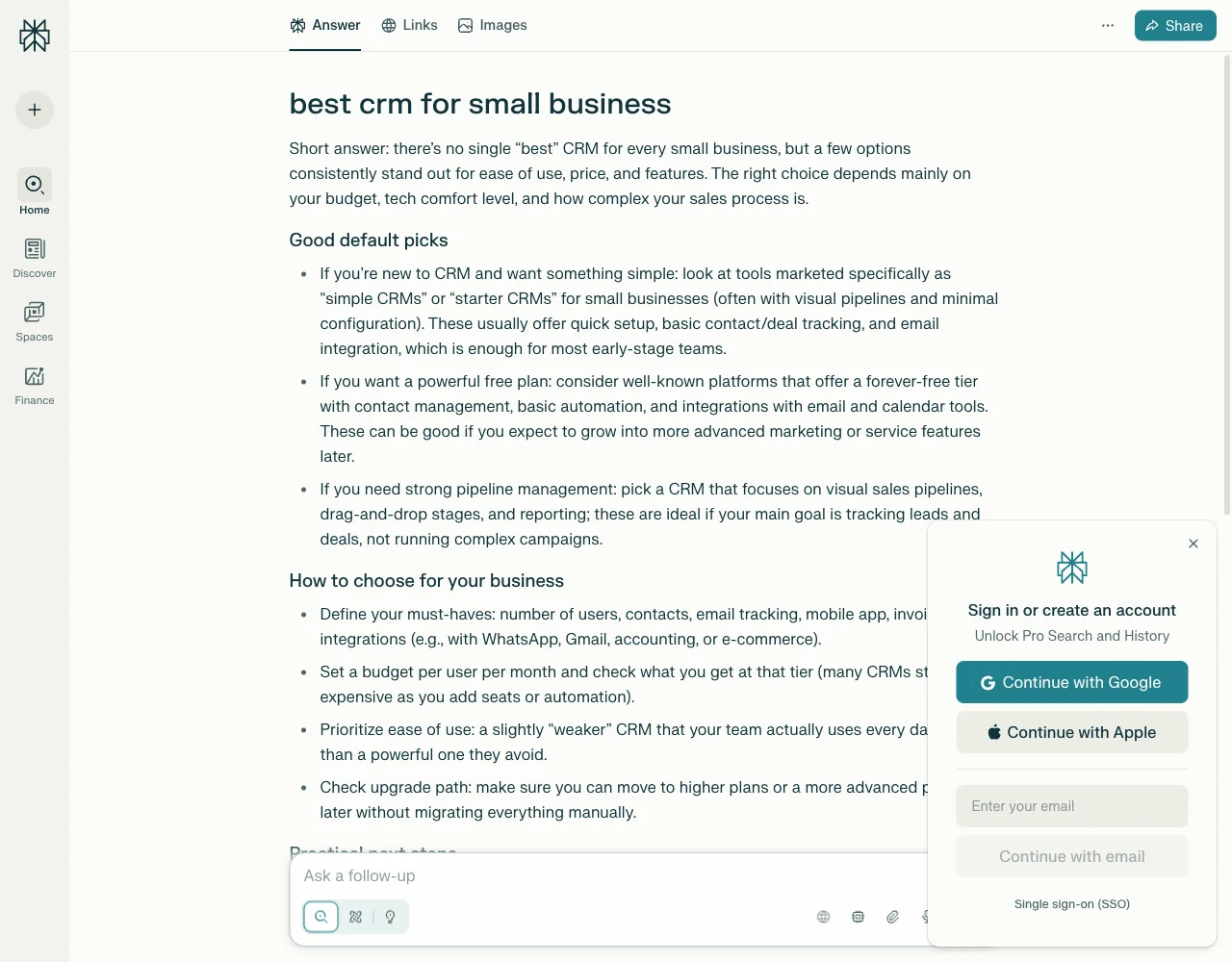
The takeaway: The same query produces three different experiences. Optimizing for just one means missing two-thirds of potential visibility.
How SEO, AEO, and GEO Work Together
Here's the key insight most guides miss:
GEO doesn't replace SEO. It builds on it.
The Search Visibility Stack
- 1
SEO Foundation
Get indexed, build authority, rank for keywords
- 2
AEO Layer
Optimize for featured snippets and AI Overviews
- 3
GEO Layer
Structure for AI citation and recommendation
- 4
Complete Visibility
Found in search, featured in answers, cited by AI
Think of it like this: SEO gets you in the library. AEO puts you on the display shelf. GEO makes sure the AI librarian recommends your book when someone asks for help.
The good news: many tactics overlap. Good content structure helps all three. Strong E-E-A-T signals benefit all three. Quality backlinks support all three.
The key difference is what you're optimizing for:
SEO
Optimize for ranking algorithms
AEO
Optimize for answer extraction
GEO
Optimize for AI citation
Real-World Application: A Step-by-Step Example
Let's say you run an accounting software company and want to rank for "best accounting software for freelancers." Here's how you'd approach it with all three optimization layers:
Definition
The Target
A comprehensive guide about accounting software options for freelancers, designed to appear in traditional search, featured answers, and AI recommendations.
Layer 1: SEO Foundation
First, you handle the basics that get you indexed and ranking:
- → Keyword in title: "Best Accounting Software for Freelancers (2025 Comparison)"
- → Meta description that drives clicks with a clear value proposition
- → H2s covering related topics: pricing, features, integrations, mobile apps
- → Internal links to your product pages and related content
- → Fast loading speed, mobile-responsive design
Layer 2: AEO Optimization
Next, you structure content for featured snippets and AI Overviews:
- → Answer the main question in the first 100 words: "The best accounting software for freelancers is..."
- → Add a comparison table with clear criteria and ratings
- → Include FAQ section with common questions
- → Use schema markup (FAQ, Product, Review schemas)
- → Create scannable lists for "pros and cons" of each option
Layer 3: GEO Enhancement
Finally, you optimize for AI citation and recommendation:
- → Add author credentials: "Written by [Name], CPA with 15 years helping freelancers with tax strategy"
- → Include first-hand experience: "I've personally tested all 8 platforms on this list over 6 months"
- → Cite verifiable sources for any data claims with linked references
- → Structure recommendations as definitive statements: "For freelancers earning under $75K, FreshBooks offers the best value"
- → Build entity authority through author schema and linked professional profiles
The result: One piece of content that ranks in Google, appears in AI Overviews, and gets cited when someone asks ChatGPT or Perplexity for accounting software recommendations. Three visibility channels from a single optimized asset.
Which Should You Focus On First?
It depends on your audience and goals. But here's a decision framework that works for most businesses:
Question
What's your current situation?
Build SEO foundation first. You can't optimize for AI if you're not indexed and authoritative.
Add AEO and GEO layers. Optimize existing content for featured snippets and AI extraction.
Prioritize GEO alongside SEO. Your prospects might find you through ChatGPT before Google.
GEO is especially important. Decision-makers increasingly use AI for research and recommendations.
The safest approach for most businesses:
60% SEO foundation + 20% AEO optimization + 20% GEO tactics
Adjust based on where your audience actually discovers you.
Common Misconceptions (Cleared Up)
"GEO will replace SEO"
Reality: No. Gartner predicts 25% search decline by 2026, not elimination. Traditional search will remain the primary traffic source for years. GEO is an addition, not a replacement.
"AEO is just a subset of SEO"
Reality: Partially true. AEO tactics build on SEO, but the optimization target is different. You can rank #1 without appearing in featured snippets, and vice versa.
"GEO is just rebranded SEO"
Reality: No. While 60% of SEO skills transfer to GEO, the targets are fundamentally different. SEO optimizes for ranking algorithms; GEO optimizes for AI citation algorithms.
"I can ignore AI search if my rankings are good"
Reality: Risky. Traffic is declining even for sites with stable rankings. If AI answers your audience's questions, they won't click through regardless of where you rank.
FAQ
What is the difference between GEO, AEO, and SEO?
Do I need all three - SEO, AEO, and GEO?
Is GEO just rebranded SEO?
Which should I focus on first - SEO, AEO, or GEO?
How long does it take to see results from GEO?
Can I optimize for all AI platforms at once?
Ready to Optimize for All Three?
Understanding the difference is step one. Now find out how ready your content is for AI search.
I've built a system to help brands go from invisible to cited in AI responses. But before I share it with you, I want you to see exactly where you stand.
Take the GEO Readiness Quiz →60 seconds · Personalized report · Free
Continue Learning
Dive deeper into AI search with these related articles:
GEO Explained in Plain English: What It Is and Why It Matters
Generative Engine Optimization (GEO) explained without jargon. Learn what GEO is, how it differs from SEO, and why it matters for your website.
How ChatGPT Decides What to Cite (And What to Ignore)
Ever wondered why ChatGPT cites some websites and ignores others? Learn the citation mechanics and how to increase your chances of being cited.
SEO Is Not Dead: How Your Skills Transfer to AI Search
Already skilled in SEO? Good news: about 60% of your skills transfer to GEO. Learn which tactics still work and which to leave behind.