GEO Fundamentals
Product Schema: E-Commerce GEO Optimization
Quick Answer
Product schema is structured data that tells AI engines your product name, price, availability, specifications, and reviews. It enables ChatGPT, Perplexity, and other AI platforms to recommend your products when users ask shopping queries. Pages with complete Product schema are 3.7x more likely to be cited by AI systems because the structured data provides verifiable product details that AI can confidently present to users making purchase decisions.
You have a Shopify store with 500 products. Your SEO is solid-product pages rank well on Google. Your conversion rate is decent. But when someone asks ChatGPT "best wireless headphones under $100" or Perplexity "laptop stand for standing desk," your products never appear in the recommendations.
The problem is not your products or your prices. The problem is that AI engines cannot reliably extract product specifications from paragraph descriptions. They read your page and understand it is about headphones, but they cannot confidently state the price, confirm stock availability, or verify customer ratings without structured data.
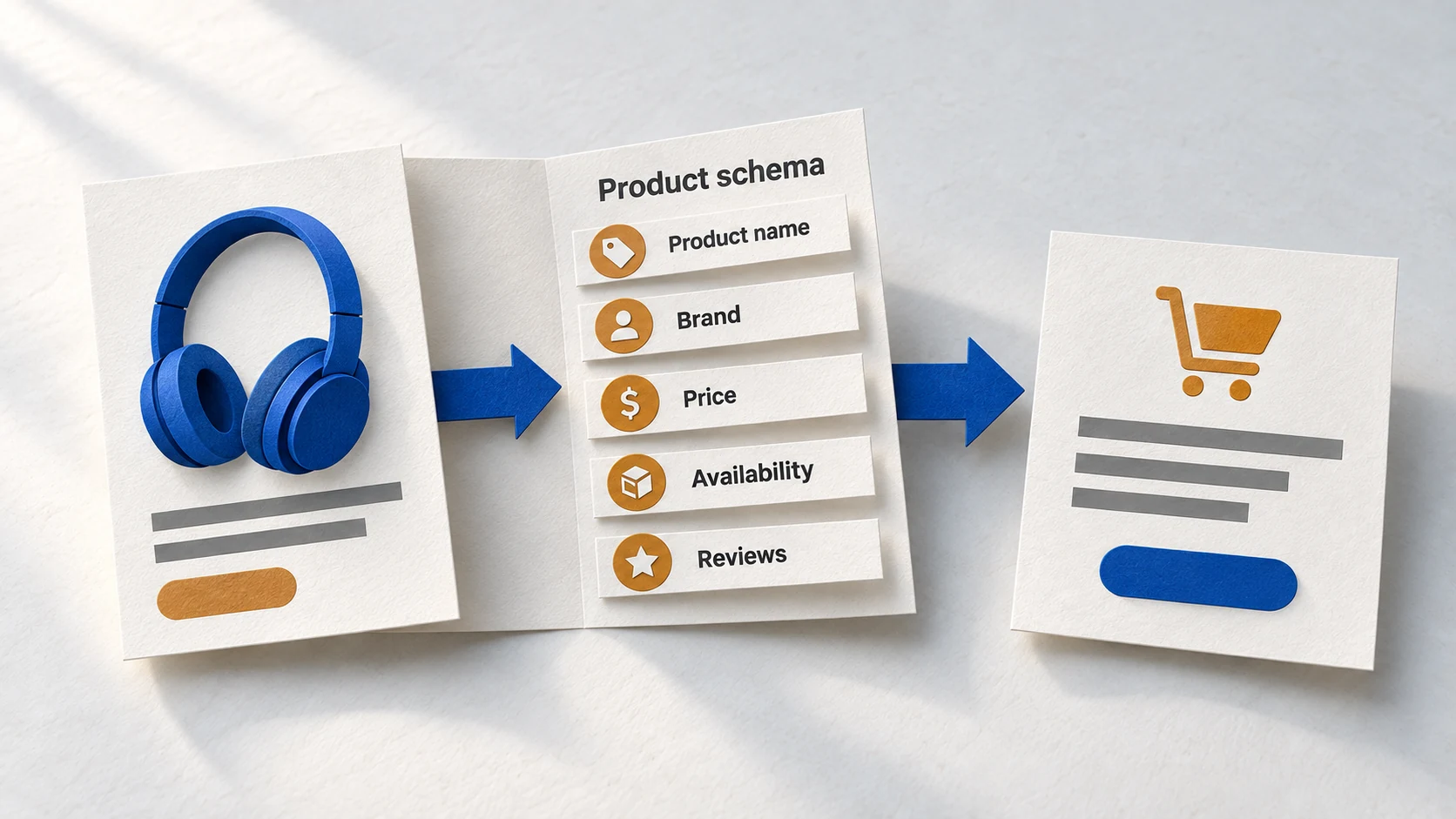
Product schema solves this by providing machine-readable product details. When you mark up your products with schema, AI systems can parse name, brand, price, availability, SKU, and reviews instantly-making your products quotable, comparable, and recommendable.
What Is Product Schema?
Product schema is a type of structured data specifically designed for e-commerce product pages. It defines properties like name, description, brand, SKU, price, currency, stock availability, condition (new/used/refurbished), and aggregate ratings.
Think of it this way: Without Product schema, your product page is like a printed catalog-humans can read the details, but machines have to guess which number is the price and whether the product is in stock. With Product schema, your product page is like a database entry-every detail has a label, nothing is ambiguous, and AI can extract facts confidently.
When someone asks ChatGPT for product recommendations, the AI does not just search web pages and summarize descriptions. It looks for structured data that confirms specifications, pricing, and availability. Products with complete schema are prioritized because AI systems can verify the information and present it to users without hedging.
Research on AI e-commerce schema optimization found that pages with complete Product schema are 3.7 times more likely to be cited by AI systems compared to pages without schema. This citation advantage translates directly to visibility in AI shopping assistants, which are rapidly becoming a significant traffic source for e-commerce.
Definition
Product Schema
Structured data markup that provides machine-readable information about e-commerce products-including name, price, availability, brand, SKU, and reviews-enabling AI shopping assistants to confidently recommend and compare your products in response to purchase-intent queries.
The AI Shopping Revolution
AI-powered shopping is not speculative-it is happening now. ChatGPT has launched shopping features, Perplexity recommends products with affiliate links, and major AI platforms are pushing deeper into e-commerce with conversational product discovery.
1,300%
YoY AI referral traffic growth
Holiday season 2024
Source: Adobe Analytics
1B+
ChatGPT weekly searches
Including shopping queries
Source: Superprompt 2025
Complete analysis of AI-powered product discovery shows that consumers increasingly start their shopping research with AI assistants rather than Google. They ask conversational questions: "What is the best vacuum for pet hair under $300?" or "Laptop for video editing with long battery life." AI systems respond with specific product recommendations-and those recommendations overwhelmingly favor products with complete schema markup.
Trend 1
Shopify + AI Platform Integration
Shopify introduced Agentic Storefronts in December 2025, allowing merchants to publish product catalogs directly to ChatGPT, Perplexity, and Microsoft Copilot. This means Shopify stores with proper Product schema can now surface in AI shopping features without additional API integrations.
The integration works by reading your existing Product schema. If your schema is incomplete or missing critical properties like brand, SKU, or reviews, AI platforms may skip your products even if they are technically indexed. Complete schema is the gateway to these emerging distribution channels.
Trend 2
Conversational Product Queries
Traditional search uses keyword queries: "wireless headphones." AI search uses conversational queries: "wireless headphones with noise cancellation for gym use under $100." These queries require AI to filter by price, features, and use case-all of which depend on structured product data.
Product schema makes these filters possible. When your schema includes properties like price range, color options, material, dimensions, and features, AI can match your product to granular query parameters. Without schema, AI cannot confidently determine whether your headphones fit the user's budget or feature requirements.
Trend 3
Direct Purchase Paths
AI shopping assistants are moving toward enabling purchases within the conversation. ChatGPT and Perplexity are testing "buy now" functionality where users can complete transactions without leaving the AI interface. For this to work, AI systems need verified product data-price, availability, shipping details-all of which come from Product schema.
Early adopters of comprehensive Product schema will benefit most from these direct purchase features. If your schema includes offers markup with price, currency, and availability status, AI platforms can present your products as immediately purchasable options.
Essential Product Properties
Product schema includes dozens of possible properties, but certain properties are critical for AI visibility while others are optional enhancements.
Required Properties (Must Include)
Product name
Clear, descriptive title: "Sony WH-1000XM5 Wireless Noise Cancelling Headphones"
Product image URL
High-resolution image, preferably multiple angles
Offer object with price and availability
Contains price, priceCurrency, availability, url
Strongly Recommended Properties
Brand or manufacturer name
Sony, Apple, Nike, etc. Required for brand-filtered queries
Stock Keeping Unit
Unique product identifier for inventory tracking
Product description
Concise summary of features and benefits
Average customer rating
ratingValue, reviewCount, bestRating
Individual customer reviews
Author, reviewRating, reviewBody
The more properties you include, the more AI systems can match your product to specific queries. A minimal Product schema with just name and price is better than nothing, but a comprehensive schema with brand, SKU, description, ratings, and multiple images significantly increases citation probability.
Offers and Pricing Markup
The offers property within Product schema is where you define pricing, availability, and purchase details. This is critical because AI shopping queries often include budget constraints or availability requirements.
Offer Properties Breakdown
Numeric price value
"299.99" (no currency symbol in the number)
ISO 4217 currency code
"USD", "EUR", "GBP", etc.
Stock status
InStock, OutOfStock, PreOrder, Discontinued, LimitedAvailability
Product page URL
Direct link to where users can purchase
Price expiration date (optional)
YYYY-MM-DD format for sale prices
Accurate availability status is particularly important. AI systems avoid recommending products that may be out of stock because it damages user trust. If your schema says "InStock" but the product is actually unavailable, AI platforms learn not to cite your products.
For variable pricing (discounts, promotions), include priceValidUntil to indicate when the current price expires. This transparency helps AI confidently present your pricing without disclaimers.
Reviews and Ratings Schema
Reviews and ratings are trust signals. When AI recommends products, it prioritizes items with verified social proof. Product schema allows you to include both aggregateRating (summary statistics) and individual review objects.
AggregateRating
Summary statistics displayed in AI recommendations
Individual Reviews
Detailed reviews AI can cite for credibility
AI systems use review schema in two ways. First, they filter recommendations by rating-products below 4.0 stars are less likely to be suggested. Second, they extract review snippets to support recommendations with social proof: "This laptop has a 4.8-star rating with customers praising its battery life."
Ensure your review schema matches actual customer reviews visible on your page. Google and AI platforms require that schema reflects real, verifiable content. Fake or inflated reviews damage trust permanently.
Implementation for E-Commerce Platforms
Most e-commerce platforms offer built-in schema support or plugins that automatically generate Product schema. Here is how to implement it on popular platforms:
Shopify
Shopify includes basic Product schema by default, but it may be incomplete. Install apps like "JSON-LD for SEO" or "Schema Plus for SEO" to add comprehensive schema including reviews, availability, and brand information.
Verify your schema using Google Rich Results Test. Shopify themes sometimes have conflicts where multiple schema blocks create duplicates or errors. Use the Schema Markup Validator to check for issues.
With Shopify's new AI platform integrations, proper Product schema is now mandatory for appearing in ChatGPT and Perplexity shopping features.
WooCommerce (WordPress)
WooCommerce includes basic schema, but plugins like "Schema Pro," "Rank Math Pro," or "Yoast WooCommerce SEO" provide enhanced Product schema with reviews, offers, and custom properties.
Enable review schema in your plugin settings and ensure customer reviews are visible on product pages. Schema markup must match visible content-if reviews are hidden, do not include review schema.
For variable products (size, color options), ensure each variation has its own offer object with specific pricing and availability.
Magento / Adobe Commerce
Magento requires extensions for comprehensive Product schema. "MageWorx SEO Suite" and "Amasty SEO Toolkit" include Product schema with offers, reviews, and rich snippet support.
For enterprise Magento installations, custom schema implementation via JSON-LD in page templates provides more control and allows custom properties specific to your products.
Custom E-Commerce Sites
For custom-built e-commerce sites, implement Product schema via JSON-LD in your product page template. Use AI to generate schema from your product database fields: name, price, SKU, brand, description, image URLs, and review data.
Automate schema generation so that every new product automatically gets complete markup. Manual implementation is impractical for catalogs with hundreds or thousands of products.
Include schema in server-side rendered HTML-not loaded via JavaScript after page load-to ensure AI crawlers and search engines can read it immediately.
Shopify and AI Platform Integration
Shopify's December 2025 announcement of Agentic Storefronts represents a major shift for e-commerce visibility. Merchants can now publish product catalogs directly to AI platforms, but the integration depends entirely on properly structured Product schema.
How It Works
Schema Detection: AI platforms read your Product schema to understand catalog structure
Product Matching: When users ask shopping queries, AI matches your products to query parameters (price, features, brand)
Citation and Links: AI recommends your products with direct links to purchase pages
Checkout Integration: Some platforms enable in-conversation purchases via API connections
This integration is opt-in for Shopify merchants but will likely become standard as AI shopping grows. E-commerce businesses that optimize Product schema now gain first-mover advantage in AI-driven traffic channels.
Optimizing Shopify for AI search indexing requires ensuring your Product schema is complete, reviews are imported and marked up, and availability status is updated in real-time. AI platforms de-prioritize stores with outdated or incomplete schema because it degrades user experience.
FAQ
Do I need Product schema if I use Shopify's default settings?
How do I handle variable products with multiple variants?
Should I include out-of-stock products in schema?
How important are product reviews for AI shopping recommendations?
Ready to Get Your Products Recommended by AI?
Product schema is mandatory for appearing in ChatGPT Shopping, Perplexity recommendations, and AI-powered product discovery.
I've built a system to help brands go from invisible to cited in AI responses. But before I share it with you, I want you to see exactly where you stand.
Take the GEO Readiness Quiz →60 seconds · Personalized report · Free
Continue Learning
Dive deeper into AI search with these related articles:
The Complete Schema Markup Guide for GEO
Master schema markup for AI visibility. Essential types, implementation strategy, and common mistakes.
FAQPage Schema: Your Secret Weapon for AI Visibility
Pages with FAQ schema are 3.2x more likely to appear in AI Overviews. Learn the implementation strategy that maximizes AI citation potential.
How ChatGPT Decides What to Cite (And What to Ignore)
Ever wondered why ChatGPT cites some websites and ignores others? Learn the citation mechanics and how to increase your chances of being cited.