GEO & AI Search
FAQPage Schema: Your Secret Weapon for AI Visibility
Quick Answer
FAQPage schema is structured data that marks up question-answer pairs, making them extractable by AI platforms. Pages with FAQ schema are 3.2x more likely to appear in Google AI Overviews, and AI-referred sessions from FAQ-optimized content jumped 527% in 2025. Implement FAQPage schema on any page with a visible FAQ section to dramatically increase your chances of being cited when AI answers user questions.
Google restricted FAQ rich results in August 2023, and many SEOs declared the format dead. Then something unexpected happened: AI search platforms made FAQ sections more valuable than ever. While Google limited who could display FAQ snippets, ChatGPT, Perplexity, and Claude made FAQ the most-cited content structure.
This is the platform shift that defines GEO. What works for traditional search doesn't always work for AI search-and what stopped working for Google became critical for AI visibility. FAQ schema is now your secret weapon for getting cited across every AI platform that matters.
According to Frase.io research, pages appearing in Google AI Overviews are 3.2x more likely to have FAQ schema implemented compared to pages without structured Q&A format.
What Is FAQPage Schema?
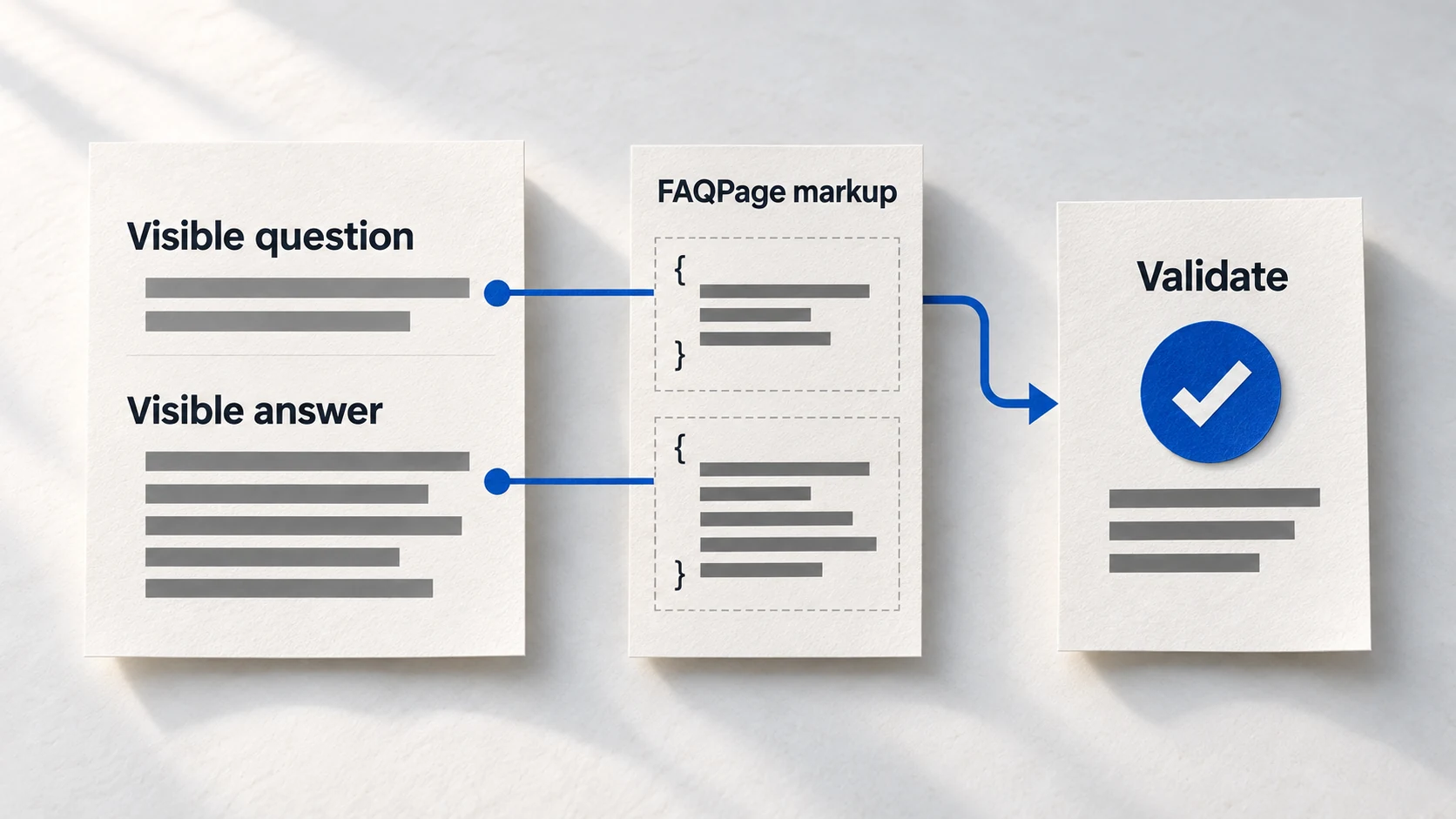
FAQPage schema is structured data markup that explicitly identifies question-answer pairs on a page. It uses the Question type (with a name property for the question) and an Answer type (with a text property for the answer) wrapped in an FAQPage container.
How FAQPage Schema Works
@type: FAQPage
Declares the page contains FAQ content.
This is the container wrapping all Q&A pairs.
mainEntity (array)
Contains one or more Question objects.
Each Question has a name (the question text) and an acceptedAnswer.
Question → name
The actual question text users are asking.
Frame as natural questions: "What is X?" not "X Definition".
Answer → text
The complete answer to that question.
Keep answers citation-sized: 2-4 sentences, 100-150 words.
Unlike Article schema (which structures the entire page) or Organization schema (which identifies an entity), FAQPage schema directly formats content in the exact structure AI uses for answering questions. It's not just metadata about your content-it's the content itself, pre-formatted for AI extraction.
Why AI Platforms Love FAQ Formats
AI platforms face a fundamental challenge: extracting concise, accurate answers from long-form content. FAQ sections solve this by pre-packaging information in question-answer units that require minimal processing.
3.2x
More likely in AI Overviews
Pages with FAQ schema appear 3.2x more often in Google AI Overviews.
Source: Frase.io →527%
YoY AI referral growth
AI referrals to top websites surged 527% year-over-year between 2024-2025.
Source: Frase.io →12.4%
of websites use structured data
Only 12.4% of websites implement any structured data-massive opportunity.
Source: Frase.io →Research from GetPassionFruit shows FAQ structured data has one of the highest citation rates in AI-generated answers, with content using FAQPage schema appearing in ChatGPT, Perplexity, and Google AI Overviews significantly more than unstructured content.
The key insight: AI platforms optimize for answering questions, not indexing pages. FAQ schema formats your content in the exact structure AI needs-question-answer pairs that can be extracted and cited without additional processing.
The Google Restriction That Created an AI Opportunity
In August 2023, Google restricted FAQ rich results to "well-known, authoritative government and health websites." Most sites lost their FAQ snippets in search results, and many SEOs stopped implementing FAQ schema entirely.
But Here's What Happened Instead
While Google limited FAQ display in traditional search, AI search platforms made FAQ the most-cited content structure. ChatGPT, Perplexity, Claude, and Google's own AI Overviews all prioritized FAQ-formatted content because it perfectly matches how users ask questions and how AI answers them.
According to QuickTop10 analysis, FAQ schema still works and remains actively supported by Google as of early 2026, with the schema markup providing SEO benefits through improved content structure and AI platform optimization-even without rich result display.
This is the GEO paradigm shift in action. Traditional SEO focused on Google's visual display (rich snippets). GEO focuses on AI consumption-how platforms extract and cite content regardless of visual presentation. FAQ schema lost its rich snippet but gained something more valuable: universal AI visibility.
How to Implement FAQPage Schema
FAQPage schema uses JSON-LD format and should be placed on any page with a visible FAQ section. Critical rule: your schema must match the visible Q&A pairs on your page exactly.
<script type="application/ld+json">
{
  "@context": "https://schema.org",
  "@type": "FAQPage",
  "mainEntity": [
    {
      "@type": "Question",
      "name": "What is Generative Engine Optimization?",
      "acceptedAnswer": {
        "@type": "Answer",
        "text": "Generative Engine Optimization (GEO) is the practice of optimizing content to be discovered, understood, and cited by AI platforms like ChatGPT, Perplexity, Claude, and Google AI Overviews. Unlike SEO which focuses on ranking in search results, GEO focuses on being cited in AI-generated answers."
      }
    },
    {
      "@type": "Question",
      "name": "How is GEO different from SEO?",
      "acceptedAnswer": {
        "@type": "Answer",
        "text": "SEO optimizes for visibility in search engine results pages (rankings). GEO optimizes for citation in AI-generated responses. SEO targets keywords and backlinks; GEO targets entity recognition, structured data, and answer-first content formatting. Both matter, but they serve different platforms with different ranking mechanisms."
      }
    },
    {
      "@type": "Question",
      "name": "Do I still need SEO if I'm doing GEO?",
      "acceptedAnswer": {
        "@type": "Answer",
        "text": "Yes. AI platforms often crawl content that ranks well in traditional search. Strong SEO improves your baseline visibility, which then feeds into GEO. Think of SEO as the foundation and GEO as the next layer-they complement each other rather than compete."
      }
    }
  ]
}
</script>
Best Practice #1
Match Schema to Visible Content Exactly
Google penalizes hidden structured data. If your page shows 5 FAQs visibly, your schema should contain those exact 5 questions and answers. If the text differs, AI sees inconsistency and may ignore the schema entirely.
Test: Copy your visible FAQ text and compare to your schema text. They should match word-for-word.
Best Practice #2
Frame Questions Naturally
Write questions as users actually ask them: "What is X?", "How do I Y?", "Why does Z happen?" Avoid heading-style phrasing like "X Definition" or "Y Overview." AI matches user queries to your questions-natural language increases match likelihood.
Good: "What's the ROI of GEO?" Bad: "GEO ROI Metrics"
Best Practice #3
Keep Answers Citation-Sized
AI prefers answers it can quote directly. Target 2-4 sentences (100-150 words). Long answers get truncated or ignored. Short answers lack sufficient context. Citation-sized answers strike the balance-complete enough to be useful, concise enough to be quotable.
According to LuccaAM research, FAQPage schema highlights Q&A sections making it easier for AI to extract question-answer pairs when answers are kept to 2-4 sentences.
Writing FAQ Sections That AI Wants to Cite
Not all FAQs are equal for AI visibility. Strategic FAQ writing focuses on answering high-value questions with citation-worthy precision.
The Citation-Worthy FAQ Formula
Research Actual Questions
Use "People Also Ask" from Google, Reddit threads, Quora topics, customer support tickets. Write answers to questions people actually ask, not questions you wish they asked.
Answer Directly in First Sentence
Don't bury the answer. First sentence = direct answer. Following sentences = context, examples, caveats. AI often extracts only the first 1-2 sentences.
Avoid pronouns (it, they, this). Repeat key terms explicitly. "GEO focuses on entity recognition" is better than "It focuses on this." AI extracts answers as standalone text-pronouns break context.
Include Verifiable Data When Possible
Answers with statistics or specific details get cited more. "FAQ schema is 3.2x more likely to appear in AI Overviews" is more citation-worthy than "FAQ schema helps visibility."
Prioritize High-Value Questions
Not every question deserves an FAQ. Focus on decision-making questions, comparison questions, and "how to" procedural questions-the types AI gets asked most.
What Kills FAQ Citation Potential
Promotional FAQ Answers
"Why choose us?" followed by marketing copy doesn't get cited. AI ignores promotional content. Answer informational questions, not sales questions.
Vague, Generic Answers
"GEO is important for visibility" lacks specificity. "GEO optimizes content for AI citations, which grew 527% YoY" is citation-worthy because it's precise.
Too Many FAQs Per Page
20+ FAQs dilute relevance. AI prioritizes pages with focused, high-quality Q&A over pages with exhaustive but generic lists. Quality > quantity.
Accordion FAQs Without Visible Text
If answers are hidden behind accordions that load on click, ensure the text is still in the HTML (just CSS-hidden). JavaScript-loaded content might not get indexed or matched to schema.
Definition
FAQPage Schema
Structured data markup that identifies question-answer pairs on a page, using the Question and Answer types wrapped in an FAQPage container. Pre-formats content in the exact structure AI platforms use for answering user queries.
FAQ
Does Google still support FAQ schema after the 2023 restrictions?
How many FAQs should I include per page?
Can I use FAQ schema on pages without visible FAQ sections?
Should FAQ answers be short or detailed?
Ready to Turn Questions Into Citations?
FAQ schema is the fastest path to AI visibility.
Discover how to structure Q&A content that AI platforms extract and cite automatically.
Take the GEO Readiness Quiz →60 seconds · Personalized report · Free
Continue Learning
Dive deeper into AI search with these related articles:
Organization Schema: The Foundation of Entity Establishment
Learn how Organization schema creates machine-readable entity profiles that AI engines use when deciding which brands to cite and recommend.
Person Schema: Building Author Authority for AI Citations
Discover how Person schema helps AI engines verify author credibility and connect expertise signals across the web for higher citation rates.
The Perfect FAQ Section for AI Visibility
Pages with FAQ schema are 3.2x more likely to appear in AI Overviews.