GEO & AI Search
How ChatGPT, Claude, and Perplexity Actually Find and Cite Content
Quick Answer
Each AI platform uses different methods to find and cite content. ChatGPT searches via Bing's index, favoring authoritative sources (Wikipedia accounts for nearly 48% of top-cited sources). Perplexity searches the live web and cites almost every claim. Claude primarily uses training data but can browse when enabled. Understanding these differences is essential for effective GEO strategy.
You publish a comprehensive guide. It ranks well on Google. But when you ask ChatGPT about the topic, your content is nowhere to be found.
Meanwhile, a competitor's site-with lower domain authority and fewer backlinks-keeps getting cited.
What's going on?
The answer lies in understanding how each AI platform actually discovers, evaluates, and chooses to cite content. And it's not the same as how Google ranks pages. Each platform has its own discovery mechanism, its own evaluation criteria, and its own citation philosophy.
This guide breaks down the citation mechanics of ChatGPT, Claude, Perplexity, and Google AI Overviews-so you can optimize for the platforms that matter to your audience. By the end, you'll understand exactly why some content gets cited while other content gets ignored.
How ChatGPT Finds and Cites Content
ChatGPT operates in two distinct modes, and understanding the difference is crucial for your GEO strategy:
Training Data Mode
How it works: Draws from pre-trained knowledge (cutoff date varies)
Citations: Rarely cites specific sources
Best for: General knowledge questions
Your opportunity: Limited-content must have been prominent before training cutoff
Browsing Mode
How it works: Searches live web via Bing index
Citations: Often includes source links
Best for: Current events, specific queries
Your opportunity: High-optimize for Bing + authority signals
Definition
The Bing Factor
When ChatGPT browses the web, it uses Bing's search index-not Google's. This means your Bing rankings directly influence your ChatGPT citation likelihood. Many marketers overlook this, focusing exclusively on Google optimization.
Seer Interactive Research (2026)
87% of SearchGPT citations match Bing's top-ranked pages
The Bing index is essentially the citation source pool for ChatGPT's web browsing mode. If you're in Bing's top results, you're a candidate for ChatGPT citations.
When ChatGPT browses, it doesn't use Google. It uses Bing's search index. This means:
- → Your Bing rankings matter more than you thought
- → Bing Webmaster Tools becomes a priority
- → Schema markup (which Bing heavily uses) gains importance
48%
of ChatGPT citations include Wikipedia
This reveals ChatGPT's strong preference for established, authoritative domains. If you can't be Wikipedia, be like Wikipedia: well-structured, factual, and authoritative.
Source: TryProfound AI Citation StudyWhat ChatGPT Looks For
Authority signals
Established domains, author credentials, institutional backing. ChatGPT favors content from sources that have proven credibility over time.
Clear, direct answers
Content that directly answers the user's question in the first paragraph. No burying the lead-the answer should be immediately accessible.
Factual accuracy
Data, statistics, and claims that can be verified. ChatGPT cross-references information across sources, so accuracy matters.
Recency
Fresh content for time-sensitive queries. Outdated content gets passed over when fresher alternatives exist.
Pro Tip
Submit your site to Bing Webmaster Tools if you haven't already. Many marketers focus exclusively on Google Search Console, missing the Bing opportunity entirely. Since ChatGPT uses Bing for browsing, your Bing visibility directly affects your AI citation chances.
How Perplexity Finds and Cites Content
Perplexity is fundamentally different from ChatGPT. It was built as a "search engine for the AI era"-citation is core to its identity, not an add-on. Every response comes with numbered references that users can click to verify.
Perplexity's Citation Philosophy
Every claim gets a numbered citation. Every source is linked. Users can verify anything the AI says with one click. This transparency makes Perplexity the most citation-friendly platform for content creators.
This makes Perplexity the most transparent AI search platform-and potentially the best opportunity for content visibility.
Perplexity's Discovery Process
How Perplexity Finds Your Content
- 1
Live Web Search
Searches the web in real-time, pulling from multiple sources simultaneously
- 2
Source Evaluation
Evaluates sources for relevance, authority, and answer quality
- 3
Citation Assignment
Each piece of information gets attributed to a specific source with a clickable number
- 4
Traffic Generation
Users click citations to verify claims, driving traffic to your site
What Perplexity Prioritizes
Direct Answers
Content that answers the specific question in the first 100 words. Perplexity extracts snippets, so front-load your key points.
Data & Statistics
Original research, surveys, and verifiable numbers. Perplexity loves citing specific data points with sources.
Structured Content
Lists, tables, and clear formatting that's easy to extract. Well-structured content is easier for AI to parse and cite.
Freshness
Recent content, especially for time-sensitive topics. Perplexity heavily weights recency for current events and evolving topics.
Pro Tip
Include specific statistics with sources in your content. Perplexity loves citing data points because they're easy to attribute. Instead of 'many marketers struggle with AI,' write 'according to a 2024 HubSpot survey, 67% of marketers report struggling with AI adoption.' The specific number with a source is citation gold.
How Claude Handles Content and Citations
Claude (by Anthropic) takes a more cautious approach to web content than its competitors. Understanding Claude's unique behavior helps you set appropriate expectations for this platform.
Claude's Default Behavior
By default, Claude relies on its training data and does not search the web. This means for most queries, it draws from knowledge acquired during training rather than live sources. This makes Claude fundamentally different from Perplexity and browsing-enabled ChatGPT.
However, Claude can be integrated with web browsing capabilities through:
- → Claude.ai with internet access (when enabled by users)
- → API integrations where developers add web search capabilities
- → Third-party tools that combine Claude with search functionality
Implications for GEO
Because Claude often doesn't browse the web, your GEO strategy for Claude is different from other platforms:
Build long-term authority
Content that was prominent and authoritative before Claude's training cutoff has the best chance of being in its knowledge base. This means SEO success today can translate to Claude recognition in future training runs.
Focus on other platforms first
ChatGPT and Perplexity offer more immediate optimization opportunities since they actively search the web.
Monitor Claude's evolution
Anthropic is continuously updating Claude's capabilities-web browsing may become more central in future versions.
Google AI Overviews: The Hybrid Approach
Google AI Overviews represent the fusion of traditional search and AI-generated answers. They appear at the top of search results, synthesizing information from multiple sources into a cohesive response.
What Makes AI Overviews Different
Unlike ChatGPT or Perplexity, Google AI Overviews are deeply integrated with Google's existing search infrastructure. This means traditional SEO factors carry significant weight-perhaps more than any other AI platform.
How AI Overviews Select Sources
Traditional Ranking Signals
E-E-A-T, backlinks, page experience-all the factors you already optimize for in SEO still matter significantly for AI Overviews.
Content Relevance
How well your content answers the specific query. AI Overviews pull from content that directly addresses the user's intent.
Source Diversity
AI Overviews often synthesize from multiple sources, so you don't need to be the only source-just one of the credible ones.
Structured Data
Schema markup helps Google understand and extract content. Well-structured data makes your content easier to include in synthesized answers.
76%
of AI-cited sources also rank in Google's top 10
This confirms that strong traditional SEO creates a foundation for AI visibility. You don't need to choose between SEO and GEO-they reinforce each other.
Source: Ahrefs Research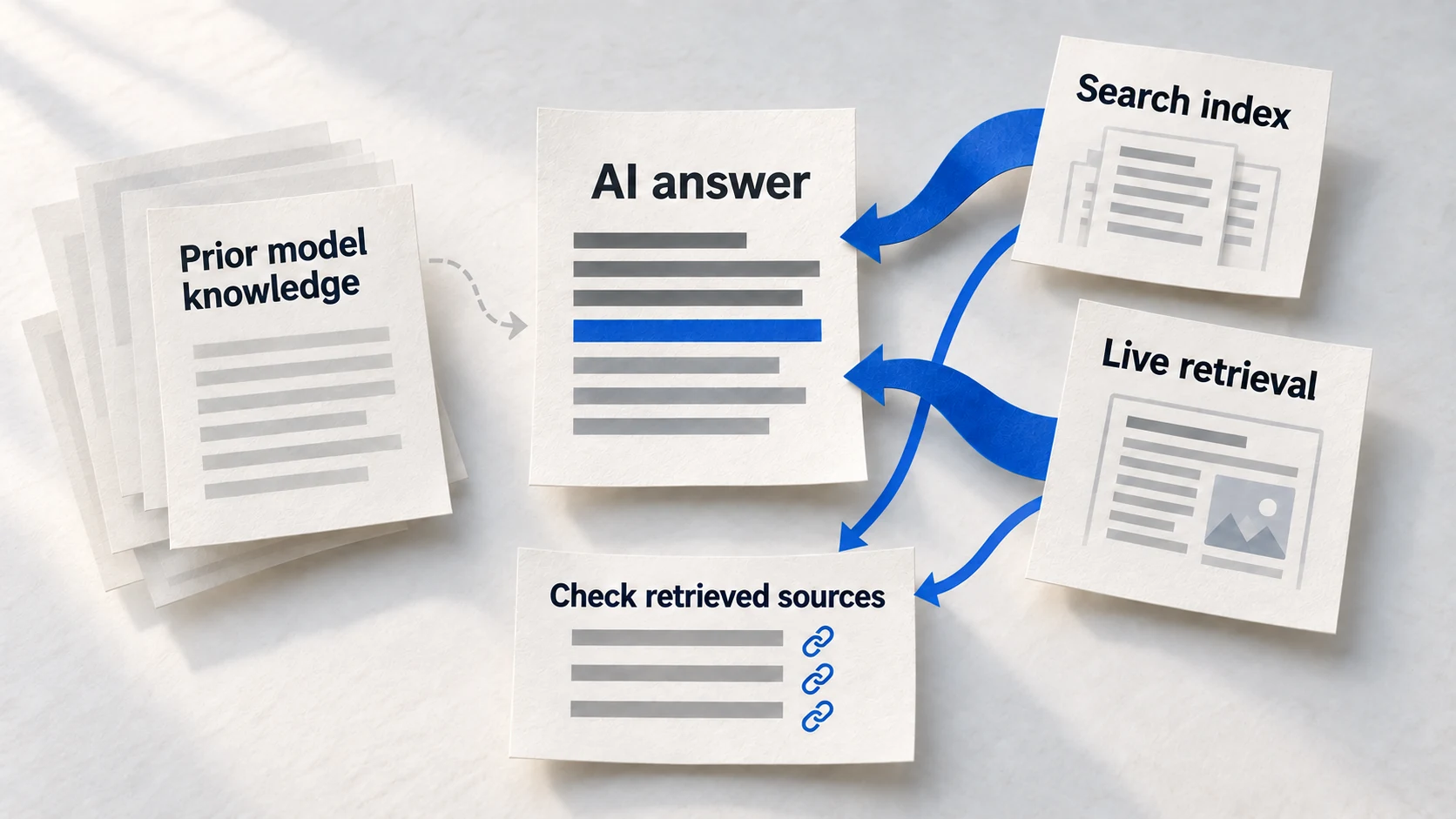
Platform-by-Platform Comparison
Here's how the four major AI platforms compare in terms of how they discover, evaluate, and cite content:
AI Platform Citation Comparison
| Feature | ChatGPT | Perplexity | Claude | Google AI Overviews |
|---|---|---|---|---|
| Discovery Method | Bing Index (browsing mode) | Live web search | Training data (primarily) | Google's search index |
| Citation Style | Occasional inline links | Numbered references for every claim | Rarely cites specific sources | Source cards with links |
| Citation Transparency | Medium | Very High | Low | High |
| Update Frequency | Real-time (browsing mode) | Real-time | Training cutoff | Real-time |
| SEO Overlap | Moderate (via Bing) | Moderate | High (long-term) | Very High |
| Best Optimization Approach | Bing SEO + Authority | Answer-first + Statistics | Long-term authority building | Traditional SEO + Structure |
Building a Multi-Platform GEO Strategy
Given these different citation mechanisms, how do you optimize for all platforms simultaneously? The answer is to start with universal principles that work everywhere, then layer platform-specific optimizations.
Universal Principles (All Platforms)
- → Answer-first content structure-Put the key answer in the first 100 words. Every platform prioritizes content that directly addresses the query.
- → Clear, extractable formatting-Lists, tables, and defined sections. AI can only cite what it can parse.
- → Authority signals-Author credentials, citations, institutional backing. Every platform favors credible sources.
- → Schema markup-Article, FAQ, HowTo schemas help AI understand your content and increase citation likelihood.
- → Original data and research-Unique insights that can't be found elsewhere. This is the ultimate differentiator.
Platform-Specific Optimizations
| Platform | Priority Focus | Key Optimization |
|---|---|---|
| ChatGPT | Bing visibility, authority | Optimize for Bing, build domain authority, submit to Bing Webmaster Tools |
| Perplexity | Direct answers, data | Answer-first format, original statistics with sources, structured data |
| Claude | Long-term authority | Build enduring reputation, strong E-E-A-T signals, monitor updates |
| Google AI Overviews | Traditional SEO + structure | E-E-A-T optimization, schema markup, top 10 rankings |
Key Takeaways
FAQ
How does ChatGPT find content to cite?
What's the difference between how Perplexity and ChatGPT cite sources?
Does ranking high on Google help with AI citations?
How can I optimize content for multiple AI platforms?
Which AI platform should I prioritize for GEO?
Can I guarantee my content will be cited by AI?
Ready to Get Cited by AI?
Understanding how AI finds content is step one. Implementing a strategy is step two.
I've built a system to help brands go from invisible to cited in AI responses. But before I share it with you, I want you to see exactly where you stand.
Take the GEO Readiness Quiz →60 seconds · Personalized report · Free
Continue Learning
Dive deeper into AI search with these related articles:
How ChatGPT Decides What to Cite (And What to Ignore)
Ever wondered why ChatGPT cites some websites and ignores others? Learn the citation mechanics and how to increase your chances of being cited.
Perplexity vs ChatGPT: Different Engines, Different Optimization
Perplexity cites Reddit 46.7% of the time. ChatGPT cites Wikipedia 47.9%. Learn platform-specific strategies.
GEO vs AEO vs SEO: The Complete Guide to AI Search Optimization
Confused by GEO, AEO, and SEO? This guide explains the differences, when to use each, and how they work together. No jargon, just clarity.