GEO & AI Search
Trust Signals for AI: Security, Transparency, and Credibility
Quick Answer
Trust signals for AI engines include security indicators (HTTPS, privacy policies), transparency markers (clear authorship, source citations, contact information), and credibility validators (third-party mentions, schema verification, consistent entity data). AI engines cross-reference these signals before citing your content. Sites lacking basic trust infrastructure rarely get cited, regardless of content quality.
You've optimized your content. You've built expertise signals. Your E-E-A-T looks solid. But there's a checkbox you might be missing: does your site look trustworthy to a machine that can't read facial expressions or sense sincerity?
AI engines evaluate trust differently than humans. They can't gauge your intentions. They can't tell if you're being honest. What they can do is check verifiable signals: Is your site secure? Are your claims sourced? Can your identity be cross-referenced?
Trust is the "T" in E-E-A-T-and for AI engines, it's the most programmatically verifiable component. Here's what actually builds machine trust.
Definition
Trust Signals
Verifiable indicators-security certificates, transparency markers, third-party validation-that help AI engines assess whether a source is reliable enough to cite.
What Are Trust Signals for AI?
Trust signals are verifiable indicators that help AI engines assess whether a source is reliable enough to cite. Unlike expertise or authority, which require interpretation, trust signals are often binary: present or absent, valid or invalid.
Security
Technical indicators that your site is safe: HTTPS, privacy policies, secure data handling.
Transparency
Openness about who you are, where your information comes from, and how to contact you.
Credibility
Third-party validation: mentions on authoritative sites, consistent information across platforms.
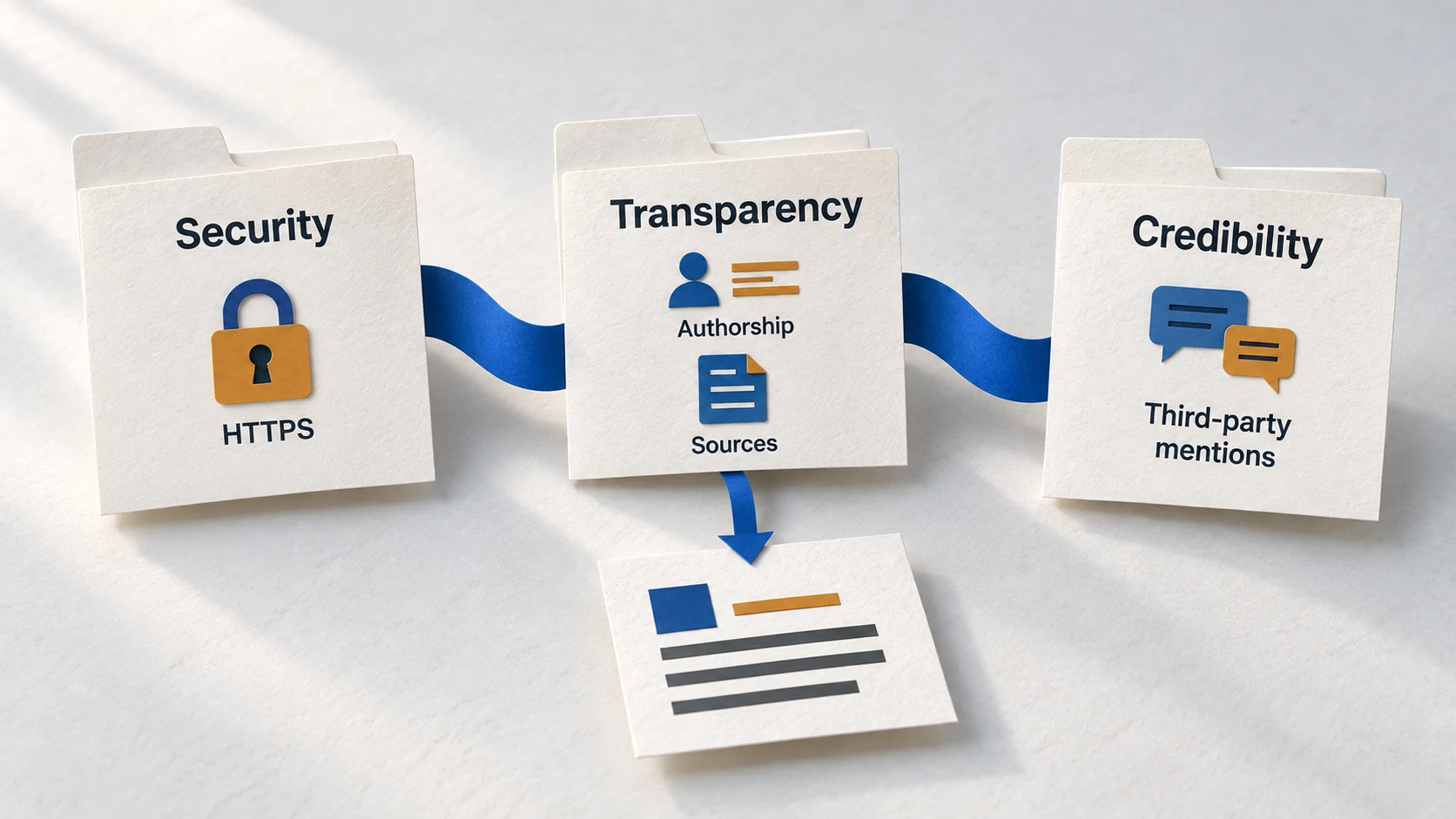
AI engines don't evaluate trust holistically the way humans do. They check specific, verifiable data points. If those data points are missing or inconsistent, your content becomes a citation risk-and AI systems are risk-averse by design.
Security Signals: HTTPS, Privacy, and Technical Trust
Security signals are the foundation. Without them, other trust signals don't matter because AI engines may not consider your content at all.
Security Signal Checklist
HTTPS everywhere
Valid SSL certificate on all pages, not just checkout. Mixed content warnings are red flags.
Privacy policy
Clear, accessible privacy policy that explains data collection practices. Boilerplate is fine-absence is not.
Terms of service
Demonstrates legitimate business operation. Especially important for sites offering products or services.
No malware or suspicious scripts
AI engines inherit blocklists from their data sources. Flagged sites don't get cited.
These aren't differentiators-they're disqualifiers. Missing HTTPS doesn't make you slightly less trustworthy; it can exclude you from consideration entirely. AI systems are trained on data where security signals correlate strongly with legitimacy.
Transparency Signals: Showing Your Work
Transparency signals demonstrate you have nothing to hide. They make it easy for both humans and AI to verify who you are and where your information comes from.
Clear Authorship
Every piece of content should have an identifiable author with a linked bio page. Anonymous content is a trust red flag.
Implementation: Author name + link to About page with credentials, experience, and contact information.
Source Citations
Claims backed by citations to reputable sources are more trustworthy than unsourced assertions.
Implementation: Link to primary sources for statistics and significant claims. Name the source, don't just hyperlink.
Contact Information
A real business has real contact information. A contact form alone isn't enough.
Implementation: Physical address (if applicable), phone number, email address, and social profiles.
Editorial Standards
For content sites, editorial policies signal commitment to accuracy and accountability.
Implementation: Editorial guidelines page explaining fact-checking process, corrections policy, and content standards.
AthenaHQ research emphasizes that "answer engines synthesize information from multiple sources to deliver direct, conversational responses." When your content lacks transparency signals, AI engines can't verify your claims against other sources-making citation risky.
Credibility Signals: Third-Party Validation
Credibility signals come from outside your site. They're harder to fake because they require other entities to validate your trustworthiness.
Consistent Entity Information
When your business name, address, and details match across your website, Google Business Profile, LinkedIn, and other platforms, AI engines can verify your entity exists and is legitimate.
Mentions on Authoritative Sites
When trusted sources reference your brand or content, that creates a credibility signal AI engines can detect. Press mentions, industry recognition, and third-party reviews all contribute.
Schema Verification
Properly implemented schema markup provides machine-readable trust signals. Organization, Person, and Article schemas with sameAs properties create verifiable connections between your identity claims.
Review and Rating Signals
Customer reviews on Google, Trustpilot, and industry-specific platforms provide credibility signals that AI engines can cross-reference when evaluating your trustworthiness.
Research Finding
85% of AI-cited sources exhibit 3+ E-E-A-T signals
According to Agenxus research, the vast majority of content cited by AI engines demonstrates multiple E-E-A-T signals. Trust signals aren't optional-they're table stakes for citation consideration.
The Trust Audit Checklist
Use this checklist to audit your site's trust signals. Each item is binary-either present or absent. The goal is 100% completion on the essentials.
Essential Trust Signals (Non-Negotiable)
Enhanced Trust Signals (Differentiators)
Trust signals are the most verifiable component of E-E-A-T for AI engines. While expertise and authority require interpretation, trust signals are largely binary: HTTPS is either valid or not, your contact information either exists or doesn't, your entity data either matches across platforms or contradicts itself.
Start with the essentials checklist. Every site should have HTTPS, a privacy policy, clear authorship, and real contact information. Then add the differentiators: schema markup, editorial policies, and cross-platform entity consistency. Each signal you add reduces the citation risk AI engines perceive-and increases your likelihood of being cited.
FAQ
Does HTTPS really matter for AI citations?
How do AI engines verify claims in my content?
Can small businesses compete on trust signals with large brands?
How important is schema markup for trust?
Does Your Site Pass the AI Trust Audit?
Great content isn't enough if trust signals are missing. Find out which boxes you're checking-and which you're not.
I've built a system to help brands go from invisible to cited in AI responses. But before I share it with you, I want you to see exactly where you stand.
Take the GEO Readiness Quiz →60 seconds · Personalized report · Free
Continue Learning
Dive deeper into AI search with these related articles:
E-E-A-T in the AI Era: How to Build Machine Trust
85% of AI-cited sources show strong E-E-A-T signals. Learn how to build Experience, Expertise, Authoritativeness, and Trust that AI engines recognize.
Building Expertise Signals That AI Engines Trust
AI engines evaluate expertise through demonstrated knowledge, topical depth, and verifiable credentials.
Authority Building in the AI Era: Beyond Backlinks
Backlinks aren't enough anymore. Learn the authority signals AI engines actually prioritize.