GEO & AI Search
Authority Building in the AI Era: Beyond Backlinks
Quick Answer
Authority in AI search goes beyond backlinks to include brand mentions, entity consistency, earned media, and digital PR. While backlinks still matter for traditional SEO, AI engines prioritize different signals: unlinked brand mentions on authoritative sites, consistent entity information across platforms, and recognition from industry publications and experts. Building AI authority requires a diversified approach that traditional link building alone can't achieve.
You've spent years building backlinks. Thousands of referring domains. Strong Domain Authority. Your link profile would make most SEOs envious. But when you test AI search, your competitors with half your backlinks are getting cited more often.
What's happening? AI engines don't count backlinks the way search engines do. They evaluate authority through different signals-signals you may not be building.
This isn't about abandoning backlinks. It's about understanding that authority in the AI era requires a broader strategy. Here's what actually moves the needle for AI citation.
Do Backlinks Still Matter for AI Search?
Yes-but not in the way you might expect. Backlinks influence AI visibility primarily through two indirect channels:
Google Signal Inheritance
Many AI systems, including ChatGPT via Bing, use Google's ranking signals as inputs. Your backlink-driven SEO performance can influence what AI engines "see" as authoritative.
Training Data Quality
Highly-linked content was more likely to be included in AI training data. But this is backward-looking-new AI training increasingly values recency and relevance over link metrics.
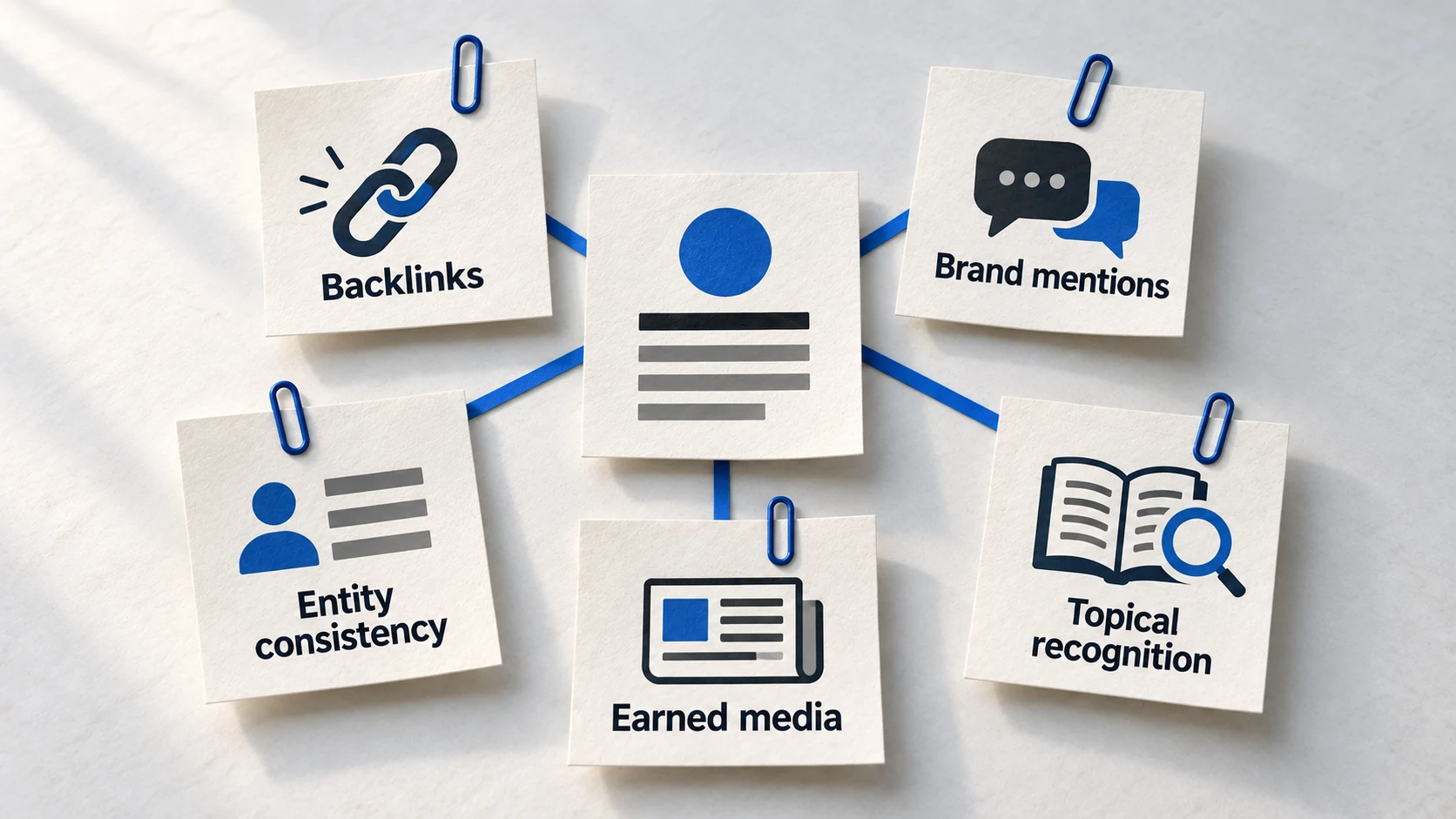
ALLMA SEO research puts it directly: "Beyond Backlinks in 2025, the new 'digital PR' is getting AI systems to mention and cite your brand as an authoritative source." When ChatGPT or Perplexity references your brand, that's considered the modern equivalent of a front-page newspaper mention.
The shift is significant: traditional SEO metrics like Domain Authority and Domain Rating are less predictive of AI citation success. What AI engines care about is whether you're a recognized authority in your space-and they measure that differently than Google's PageRank algorithm ever did.
Brand Mentions: The New Authority Currency
AI engines process language, not hyperlinks. When they encounter "according to [YourBrand]" or "[YourBrand] recommends" in their training data or retrieval sources, that builds authority-whether or not there's an HTML link attached.
Research Finding
95% of AI-cited links are unpaid, 89% from earned media
According to Muck Rack 2025 research, over 95% of links cited in generative AI answers are unpaid, with 89% specifically from earned media sources. This isn't about buying links-it's about earning mentions.
What makes brand mentions powerful for AI authority:
They're harder to manufacture
You can buy backlinks (though you shouldn't). You can't easily buy genuine brand mentions in trusted publications. This scarcity makes them more valuable as authority signals.
They appear in natural language
AI engines parse text, not link graphs. Brand mentions in sentences-"experts like [YourBrand] recommend..."-create authority signals in exactly the format AI systems understand.
They create context associations
When your brand is consistently mentioned alongside a topic, AI systems learn the association. This is how you become "the GEO experts" or "the schema markup authority" in AI's training and retrieval.
Entity Consistency: Building Recognition Across Platforms
AI engines build authority profiles by aggregating signals across platforms. If your brand information is inconsistent-different names, descriptions, or details across websites-that fragmentation weakens your authority signal. (For a complete guide, see entity optimization.)
Entity Consistency Checklist
Consistent brand name
Same spelling, capitalization, and formatting everywhere (not "YourBrand" on one site and "Your Brand Inc." on another)
Consistent descriptions
Similar language about what you do across LinkedIn, Google Business, website, and directory listings
Consistent NAP data (Name, Address, Phone)
Exact match contact information across all business listings and profiles
Connected sameAs links
Organization schema with sameAs properties linking to all official profiles
Verified profiles
Verified Google Business, LinkedIn Company page, and industry-specific profiles
Entity consistency creates a verifiable web of authority signals. When AI engines encounter your brand in one place, they can cross-reference with your presence elsewhere. Each consistent signal reinforces the others; inconsistencies create doubt and dilute authority.
Digital PR for AI Visibility
Digital PR isn't just about getting links anymore-it's about getting mentioned as an authority in the sources that AI engines trust. This requires a shift in strategy from link acquisition to authority positioning.
Pro Tip
AI engines weight recent expert commentary heavily. One quote in a 2024 industry article can outweigh 10 old backlinks for AI citation likelihood.
Expert Commentary
Being quoted as an expert source in news articles and industry publications creates high-value authority signals.
Tactic: Use HARO, Featured, and direct journalist relationships to provide expert quotes on trending topics in your field.
Original Research
Publishing original data studies creates citeable authority that both journalists and AI systems reference.
Tactic: Conduct surveys, analyze industry data, or publish case studies with specific metrics that others can cite.
Thought Leadership
Guest articles in respected publications position you as a voice worth citing in your field.
Tactic: Pitch bylined articles to industry publications. Focus on providing unique insights, not promotional content.
Industry Recognition
Awards, rankings, and "best of" list features create third-party authority validation.
Tactic: Apply for relevant industry awards. Submit to "top X in [your field]" lists. Document recognition on your site.
The PR-to-AI Pipeline
When you're quoted in Search Engine Journal, that quote becomes part of AI training data and retrieval sources. When Perplexity or ChatGPT needs an expert perspective on your topic, it draws from those mentions. The PR investment compounds: today's media mention becomes tomorrow's AI citation.
The 5 Authority Signals AI Engines Prioritize
Before You Start
- ✓ Complete entity home (About page)
- ✓ Consistent NAP across platforms
- ✓ Basic schema markup implemented
- ✓ At least one verifiable credential
Based on ALLMA SEO's research into what AI engines actually prioritize, these five signals represent the new foundation of digital authority:
Question
Which authority signal should you prioritize first?
Start with Entity Establishment
Foundation first
Focus on Digital PR
Build external signals
Optimize for AI platforms
Platform-specific strategies
Start with Entity Establishment
Foundation first
Focus on Digital PR
Build external signals
Optimize for AI platforms
Platform-specific strategies
Consistent, High-Quality Content
Content that demonstrates genuine expertise through specific examples, technical accuracy, and depth. AI engines detect the difference between surface-level content and genuine expertise.
Brand Mentions & AI Citations
When AI systems reference your brand in answers, it creates direct exposure and reinforces authority. Each mention compounds-AI systems learn from their own outputs.
Semantic Richness & Entity Recognition
AI maps relationships between concepts and entities. Use of relevant terminology, mention of related entities, and comprehensive topical coverage signal authoritative knowledge.
Structured Data Implementation
Schema markup signals professionalism and helps AI understand relationships between information. Organization, Person, Article, and FAQ schemas are foundational.
Multi-Platform Presence
Consistent contributions across LinkedIn, industry forums, and professional platforms create a web of authority signals. Multi-platform presence captures authority that single-site analysis could never measure.
Backlink Research (2026)
Sites with 32,000+ referring domains see 3.5x higher AI citation rates
Authority thresholds matter: there's a non-linear jump in AI citation likelihood once a domain crosses the 32K referring domains threshold. Building broad backlink authority is still valuable-just not for the reason traditional SEO taught us.
2010
Backlinks Era
Link quantity dominated authority signals
2020
E-A-T Focus
Expertise, Authority, Trust became central
2024
AI Citation Signals
Entity verification and expert commentary drive AI visibility
Authority in the AI era isn't about link counts-it's about being recognized as a trusted voice in your space. Backlinks still matter, but they're not enough. Brand mentions, entity consistency, and earned media create authority signals that directly influence AI citation decisions.
Start with an entity audit: is your brand information consistent across all platforms? Then invest in digital PR that creates brand mentions, not just backlinks. Finally, build multi-platform presence that establishes you as a recognized authority in your specific niche. The compounding effect of these signals is what positions you for sustainable AI visibility.
FAQ
Should I stop building backlinks entirely?
What's the difference between a backlink and a brand mention?
How long does it take to build authority for AI citations?
Can small businesses compete on authority with large brands?
Are Backlinks Enough for Your AI Visibility?
You've built the links. Now find out if AI engines see your authority-or if you're missing the signals that actually matter.
I've built a system to help brands go from invisible to cited in AI responses. But before I share it with you, I want you to see exactly where you stand.
Take the GEO Readiness Quiz →60 seconds · Personalized report · Free
Continue Learning
Dive deeper into AI search with these related articles:
E-E-A-T in the AI Era: How to Build Machine Trust
85% of AI-cited sources show strong E-E-A-T signals. Learn how to build Experience, Expertise, Authoritativeness, and Trust that AI engines recognize.
Building Expertise Signals That AI Engines Trust
AI engines evaluate expertise through demonstrated knowledge, topical depth, and verifiable credentials.
The Experience Signal: Proving First-Hand Knowledge to AI
AI engines prioritize content from people who've actually done the work. Learn how to demonstrate first-hand experience.