GEO & AI Search
Answer-First Writing: How to Structure Content AI Wants to Cite
Quick Answer
Answer-first writing places the direct answer to a question immediately after the heading, before any context, background, or elaboration. This structure-also called inverted pyramid-gives AI engines extractable content for citations. Research shows 72.4% of AI-cited blog posts include clear "answer capsules" that AI can pull and attribute.
Your article has the perfect answer. Thorough research, expert insight, practical advice. But it's buried in paragraph four, after three paragraphs of context-setting and background explanation.
AI engines don't dig. They scan. When your answer is buried, they either cite someone else whose answer is immediately accessible-or they synthesize their own response without citing anyone at all.
Answer-first writing isn't about dumbing down content. It's about reorganizing it so both AI engines and human readers get what they need without hunting for it.
Definition
Answer Capsule
A self-contained, 40-60 word response that directly answers a question-based heading. Answer capsules can be extracted and understood without any surrounding context, making them ideal for AI citation.
What Is Answer-First Writing?
Answer-first writing is a content structure where the direct answer to a question appears immediately after the question-based heading-before any context, backstory, or elaboration.
❌ Traditional Structure
H2: What is GEO?
Before we dive into GEO, it's important to understand the evolution of search. For decades, SEO has been the primary way websites attract organic traffic. However, with the rise of AI tools like ChatGPT and Perplexity, the landscape is changing. These platforms synthesize information differently than traditional search engines...
[Answer finally appears in paragraph 3 or later]
✓ Answer-First Structure
H2: What is GEO?
GEO (Generative Engine Optimization) is the practice of optimizing content to appear as sources and citations in AI-generated responses from platforms like ChatGPT, Perplexity, and Google AI Overviews.
[Context and elaboration follow]
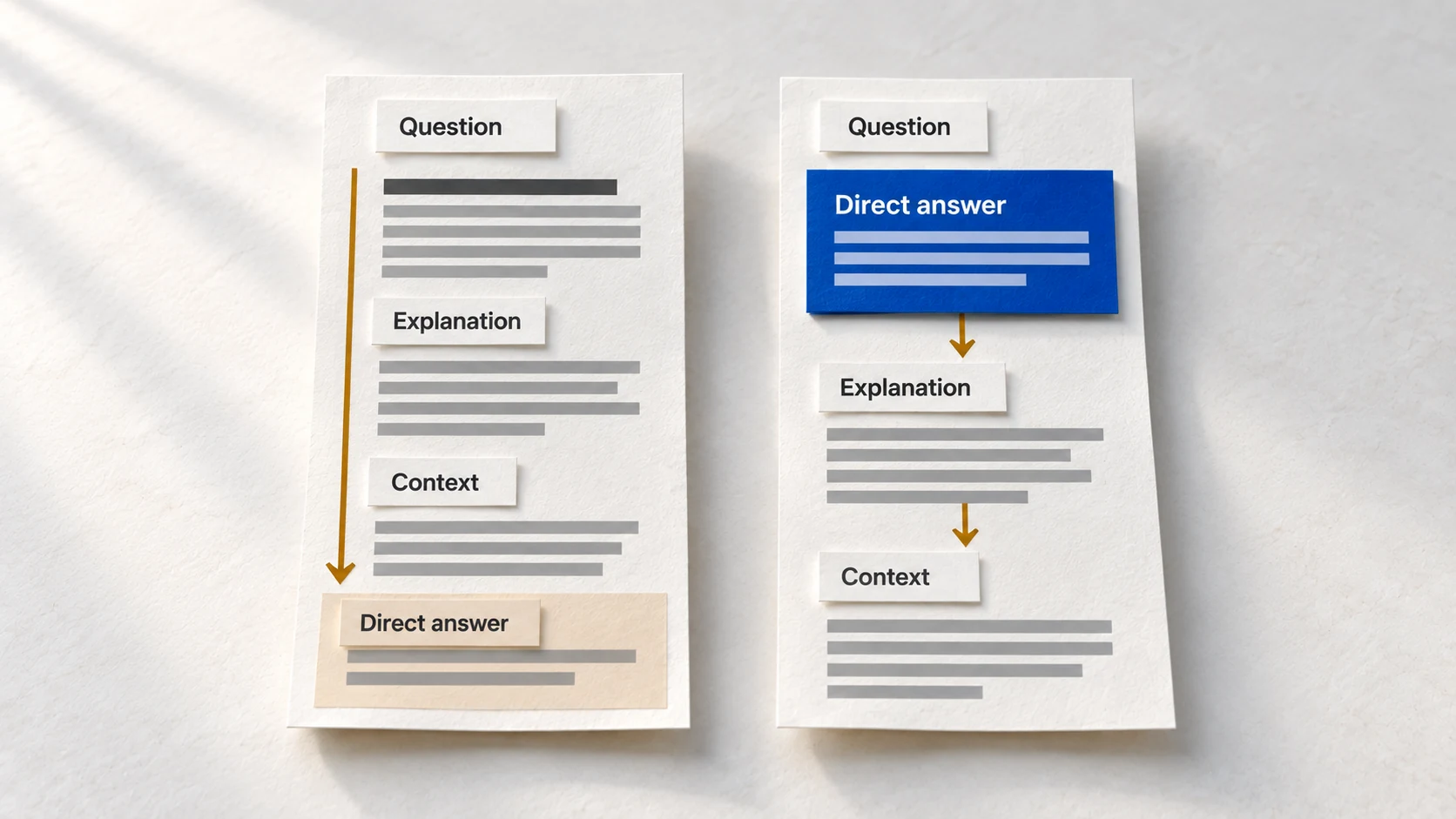
The inverted pyramid structure-used by journalists for a century-puts the most important information first. Answer-first applies this principle specifically to question-based content, making answers immediately extractable. This is one component of the complete content structuring framework for AI visibility.
Why AI Engines Prefer Answer-First Content
AI engines don't process content the way humans read articles. They scan for relevant, extractable information that directly answers user queries.
Research Finding
72.4% of AI-cited blog posts include answer capsules
According to Search Engine Land research, the vast majority of content cited by AI engines includes identifiable "answer capsules"-concise, self-contained answers immediately following question-based headings.
AI processes content in chunks
AI engines don't read whole pages sequentially. They identify relevant sections by heading, then evaluate the content immediately following. If the answer isn't there, they move on.
Position correlates with citation likelihood
StoryChief research confirms: "AI systems are more likely to retrieve information that appears early in content." Key takeaways placed at the end often get missed.
Self-contained answers are easier to attribute
When AI cites a source, it needs a clean excerpt. Answer capsules provide exactly that-a complete thought that can be extracted without losing meaning or requiring context from surrounding paragraphs.
StoryChief's GEO research found that only 12% of URLs cited by ChatGPT, Perplexity, and Copilot appear in Google's top 10 results. Traditional SEO ranking doesn't guarantee AI citation-but content structure does influence it.
The Answer Capsule Formula
An answer capsule is a self-contained response that directly addresses the question posed by the heading. It should work as a complete answer even if removed from the surrounding content.
Answer Capsule Requirements
Direct Response
Answers the heading question without preamble. No "Before we discuss..." or "To understand this..."
Self-Contained
Makes sense when extracted alone. No pronouns referring to previous content ("it," "they," "this approach").
Concise
40-60 words or 120-150 characters. Long enough to be complete, short enough for clean extraction.
Immediately Following Heading
First paragraph after H2/H3. No introductory text, context-setting, or "warming up" to the answer.
Understanding how AI engines find content helps explain why answer capsules work. AI systems extract passages based on heading-content matching.
Answer Capsule Example
❌ Before (Buried Answer):
"When considering schema markup for your website, there are many options to choose from. Different schemas serve different purposes, and the right choice depends on your content type and goals. For most businesses looking to improve their AI visibility, the most impactful option is..."
✓ After (Answer Capsule):
"FAQPage schema is the most impactful schema type for AI visibility. It structures question-answer pairs in a machine-readable format that AI engines can directly extract and cite. Implementation is straightforward and works for any content with Q&A elements."
Content Structure Patterns That Get Cited
Beyond answer capsules, certain structural patterns make content more likely to be extracted and cited by AI engines.
Q&A Format
Question-based headings followed by direct answers. Highest semantic relevance to user queries.
Pattern: "What is [X]?" → Direct definition → Elaboration
Numbered Lists
Sequential steps or ranked items. AI engines can extract individual items or the complete list.
Pattern: "How to [X]: 5 Steps" → Numbered sequence with clear step descriptions
Definition Boxes
Clearly delineated definitions for key terms. AI can extract and cite these as authoritative definitions.
Pattern: Highlighted/boxed text with "[Term]: [Definition]" structure
Comparison Tables
Side-by-side comparisons of options, features, or approaches. Highly structured and extractable.
Pattern: HTML table with clear headers and consistent data structure
Pairing these structural patterns with proper schema markup amplifies their effectiveness for AI extraction.
Paragraph Design for AI Extraction
60-100
words per paragraph
15-20
words per sentence
1
idea per paragraph
According to StoryChief: "To make your content citation-ready for LLMs, aim for short, structured paragraphs-about 60–100 words each. That's enough space to explain a single idea with clarity."
Common Structure Mistakes That Block Citations
These structural patterns reduce your chances of AI citation-even when your content is accurate and comprehensive.
❌ Long Introductions Before Answers
Three paragraphs of context before the actual answer. By then, AI has moved to another source.
Fix: Lead with the answer. Move context to the second or third paragraph.
❌ Ambiguous Pronouns
"It helps with this" or "They recommend that approach." AI can't extract these sentences because they depend on previous context.
Fix: Use specific nouns. "Schema markup helps with entity recognition." "Google recommends the answer-first approach."
❌ Dense Prose Paragraphs
200+ word paragraphs with multiple ideas. AI struggles to extract clean, attributable content from these walls of text.
Fix: Break into 60-100 word paragraphs. One idea per paragraph. Use lists and bullet points.
❌ Key Information at the End
Building to a conclusion with the main insight in the final paragraph. AI engines weight early content more heavily.
Fix: BLUF (Bottom Line Up Front). State your conclusion first, then explain how you got there.
❌ Headings That Don't Match Content
Heading says "What is GEO?" but the section discusses the history of SEO first. AI matches headings to queries-mismatches cause citation failures.
Fix: First paragraph must directly address the heading. Related but different content goes in separate sections.
Answer-first writing isn't about sacrificing depth for accessibility. It's about restructuring content so the most important information-the answer-is immediately accessible to both human readers and AI engines.
Start by auditing your existing content. Find sections where the answer is buried and restructure them with answer capsules. Then apply the principle to new content: write your answer first, make it self-contained, and keep paragraphs focused on single ideas. The result is content that's both more readable and more citable.
FAQ
Does answer-first writing hurt engagement metrics?
How long should an answer capsule be?
Should every section start with an answer?
What about storytelling and building suspense?
Is Your Content Structured for AI Citation?
Answer-first is just one structural pattern. Find out if your complete content architecture is AI-ready.
I've built a system to help brands go from invisible to cited in AI responses. But before I share it with you, I want you to see exactly where you stand.
Take the GEO Readiness Quiz →60 seconds · Personalized report · Free
Continue Learning
Dive deeper into AI search with these related articles:
The Content Marketer's Guide to Getting Cited by AI
72.4% of AI-cited content includes answer capsules. Learn the content traits that make AI engines cite your work.
How ChatGPT Decides What to Cite (And What to Ignore)
Ever wondered why ChatGPT cites some websites and ignores others? Learn the citation mechanics and how to increase your chances of being cited.
E-E-A-T in the AI Era: How to Build Machine Trust
85% of AI-cited sources show strong E-E-A-T signals. Learn how to build Experience, Expertise, Authoritativeness, and Trust that AI engines recognize.