GEO & AI Search
The Zero-Click Reality: Why Your Traffic Is Down 40% (And What To Do About It)
Quick Answer
Your traffic is declining because 80% of searchers now get answers without clicking any links. But here's what matters: traffic volume is no longer the metric that predicts success. Companies like NerdWallet grew revenue 37% while losing 20% of their traffic. The game has shifted from quantity to quality.
You pull up your analytics dashboard. Rankings: stable. Keywords: holding position. Technical health: green across the board.
Then you see the traffic graph. Down 40%.
You double-check the date range. You verify the tracking code. You run it against Search Console data.
The numbers are real.
Your instinct is to panic. Your next instinct is to start an SEO audit. But before you tear apart your website looking for problems that don't exist, you need to understand what's actually happening.
You're not experiencing a ranking drop. You're experiencing the zero-click reality-a fundamental shift in how people consume information online. And surprisingly, this shift might actually be good for your business.
What Zero-Click Search Actually Means
Zero-click search is exactly what it sounds like: users get their answer without clicking through to any website.
They type a question. The answer appears directly on the results page. They leave satisfied-having never visited a single website.
80%
of Searchers
rely on zero-click results
Source: Bain
15-25%
Traffic Decline
across industries despite stable rankings
Source: Bain
25.11%
of All Google Searches
show AI Overviews (doubled since March 2025); 47%+ for informational queries
Source: Authoritas/BrightEdge, March 2026
This isn't a temporary glitch. This is the new architecture of search.
Where Zero-Click Answers Come From
- Google AI Overviews: Synthesized answers at the top of search results
- Featured Snippets: Extracted answers from web pages (position zero)
- Knowledge Panels: Entity information pulled from Google's database
- ChatGPT & Perplexity: AI-generated answers that bypass search entirely
- Voice Assistants: Spoken answers from Siri, Alexa, and Google Assistant
Think of it this way: Traditional search was like a shopping mall directory-it pointed you to the right store, and you had to walk there. Zero-click search is like having a personal shopper who brings you exactly what you need at the entrance. More convenient for shoppers, but the stores inside see fewer visitors.
The question isn't how to get more mall traffic. It's how to be the brand the personal shopper recommends.
80%
of searchers now rely on zero-click results
This isn't a temporary trend-it's the new architecture of how people find information online.
Source: Bain Research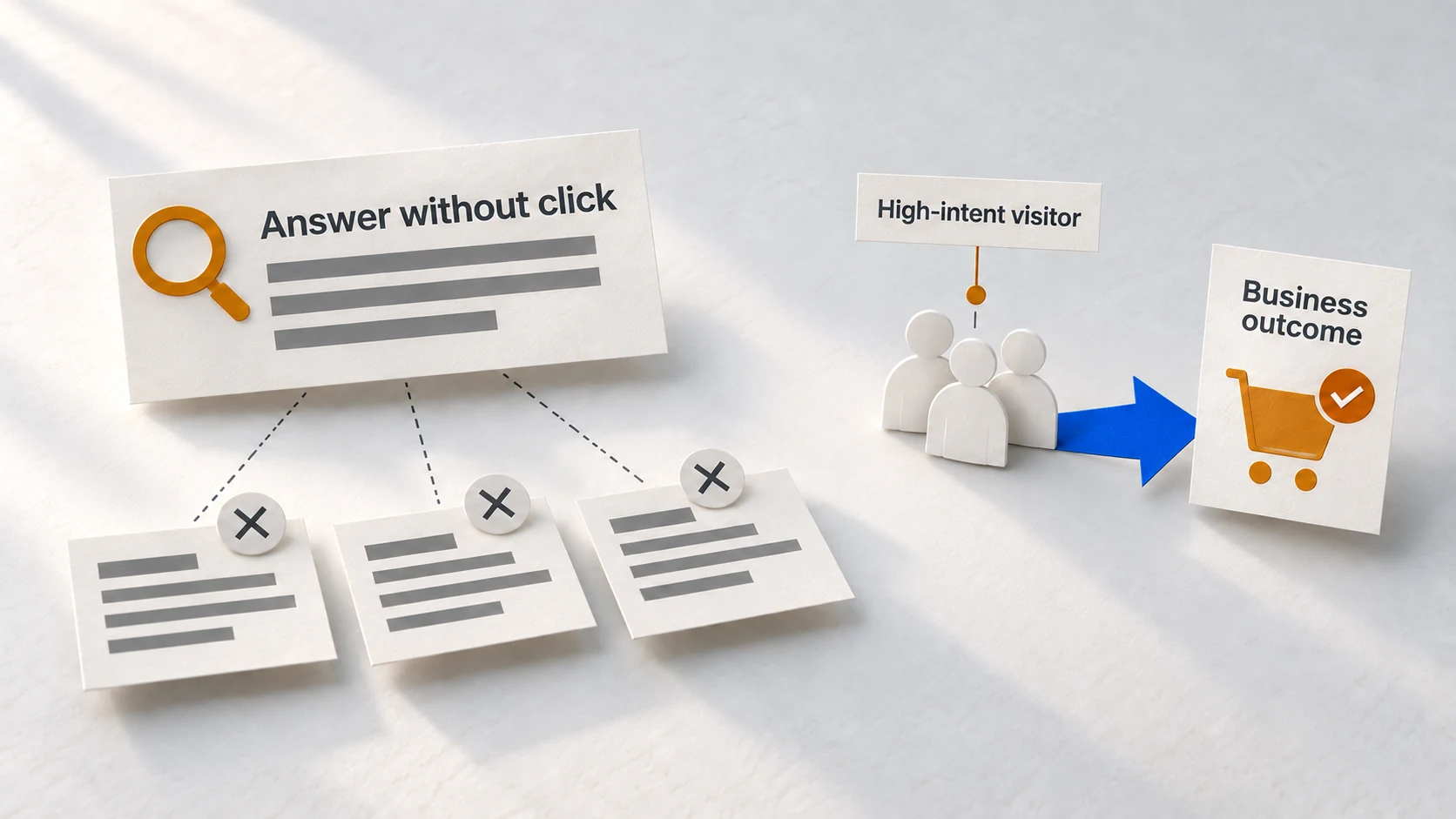
The Counterintuitive Truth: Why Less Traffic Can Mean More Revenue
Before you spiral into despair over your declining traffic, consider this:
Case Study
NerdWallet: 37% Revenue Growth Despite 20% Traffic Decline
In 2024, NerdWallet experienced the same traffic decline hitting most content-heavy websites. Their organic traffic dropped approximately 20%. Many would call this a catastrophe.
Instead, their revenue grew 37%.
How? They shifted focus from traffic volume to traffic quality. They optimized for visitors who convert, not visitors who browse. The result: fewer visitors, but each visitor was worth significantly more.
Source: NerdWallet Investor Relations →The lesson: Traffic is a vanity metric. Revenue is what matters.
Old Mindset vs New Reality
| Metric | Traditional Approach | Zero-Click Era |
|---|---|---|
| Strategy | Chase maximum traffic | Attract qualified visitors |
| Keywords | Target high-volume terms | Target high-intent queries |
| Success Metric | More visitors | Right visitors |
| Conversion Rate | 1-2% | 8-15% |
| Result (10K vs 2K visits) | 100-200 conversions | 160-300 conversions |
The math is simple: 200 highly-qualified AI referrals often outperform 1,000 generic organic visits in terms of actual business outcomes.
Why? Because someone who asks ChatGPT "what's the best project management tool for remote teams under 50 people" and gets referred to your site has extremely high intent. They're not browsing. They're ready to buy.
Measuring What Actually Matters Now
If traffic is no longer the primary success metric, what is? Here's the new measurement framework:
Metric #1
Revenue Per Visitor (RPV)
Instead of tracking total visitors, track how much each visitor is worth. If your traffic drops 30% but your RPV increases 50%, you're winning.
Calculate: Total Revenue ÷ Total Visitors = RPV
Metric #2
AI Citation Frequency
How often are AI tools citing your content? This is the new "ranking" for the AI era. Being cited by ChatGPT, Perplexity, or Google AI Overviews delivers visitors with exceptional intent.
Track: Manually query AI tools with your target topics. Monitor referral traffic from AI sources in GA4.
Metric #3
Conversion Rate by Source
Segment your conversions by traffic source. You'll likely find that AI referral traffic converts at 3-5x the rate of generic organic traffic.
Compare: Organic Search CR vs. AI Referral CR vs. Direct CR
How to Explain This to Your Boss
When your traffic report looks scary, reframe the conversation:
- Acknowledge the change: "Yes, traffic is down 25%-this is an industry-wide shift, not a problem with our site."
- Show the quality shift: "But our conversion rate increased from 2% to 4.5%, meaning each visitor is worth more."
- Present the business outcome: "Net result: revenue is up 12% despite lower traffic."
- Explain the strategy: "We're optimizing for AI visibility to attract higher-intent visitors."
Practical Steps: How to Thrive in the Zero-Click Era
Accepting the zero-click reality is step one. Adapting to it is where the real work begins. Here's your action plan:
Your Zero-Click Era Action Plan
- 1
Optimize for AI Citations
Structure content for AI extraction and citation
- 2
Update Your Metrics
Track revenue per visitor, not just traffic volume
- 3
Treat Visibility as Advertising
Brand mentions in AI build awareness
- 4
Target Complex Queries
Focus on high-intent topics AI can't summarize
Optimize for AI Citations, Not Just Rankings
Being cited by ChatGPT, Perplexity, and Google AI Overviews is the new SEO goal. This means:
- • Structure content with clear, direct answers (answer-first format)
- • Build entity authority so AI recognizes your brand as credible
- • Use schema markup to help AI understand your content
Shift from Traffic Metrics to Business Metrics
Update your reporting dashboards to focus on what matters:
- • Track revenue per visitor, not just total visitors
- • Monitor conversion rates by traffic source
- • Measure AI referral traffic separately
Treat Zero-Click Visibility as Brand Advertising
Even when users don't click, they see your brand mentioned in AI answers. This is valuable:
- • Brand mentions in AI responses build awareness
- • Being cited positions you as an authority
- • Users who see you cited may search for you directly later
Focus on High-Intent, Complex Queries
Simple questions get zero-click answers. Complex, nuanced topics still drive traffic:
- • Target queries that require depth and expertise
- • Create content AI can't fully summarize in one answer
- • Offer tools, calculators, and interactive elements
Key Takeaways
- → 80% of searchers now get answers without clicking-this is the new normal, not a temporary trend.
- → Traffic decline doesn't mean failure. NerdWallet grew revenue 37% while losing 20% of traffic.
- → Quality beats quantity. 200 high-intent AI referrals often outperform 1,000 generic organic visits.
- → Optimize for AI citations. Being recommended by ChatGPT and Perplexity is the new ranking goal.
- → Update your metrics. Track revenue per visitor, conversion by source, and AI citation frequency.
FAQ
What is zero-click search?
Why is my traffic down if my rankings haven't changed?
Can you still succeed with declining traffic?
How do I explain traffic decline to stakeholders?
Ready to Win in Zero-Click Search?
Traffic is declining, but business doesn't have to. The brands that adapt now will dominate AI visibility for years. Find out where you stand.
I've built a system to help brands go from invisible to cited in AI responses. But before I share it with you, I want you to see exactly where you stand.
Take the GEO Readiness Quiz →60 seconds · Personalized report · Free
Continue Learning
Dive deeper into AI search with these related articles:
Case Study: How NerdWallet Grew Revenue 37% Despite Traffic Decline
NerdWallet lost 20% of organic traffic but grew revenue 37%. Here's exactly how they did it and what you can learn.
The Quality vs Quantity Shift: Why 200 AI Referrals Beat 1,000 Organic Visits
AI referral traffic converts 4.4x better than traditional organic. Learn why quality trumps quantity in AI search.
How to Explain Traffic Decline to Your Boss (With Template)
Your traffic is down but your business isn't. Here's exactly how to explain the AI search shift to stakeholders.