GEO & AI Search
Semantic Specificity: Why 'It' and 'They' Kill Your AI Citations
Quick Answer
Semantic specificity means using explicit nouns instead of pronouns like "it," "they," "this," and "that"-especially at the start of sentences. AI engines extract sentences and paragraphs in isolation. When those extractions start with pronouns, they become meaningless without context and get skipped for citation. Self-contained sentences with specific subjects get cited.
You learned in school that pronouns make writing flow. "Don't repeat yourself. Use 'it' and 'they' to avoid redundancy." That advice made perfect sense for human readers who track context across paragraphs.
AI engines don't read that way.
When ChatGPT, Perplexity, or Google AI Overviews pull a sentence from your content, that sentence must stand alone. A sentence starting with "It improves conversion rates by 40%" means nothing without the previous sentence explaining what "it" refers to. So AI skips it-and cites your competitor who wrote "Schema markup improves conversion rates by 40%" instead.
Definition
Semantic Specificity
The practice of using explicit, specific nouns instead of pronouns or vague references-particularly at sentence starts. Semantically specific sentences can be extracted and understood in isolation, making them ideal for AI citation.
What Is Semantic Specificity?
Semantic specificity is the practice of using explicit, specific nouns instead of pronouns or vague references-particularly at sentence starts and in passages you want AI engines to extract and cite.
Key Principle
Every sentence should make sense when read in isolation.
If you extract any sentence from your content, could a reader understand it without reading the sentences before or after? If not, that sentence is not citation-ready.
Low Specificity (Uncitable)
"It helps improve search visibility."
"They recommend implementing it early."
"This approach works for most websites."
"That strategy increases engagement."
High Specificity (Citable)
"FAQ schema markup helps improve search visibility."
"Google's documentation recommends implementing schema early."
"Answer-first content structure works for most websites."
"The question-based heading strategy increases engagement."
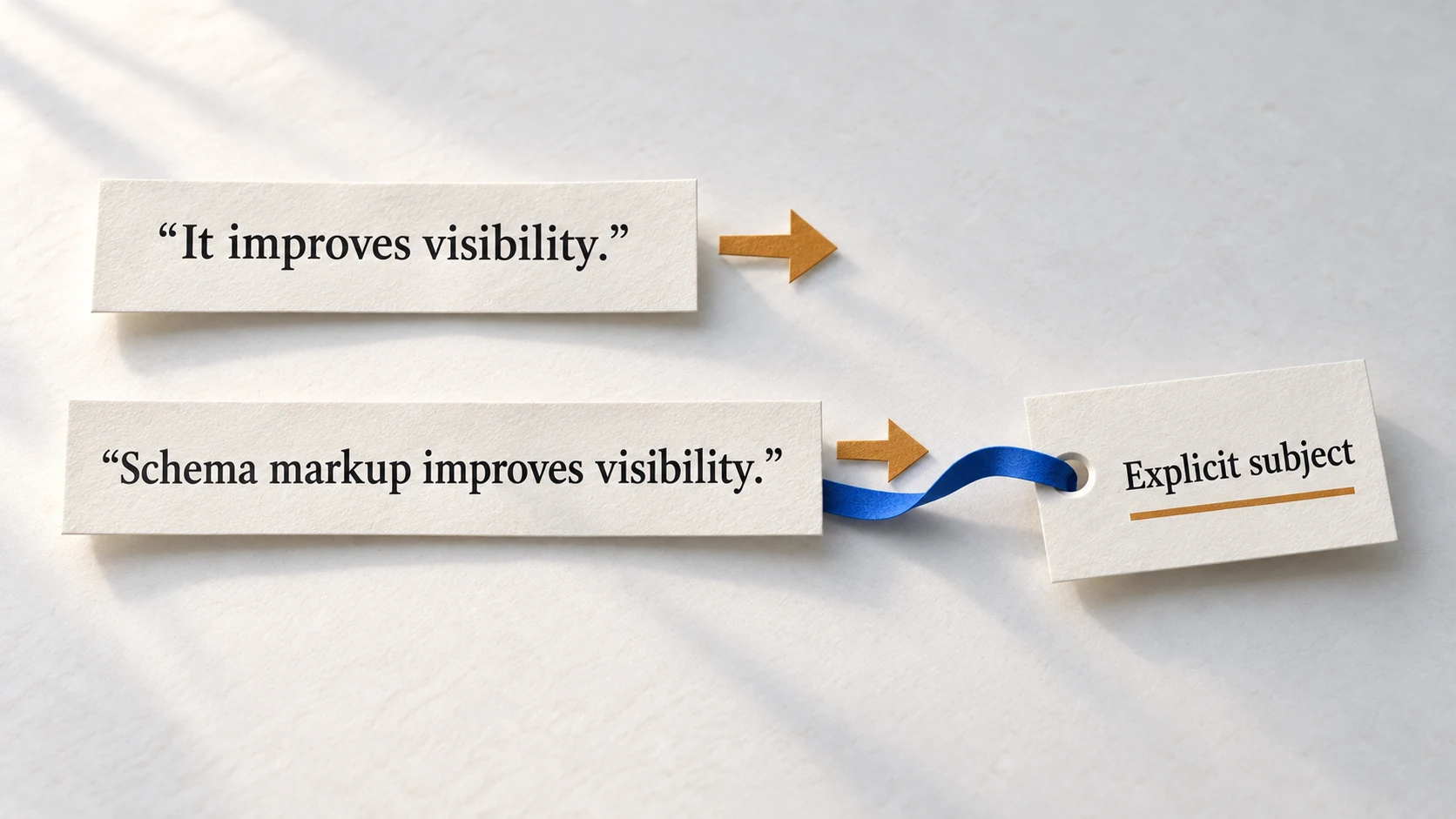
The high-specificity versions can be extracted, understood, and cited without any surrounding context. The low-specificity versions require readers (or AI) to know what "it" and "they" refer to-information that's lost during extraction. This principle applies across all AI-optimized content structures.
Why Pronouns Block AI Citations
AI engines don't read content the way humans do. They extract relevant passages-sentences, paragraphs, or structured blocks-and evaluate whether those passages can answer user queries on their own.
Research Finding
AI models prioritize extractable, clearly-sourced content with minimal ambiguity
According to Animalz research on answer engine citation techniques, replacing leading "this/that/it/they" with specific nouns is a core requirement for AI visibility-especially at sentence starts.
AI extracts, not reads
AI engines identify passages that match user intent, pull those passages from the page, and evaluate them independently. Context from surrounding paragraphs doesn't transfer to the extraction.
Pronouns create dependency
Sentences starting with "It," "This," "They," or "That" depend on previous sentences for meaning. When extracted alone, those sentences become semantic orphans-understood only by readers who have the context.
AI skips ambiguous content
When AI encounters a pronoun-heavy passage, it either misinterprets the meaning or skips to clearer content. Competitors with self-contained sentences get cited instead.
This isn't about AI being limited-it's about how retrieval systems work. AI must be able to quote your content accurately, and accuracy requires clarity about what subjects and objects are being discussed.
The Pronoun Audit Framework
Use this systematic approach to identify and fix citation-blocking pronouns in your existing content.
Priority 1: Sentence Starters
Sentence-starting pronouns are the biggest citation blockers. Fix these first:
Pronoun Audit Checklist
Search for sentence-starting pronouns: Find all instances of "It," "This," "They," "That," "These," and "Those" at sentence beginnings.
Test extraction: Copy each flagged sentence alone. Does it make sense without context? If not, it needs fixing.
Identify the referent: What does the pronoun actually refer to? That's what should replace it.
Rewrite with specificity: Replace the pronoun with the specific noun, tool name, concept name, or entity.
Re-test extraction: Read the revised sentence alone. Does it now stand independently? If yes, it's citation-ready.
Prioritize content you most want AI to cite: opening paragraphs, key insight sections, answer capsules after headings, and FAQ answers. Internal paragraph flow can remain natural-focus your pronoun fixes on extractable passages.
Before and After: Real Transformations
These examples show how small pronoun changes transform uncitable content into citation-ready passages.
Before: Pronoun-Dependent
"Schema markup is essential for AI search optimization. It helps search engines understand your content better. They can then match your pages to relevant queries. This leads to higher visibility in AI-generated answers."
After: Self-Contained
"Schema markup is essential for AI search optimization. Schema markup helps search engines understand your content better. Search engines with schema context can then match your pages to relevant queries. Enhanced content understanding leads to higher visibility in AI-generated answers."
Before: Ambiguous References
"Google recommends using FAQ schema for informational content. It creates rich results in search. They appear as expandable dropdowns. This format increases click-through rates."
After: Entity-Clear
"Google recommends using FAQ schema for informational content. FAQ schema markup creates rich results in search. FAQ rich results appear as expandable dropdowns. The expandable FAQ format increases click-through rates."
Search Engine Land research shows that pages with paragraph-length summaries at the top-written with high semantic specificity-achieve 35% higher inclusion in AI-generated snippets.
Writing Self-Contained Sentences
Beyond pronoun replacement, self-contained writing involves crafting sentences that deliver complete meaning independently.
Name entities explicitly
Use full names for tools, platforms, and concepts. Don't assume context.
Instead of: "The platform recommends..."
Write: "ChatGPT's documentation recommends..."
Include context in claims
Data points need their subject explicitly stated.
Instead of: "It increased by 40%."
Write: "AI referral traffic increased by 40%."
Repeat key terms strategically
Restate important concepts at the start of sentences where they matter.
Instead of: "This is why it matters."
Write: "Semantic specificity matters because..."
Avoid "experts say" without attribution
Vague authorities are as bad as pronouns. Name sources.
Instead of: "Experts recommend..."
Write: "Google's Search Quality guidelines recommend..."
The Extraction Test
Before publishing, apply this test to your most important sentences:
- Copy the sentence into a blank document
- Read it with no surrounding context
- Ask: "What is the subject? What is the claim? What is the source?"
- If any answer is unclear, rewrite with explicit specificity
- Repeat until the sentence stands alone completely
Semantic specificity isn't about abandoning good writing principles. It's about adapting those principles for how AI engines actually process and cite content. The same clarity that helps AI extract your content also helps human readers scan and understand faster.
Start with your highest-value content: opening paragraphs, answer capsules after headings, FAQ answers, and key insight sections. Run the pronoun audit, apply the extraction test, and transform context-dependent sentences into self-contained, citable passages.
FAQ
Does replacing all pronouns make writing robotic?
How often should I repeat specific nouns?
Which pronouns cause the most problems?
Do AI engines actually penalize pronoun use?
Is Your Content Self-Contained Enough for AI?
Pronouns are just one citation killer. Find out if your full content architecture passes the AI extraction test.
I've built a system to help brands go from invisible to cited in AI responses. But before I share it with you, I want you to see exactly where you stand.
Take the GEO Readiness Quiz →60 seconds · Personalized report · Free
Continue Learning
Dive deeper into AI search with these related articles:
The Content Marketer's Guide to Getting Cited by AI
72.4% of AI-cited content includes answer capsules. Learn the content traits that make AI engines cite your work.
Answer-First Writing: How to Structure Content AI Wants to Cite
72.4% of AI-cited blog posts use answer capsules. Learn the answer-first writing structure.
How ChatGPT Decides What to Cite (And What to Ignore)
Ever wondered why ChatGPT cites some websites and ignores others? Learn the citation mechanics and how to increase your chances of being cited.