GEO & AI Search
GEO Portfolio Building: Projects That Prove Your Skills
Quick Answer
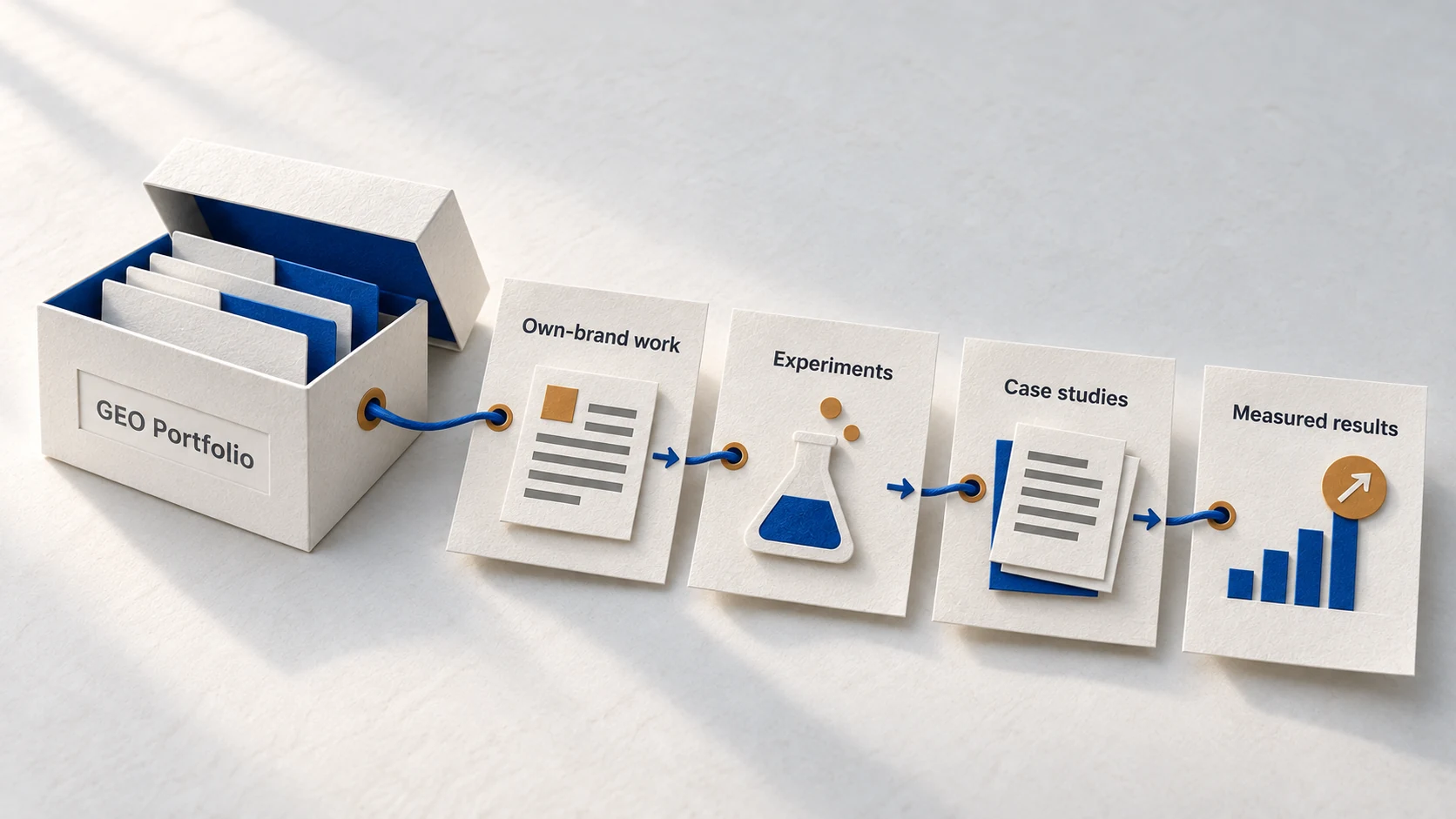
A strong GEO portfolio demonstrates real results, not theoretical knowledge. Start by optimizing your own brand for AI visibility, then document experiments and create case studies. Clients check your own AI visibility before trusting you with theirs. Aim for 4-6 detailed projects showing entity optimization, content restructuring, citation engineering, and measurable visibility improvements.
Here's the uncomfortable truth about breaking into GEO: clients will search for you in ChatGPT before hiring you.
According to Writesonic's agency research, when offering GEO services, clients may check your own AI visibility before trusting you with theirs. If you're invisible when someone asks "Who's the best GEO consultant?"-why would they believe you can make them visible?
Here's how to build a GEO portfolio that proves you know what you're doing.
Definition
GEO Portfolio
A collection of documented projects demonstrating your ability to improve AI search visibility. Unlike traditional SEO portfolios focused on rankings, GEO portfolios prove you can get content cited by ChatGPT, Perplexity, Claude, and AI Overviews.
Start With Your Own Visibility
The most credible GEO portfolio starts with you. Before you can help clients, demonstrate you can help yourself.
Your Personal GEO Project
Turn your own website into your first case study:
- Baseline your current visibility: Test queries related to your expertise across ChatGPT, Perplexity, Claude, and Google AI Overviews. Document where you appear (or don't).
- Implement GEO optimizations: Schema markup, entity consistency, answer capsule content, citation engineering through guest posts and mentions.
- Track improvements: Re-test the same queries monthly. Document any new citations.
- Create the case study: Before/after metrics, specific changes made, timeline to results.
| Metric | Before GEO | After GEO | Notes |
|---|---|---|---|
| ChatGPT citations | 0 across 20 queries | 4 citations | Which queries, what content |
| Perplexity mentions | 1 mention | 7 mentions | Types of queries triggering |
| AI referral traffic | 23 visits/month | 187 visits/month | GA4 tracking setup |
| Schema implementation | None | Organization, Person, FAQ | Rich Results Test passed |
Portfolio Project Types
Based on Superlines' agency playbook, build your portfolio around these project types:
1. Entity Optimization Project
Demonstrates you understand how AI engines identify and trust brands.
- Entity audit: Document inconsistencies across web presence
- Schema implementation: Before/after technical changes
- Knowledge Graph impact: Changes in how AI describes the brand
- Measurement: Entity recognition improvements in AI queries
Example outcome: "Implemented Organization and Person schema, connected 12 brand profiles via sameAs properties. AI engines now correctly identify the brand."
2. Content Restructuring Project
Shows you can transform existing content into AI-friendly format.
- Content audit: Identify pages with citation potential but poor structure
- Answer capsule additions: Before/after content samples
- Semantic specificity improvements: Pronoun elimination, self-contained sentences
- Results: Citation frequency changes
Example outcome: "Restructured 15 top-performing blog posts with answer capsules. Citation rate increased from 2 AI mentions to 11 within 60 days."
3. Citation Engineering Project
Proves you can build authority signals that AI engines trust.
- Authority gap analysis: Where competitors get cited, client doesn't
- Earned media strategy: Guest posts, expert contributions, PR placements
- Third-party optimization: Directory listings, review profiles
- Results: New citations from authoritative sources
Example outcome: "Placed expert contributions in 4 industry publications. Brand now appears in Perplexity recommendations for competitive queries."
4. Visibility Improvement Project
The comprehensive case study showing measurable business impact.
- Baseline metrics: Starting AI visibility across platforms
- Multi-tactic implementation: Combination of above approaches
- Timeline documentation: When changes were made, when results appeared
- Business impact: Traffic, leads, revenue attributed to AI visibility
Creating Experiments as Portfolio Pieces
According to Foundation Inc's research, GEO methods can boost source visibility by up to 40%. Document your experiments to prove you can achieve similar results.
Experiment Framework
- Hypothesis: "Adding answer capsules to blog posts will increase AI citations."
- Test setup: Control group (unchanged posts) vs. treatment group (optimized posts)
- Variables measured: Citation frequency, AI referral traffic, specific queries
- Timeline: How long to run the experiment
- Results: What happened, with specific numbers
- Learnings: What would you do differently?
Sample Experiment: Answer Capsule Impact
Hypothesis: Adding self-contained answer capsules (120-150 characters) immediately after question-based headings will increase AI citation probability.
Test: Selected 10 blog posts with question-based headings. Added answer capsules to 5 (treatment), left 5 unchanged (control).
Results (60 days):
- Treatment group: 3 posts cited at least once (60%)
- Control group: 1 post cited (20%)
- Citation frequency: Treatment averaged 2.1 citations, Control averaged 0.4
Learning: Answer capsules work, but placement matters. Capsules at the top of posts performed better than those buried in content.
Publishing Your GEO Thinking
"Agencies that speak clearly about AI Search, publish their thinking and show real results position themselves as credible partners."
Content to Publish
- Case studies: Full documentation of projects
- Experiments: What you tested and learned
- Practical tips: Techniques from your GEO playbook
- Industry analysis: Your perspective on trends
- Tool reviews: GEO tools you've tested
Where to Publish
- Personal blog: Full case studies, experiments (builds entity authority)
- LinkedIn: Short insights, results snippets (AI indexes profiles)
- Industry publications: Guest posts (builds third-party citations)
- Reddit/communities: Helpful answers (Perplexity heavily cites Reddit)
Portfolio Presentation
Portfolio Page Structure
- Summary: Brief overview of your GEO expertise and approach
- Featured case study: Your strongest, most detailed project
- Project gallery: 4-6 additional projects with key metrics
- Skills demonstration: Specific capabilities with evidence
- Experiment library: Published learnings and insights
| Case Study Section | What to Include |
|---|---|
| Challenge | Starting visibility, specific problems, business context |
| Approach | Strategy, specific tactics used, implementation timeline |
| Implementation | Technical details, content changes, citation engineering steps |
| Results | Metrics before/after, timeline to see improvements |
| Learnings | What worked best, what you'd do differently, surprises |
Building Without Paid Clients
If you don't have GEO clients yet, you can still build a credible portfolio:
Pro Bono Projects
Offer free GEO audits or optimization to:
- Non-profits in industries you understand
- Local businesses needing AI visibility
- Startups willing to be case studies
- Industry associations or communities
Personal Projects
- Your own website: Full GEO optimization with documented results
- Side projects: Niche sites you can optimize and track
- Content experiments: A/B tests you run and publish
Competitive Analysis
Create valuable analysis without client work:
- Analyze how top brands in an industry perform in AI search
- Document what makes certain sources get cited
- Publish insights about platform-specific citation patterns
FAQ
How do I build a GEO portfolio without clients?
What makes a strong GEO case study?
How many GEO projects should be in my portfolio?
Should I share my GEO experiments publicly?
Ready to Prove Your GEO Expertise?
Your portfolio is your proof. Clients will search for you in AI engines before hiring you-make sure they find you.
Take this 60-second quiz to see where you stand in AI visibility. Then start building your portfolio with a clear baseline.
Take the GEO Readiness Quiz →60 seconds · Personalized report · Free
Continue Learning
Dive deeper into AI search with these related articles:
Training Your Team on GEO: Agency Leader's Guide
GEO methods can boost source visibility by up to 40%. Train your team on entity optimization and citation engineering.
Agency Owner's Playbook: GEO Services and Premium Rates
Add GEO services to your agency. Learn what to offer, how to price, and how to deliver results for AI search optimization.
7 SEO Skills That Transfer to GEO (And 3 That Don't)
Your SEO expertise isn't wasted. Learn exactly which skills carry over to GEO and which need updating.