GEO & AI Search
7 SEO Skills That Transfer Directly to GEO (And 3 That Don't)
Quick Answer
Seven core SEO skills transfer directly to GEO: intent analysis, content structure, E-E-A-T signals, technical foundations, authority building, user experience, and analytics thinking. Three skills don't transfer: exact-match keyword stuffing, meta tag manipulation, and link quantity over quality. Research shows brands ranking on Google's first page appear in ChatGPT answers 62% of the time-which means your SEO foundation gives you a significant head start, but the 38% gap is exactly why GEO skills matter.
You've spent years building SEO expertise. You understand how search engines think, how to structure content, how to earn authority in your space. And now AI search is here, and you're wondering: does any of that still matter?
Here's what most people don't realize. The SEO professionals who are panicking about GEO are usually the ones who haven't yet recognized how much of their expertise applies directly to this new landscape. The fundamentals haven't changed-what's changed is how those fundamentals get applied.
As Search Engine Land puts it: "GEO isn't the death of SEO. It's what happens when search becomes multi-platform, multi-modal, and powered by AI." The game is the same. Some of the skills are new. Let me walk you through exactly what transfers and what needs to evolve.
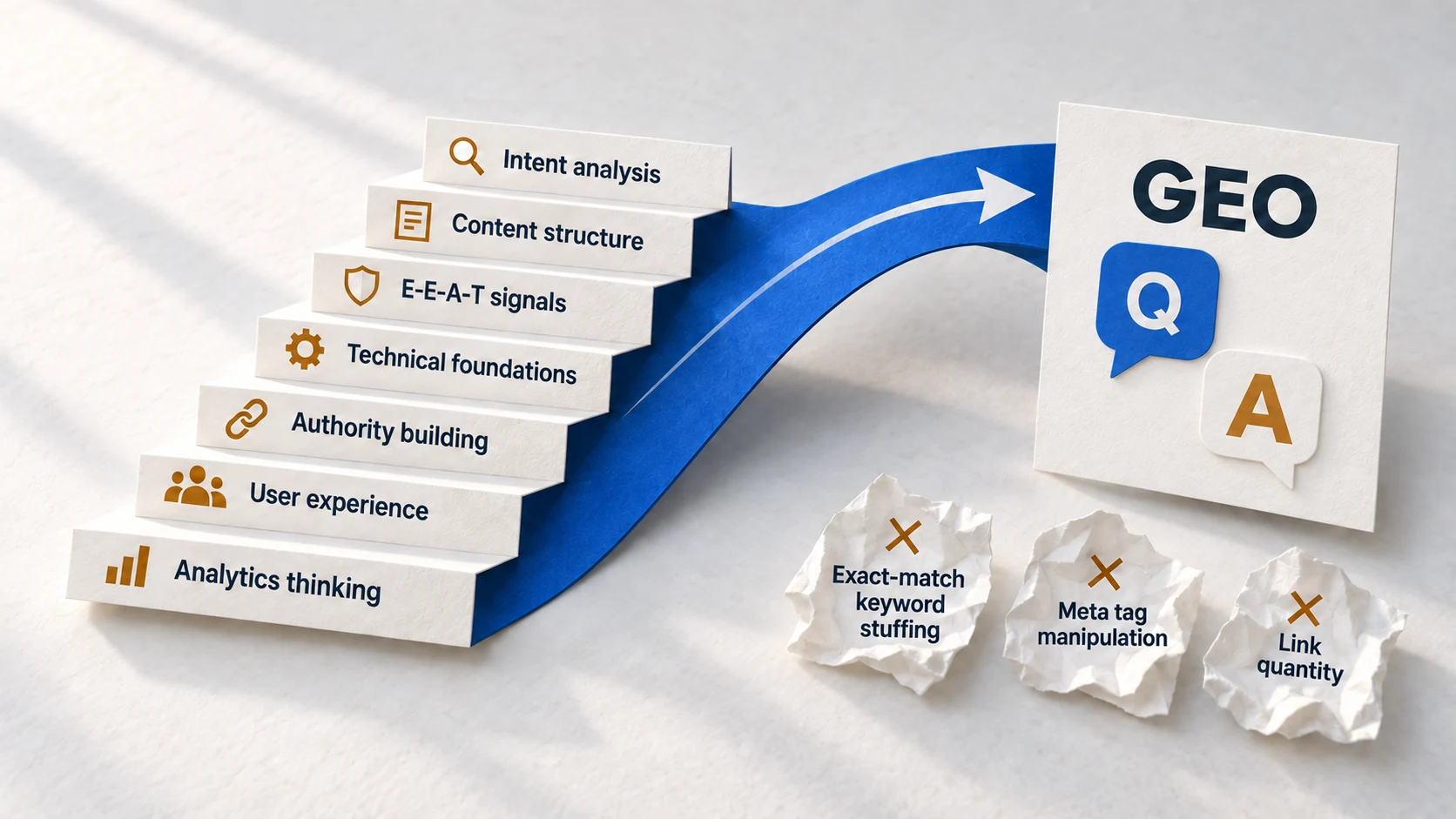
The Seven Skills That Transfer Directly
If you've been doing SEO for any length of time, you already have most of what you need. Here's why each of these skills matters just as much-and often more-in the AI search era.
User Intent Analysis
Understanding what users actually want-not just what they type-has always been the heart of good SEO. That doesn't change with AI search. If anything, it matters more.
When someone asks ChatGPT "what's the best CRM for a small business," they're not looking for a keyword match. They're looking for a thoughtful recommendation from someone who understands their situation. Your ability to read between the lines, to understand the real question behind the surface question-that's exactly what AI search rewards.
The GEO adaptation: Instead of analyzing keyword modifiers, you're now mapping the full range of questions your audience asks AI engines. Same skill, broader application.
Content Structure & Formatting
Your H1-H2-H3 hierarchy skills? Still critical. Clear heading structures, logical flow, proper formatting-all of this transfers directly.
The difference is that AI engines don't just use your structure as a ranking signal-they extract answers directly from it. When you write a clear heading followed by a direct answer, that's exactly what AI engines pull into their responses. The structure you've been building for Google becomes the source material for AI citations.
The GEO adaptation: Answer-first structure. Put your main point up front, then explain. AI engines are scanning for extractable answers, not building to a climax.
E-E-A-T Signals
Experience, Expertise, Authoritativeness, and Trust-these matter even more for AI search than they did for traditional SEO. And here's why: AI engines are trying to recommend sources, not just rank pages.
Think about it from the AI's perspective. It's going to cite something in its answer. Would it rather cite a generic content mill, or a recognized expert with verifiable credentials? Wikipedia accounts for nearly 48% of ChatGPT's top-cited sources-and that's pure E-E-A-T in action.
The GEO adaptation: Author bios, schema markup, and verifiable credentials become non-negotiable. Not nice-to-have-essential.
Technical Foundations
Site speed, crawlability, mobile optimization-all still critical. Here's the connection most people miss: AI engines like ChatGPT and Perplexity don't crawl the web themselves. They pull from existing search indexes. If Google can't crawl your content, AI can't cite it.
Your technical SEO foundation is literally the gateway to AI visibility. A well-structured, fast-loading, properly indexed site gives AI engines something to work with. A technically broken site is invisible to them entirely.
The GEO adaptation: Schema markup becomes significantly more important. It's how you tell AI engines exactly what your content means-not just what it says.
Authority Building
Building credibility through mentions, citations, and third-party recognition transfers completely. In fact, it becomes more important-because AI engines are specifically looking for sources they can trust.
The skills you've developed for earning coverage, getting mentioned in industry publications, building a recognizable brand-all of that positions you exactly where AI engines are looking.
The GEO adaptation: Quality over quantity, more than ever. One mention in a trusted source beats a hundred directory links.
User Experience Optimization
Engagement signals still matter. And here's something remarkable about AI-referred traffic: visitors from AI search convert at 14.2% compared to Google's 2.8%-that's 5x higher.
Why? Because AI pre-qualifies users. By the time someone clicks through from ChatGPT, they've already been told why your content is relevant to their question. They arrive with context and intent. Your job is to deliver on the promise. Poor UX kills that opportunity.
The GEO adaptation: Focus on the conversion experience. AI sends fewer visitors, but they're significantly more qualified. Make every visit count.
Analytics Thinking
The hypothesis-test-measure-refine loop is identical. The metrics change-you're tracking citation frequency and AI referral traffic instead of just rankings-but analytical thinking remains critical.
If you know how to read data, identify patterns, and make decisions based on evidence, you already have what you need. The dashboard looks different, but the mental model is the same.
The GEO adaptation: New metrics to track: citation frequency, Share of Model Visibility, AI referral segments in GA4. Same analytical mindset, new data points.
The Three Skills That Don't
These aren't skills that became useless. They're tactics that now work against you in AI search. The sooner you let them go, the faster you'll adapt.
Exact-Match Keyword Density
Repeating "best project management software" fifteen times in a post used to help. Now it makes content sound robotic-and AI engines skip robotic content. They understand semantic meaning. Repetition signals low quality, not relevance.
Instead: Comprehensive topical coverage using varied, natural language that demonstrates genuine expertise.
Meta Tag Manipulation
AI engines read your entire content to understand context. They don't rely on title tags and meta descriptions the way traditional search algorithms did. Gaming metadata while having thin content simply doesn't work anymore.
Instead: Front-load your best answer in the first 100 words of actual content. That's what AI engines extract.
Link Quantity Over Quality
Building hundreds of mediocre backlinks used to move rankings. AI engines care about who vouches for you, not how many sites link to you. One mention in Wikipedia or a major industry publication beats a hundred directory listings.
Instead: Focus on being cited by sources AI engines already trust. Quality signals compound; quantity doesn't.
The pattern here is clear. What's becoming obsolete isn't SEO knowledge-it's SEO manipulation tactics. The skills that always should have mattered (understanding users, creating valuable content, building real authority) now matter more. The tricks that gamed algorithms don't work on AI that actually reads and understands content.
FAQ
Do I need to learn entirely new skills for GEO?
How long does it take an SEO professional to learn GEO?
Is keyword research still relevant for GEO?
Ready to Evolve Your SEO Skills?
You already have most of what you need for GEO success.
See exactly where your existing skills apply and where you'll need to adapt.
Take the GEO Readiness Quiz →60 seconds · Personalized report · Free
Continue Learning
Dive deeper into AI search with these related articles:
Why SEO Experience Is Your Competitive Advantage in GEO
Your SEO background gives you a 6-12 month head start in GEO. Here's how to leverage your existing expertise.
From Keyword Research to Intent Optimization: The Complete Translation
Transform your keyword research skills into powerful intent optimization. A practical guide for SEO professionals moving to GEO.
The SEO Professional's Career Survival Guide for 2025
AI is transforming SEO jobs. Learn which skills to develop, which to abandon, and how to position yourself for the GEO era.