GEO & AI Search
Agency Owner's Playbook: GEO Services and Premium Rates
Quick Answer
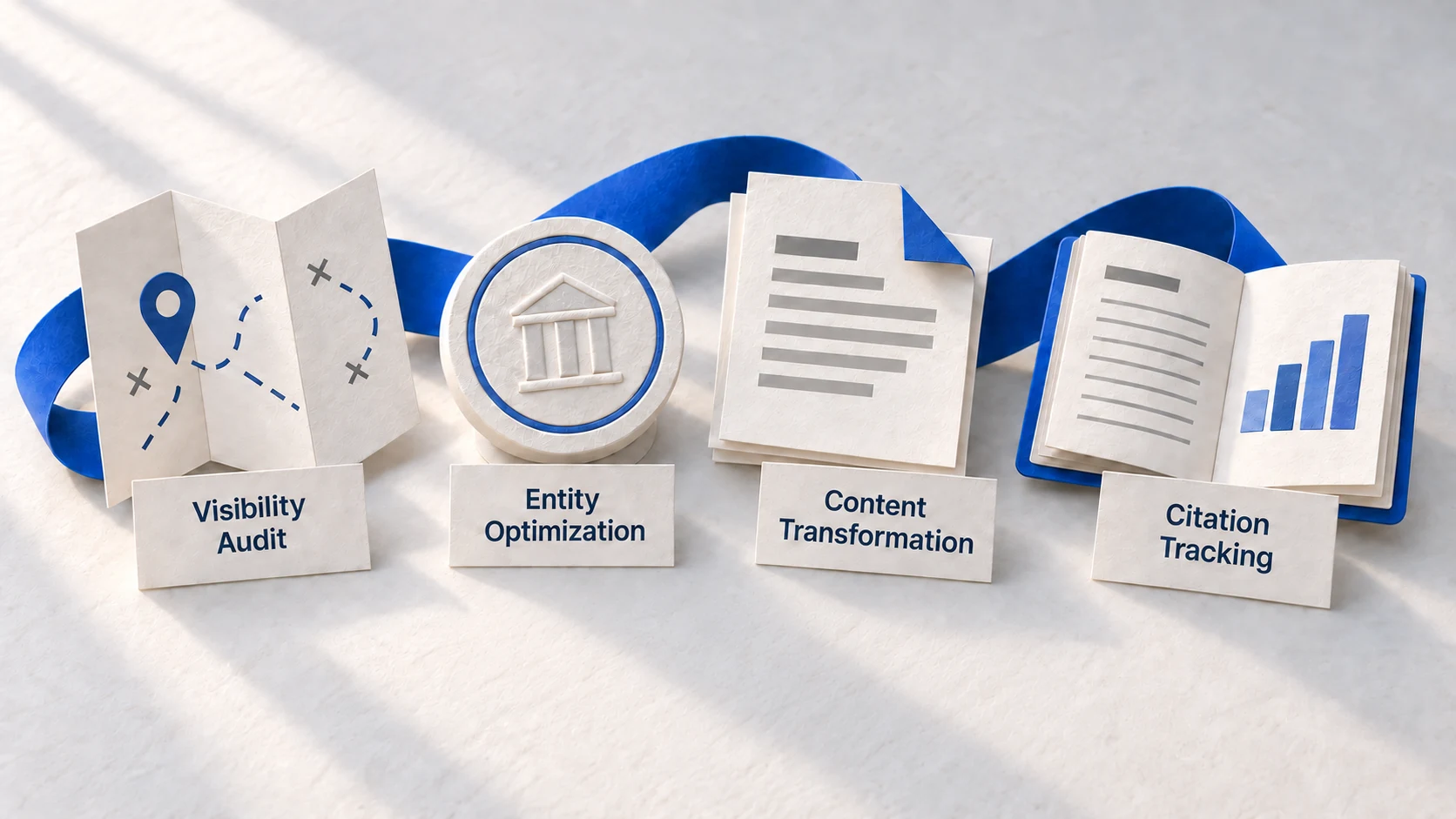
GEO services typically command $1,500-$10,000/month based on scope, and agencies that move first capture premium rates. A complete GEO service package includes visibility tracking, entity optimization, content transformation, schema implementation, and citation frequency measurement. Early adopters are establishing premium pricing before the market commoditizes.
Your clients are coming to you with the same concern: organic traffic is down, Google AI Overviews are taking clicks, and they're not showing up when prospects ask ChatGPT for recommendations.
You've watched traffic decline across your client base. Gartner predicts 25% less search traffic by 2026, and that's a conservative estimate based on early 2024 data. Semrush's 2024 analysis found that 98.8% of search queries now show zero-click results.
Traditional SEO isn't dead, but it's no longer enough on its own. The agencies that will thrive in 2025 and beyond aren't abandoning SEO-they're adding GEO (Generative Engine Optimization) as a premium service layer that addresses what SEO can't.
This playbook shows you how to package GEO services, price them profitably, deliver measurable results, and position your agency ahead of the market. If you move now, you capture premium rates before this becomes commoditized.
Why Add GEO Services Now (The Opportunity Window Is Closing)
Right now, in late 2025 and early 2026, most agencies are still treating GEO as "SEO 2.0" or ignoring it entirely. That's the opportunity. Early adopters are establishing premium pricing and capturing market share while the majority waits for proof.
The data shows why waiting is costly. Semrush's late 2024 study analyzing 41 million queries found that only 1.7% of sites appeared in both traditional SEO results and AI-generated answers. Ranking well on Google does not guarantee AI visibility-80% of AI-cited sources don't even rank in the top 3 organically.
Top 13%
of agencies charge $2,000-$5,000/month retainers
SE Ranking's survey of 260 agencies found only 13% charge $2,000-$5,000 monthly, with just 2% exceeding $5,000. Agencies offering specialized services like GEO can command these premium rates-positioning in the top 15% of the market by demonstrating measurable AI visibility improvements.
Source: SE Ranking 2025 SurveyThe window for premium pricing is narrow. In 2023, agencies charging $10,000/month for "ChatGPT optimization" (before the methodology was proven) captured early adopter clients. By mid-2024, GEO pricing started normalizing around $2,000-$4,000/month as competition increased. By 2026, late movers will compete on price, not value.
The Three Reasons Clients Will Pay Premium Rates for GEO
Clients don't pay premium rates for new services unless the pain is real, the solution is scarce, and the value is measurable. GEO hits all three triggers right now.
Real Pain
Traffic decline isn't hypothetical anymore. Clients are watching conversions drop as AI Overviews answer questions without sending clicks. They need solutions, not reassurance.
Scarce Solution
Most agencies don't offer GEO yet. The ones that do often bundle it as "advanced SEO" instead of positioning it as distinct value. Scarcity creates pricing power.
Measurable Value
Citation tracking, Share of Model Visibility, and AI referral traffic are all measurable. You're not selling hope-you're selling visibility metrics clients can track monthly.
When you combine measurable pain with scarce expertise and trackable outcomes, clients will pay. The agencies capturing premium rates today are the ones demonstrating GEO expertise before their competitors wake up.
The GEO Service Package: What to Offer
A comprehensive GEO service package has four core pillars. Each pillar addresses a specific aspect of AI visibility, and together they create a cohesive optimization strategy that clients can't get from traditional SEO alone.
The Four-Pillar GEO Service Framework
- 1
Foundation: Entity & Schema
Establish the client as a recognized entity in AI systems. Implement Organization and Person schema, optimize Entity Home (About page), ensure cross-platform NAP consistency, build Knowledge Graph presence.
- 2
Visibility: Content Transformation
Restructure existing content for AI consumption. Add answer capsules, implement semantic specificity, create FAQ sections with schema, optimize heading hierarchy, add evidence blocks with attribution.
- 3
Authority: Digital PR & Off-Site
Build third-party citations and authority signals. Directory listings (Wikidata, Crunchbase, industry-specific), guest content on AI-trusted publications, reactive PR (HARO/Featured), podcast appearances for transcript citations.
- 4
Measurement: Tracking & Reporting
Monitor AI visibility and citation frequency. Set up GA4 AI referral tracking, establish citation frequency baselines, track Share of Model Visibility, provide monthly stakeholder reports with trend analysis.
The beauty of this structure is modularity. You can offer all four pillars as a comprehensive package ($5,000-$10,000/month) or sell them individually based on client needs and budget. Foundation work is the fastest ROI (30-45 days to see initial citation improvements), making it the ideal starting point for skeptical clients.
Tiered Service Options (From Entry to Enterprise)
Not every client needs the full GEO service from day one. Offering tiered packages lets you meet clients where they are while creating clear upgrade paths as they see results.
GEO Service Tiers
| Tier | What's Included | Monthly Rate |
|---|---|---|
| Foundation | Schema implementation, entity optimization, content audit, citation baseline. 3-month minimum. Perfect for skeptical clients or smaller businesses. | $1,500-$2,500 |
| Growth | Everything in Foundation + content transformation (5-10 pages/month), FAQ optimization, monthly citation tracking, quarterly strategy updates. | $3,000-$5,000 |
| Enterprise | Everything in Growth + digital PR execution, multi-platform monitoring, competitive analysis, dedicated account strategist, custom dashboards. | $6,000-$10,000 |
The tier structure serves two purposes. First, it gives prospects a low-risk entry point-Foundation tier delivers measurable results in 60-90 days, proving value before they commit to higher spend. Second, it creates natural expansion revenue as clients graduate from Foundation to Growth to Enterprise based on demonstrated ROI.
Pricing and Positioning
GEO pricing should reflect transformation value, not hourly effort. The biggest mistake agencies make is pricing GEO like traditional SEO-charging based on hours or content volume instead of business impact.
When you position GEO as "future-proofing your visibility strategy" or "capturing the AI search market before your competitors," you're selling strategic value. When you position it as "schema markup implementation," you're selling hours. Same service, different price points.
Pricing Framework by Client Segment
Local Businesses ($1,500-$3,000/month)
Focus on Google Business Profile optimization, LocalBusiness schema, citation consistency, and review management. Lower complexity, faster wins. Position as "showing up when locals ask AI for recommendations."
B2B Service Providers ($3,000-$6,000/month)
Entity establishment, thought leadership content transformation, FAQ optimization for service pages. Higher value per client, longer sales cycles. Position as "being the source ChatGPT cites when prospects research solutions."
E-commerce & SaaS ($5,000-$10,000/month)
Product schema at scale, multi-platform optimization, competitive Share of Voice tracking. High transaction value justifies premium pricing. Position as "capturing AI-assisted purchase decisions."
Your pricing should ladder with value delivered. Foundation work (schema, entity optimization) is table stakes-charge $1,500-$2,500/month. Content transformation at scale requires more effort-$3,000-$5,000/month. Full digital PR integration with custom reporting-$6,000-$10,000/month.
See the complete GEO service pricing guide for detailed rate benchmarks by industry, client size, and service scope.
The GEO Delivery Workflow
A systematic delivery workflow ensures consistent results across clients and prevents scope creep. Here's the proven month-by-month sequence for new GEO clients.
Month 1: Foundation & Audit
Month 1: Foundation & Audit
- GEO visibility audit - Test client brand across ChatGPT, Perplexity, Claude, Google AI Overviews. Establish citation frequency baseline (0 citations/1000 queries is typical for new clients).
- Entity assessment - Check Knowledge Panel existence, Wikidata entry, Organization schema implementation, cross-platform NAP consistency.
- Content structure analysis - Identify pages with answer-first potential, FAQ opportunities, and semantic clarity issues.
- Schema gap analysis - Audit current schema markup (if any), identify high-priority schema types (Organization, Article, FAQPage, LocalBusiness, Product).
Month 2: Quick Wins Implementation
Month 2: Quick Wins Implementation
- Schema implementation - Organization schema on homepage, Person schema for key executives, FAQPage schema on service pages, Article schema on blog posts.
- Entity Home optimization - Transform About page into Entity Home with complete company narrative, leadership bios, sameAs property linking all official profiles.
- Top 5 pages transformation - Add answer capsules, semantic specificity fixes, FAQ sections. Target pages with existing traffic but low AI visibility.
- Citation baseline retest - Measure improvements from Month 1 baseline. Typical improvement: 10-15% citation frequency increase in 30 days from foundation work alone.
Month 3+: Scale & Optimize
Month 3+: Scale & Optimize
- Content transformation pipeline - 5-10 pages per month depending on tier. Prioritize high-traffic pages, product/service pages, and thought leadership content.
- Digital PR execution - Secure 2-3 third-party mentions monthly through HARO responses, guest posts on AI-trusted publications, directory listings.
- Competitive monitoring - Track Share of Model Visibility versus 3-5 competitors. Identify citation gaps and content opportunities.
- Monthly reporting - Citation frequency trends, AI referral traffic, new citations discovered, Share of Voice metrics, next month priorities.
How to Pitch GEO to Skeptical Clients
Most clients won't ask for GEO services-they don't know what GEO is yet. Your job is to connect their existing pain (traffic decline, fewer leads from organic search) to the GEO solution without overwhelming them with jargon.
The pitch that works starts with validation, not education. "I've noticed your organic traffic declined 15% over the past six months. That's not a ranking problem-you're still on page one for most target keywords. It's a zero-click problem. People are getting answers from AI instead of clicking through to your site."
Now they're nodding because you've named something they're experiencing but couldn't explain. The next step is demonstrating invisibility. Pull up ChatGPT or Perplexity in front of them (or over screen share) and ask it a question their ideal client would ask. When their competitors appear in the answer but they don't, the urgency becomes visceral.
The Five Objections You'll Hear (And How to Handle Them)
"Can't we just keep doing what we're doing?"
Translation: They're risk-averse and need proof of declining effectiveness.
Response: "Absolutely-traditional SEO still works for now. But Gartner predicts 25% less search traffic by 2026, and Semrush found that 98.8% of queries now show zero-click results. The question isn't whether to adapt, it's when. Do you want to be ahead of the curve or scrambling to catch up when traffic hits a crisis point?"
"This sounds expensive."
Translation: They need to see ROI justification.
Response: "What's expensive is losing 40% of your organic traffic over the next 18 months because you're invisible to AI. GEO isn't an expense-it's insurance. And unlike traditional advertising, every citation compounds. One appearance in ChatGPT reaches millions of users asking that question."
"How long until we see results?"
Translation: They want realistic timelines, not hype.
Response: "Foundation work shows initial improvements in 60-90 days-you'll see your first citations within 2-3 months. Full visibility transformation takes 6-12 months because we're building authority signals AI engines trust. This isn't a quick fix, it's future-proofing your visibility strategy."
"What if Google changes how AI Overviews work?"
Translation: They fear investing in something that becomes obsolete.
Response: "GEO isn't about gaming one platform. Entity optimization, semantic clarity, and authoritative content benefit you across all AI systems-ChatGPT, Claude, Perplexity, Google AI Overviews. The fundamentals of how AI engines evaluate trustworthiness and citation-worthiness are consistent across platforms."
"Can't we just wait and see what happens?"
Translation: They want someone else to go first and validate the approach.
Response: "You could, but here's what happens when you wait. Early movers are establishing authority signals now-citations, schema markup, Knowledge Panels. AI engines favor sources with existing citation history. By the time it's 'proven,' your competitors have a 12-18 month head start in AI visibility that's very difficult to overcome."
For complete objection handling scripts with proof points and transition phrases, see How to Pitch GEO to Skeptical Clients.
Training Your Team on GEO
Your team doesn't need to become GEO experts overnight. They need to understand three things: the core principles, the client-facing language, and the delivery workflow. Everything else can be learned through repetition on client work.
Start with the fundamentals. GEO is optimization for how AI engines discover, evaluate, and cite content. It overlaps with SEO (~60% of skills transfer) but prioritizes different signals: semantic clarity over keyword density, entity recognition over PageRank, citation-worthiness over click-worthiness.
The 30-Day Team Onboarding Plan
Week 1: Concepts & Context
Read 5 foundational articles on GEO vs SEO differences. Test visibility across AI platforms for 10 brands. Document what appears vs what doesn't. Understand the zero-click reality with data (Gartner, Semrush studies).
Week 2: Technical Foundation
Learn schema markup basics (Organization, Person, FAQPage, Article). Practice using AI tools to generate schema. Validate schema with Google's Rich Results Test. Audit 3 client sites for entity signals.
Week 3: Content Transformation
Study answer capsule structure (120-150 characters, self-contained, link-free). Practice transforming 5 existing blog posts with answer-first formatting. Learn semantic specificity rules (replace pronouns, use full entity names).
Week 4: Client Delivery & Reporting
Shadow GEO audit on real client. Practice citation baseline measurement. Learn client reporting language (avoid "schema markup"-say "making your brand recognizable to AI"). Review objection handling scripts.
After 30 days, your team should be able to execute Foundation tier work independently. Growth and Enterprise tiers require more experience-expect 3-6 months of supervised client delivery before team members can handle complex multi-platform optimization and digital PR integration.
The agencies that will dominate in 2026 and beyond aren't the ones with the largest teams or the most sophisticated tools. They're the ones that recognized the AI search shift early, built GEO expertise while it was still scarce, and positioned themselves as the guides clients trust to navigate this transformation.
If you're reading this in early 2026, you're still early. The majority of agencies are still treating GEO as a buzzword or future threat rather than a current service opportunity. Move now, capture premium pricing, build case studies that prove ROI, and establish your agency as the GEO authority in your market before your competitors figure out what you already know.
FAQ
Can I offer GEO services if I'm still learning GEO myself?
How long does it take to see GEO results for clients?
What if a client asks for guaranteed citation rates?
Should I unbundle GEO from SEO or offer them together?
Ready to Add GEO Services to Your Agency?
You see the pricing opportunity. You understand the service structure. Now discover how visible your agency's own content is to AI engines-and use that as your proof of concept.
I've built a system to help brands go from invisible to cited in AI responses. But before I share it with you, I want you to see exactly where you stand.
Take the GEO Readiness Quiz →60 seconds · Personalized report · Free
Continue Learning
Dive deeper into AI search with these related articles:
GEO Service Pricing: What to Charge and Why
GEO services typically cost $1,500-$10,000/month. Learn the pricing tiers, what affects rates, and how to justify premium GEO pricing.
How to Pitch GEO to Skeptical Clients: Objection Handling Guide
Handle the 5 most common GEO objections. Scripts, proof points, and trial structures that convert skeptics.
ROI of GEO: Calculating the Value of an AI Citation
Learn how to calculate the dollar value of AI citations. Practical ROI framework with formulas and benchmarks.