GEO & AI Search
Training Your Team on GEO: Agency Leader's Guide
Quick Answer
GEO training focuses on four skill areas: entity optimization, citation engineering, AI-friendly content structuring, and measurement. SEO specialists can learn foundational GEO in 2-4 weeks because 60% of SEO skills transfer. Research shows GEO methods can boost source visibility by up to 40%, making team training a high-ROI investment.
You've sold GEO services. Now your team needs to deliver them. And "figure it out" isn't a training plan.
GEO is new enough that most agencies are learning on the job. But agencies that systematize their GEO training-building real competency instead of surface knowledge-deliver measurably better results. According to Foundation Inc's research, GEO methods are capable of boosting source visibility by up to 40%.
Here's how to train your team on GEO systematically-from foundations to advanced implementation.
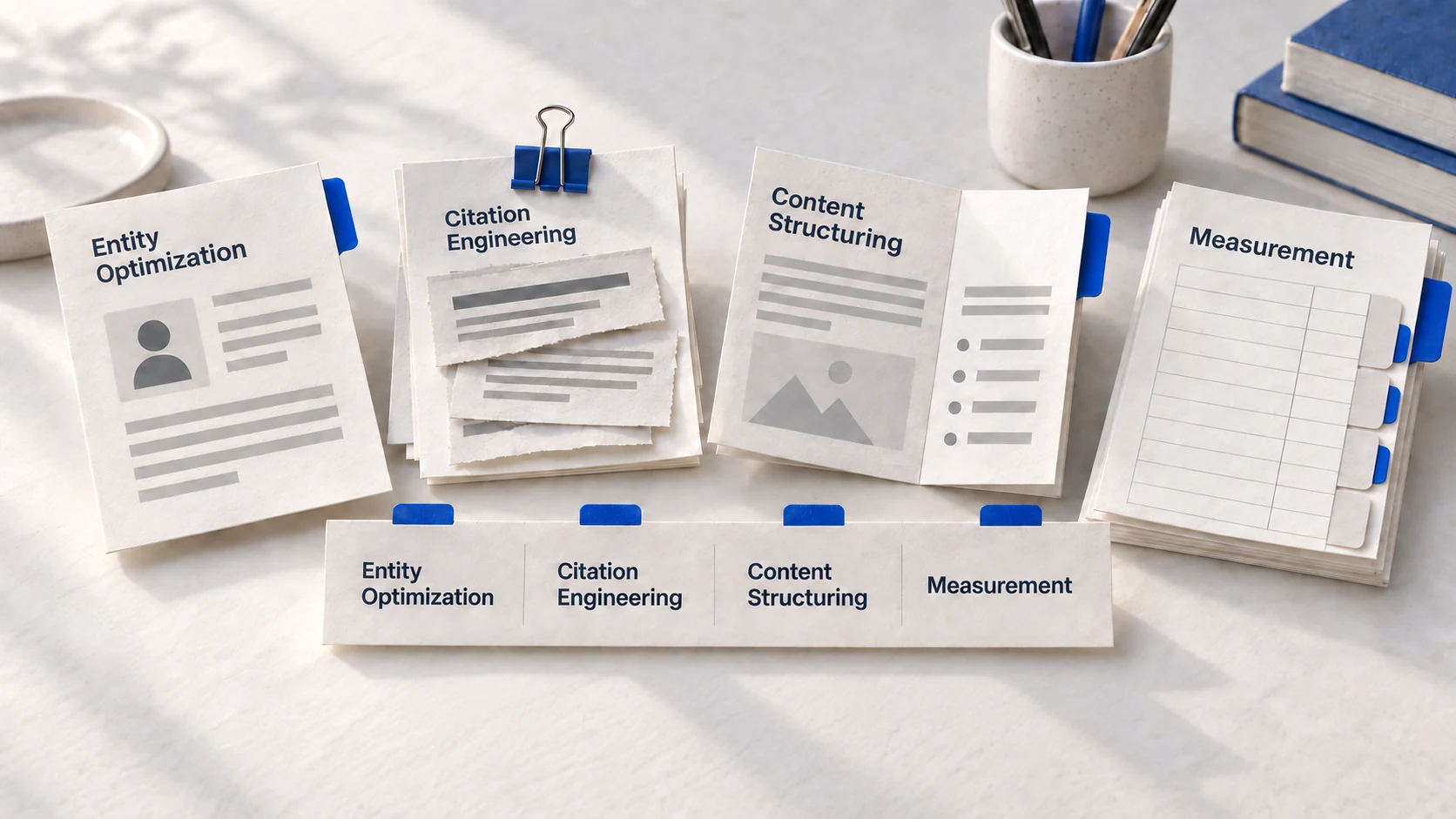
The Four GEO Skill Pillars
Based on Omniscient Digital's agency analysis, GEO expertise breaks into four interconnected skill areas:
1. Entity Optimization
Making sure your brand, products, and key topics are clearly defined and consistently described across the web. AI engines can't recommend what they don't understand.
- Schema markup implementation: Organization, Person, Product, LocalBusiness, Article schemas
- Knowledge Graph optimization: Entity home pages, sameAs linking, consistent NAP
- Entity consistency audits: Finding and fixing conflicting brand information
- Wikipedia and Wikidata: When and how to pursue Knowledge Panel qualification
2. Citation Engineering
Earning authoritative, context-rich mentions and links that LLMs can use to verify your claims. This is the GEO equivalent of link building-but with different rules.
- Source authority signals: What makes AI engines trust a citation
- Earned media strategies: Digital PR optimized for AI citation
- Third-party directory optimization: Managing presence where AI looks
- Expert contribution placement: Guest posting for citation, not just backlinks
3. AI-Friendly Content Structuring
Giving AI engines clear, machine-readable content that answers questions completely and in context. The format matters as much as the substance.
- Answer capsule creation: Self-contained answers that can be extracted
- Semantic specificity: Avoiding pronouns that break extraction
- FAQ optimization: Question-answer structures AI prefers
- Structured data for content: FAQ schema, HowTo schema, Article schema
4. Measurement and Reporting
Tracking AI visibility and demonstrating ROI to clients. Without measurement, GEO becomes guesswork.
- Citation tracking setup: Tools and manual verification methods
- Share of Voice calculation: Competitive benchmarking for AI
- AI referral attribution: GA4 configuration for AI traffic
- Client reporting templates: Presenting GEO results effectively
GEO Training Curriculum
A structured approach to building team competency:
Week 1-2: Foundation Building
| Day | Topic | Exercise |
|---|---|---|
| 1-2 | How AI Search Works | Test 20 queries across ChatGPT, Perplexity, Google AI |
| 3-4 | SEO vs GEO Differences | Document differences in source selection patterns |
| 5-6 | Entity Fundamentals | Audit entity consistency for sample brand |
| 7-8 | Schema Basics | Implement Organization schema on test site |
| 9-10 | Content Structure Analysis | Analyze why specific content gets cited |
Week 3-4: Practical Application
| Day | Topic | Exercise |
|---|---|---|
| 11-12 | Answer Capsule Writing | Rewrite 5 content pieces with answer capsules |
| 13-14 | Citation Engineering | Identify 10 citation opportunities for sample client |
| 15-16 | Measurement Setup | Configure GA4 for AI referral tracking |
| 17-18 | Audit Process | Complete full GEO audit on practice account |
| 19-20 | Report Creation | Build monthly GEO report for audit client |
Skills Transfer from SEO
Good news: your SEO team already has many GEO-relevant skills. According to our analysis, about 60% of SEO expertise transfers directly.
| SEO Skill | GEO Application | Modification Needed |
|---|---|---|
| Technical SEO | Schema implementation, structured data | Expand schema types, focus on entity clarity |
| Content optimization | AI-friendly formatting, answer structure | Prioritize extractability over keyword density |
| Link building | Citation engineering, authority building | Focus on brand mentions, not just links |
| Competitor analysis | AI Share of Voice monitoring | Track AI recommendations, not just rankings |
| Reporting | AI visibility dashboards | Add citation metrics, inclusion rates |
Hands-On Training Exercises
Exercise 1: AI Citation Analysis
Build understanding of what AI engines actually cite:
- Choose 10 queries in client's industry
- Ask each query to ChatGPT, Perplexity, and Claude
- Document which sources get cited
- Analyze common patterns: domain authority, content structure, freshness
- Identify gaps where client should appear but doesn't
Exercise 2: Answer Capsule Transformation
Practice converting existing content to AI-friendly format:
- Select a client's top 5 performing pages
- Identify questions each page could answer
- Write answer capsules (120-150 characters) for each
- Add capsules immediately after question-based headings
- Test by asking AI the questions-does it cite the capsule?
Exercise 3: Entity Consistency Audit
Develop entity optimization skills:
- Search for brand name across Google, Bing, AI engines
- Document every mention, profile, directory listing
- Flag inconsistencies in name, description, contact info
- Prioritize fixes by authority of the source
- Create correction implementation plan
Building a GEO Knowledge Base
According to Go Fish Digital's agency approach, successful GEO teams build internal knowledge systems:
Documentation to Create
- Process docs: Step-by-step guides for common GEO tasks
- Prompt libraries: Tested queries for visibility testing
- Tool guides: How to use each tool in your GEO stack
- Case study library: What worked, what didn't, why
- Client templates: Standard audit and setup processes
Weekly Learning Rituals
- Citation pattern review: Analyze interesting AI citations
- Algorithm monitoring: Discuss AI platform updates
- Cross-client learnings: Share what's working
- Tool experimentation: Test new GEO tools and techniques
Measuring Training Effectiveness
Track these metrics to assess GEO competency development:
| Metric | Baseline (Week 0) | Target (Week 4) |
|---|---|---|
| Audit completion time | 8-10 hours | 3-4 hours |
| Schema implementation accuracy | 50-60% | 90%+ |
| Answer capsule quality score | 60% | 85%+ |
| Client report quality | Needs revision | Client-ready |
Definition
GEO Skill Pillars
The four interconnected competency areas required for effective GEO practice: entity optimization (making brands machine-readable), citation engineering (earning AI-trustworthy mentions), AI-friendly content structuring (formatting for extraction), and measurement (tracking visibility and ROI). About 60% of SEO skills transfer directly, allowing trained SEO specialists to reach GEO proficiency in 2-4 weeks.
Key Takeaways: GEO Team Training
- 1. 4-week curriculum-Weeks 1-2 build foundations, Weeks 3-4 focus on practical application with hands-on exercises
- 2. 60% skill transfer-SEO professionals already have technical SEO, content optimization, and reporting skills that apply directly to GEO
- 3. Hands-on exercises are essential-AI citation analysis, answer capsule transformation, and entity audits build real competency
- 4. Build a knowledge base-process docs, prompt libraries, case studies, and templates compound team learning over time
- 5. Measure training effectiveness-track audit completion time, schema accuracy, and report quality to assess competency growth
FAQ
How long does it take to train SEO specialists on GEO?
What skills do GEO practitioners need?
Can AI tools help with GEO training?
What GEO training resources exist?
Ready to Build GEO Expertise?
Trained teams deliver better results. Start systematic GEO training.
From foundations to advanced implementation in 4 weeks.
Take the GEO Readiness Quiz →60 seconds · Personalized report · Free
Continue Learning
Dive deeper into AI search with these related articles:
Agency Owner's Playbook: GEO Services and Premium Rates
Add GEO services to your agency. Learn what to offer, how to price, and how to deliver results for AI search optimization.
The GEO Service Package: What to Include
A comprehensive GEO service package includes visibility tracking, entity management, content refresh, and sentiment monitoring.
GEO Portfolio Building: Projects That Prove Your Skills
Build a GEO portfolio that demonstrates real expertise with case studies and documented experiments.