GEO & AI Search
The GEO, AEO, SEO Integration Framework: A Unified Approach
Quick Answer
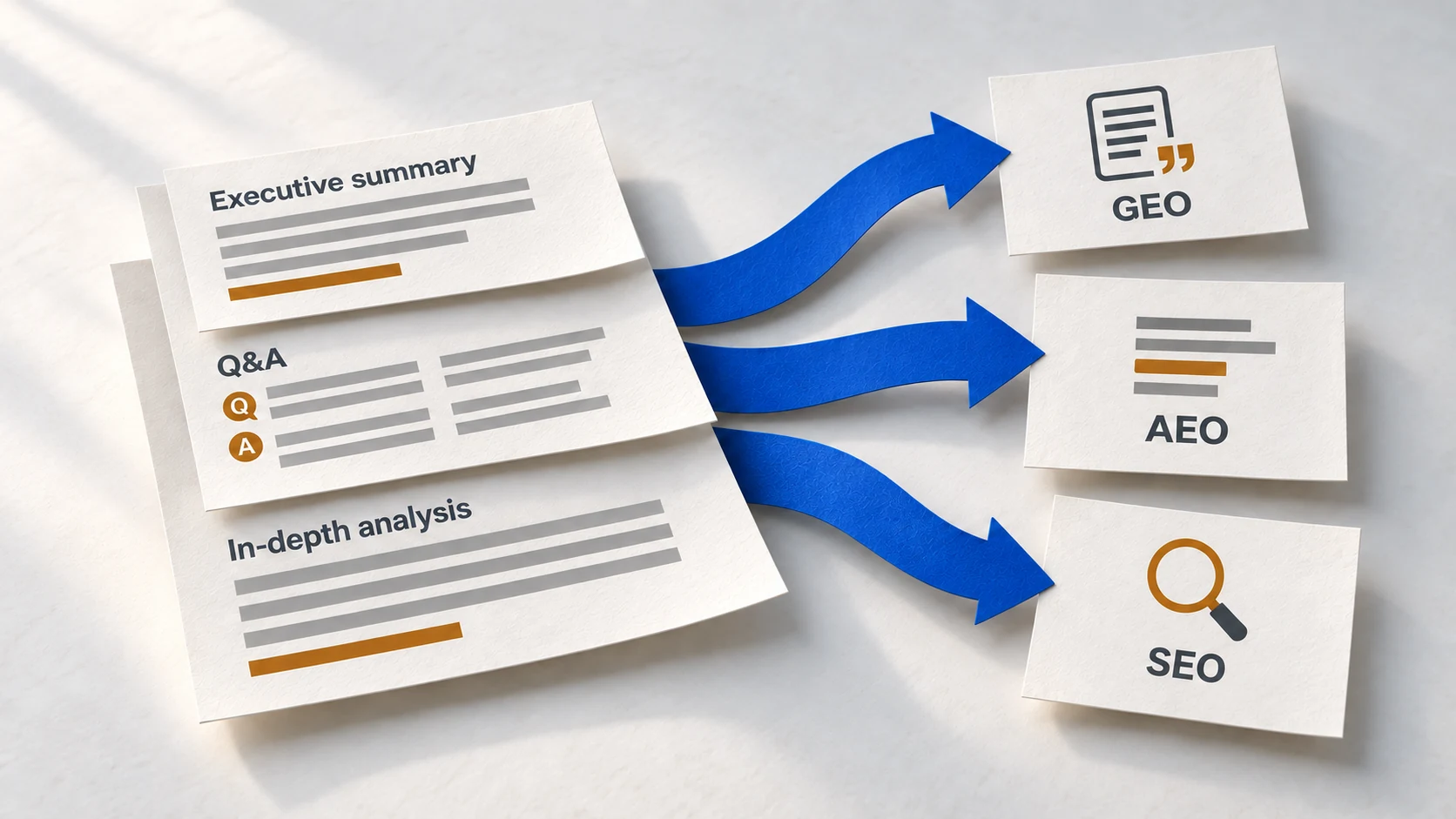
The most effective approach unifies SEO, AEO, and GEO around user behavior-not separate platform strategies. Use content layering: executive summary (for AI), Q&A sections (for answer engines), and in-depth analysis (for traditional SEO). One content piece, three optimization layers.
You've learned what SEO, AEO, and GEO mean. Now the real question: how do you actually implement all three without tripling your workload?
Most guides treat them as separate disciplines requiring separate strategies. That's the wrong approach.
The brands winning in 2025's fragmented search landscape aren't building three separate content strategies. According to Conductor research, they're unifying their approach around user behavior.
Here's the framework that makes integration practical.
Why Integration Beats Isolation
Consider how people actually search today:
A typical research journey:
- 1 Ask ChatGPT a broad question → "What's the best approach to local SEO?"
- 2 Google a specific follow-up → "Google Business Profile optimization checklist"
- 3 Click a featured snippet for quick answer
- 4 Read the full guide for detailed implementation
- 5 Return to AI to verify specific tactics
Users move fluidly between AI platforms, traditional search, and featured snippets-often in a single session.
The implication:
If you optimize for only one search surface, you're invisible during parts of your audience's research journey. Integration isn't optional-it's how modern search works.
The Unified Framework: 5 Shifts
Shift #1
Reframe Around User Behavior, Not Platforms
Stop asking "How do I rank on Google?" or "How do I get cited by ChatGPT?" separately.
Start asking: "What do users need, regardless of where they search?"
Practical shift: Build content around user questions and needs first. Platform-specific optimization becomes a formatting layer, not a strategy.
Shift #2
Build Content Ecosystems, Not Isolated Posts
Create "big rock content"-substantial cornerstone pieces supported by complementary assets across channels.
Practical shift: One comprehensive pillar post supported by cluster articles, social content, video summaries, and downloadable resources. The pillar ranks for SEO, clusters capture long-tail featured snippets, and the comprehensive nature earns AI citations.
Shift #3
Expand Metrics Beyond Clicks
Low-value awareness traffic is vanishing. The visitors who remain are often further along in their buying journey.
New metrics to track:
- • Bot crawl frequency from AI platforms
- • Citation tracking and sentiment analysis
- • Featured snippet capture rate
- • Impression-to-engagement ratios
- • Revenue and qualified lead generation (not just traffic)
Shift #4
Deploy Strategic, Industry-Specific Schema
Move beyond generic article markup. Implement structured data that reflects your domain expertise.
Practical shift: Use schema markup that matches your content type-FAQPage for Q&A sections, HowTo for tutorials, Organization/Person for entity establishment. Schema helps both featured snippets (AEO) and AI parsing (GEO).
Shift #5
Apply SEO Fundamentals Everywhere
Here's the good news: SEO skills translate directly to AI search.
Key insight: Page-one rankings correlate directly with LLM citations. The fundamental job is the same-help users find accurate, authoritative answers.
Source: Conductor →
Content Layering Structure
The practical solution: structure every content piece with three layers that serve all platforms simultaneously.
Executive Summary Layer (GEO)
First 100-150 words contain the complete answer. AI systems extract this for generated responses.
"Quick Answer" boxes, TL;DR sections, and definitive opening statements serve this layer.
Q&A Structure Layer (AEO)
Question-based headings and FAQ sections. Answer engines scan for direct question-answer pairs.
H2s phrased as questions, FAQ schema markup, and concise answers beneath each heading serve this layer.
In-Depth Analysis Layer (SEO)
Comprehensive content that demonstrates expertise, earns backlinks, and satisfies users seeking detailed guidance.
Data, case studies, expert quotes, and thorough explanations serve this layer.
The efficiency:
You're not creating three separate pieces of content. You're structuring one piece to serve three audiences. The same article ranks in Google (Layer 3), captures featured snippets (Layer 2), and gets cited by AI (Layer 1).
Measuring Integrated Success
Unified strategy requires unified measurement. Here's what to track:
| Layer | Metrics to Track | Tools |
|---|---|---|
| GEO | AI citation frequency, brand mentions in chatbot responses, bot crawl frequency | Profound, Goodie, Daydream, manual spot-checks |
| AEO | Featured snippet captures, AI Overview appearances, position zero rate | Ahrefs, Semrush, Google Search Console |
| SEO | Organic rankings, traffic, click-through rate, dwell time | Google Analytics, Search Console, rank trackers |
| Business | Qualified leads, revenue from organic sources, conversion rate | CRM, attribution platforms |
Key insight:
The most important metric is business outcomes. If your traffic drops but qualified leads increase, you're winning. AI referrals convert at 4.4x the rate of traditional organic traffic.
Implementation Checklist
Use this checklist for every content piece:
□ GEO Layer
- □ Quick Answer / Executive Summary in first 150 words
- □ Entity clarity (name brand/topic early, maintain consistency)
- □ Clean HTML structure with semantic headings
- □ Factual accuracy with verifiable claims
- □ Author credentials visible
□ AEO Layer
- □ Question-based H2 headings where appropriate
- □ FAQ section with FAQPage schema
- □ Direct answers immediately following questions
- □ Numbered lists for process/step content
- □ Definition boxes for key terms
□ SEO Layer
- □ Target keyword in title, URL, H1, first paragraph
- □ Comprehensive coverage (1,500-3,000+ words for pillars)
- □ Internal links to related content
- □ External links to authoritative sources
- □ Optimized meta title and description
□ Universal Requirements
- □ Article schema with hasPart for sections
- □ Author/Person schema with sameAs links
- □ Mobile-responsive formatting
- □ Page speed optimized
- □ Content updated with fresh data (within 90 days)
FAQ
Do I need separate strategies for SEO, AEO, and GEO?
Which should I prioritize: SEO, AEO, or GEO?
How do I track success across all three?
What's the content layering approach?
Unify Your Strategy
Now you understand how the pieces fit together.
Take the assessment to see where your current approach has gaps-and which of the three layers needs the most work.
Take the GEO Readiness Quiz →60 seconds · Personalized report · Free
Continue Learning
Dive deeper into AI search with these related articles:
GEO vs AEO vs SEO: The Complete Guide to AI Search Optimization
Confused by GEO, AEO, and SEO? This guide explains the differences, when to use each, and how they work together. No jargon, just clarity.
GEO Explained in Plain English: What It Is and Why It Matters
Generative Engine Optimization (GEO) explained without jargon. Learn what GEO is, how it differs from SEO, and why it matters for your website.
AEO vs GEO: When to Use Each Strategy
Learn when Answer Engine Optimization (AEO) makes more sense than GEO, and when to combine both strategies.