GEO & AI Search
Common Schema Mistakes That Kill Your GEO Efforts
Quick Answer
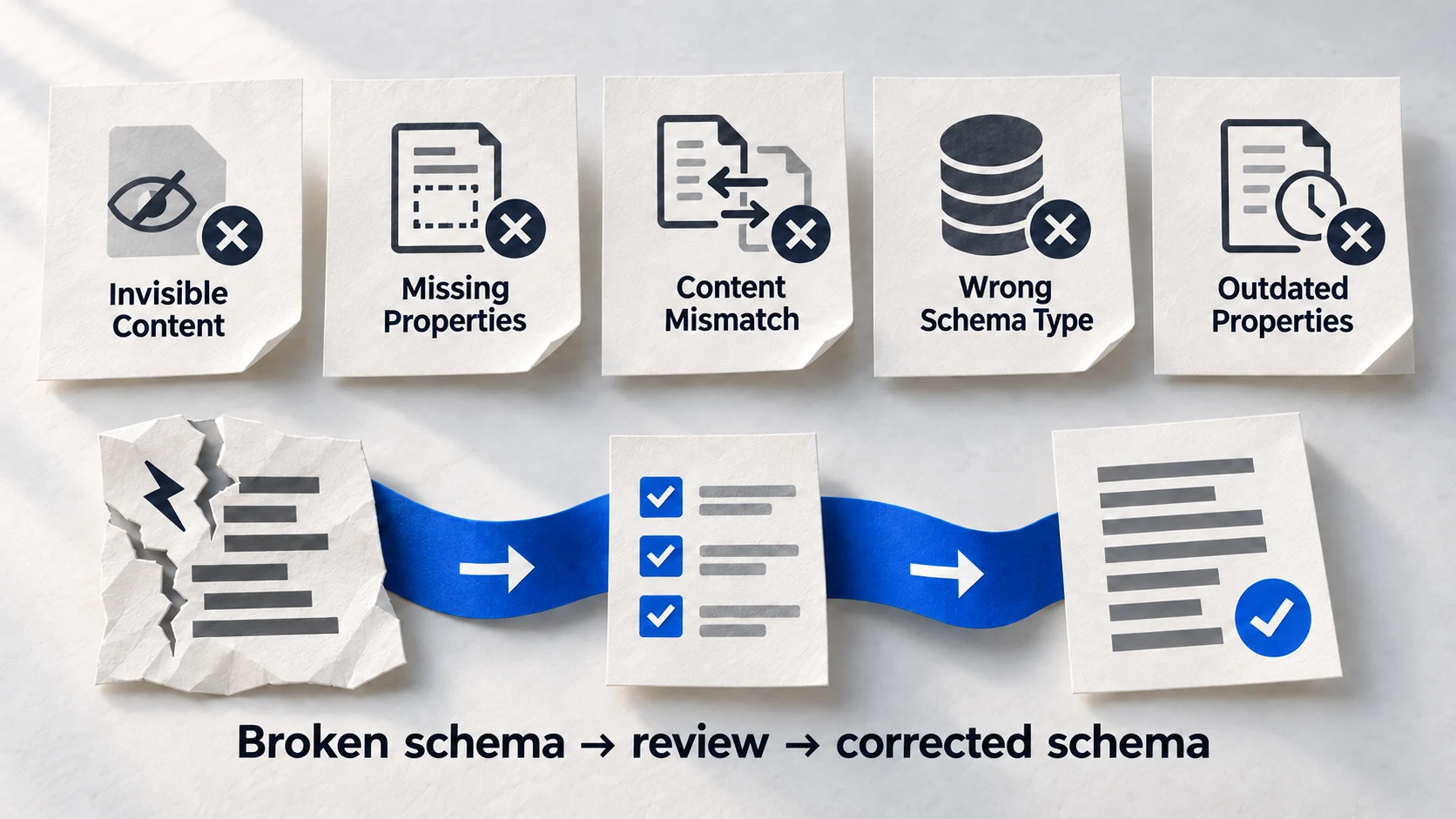
The five most common schema mistakes are: marking up invisible content, missing required properties, content-markup mismatches, using wrong schema types, and implementing outdated properties. Each mistake creates conflicting signals that reduce AI citation likelihood. Pages with comprehensive, validated schema are significantly more likely to appear in AI-generated answers, while incomplete or incorrect markup gets ignored entirely.
Definition
Schema Anti-Pattern
A schema implementation that technically functions but violates best practices-creating conflicting signals that reduce AI trust. Anti-patterns include marking up invisible content, using generic types when specific ones exist, and allowing markup to drift out of sync with page content. AI systems treat anti-patterns as red flags that damage citation likelihood.
Your content is well-written. Your research is solid. Your expertise is real. But AI systems aren't just reading your words-they're looking for structured signals that confirm what you're saying. And if your schema markup has errors, those signals become noise.
According to Search Engine Land, a September 2025 test found pages with robust schema markup significantly more likely to appear in Google AI Overviews compared to pages without structured data. But here's the catch: incomplete or incorrect schema can hurt your visibility more than having no schema at all.
This post covers the five schema mistakes that sabotage GEO efforts-and exactly how to fix them before they cost you citations.
Mistake #1: Marking Up Invisible Content
The most damaging schema mistake is marking up content that users can't see on the page. This includes reviews hidden behind tabs, FAQs that don't exist in visible text, or product details only shown after clicking.
Real Example
A site adds FAQPage schema listing 10 questions, but only 3 are visible without clicking "Show More." SEO Clarity research found Google flags this as deceptive markup and ignores the entire schema implementation.
Rule: If users can't see it without interaction, don't mark it up.
AI platforms verify that marked-up content matches visible page text. When they detect mismatches, they reduce trust in your entire domain-not just that page. The risk isn't worth the attempted shortcut.
Why this matters for GEO: ChatGPT and Perplexity verify claims against visible content. If your schema claims you have 50 FAQs but the page only shows 5, AI platforms flag the inconsistency and skip your content when generating answers.
Mistake #2: Missing Required Properties
Each schema type has required properties that AI platforms need for extraction. Missing even one required property can invalidate your entire markup structure.
Missing: offers (price, availability)
Without pricing and availability, AI can't recommend products. The markup becomes useless metadata.
Missing: headline, author, datePublished
AI needs attribution for citations. Articles without clear authorship get skipped for trust reasons.
Missing: acceptedAnswer for each Question
Questions without answers are incomplete entities. AI extracts Q&A pairs-partial markup creates confusion.
Missing: address, telephone, openingHours
Location-based recommendations require complete contact information. Partial data reduces citation likelihood.
Research from AISO Hub shows incomplete schema fails validation checks and prevents rich results entirely. AI platforms treat invalid markup the same as no markup-they ignore it.
Mistake #3: Content That Doesn't Match Markup
Your schema claims one thing, but your visible content says something different. This mismatch creates conflicting signals that reduce AI trust in your content.
Markup Says
"5.0 average rating from 200 reviews"
Schema declares perfect rating with substantial review count.
Page Shows
"4.2 average rating from 47 reviews"
Visible content contradicts schema data completely.
SEO Clarity identifies this as a common violation that triggers manual penalties. Google explicitly states marked-up data must match visible content exactly-and AI platforms apply the same standard.
Common Mismatch Scenarios
Price discrepancies: Schema shows $99, page displays $149
Date confusion: datePublished doesn't match article byline
Author misattribution: Schema credits different author than byline
Availability errors: Schema claims "In Stock," page shows "Sold Out"
Each mismatch reduces AI confidence in your content as a reliable source.
Mistake #4: Using the Wrong Schema Type
Using BlogPosting when you should use Article, or Product when you mean Service, creates entity confusion. AI platforms rely on schema types to understand what kind of content they're processing-wrong types mean wrong extraction.
Wrong Schema Type
Service Page Marked as Product
You offer consulting services but use Product schema with pricing. AI platforms extract this as a physical product, confusing recommendations.
Fix: Use Service schema with serviceType, provider, and areaServed properties. This clarifies you offer services, not products.
Wrong Schema Type
Tutorial Content Marked as Article
Your content is step-by-step instructions, but you use generic Article schema. AI can't extract the procedural structure.
Fix: Use HowTo schema with step-by-step structure. AI platforms prioritize HowTo content for procedural queries.
Wrong Schema Type
Mixed Schema Types on Same Content
Using both Article and BlogPosting on the same page. SEO Clarity reports this creates entity duplication that confuses search engines.
Fix: Choose the most specific type. For blog posts, use BlogPosting. For news or in-depth guides, use Article. Never use both.
Mistake #5: Outdated or Deprecated Properties
Schema.org evolves. Properties get deprecated, new recommendations emerge, and AI platforms update their extraction logic. Outdated schema creates conflicting signals that reduce citation likelihood.
The problem: Your schema implementation from 2020 worked fine for Google rich results, but AI platforms prioritized starting in 2024-2025 different properties.
Example: Using startDate for events without time zone information. Modern AI platforms expect ISO 8601 format with time zones for accurate event recommendations.
Date Format Evolution
Old: "startDate": "2025-09-15"
New: "startDate": "2025-09-15T19:00:00-05:00"
Author Property Requirements
Old: Simple name string sufficed
New: Person schema with name, url, sameAs properties for E-E-A-T
Image Property Expectations
Old: Single image URL acceptable
New: Multiple aspect ratios recommended (1x1, 4x3, 16x9) for different contexts
According to Search Engine Land, keeping markup synced with current recommendations is critical-outdated schema erodes trust with AI platforms.
How to Prevent Schema Mistakes
Validation prevents most schema mistakes before they damage your AI visibility. Three tools catch different types of errors.
Rich Results Test
Google's tool for eligibility checks. Catches missing required properties and invalid types.
Test Your Page →Schema Validator
Official schema.org tool for vocabulary conformance. Verifies property usage and formats.
Validate Schema →Search Console
Ongoing monitoring for deployed schema. Alerts you to errors on live pages after indexing.
Monitor Errors →Pre-Deployment Checklist
✓ All required properties present and populated
✓ Schema type matches content type exactly
✓ Markup reflects only visible page content
✓ Dates use ISO 8601 format with time zones
✓ Author schema includes Person properties
✓ No deprecated properties used
✓ Tested in Rich Results Test with zero errors
✓ Validated against schema.org vocabulary
Research from Geneo emphasizes validation before deployment: "Validate markup before deployment and ensure all marked-up content is genuinely visible and verifiable on the page."
Critical insight: Clean schema isn't about gaming AI-it's about removing friction. When your markup accurately describes your content, AI platforms extract and cite you naturally. Errors create doubt that reduces citation likelihood across all platforms.
FAQ
How do I know if my schema has missing required properties?
Can hidden schema markup help my AI visibility?
Do I need to update my schema regularly?
What happens if I use the wrong schema type?
Ready to Fix Your Schema Implementation?
Clean, complete schema markup is the foundation of AI visibility.
Discover the complete schema strategy that drives citations across ChatGPT, Perplexity, and Google AI Overviews.
Take the GEO Readiness Quiz →60 seconds · Personalized report · Free
Continue Learning
Dive deeper into AI search with these related articles:
The Complete Schema Markup Guide for GEO
Master schema markup for AI visibility. Essential types, implementation strategy, and common mistakes.
Article Schema: Making Your Content AI-Readable
Learn how Article schema markup helps AI engines understand your content, improves citation likelihood, and makes your expertise visible in ChatGPT, Perplexity, and Google AI Overviews.
FAQPage Schema: Your Secret Weapon for AI Visibility
Pages with FAQ schema are 3.2x more likely to appear in AI Overviews. Learn the implementation strategy that maximizes AI citation potential.