GEO & AI Search
Career Changer's Complete Roadmap: Breaking Into GEO
Quick Answer
Breaking into GEO requires 90 days of focused learning and portfolio building. If you have SEO experience, 60% of skills transfer directly. If you're coming from content marketing, journalism, or analytics, expect 40-50% skill transfer. The roadmap: Month 1 builds foundations and audits current AI visibility. Month 2 implements GEO optimizations. Month 3 documents results and positions you for roles.
GEO is emerging now-early movers have an advantage because demand for GEO skills is outpacing supply.
You're watching job postings shift. "GEO experience preferred." "AI search optimization knowledge." "Understanding of generative engine visibility."
A year ago, these requirements didn't exist. Now they're appearing in content roles, marketing positions, and SEO jobs-and you're wondering if there's a path from where you are to where this industry is heading.
There is. And it doesn't require starting from zero.
Why GEO Is a Career Opportunity Now
The window for early career movers in GEO is open now because supply and demand are imbalanced.
The Market Shift
- 527% year-over-year growth in AI-referred traffic (Previsible 2025 Study)
- 25% predicted decline in traditional search volume by 2026 (Gartner)
- 1B+ daily queries processed by ChatGPT alone
- 84% of marketers aware of GEO, but few have implemented strategies
The gap between awareness and implementation is your opportunity. Companies know they need GEO capabilities but struggle to find people who can deliver them. That gap won't last forever-as the field matures, competition for roles will increase.
GEO Career Evolution
2023
GEO Emerges
First GEO-specific discussions in industry
2024
Job Postings Appear
Companies start hiring for GEO skills
2025
Mainstream Demand
GEO becomes standard requirement
The Salary & Market Opportunity
The GEO services market tells a compelling story: $886 million in 2024, projected to reach $7.3 billion by 2031-a 34% compound annual growth rate (Valuates Reports). That's not incremental growth. That's an industry in its explosive formation phase.
- • 81% of SEO professionals now cite GEO/AEO/AI search optimization in their top 3 skills for 2026 (Lumar Survey)
- • 53% of U.S. tech job postings required AI/ML skills in November 2025-up from 29% just one year prior (Gloat)
- • Jobs requiring AI skills pay 20-25% more than similar roles without AI requirements
- • AI-related job postings on LinkedIn grew 38% between 2020-2024, making it one of the fastest-growing categories globally
The window is open now. As the field matures and competition increases, the barrier to entry rises. Early movers who build GEO skills today position themselves for the premium roles emerging in 2026-2027.
Skills That Transfer to GEO
GEO isn't entirely new-it builds on existing disciplines. Here's how different backgrounds translate:
| Your Background | Transfer Rate | What Transfers | What to Learn |
|---|---|---|---|
| SEO Professional | 60% | Content optimization, technical skills, analytics, competitive analysis | AI platform mechanics, citation tracking, multi-model strategies |
| Content Marketer | 50% | Writing skills, audience research, content strategy, editorial process | Schema markup, answer-first structuring, entity optimization |
| Journalist/Writer | 45% | Research skills, clear writing, source attribution, fact-checking | Technical SEO basics, schema markup, AI visibility metrics |
| Data Analyst | 40% | Analytics, measurement frameworks, data interpretation | Content strategy, E-E-A-T concepts, platform-specific optimization |
| Digital Marketing | 40% | Campaign thinking, ROI measurement, stakeholder communication | Content structuring, schema implementation, citation mechanics |
The Eight Core GEO Competencies
According to GENEO's skills framework, GEO professionals need capabilities across these domains:
1. Information Architecture: Structuring content for AI parsing
2. Conversational Intent: Question mapping and topic clustering
3. Technical Enablement: Schema, crawlability, indexability
4. Evidence & Sourcing: E-E-A-T signal building
5. Measurement: Citation tracking and AI analytics
6. Editorial Governance: Style guides for AI-friendly content
7. Platform Nuances: Multi-engine optimization strategies
8. Entity Coverage: Competitive citation analysis
Foundational Skills for GEO
- ✓ Understanding of search intent
- ✓ Content optimization experience
- ✓ Basic technical SEO knowledge
- ✓ Analytics interpretation skills
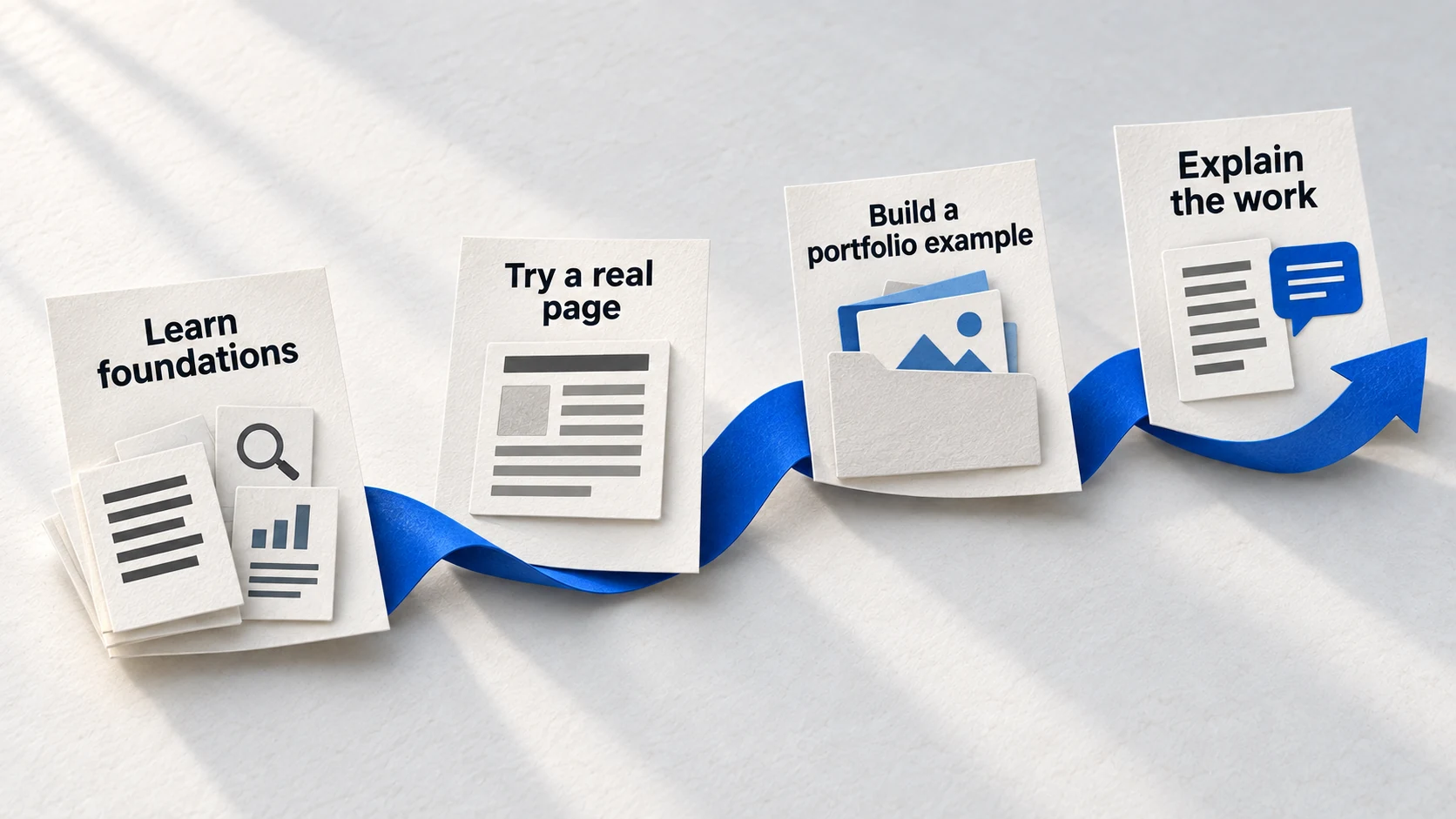
The 90-Day Learning Roadmap
This roadmap assumes 5-10 hours per week of dedicated learning and practice. Adjust timeline based on your available time.
The 90-Day Learning Roadmap
Foundations
Weeks 1-4
Hands-On Practice
Weeks 5-8
Portfolio Building
Weeks 9-12
Weeks 1-4: Foundation Building
Goal: Understand GEO concepts and establish baselines.
- • Week 1: Learn core GEO concepts-how AI systems find and cite content, platform differences, citation mechanics
- • Week 2: Study schema markup basics-Article, FAQ, Organization, Person schemas and JSON-LD syntax
- • Week 3: Audit 15-20 pages (yours or a project site) for GEO readiness-content structure, schema implementation, E-E-A-T signals
- • Week 4: Establish baselines-test key queries across ChatGPT, Perplexity, Claude, and Google AI Overviews; document current visibility
Deliverable: Audit document with baseline AI visibility measurements.
Weeks 5-8: Implementation Practice
Goal: Apply GEO optimizations to real content.
- • Week 5: Restructure 3-5 pages with answer-first formatting-add question-based headings, self-contained answer blocks, statistics with sources
- • Week 6: Implement schema markup on audited pages-FAQ schema, Article schema with author information, Organization schema
- • Week 7: Build entity consistency-ensure brand mentions match across site, add author bios with credentials, connect social profiles
- • Week 8: Set up tracking-GA4 segments for AI traffic, weekly cross-engine citation reviews, competitive monitoring
Deliverable: Implementation log showing specific changes made to each page.
Weeks 9-12: Documentation and Positioning
Goal: Build portfolio evidence and prepare for job market.
- • Week 9: Re-test visibility-compare current AI citations to baseline measurements; document improvements
- • Week 10: Run platform-specific experiments-test what works differently on ChatGPT vs. Perplexity; document findings
- • Week 11: Create case studies-before/after snapshots, specific optimizations made, measurable results
- • Week 12: Build portfolio presentation-organize learnings into shareable format; update LinkedIn/resume with GEO skills
Deliverable: 2-3 case studies with measurable GEO improvements.
Building Credibility Without Clients
The biggest challenge for career changers: how do you prove GEO skills without client work? Here's how to build credibility from scratch.
Option 1: Optimize Your Own Content
Your personal website, blog, or LinkedIn profile is a GEO testing ground. Document your own AI visibility journey:
- • Test queries about your expertise across AI platforms
- • Implement GEO optimizations on your own content
- • Track citation improvements over 30-60 days
- • Document the process as a case study
Example outcome: "I increased my AI citation rate for [topic] queries from 0 to appearing in 3 out of 4 tested platforms over 45 days."
Option 2: Pro Bono Projects
Offer GEO audits to nonprofits, small businesses, or startups in exchange for permission to use results in your portfolio:
- • Local businesses often have zero AI visibility-easy baseline
- • Small organizations appreciate free expertise
- • Real client work (even unpaid) demonstrates practical application
Option 3: Public Analysis Projects
Analyze publicly visible GEO patterns and publish findings:
- • Compare how different brands in an industry appear in AI answers
- • Test what content types get cited most for specific query categories
- • Document platform differences for your niche
- • Publish analysis on LinkedIn or your blog
This positions you as someone actively researching GEO-demonstrating both knowledge and initiative.
Landing Your First GEO Role
GEO roles exist in three forms right now:
Find Your GEO Role Path
Question
Which GEO role fits your background?
GEO Specialist role
Direct transition
Content Strategist + GEO
Leverage writing skills
GEO Analyst role
Focus on measurement
GEO Specialist role
Direct transition
Content Strategist + GEO
Leverage writing skills
GEO Analyst role
Focus on measurement
Role Type 1: GEO-Specific Positions
Titles like "GEO Specialist," "AI Search Strategist," or "Generative Engine Optimization Manager" are emerging at agencies and larger companies.
Where to find them: Marketing agencies, SaaS companies, enterprise brands with in-house marketing teams.
Role Type 2: SEO Roles with GEO Requirements
Many SEO positions now include "GEO knowledge preferred" or "AI search optimization experience." Your GEO skills become a differentiator.
Approach: Apply to SEO roles and emphasize GEO capabilities as an add-on that makes you more valuable.
Role Type 3: Content Strategy Roles
Content roles increasingly require understanding AI content consumption. Your GEO knowledge positions you as future-ready.
Approach: Pitch GEO as the evolution of content strategy-not a separate discipline, but where content strategy is headed.
Pro Tip
Don't rebrand overnight. Transition gradually by adding GEO to your existing SEO work. Clients prefer 'SEO + GEO' specialists over pure GEO specialists right now.
Interview Preparation Essentials
- 1. Know your numbers: Be ready to cite AI search statistics and explain why they matter for the business.
- 2. Show your work: Bring portfolio evidence-before/after citations, implementation logs, case studies.
- 3. Understand platform differences: Know how ChatGPT, Perplexity, Claude, and Google AI Overviews differ.
- 4. Connect to business outcomes: Explain how GEO visibility translates to brand awareness and leads.
What Employers Actually Look For (2026 Data)
Based on analysis of emerging GEO job postings and industry surveys, here's what differentiates candidates who get hired:
Data Analysis Skills (50% cite as critical)
Being able to understand GA4 is not enough. Employers want SEOs who can correlate GA4 with Google Search Console, AI platform analytics, and citation tracking tools to build a complete picture in a "no-click world."
Entity & Semantic Understanding (46% cite as emerging priority)
Moving beyond keywords to entities, semantics, structure, and authority signals that help LLMs interpret what your brand is known for-and cite you reliably.
Stakeholder Communication (39% cite as differentiator)
Explaining AI search impact to executives who don't understand the shift. Translating complex concepts into business outcomes.
Multi-Platform Strategy (39% cite as essential)
Understanding that ChatGPT, Perplexity, Google AI Overviews, and Claude each work differently-and knowing how to optimize for each.
Source: Lumar SEO Industry Report 2026
The modern GEO professional is no longer just a "Google search specialist." By 2026, the role looks more like an AI-literate growth strategist who can connect user behavior, machine understanding, and commercial outcomes. Think of SEO as building the stage, while GEO makes sure your spotlight shines when AI answers the audience.
FAQ
Can I break into GEO without SEO experience?
How long does it take to become job-ready for GEO roles?
What GEO skills are most in demand?
Do I need certifications for GEO roles?
Ready to Start Your GEO Career Transition?
You've seen the roadmap. You understand the skills gap. The question is: where do you stand right now?
I've built a system to help brands go from invisible to cited in AI responses. But before I share it with you, I want you to see exactly where you stand.
Take the GEO Readiness Quiz →60 seconds · Personalized report · Free
Continue Learning
Dive deeper into AI search with these related articles:
SEO Is Not Dead: How Your Skills Transfer to AI Search
Already skilled in SEO? Good news: about 60% of your skills transfer to GEO. Learn which tactics still work and which to leave behind.
GEO Interview Questions: What to Expect and How to Answer
Prepare for GEO job interviews with 20+ common questions covering foundational concepts, technical skills, and strategy.
GEO Portfolio Building: Projects That Prove Your Skills
Build a GEO portfolio that demonstrates real expertise with case studies and documented experiments.