GEO & AI Search
Lists, Tables, and Structured Data: What AI Prefers
Quick Answer
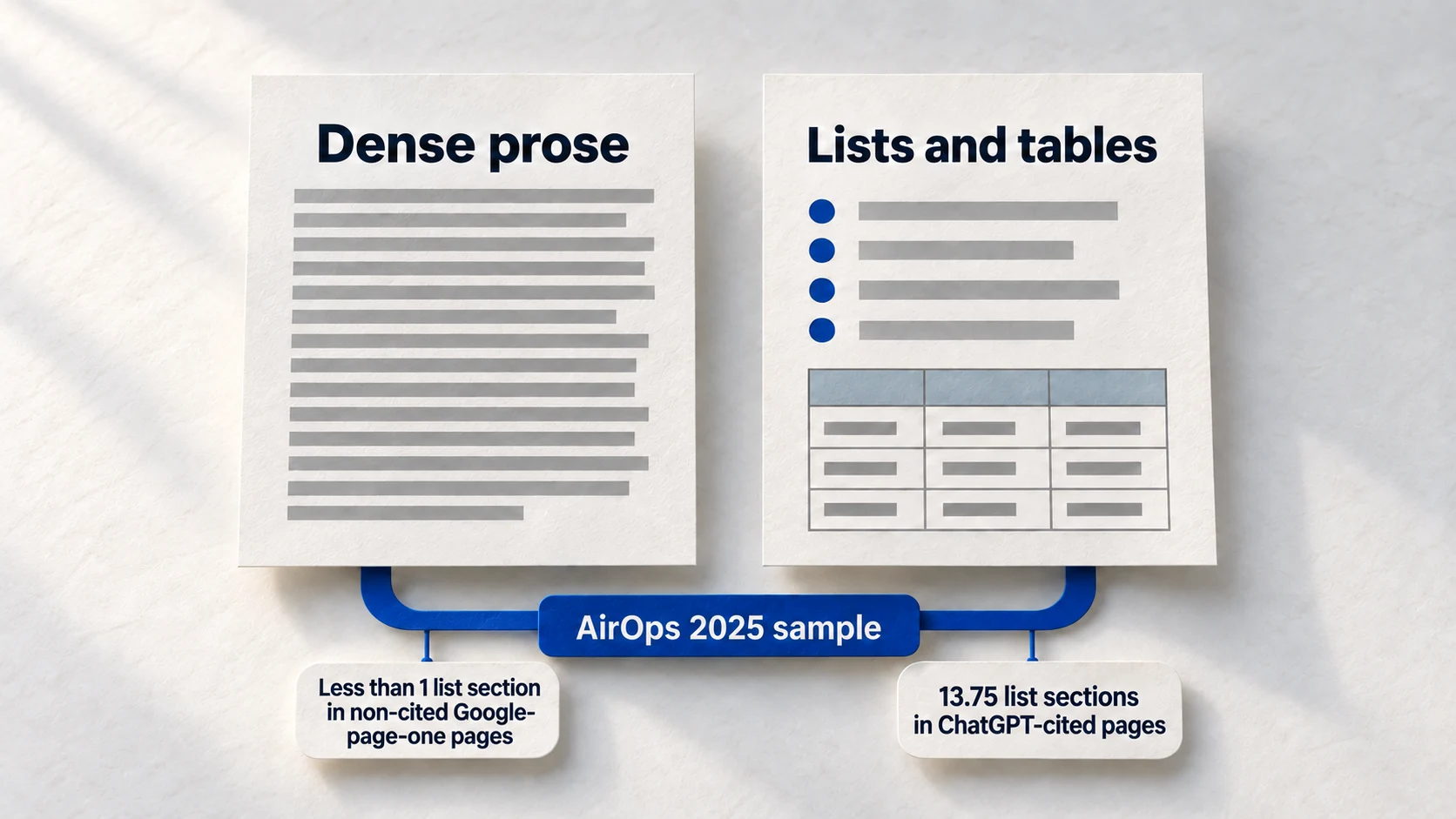
Lists and tables are the most powerful formatting elements for AI citations. ChatGPT-cited pages average 13.75 list sections compared to less than 1 for typical Google results-a 17x difference. Content with tables receives 2.5x higher citation rates than unstructured text. Listicles account for 50% of top AI citations. The pattern is clear: AI engines prefer content organized into discrete, extractable units rather than flowing prose. Combining lists and tables with proper schema markup creates the optimal structure for AI extraction.
You've written comprehensive content. Thoroughly researched. Well-organized. But when AI engines scan your page, they see a wall of text they can't easily parse.
The difference between content AI ignores and content AI cites often comes down to format, not quality. Paragraphs require AI systems to extract meaning. Lists and tables present that meaning ready to quote.
This isn't about dumbing down content-it's about making excellent content extractable.
Why Lists Dominate AI Citations
Listicles account for 50% of top AI citations. Not because AI systems are simplistic-because lists solve the extraction problem that paragraphs create.
17x
more list sections in ChatGPT-cited content
ChatGPT-cited pages average 13.75 list sections. Google SERP leaders average less than 1.
Source: AirOps Research →50%
of top AI citations are listicles
Half of the content AI engines cite most frequently uses list-based structure.
Source: Onely →Why AI Engines Prefer Lists
When AI systems parse content, they need to identify distinct pieces of information that can be extracted, compared, and quoted. Paragraphs blend ideas together-lists separate them.
- • Clear boundaries: Each list item is a discrete unit of information with defined start and end points
- • Consistent formatting: Parallel structure makes parsing predictable and reliable
- • Self-contained meaning: Well-written list items don't require context from surrounding content
- • Easy comparison: Multiple list items can be compared and ranked by AI systems
Same Content, Different Format
Paragraph Format (Hard to Extract)
E-E-A-T signals for AI citations include demonstrating first-hand experience through case studies and examples, showing expertise via credentials and author bios, building authority through external citations and mentions, and establishing trustworthiness with transparent sourcing and security signals.
List Format (Easy to Extract)
- Experience: Case studies and real examples
- Expertise: Author credentials and bios
- Authority: External citations and mentions
- Trustworthiness: Transparent sourcing
Both contain identical information. The list version is immediately extractable; the paragraph requires AI parsing.
Tables: The 2.5x Citation Multiplier
Content with tables receives 2.5x higher citation rates than unstructured comparison text. Tables provide something AI systems crave: explicit data relationships.
The table advantage: When AI systems need to compare options, answer "which is better" questions, or synthesize multi-factor decisions, tables give them structured data rather than prose they must interpret.
When Tables Work Best
- • Feature comparisons: Tool A vs Tool B across multiple criteria
- • Pricing tiers: Different service levels with included features
- • Specifications: Technical details organized by attribute
- • Process stages: Steps with associated timeframes, costs, or outcomes
- • Data summaries: Statistics organized by category or time period
| Format | AI Extraction Ease | Best For | Citation Impact |
|---|---|---|---|
| Bullet Lists | High | Features, benefits, examples | 17x more common in cited content |
| Numbered Lists | High | Steps, rankings, sequences | Essential for how-to content |
| Tables | Very High | Comparisons, specifications | 2.5x citation rate |
| Paragraphs | Low | Narrative, context | Baseline |
The table above illustrates the principle it describes: comparing four formats across multiple attributes in a structure AI can immediately parse and quote.
How Structured Data Amplifies Both
Lists and tables work at the content level. Schema markup works at the metadata level. Together, they create the optimal structure for AI extraction.
61%
of ChatGPT-cited pages have rich schema
Compared to just 25% of Google SERP URLs. Schema tells AI what type of content it's reading.
Source: AirOps Research →3-5x
more AI recommendations with comprehensive schema
Products and services with complete schema markup appear far more frequently in AI recommendations.
Source: Onely →The Three Layers of AI-Optimized Structure
Content Layer: Lists and Tables
Organize information into extractable units that AI can parse without interpretation.
Metadata Layer: Schema Markup
Tell AI systems what type of content they're reading (FAQ, HowTo, Article, Product).
Hierarchy Layer: Headings
Create the structural framework that connects content elements to topics.
Each layer reinforces the others. A FAQ section (content layer) marked up with FAQPage schema (metadata layer) under a clear H2 heading (hierarchy layer) creates maximum AI visibility for those questions and answers.
Numbered vs Bullet Lists: When to Use Each
Both formats work well for AI extraction, but they serve different purposes and trigger different AI behaviors.
| Numbered Lists | Bullet Lists |
|---|---|
| Sequential steps (first, second, third) | Non-sequential items (features, benefits) |
| Rankings and priorities | Examples and options |
| Processes with defined order | Characteristics or attributes |
| Countable items ("5 ways to...") | Open-ended collections |
The sequence principle: When order matters, use numbers. When items are interchangeable, use bullets. AI systems interpret numbered lists as sequences and may quote them in order; bullet lists are treated as collections where any item might be selected.
Implementation Patterns That Work
Based on analysis of ChatGPT-cited content, these patterns consistently outperform traditional paragraph-heavy formats.
High-Citation Content Patterns
Pattern 1: Answer + Evidence List
Start with a direct answer in 1-2 sentences, then support with a bulleted list of evidence or examples.
Example: "GEO differs from SEO in five key ways:" followed by bulleted comparison points.
Pattern 2: Comparison Table
For any content comparing 3+ items across multiple attributes, use a table instead of prose.
Example: Tool comparison with columns for features, pricing, and best-for-use-cases.
Pattern 3: Step-by-Step with Numbered List
For processes, use numbered lists with clear action verbs starting each item.
Example: "How to implement schema markup: 1. Choose your schema type, 2. Generate the JSON-LD, 3. Add to page head..."
Pattern 4: FAQ + Schema
Pair explicit Q&A format with FAQPage schema for maximum AI visibility on question-based queries.
Example: H3 heading as question, followed by direct answer paragraph, marked up with FAQPage schema.
Content Transformation Checklist
- 1. Identify paragraphs containing 3+ distinct items or steps
- 2. Convert sequential content to numbered lists
- 3. Convert non-sequential collections to bullet lists
- 4. Add comparison tables for multi-attribute content
- 5. Ensure each list item is self-contained (15-30 words)
- 6. Add relevant schema markup (FAQPage, HowTo, or Article)
- 7. Verify heading hierarchy follows H1 → H2 → H3 sequence
FAQ
How many list sections should a blog post have?
Should I use tables for all comparative content?
Does schema markup replace the need for lists and tables?
What's the ideal list item length for AI extraction?
Should I convert existing paragraphs to lists?
Ready to Transform Your Content Structure?
Lists and tables are the fastest path to AI citations.
Start with your highest-traffic pages first.
Take the GEO Readiness Quiz →60 seconds · Personalized report · Free
Continue Learning
Dive deeper into AI search with these related articles:
Content Structuring for AI Consumption: The Answer-First Framework
Master the complete framework for structuring content that AI systems cite. Lists, tables, modular blocks, and answer-first formatting for GEO success.
Heading Structure Optimization for AI Consumption
Learn how to structure H1, H2, and H3 headings for AI search visibility. Sequential heading hierarchy is 3x more common in ChatGPT-cited content.
The Answer Block: Creating Citation-Worthy Content Units
Learn how to structure content in self-contained answer blocks that AI engines can extract and cite. The 72.4% citation pattern explained.