GEO & AI Search
Zero-Click Visibility as the New Billboard: Rethinking Content ROI
Quick Answer
Zero-click visibility means being the answer users receive without ever clicking through to your website. This isn't a threat to your content ROI-it's a different measurement of success. While 80% of searches now result in zero-click answers according to Bain & Company, the traffic that does convert carries a 4.4x conversion lift versus traditional organic traffic. Your visibility is moving from clicks to recommendations, and recommendations drive higher-quality revenue.
Your dashboard shows green. Rankings are stable. Keyword positions look great. But when you ask ChatGPT about your industry, your brand is nowhere. And when you check this quarter's leads against last year's-despite all those green lights-something doesn't add up.
This disconnect is happening across industries right now, and it's causing real confusion in marketing teams everywhere.
The Paradox: Why Your Dashboard Lies
It's the most confusing feeling in modern marketing.
12.4K
847K
3.4%
8.2
Your Search Console looks healthy. But is it telling the whole story?
You pull up Google Search Console, and the lines are steady. You check your rank tracker, and you're holding position 3 for your main commercial keywords. The technical audit came back clean last month. Your content team is publishing consistently, and your backlink profile is growing.
Yet leads are trickling down. The phone isn't ringing quite as often. Your boss is asking questions you don't have great answers for. The disconnect between what your tools say and what your business feels is growing wider by the quarter.
This isn't a technical glitch. It's not a Google algorithm update you missed. It's not your competitors outspending you on content. It's a paradigm shift in how people find and consume information-and your dashboard wasn't built to track it.
25%
decline in search engine volume by 2026
Users are getting answers from AI platforms instead of clicking through to websites
Source: GartnerThat traffic isn't disappearing-it's moving. It's moving to platforms that your traditional SEO dashboard doesn't track. Users are asking ChatGPT, getting answers from Perplexity, and reading AI Overviews at the top of Google results. They're getting what they need without ever clicking your link.
If your dashboard is green, why does it feel like the sky is falling? Because your dashboard is measuring a game that fewer people are playing. Traditional metrics measure how well you rank on a list. They don't measure how often you are the answer.
Your SEO Dashboard (All Systems Green)
+12%
vs last month
847
Stable rankings
58
Industry average
0
No critical errors
And here's the uncomfortable truth: being invisible to AI means being invisible to a growing percentage of your potential customers, no matter how well you rank in traditional search.
The New Billboard Concept
We need to stop thinking about visibility solely as "traffic."
In the old world, traffic was the proxy for attention. If they clicked, they saw you. If they didn't click, you were invisible. Everything was measured in sessions and pageviews. The assumption was simple: no click, no value.
In the AI era, visibility is closer to a billboard in Times Square-or better yet, a personal recommendation from a trusted friend. You don't need to click a billboard for it to work. You don't need to "click" a friend's advice to trust it and act on it later.
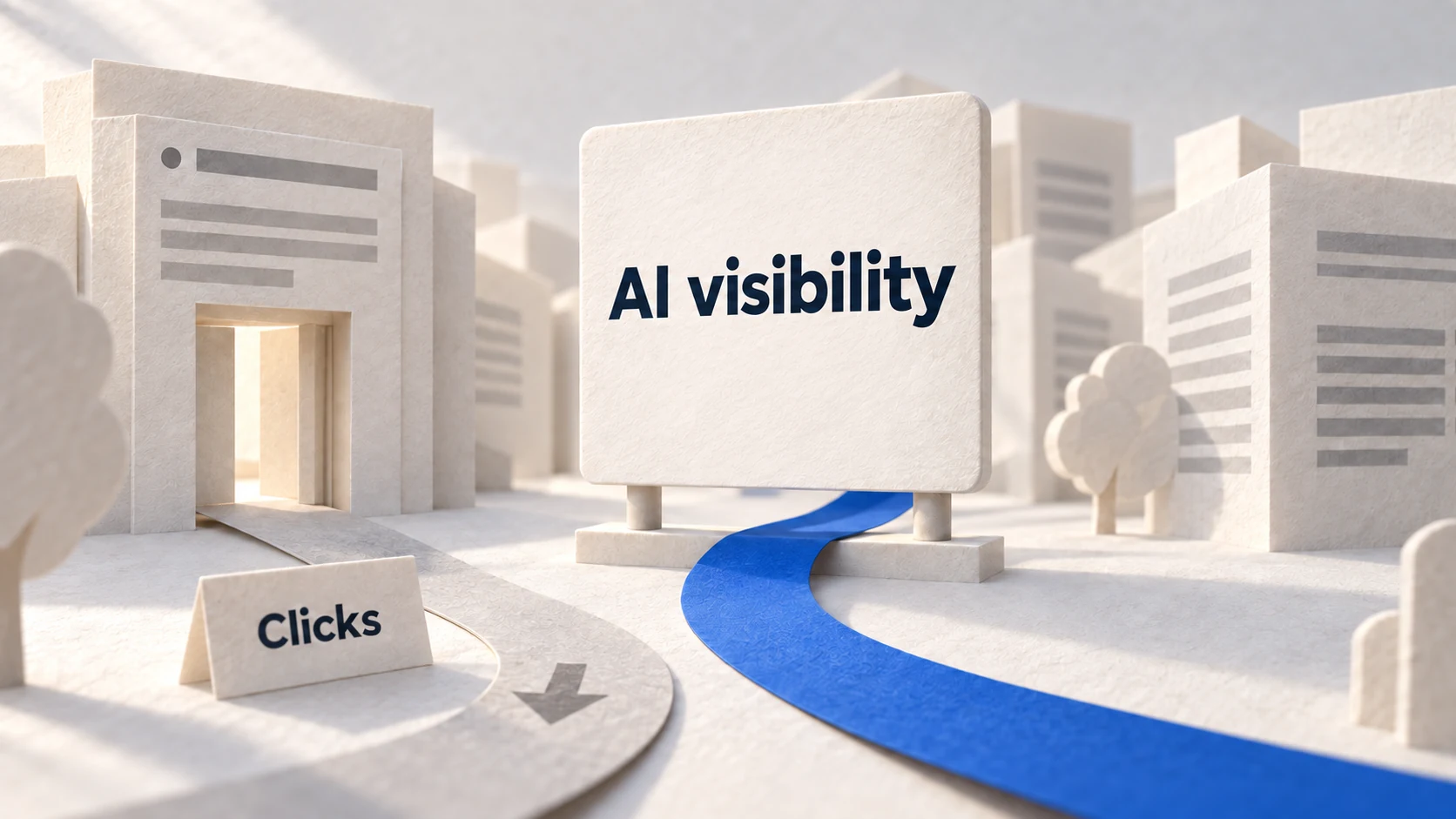
When ChatGPT recommends your product to answer a user's question, that's a recommendation. When Google's AI Overview quotes your statistic to explain a concept, that's a citation. When Perplexity lists you as one of the top three options in a category-that's visibility that drives brand awareness and purchase decisions, even if nobody clicks.
How Visibility Measurement Has Changed
Think about how you've started using AI search yourself. When ChatGPT recommends a tool, do you always click through to research it further? Or do you sometimes just trust the recommendation and Google the brand name directly when you're ready to buy?
That direct search-triggered by an AI recommendation you never clicked-doesn't show up in your traditional referral reports. But it absolutely influenced the purchase decision.
Why Billboard Visibility Actually Works
Does this "billboard" visibility actually pay the bills? The evidence says yes-and the mechanism explains why.
Look at NerdWallet. Despite a reported 20% decline in traffic, they posted 37% revenue growth. How? Because their brand authority is so strong that when they are mentioned-whether in a snippet, an AI answer, or a direct search-the user who does arrive converts at a much higher rate.
Why Zero-Click Visibility Converts Better
- 1
Pre-Qualification Happens Before the Click
- 2
Trust Transfer from AI Authority
- 3
Intent Concentration Effect
- 4
Brand Search Multiplier
They aren't chasing clicks. They're chasing the recommendation. And the recommendation is worth more because it comes with built-in trust and pre-qualified intent.
Old Metrics vs New Metrics
Your current dashboard probably tracks metrics that made perfect sense five years ago. The problem isn't that those metrics are wrong-it's that they're incomplete. They measure one type of success while leaving another type completely invisible.
How to Read This Comparison: The left column shows what traditional SEO dashboards measure. The right column shows what you need to add for AI visibility. Most businesses need both-but if you're only tracking the left column, you're flying blind on AI.
The Old Scoreboard vs The New Scoreboard
| Metric Type | Old SEO Metrics | New GEO Metrics |
|---|---|---|
| Primary KPI | Total Organic Sessions | AI Citation Frequency |
| Ranking Focus | Keyword Position | Share of Model Visibility |
| Click Measurement | Click-Through Rate (CTR) | Conversion Rate per Source |
| Quality Signal | Bounce Rate | Brand Mention Context (+/-) |
| Attribution | Last-Click Attribution | Recommendation Attribution |
| Competitive Intel | Keyword Gap Analysis | AI Share of Voice |
You can't manage what you don't measure. If you're still reporting solely on "Sessions," you're reporting on a shrinking pie while the real feast is happening in the zero-click recommendations you're not tracking.
Pro Tip
Start by adding AI referral traffic as a custom channel in GA4
Use regex patterns like chatgpt.com|perplexity.ai|claude.ai to segment AI traffic separately from organic. This gives you baseline data on AI-referred conversion quality.
How to Measure Zero-Click Visibility
If you can't rely on clicks, what do you count?
You need to shift from volume metrics to visibility metrics. The brands winning right now are tracking three new KPIs that your traditional SEO dashboard probably doesn't show:
- 1 AI Citation Frequency
How often do ChatGPT, Claude, and Gemini cite your brand for queries in your niche? This requires active monitoring-asking AI platforms queries relevant to your business and tracking whether you appear in responses. You're essentially polling AI to measure your visibility where traditional analytics can't reach.
- 2 Share of Model Visibility
What percentage of the time does your product appear in "Best X tools" or "How to Y" lists generated by AI? This is your AI search market share-your visibility relative to competitors in the same category. It's the AI equivalent of share of voice, and it's becoming the most important competitive metric in many industries.
- 3 AI Referral Traffic Quality
Not how many come, but how well they convert. Quality beats quantity in AI-referred traffic. Segment your AI referral traffic in GA4 and compare conversion rates, average order value, and customer lifetime value against other channels. This is where the 4.4x conversion lift shows up.
Tools for Tracking AI Visibility
The tooling ecosystem for AI visibility tracking is still emerging, but several solutions are already proving valuable. Here's what's available now:
AI Visibility Tracking Tools
AI Citation Monitoring
Otterly
Tracks mentions across ChatGPT, Perplexity, and Claude. Includes competitive visibility comparison and alert system for citation changes. Best for brands serious about tracking AI share of voice.
GEO Analytics Platform
Geoptie
Comprehensive AI visibility metrics with historical citation tracking and entity recognition analysis. Best for enterprise teams building GEO programs.
For teams not ready to invest in dedicated tools, you can start with manual monitoring using a simple spreadsheet. Track 10-20 key queries weekly across ChatGPT, Perplexity, and Google AI Overviews. It's not scalable long-term, but it gives you baseline visibility data.
Weekly AI Visibility Check Template
💡 Use queries your customers actually ask
💡 Track trends, not single data points
✨ Save this template for consistent formatting across all platforms
The ROI Argument
This isn't just about feeling good about "brand awareness." It's about efficiency-getting more revenue from fewer, higher-quality visits.
4.4x
higher conversion rate from AI referrals
Visitors from AI recommendations are pre-qualified with higher purchase intent because AI did the comparison work for them
Source: SemrushWhy is this conversion rate so much higher? Because the user is pre-qualified.
When a user clicks a blue link in traditional search, they are exploring. They're comparing options, reading different perspectives, trying to figure out what's best. When a user clicks a citation in ChatGPT or follows a Perplexity recommendation, they are validating a recommendation they've already received. The AI did the comparison work for them. The intent is deeper. The trust is higher.
You might get fewer visitors. But you will get better customers.
This is why NerdWallet's math works out. Fewer visits, but each visit is worth more. The zero-click visibility they've built means that when someone finally does click through-from an AI recommendation, a snippet, or a direct search for their brand-that visitor arrives with trust already established. The sales cycle is shorter. The conversion rate is higher. The customer acquisition cost is lower.
Implementation Roadmap
Shifting your measurement framework doesn't happen overnight. Here's a phased approach:
30-60-90 Day Implementation Plan
- 1
Days 1-30: Establish Baseline
- 2
Days 31-60: Build Monitoring Systems
- 3
Days 61-90: Optimize and Report
What to Do Now
You have a choice. You can keep staring at the green lights on your old dashboard, wondering why revenue is flat despite stable rankings. Or you can start optimizing for the new billboard-the zero-click recommendation that drives the revenue you actually care about.
The game has changed, and the scoreboard has changed with it.
Start this week: ask ChatGPT, Perplexity, and Google Gemini the questions your customers ask. See who appears. If it's not you, you've found your problem. If it is you, you've found an asset worth measuring and protecting.
FAQ
Does zero-click visibility actually convert to revenue?
How do I track zero-click visibility if there's no click?
Is zero-click visibility replacing traditional SEO?
What's the difference between impressions and zero-click visibility?
How long does it take to build zero-click visibility?
Measure What Actually Matters
You've just learned why traditional metrics are lying to you.
Take the GEO Readiness Quiz to see where your content stands in AI search-and get a personalized roadmap to zero-click visibility.
Take the GEO Readiness Quiz →60 seconds · Personalized report · Free
Continue Learning
Dive deeper into AI search with these related articles:
The Zero-Click Reality: Why Your Traffic Is Down 40%
80% of searches now end without a click. But traffic loss doesn't have to mean business loss. Here's how to adapt and thrive.
Case Study: How NerdWallet Grew Revenue 37% Despite Traffic Decline
NerdWallet lost 20% of organic traffic but grew revenue 37%. Here's exactly how they did it and what you can learn.
The Quality vs Quantity Shift: Why 200 AI Referrals Beat 1,000 Organic Visits
AI referral traffic converts 4.4x better than traditional organic. Learn why quality trumps quantity in AI search.