GEO & AI Search
Quality vs Quantity: Why AI Referral Traffic Converts Up to 5x Better
Quick Answer
AI-referred traffic converts 3x to 5x better than traditional organic traffic for B2B and services businesses-because these visitors arrive pre-qualified, with specific intent, and trust from the AI's recommendation. For services companies, 200 AI referrals can match 1,000 organic visits in revenue generation-the key is knowing whether your industry benefits from this lift.
You pull up your monthly traffic report. 50,000 organic visits.
Your competitor shows 10,000.
But your competitor is generating 3x your revenue.
You've checked the numbers three times. You've audited their site. Your traffic is higher. Your bounce rate is decent. Your rankings are competitive.
So what's happening?
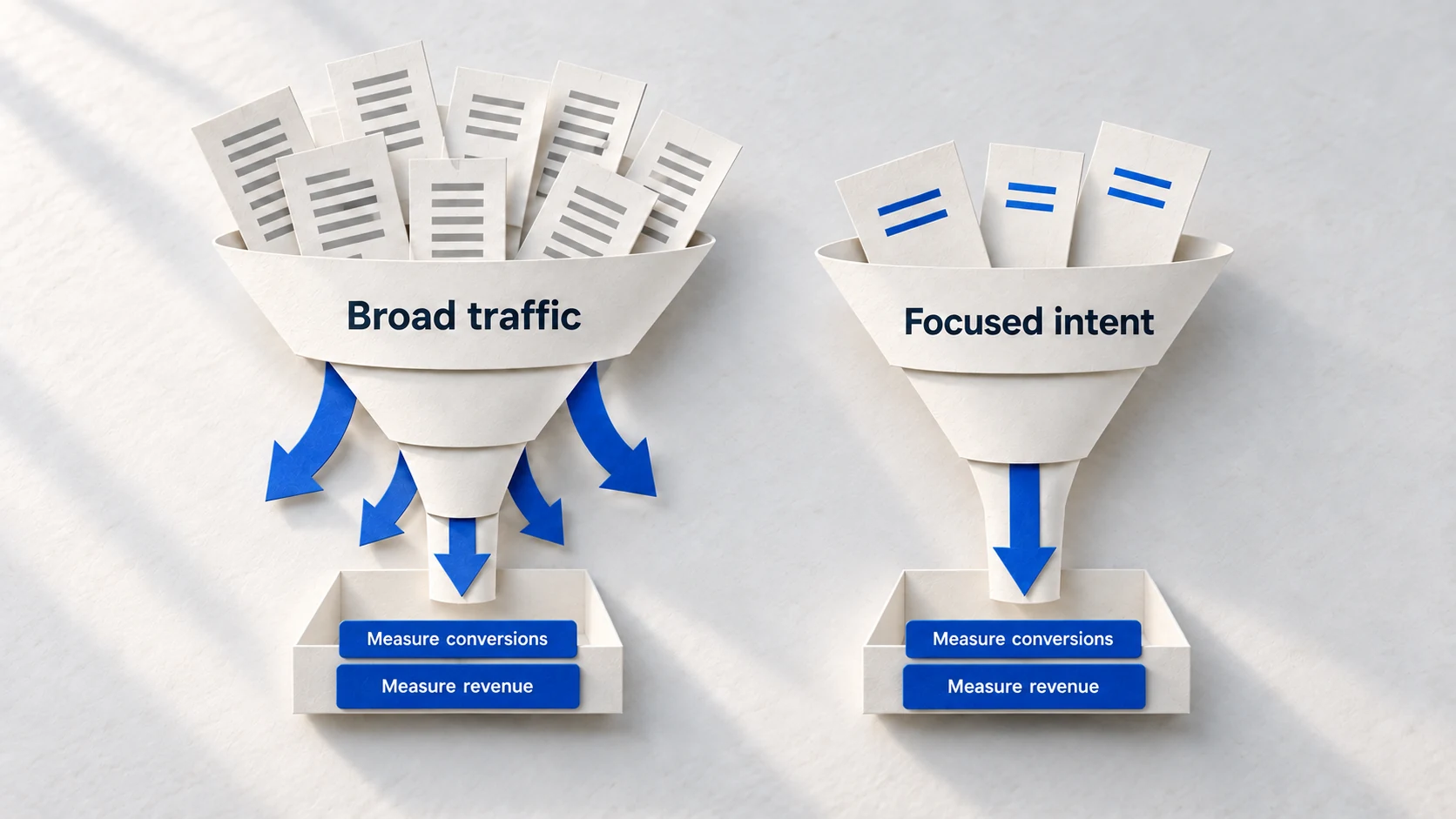
Your competitor isn't optimizing for traffic. They're optimizing for the right kind of traffic. And AI search is changing what "right" means.
Definition
Qualified Traffic vs Traffic Volume
Qualified traffic refers to visitors who arrive with specific intent and context, making them more likely to convert. Traffic volume simply counts total visitors regardless of conversion potential. In the AI search era, 200 qualified visitors (pre-screened by AI) can generate more revenue than 1,000 general organic visitors.
The Conversion Data That Changes Everything
Here's what Semrush's 2025 AI Search Study found:
3x–5x
higher conversion rate for AI-referred visitors (industry-dependent)
AI-referred visitors convert 3x-5x better than organic-strongest for B2B and services. E-commerce results are more mixed. The 3x-5x range comes from Semrush 2025 and Microsoft Clarity research across multiple industries.
Source: Semrush / Microsoft Clarity
Let's translate that into real numbers:
Scenario: Services/SaaS Company with 2% Average Conversion Rate
Traditional Organic Traffic
1,000 visitors
× 2% conversion rate
= 20 conversions
AI-Referred Traffic (5x lift)
200 visitors
× 10% conversion rate (5x better)
= 20 conversions
200 AI referrals = 1,000 traditional organic visits in conversion value (for services/B2B at 5x lift)
Note: E-commerce industries see more variable results. B2B and services businesses benefit most.
This isn't a minor difference. This is a fundamental shift in how we measure success.
Old metric:
"How much traffic can I get?"
New metric:
"How much qualified traffic can I get?"
Why AI Referrals Convert Better: The 3 Pre-Qualification Factors
AI-referred visitors don't stumble onto your site. They arrive with three critical advantages:
Factor #1
Specific Intent, Not Exploratory Browsing
Traditional SEO visitor: Types "CRM software" into Google, clicks on the top result, browses vaguely.
AI-referred visitor: Asks ChatGPT "What's the best CRM for a 15-person marketing team that integrates with HubSpot and costs under $100/user/month?"
The AI provides a specific answer. If your CRM is cited, the visitor arrives knowing:
- • You offer exactly what they need
- • You fit their budget and requirements
- • An AI "expert" vetted you
They're not browsing. They're validating a recommendation.
Factor #2
Pre-Qualified by Context, Not Just Keywords
AI doesn't just match keywords. It understands context.
When someone asks Claude: "I'm a solopreneur launching a design agency. I need project management software that won't overwhelm me but can scale as I hire."
The AI considers:
Business Context
Solopreneur, design agency, growth plans
User Experience Level
"Won't overwhelm me" = beginner-friendly
Scalability Need
Can grow with hiring
Industry Fit
Design agency workflows
If Claude cites you, it's not just because you mentioned "project management." It's because your solution matches their entire context.
Factor #3
Trust Transfer from the AI
This is the least obvious but most powerful factor.
When someone uses Google, they know they're seeing search results. They apply healthy skepticism.
When someone uses ChatGPT or Perplexity, the interaction feels like asking an expert. The AI's recommendation carries implied endorsement.
Psychological Framing:
Traditional SEO:
"Here are 10 websites that mention this topic. You figure out which is credible."
AI Search:
"Based on my analysis, here are the 2-3 best options for your specific situation."
Users arrive on your site with borrowed trust. They've already been told you're a good fit.
AI referrals convert better because they're not cold traffic. They're warm leads delivered by a trusted intermediary.
What This Means for Your Business
The quality-vs-quantity shift changes how you allocate resources.
Case Study
NerdWallet experienced a 20% traffic decline but achieved 37% revenue growth. How? They optimized for high-intent, high-converting visitors-many from AI referrals and zero-click searches.
The traditional model:
- → Optimize for traffic volume
- → More rankings = more clicks = more conversions
- → Success metric: "We got 100K visitors this month!"
The AI search era model:
- → Optimize for visitor quality
- → AI citations = pre-qualified traffic = higher conversions
- → Success metric: "Our AI-referred visitors converted at 9.2%!"
ROI Comparison: Volume vs Quality Traffic Strategy
| Metric | Volume-Focused (Traditional) | Quality-Focused (AI-Optimized) |
|---|---|---|
| Monthly Visitors | 50,000 organic | 10,000 organic + 2,000 AI |
| Avg Conversion Rate | 2% organic | 2% organic + 8.8% AI |
| Total Conversions | 1,000 | 200 + 176 = 376 |
| Revenue (@ $100 AOV) | $100,000 | $37,600 |
| BUT: AI Growth YoY | Declining 15-25% | Growing 527% |
| 3-Year Projection | $255,000 (declining) | $450,000+ (growing) |
The companies optimizing for AI citations today are building compounding advantages while competitors chase declining traffic numbers.
Strategic Implications: 3 Shifts You Need to Make
Stop Obsessing Over Total Traffic Numbers
If your analytics show 40% traffic decline but your revenue is stable (or growing), you're not failing-you're adapting successfully.
New KPIs to track:
- AI referral conversion rate vs organic conversion rate
- Revenue per visitor (not just total visitors)
- Traffic quality score (bounce rate, time on site, pages per session by source)
- AI citation frequency (how often you're recommended)
Optimize Content for Citability, Not Just Rankability
Content optimized for AI citations has different characteristics than content optimized for Google rankings.
Traditional SEO Content
- • Keyword density
- • Comprehensive word count
- • Internal linking
- • Header tag optimization
AI-Citation Content
- • Direct answer in first 100 words
- • Specific, extractable facts
- • Clear expertise signals
- • Contextual clarity (no "it", "they")
You need both. But the balance is shifting.
Diversify Traffic Sources (Don't Abandon SEO)
The worst strategy is going all-in on either traditional SEO or AI search.
The Winning Combination:
Traditional SEO:
High volume, lower conversion rate, established channel
AI Search (GEO):
Lower volume (for now), 3x-5x conversion rate (B2B/services), growing rapidly YoY
Think of it as a portfolio: mature asset (SEO) provides stability, emerging asset (GEO) provides growth.
Practical Example: SaaS Company Transition
Here's how a B2B SaaS company (project management software) navigated this shift:
Timeline: 18-Month Transition
Months 0-6: Awareness & Audit
Organic traffic: 45K/month → 32K/month (-29%)
- • Panic → Research → Discovery of AI search shift
- • Audited AI visibility: tested ChatGPT, Perplexity, Claude queries
- • Result: Zero citations in AI responses for their category
Months 7-12: Implementation
Organic traffic: 32K → 30K (-6% ongoing decline)
- • Restructured top 20 pages for AI extraction
- • Added schema markup (Organization, FAQPage, HowTo)
- • Built "Entity Home" with clear expertise signals
- • First AI citation appeared in Month 10
Months 13-18: Results
Organic traffic: 30K stable, AI referrals: 2,400/month
- • Traditional organic conversion rate: 2.1%
- • AI referral conversion rate: 9.4% (4.5x better!)
- • Result: 32% revenue increase despite 33% traffic decline
Key insight from their CEO:
"We used to celebrate hitting 50K monthly visitors. Now we celebrate hitting 10% AI referral conversion rate. The metrics that matter completely changed."
What to Do Right Now
If you're currently measuring success by traffic volume alone, here's your action plan:
1. Audit Your Current AI Visibility
Open ChatGPT, Perplexity, and Claude. Ask industry-specific questions your customers would ask.
Are you cited? If not, you're missing high-converting traffic.
2. Segment Traffic by Source
In Google Analytics, compare conversion rates:
- • Organic search
- • AI referrals (chatgpt.com, perplexity.ai, etc.)
- • Direct
You'll likely see AI referrals converting 3-5x better.
3. Optimize One High-Value Page
Pick your best-performing service/product page. Restructure it for AI citation:
- • Answer main question in first 100 words
- • Add FAQ section with schema
- • Remove vague pronouns ("it", "they")
- • Add clear expertise signals
4. Track the Right Metrics
Create a new dashboard with:
- • Conversion rate by traffic source
- • Revenue per visitor (not just total visitors)
- • AI citation frequency (manual test weekly)
- • Customer acquisition cost by source
Focus on revenue, not vanity metrics.
The companies winning in AI search aren't the ones with the most traffic.
They're the ones with the most qualified traffic.
FAQ
Why do AI-referred visitors convert better than organic visitors?
How much better do AI referrals convert compared to organic traffic?
Should I stop focusing on traditional organic traffic?
Ready to Focus on Quality Over Quantity?
You now understand why 200 qualified AI referrals can outperform 1,000 traditional organic visits. The question is: how visible is your brand in AI search right now?
I've built a system to help brands go from invisible to cited in AI responses. But before I share it with you, I want you to see exactly where you stand.
Take the GEO Readiness Quiz →60 seconds · Personalized report · Free
Continue Learning
Dive deeper into AI search with these related articles:
The Zero-Click Reality: Why Your Traffic Is Down 40%
80% of searches now end without a click. But traffic loss doesn't have to mean business loss. Here's how to adapt and thrive.
Case Study: How NerdWallet Grew Revenue 37% Despite Traffic Decline
NerdWallet lost 20% of organic traffic but grew revenue 37%. Here's exactly how they did it and what you can learn.
How to Explain Traffic Decline to Your Boss (With Template)
Your traffic is down but your business isn't. Here's exactly how to explain the AI search shift to stakeholders.