Case Study
Case Study: How NerdWallet Grew Revenue 37% Despite 20% Traffic Decline
Quick Answer
NerdWallet reported 37% year-over-year revenue growth in Q4 2024 ($183.8 million) despite a 20% decline in monthly users. Their strategy: focus on traffic quality over quantity, optimize for high-intent conversions, build brand authority, and diversify revenue streams. Less traffic, more revenue-proof that traffic volume and business success aren't the same thing.
You check your analytics dashboard. Rankings: stable. Keyword positions: holding steady. Technical SEO: all green.
Then you see the traffic graph. Down 20%.
Your first instinct is panic. Your second is to wonder what you did wrong.
Here's what you need to know: traffic decline doesn't mean business decline.
One of America's largest financial content publishers just proved this. They lost 20% of their traffic and grew revenue by 37% in the same quarter.
The Numbers That Changed Everything
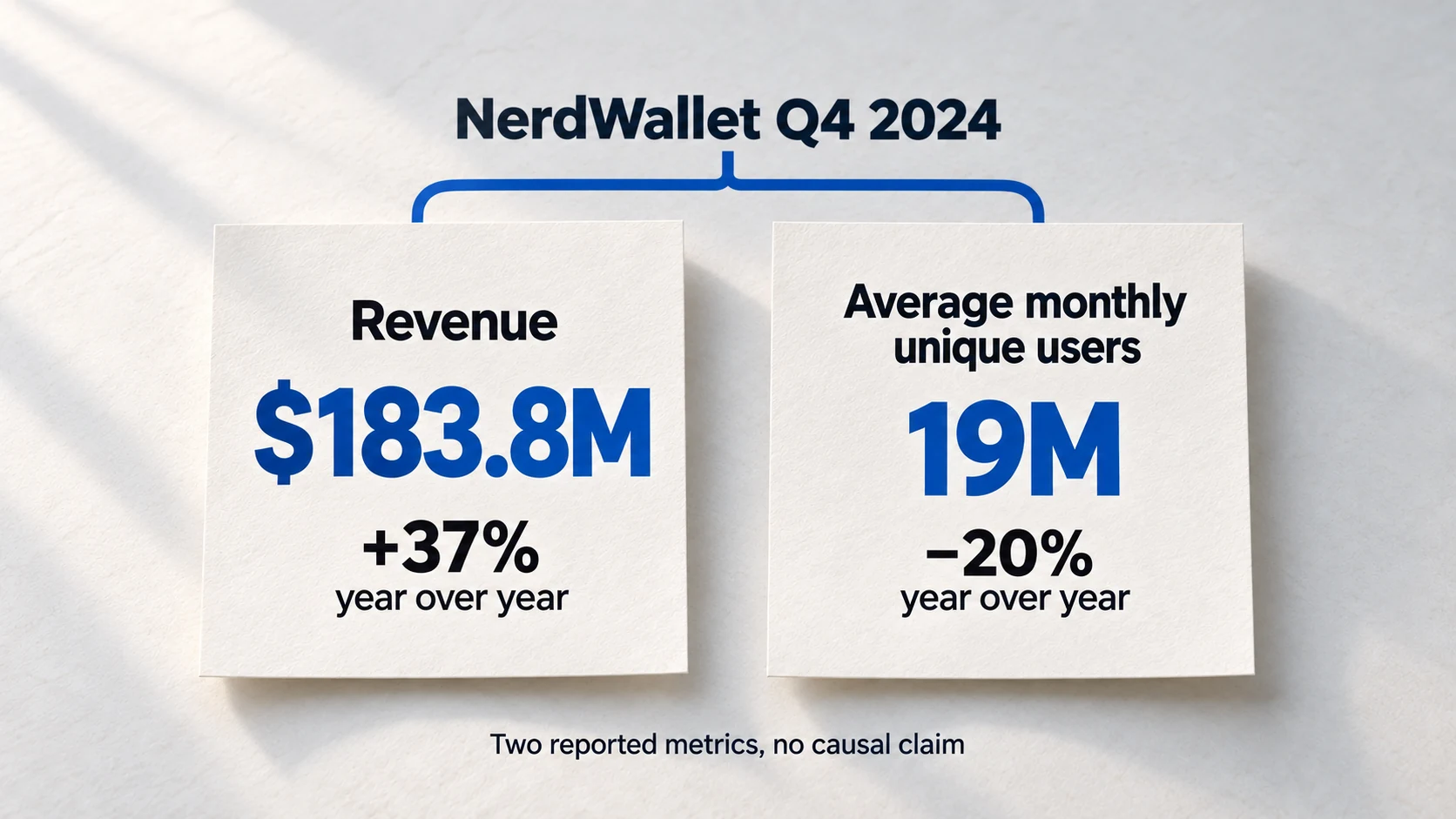
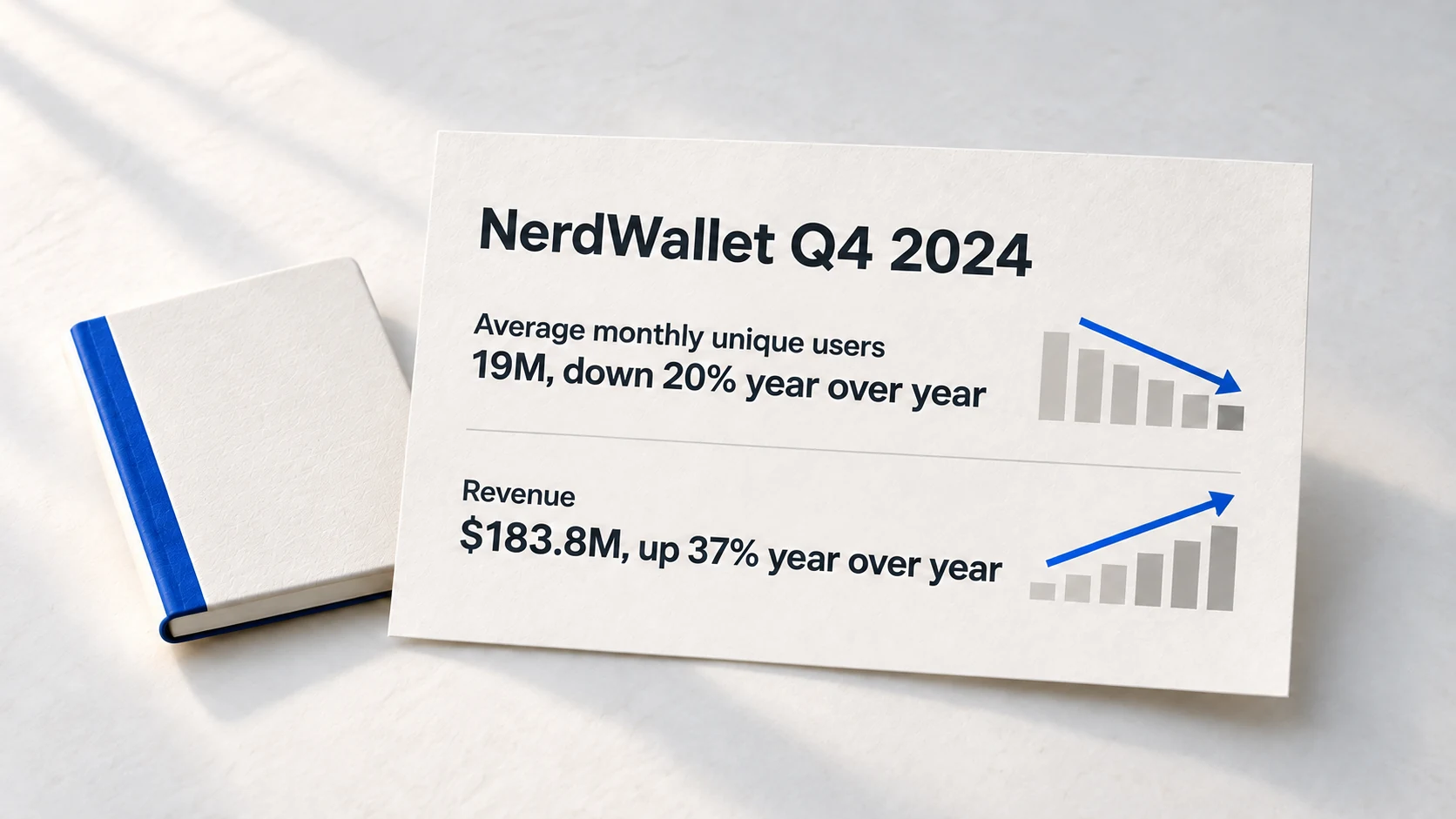
NerdWallet's Q4 2024 investor report revealed something remarkable:
37%
Revenue Growth
Q4 2024 revenue reached $183.8 million, up from $134.6 million in Q4 2023
Source: NerdWallet Investor Relations20%
User Decline
Average monthly unique users dropped from 24 million to 19 million year-over-year
Source: NerdWallet Investor RelationsCEO Tim Chen put it simply: "We closed 2024 strong, exceeding our expectations and growing revenue to $183.8 million, up 37% year-over-year."
The Paradigm Shift
Less traffic. More revenue.
This is what success looks like in the AI search era.
But how? What did NerdWallet do differently while the rest of the industry panicked about traffic decline?
The Four Strategic Shifts
NerdWallet's success wasn't luck. It was strategic adaptation to a fundamental shift in how search works. Here's their playbook:
Quality Over Quantity
Instead of chasing pageviews, NerdWallet optimized for actions that generate revenue-credit card applications, loan inquiries, account signups.
They focused on attracting visitors with genuine purchase intent rather than casual information seekers.
The math: A visitor who applies for a credit card is worth 100 visitors who just read an article.
Brand Authority Investment
NerdWallet built a brand so strong that users search for "NerdWallet credit cards" rather than just "best credit cards."
This brand traffic is immune to AI disruption. When people search for you by name, algorithm changes can't take that away.
Key insight: Branded searches are defensible. Generic searches are vulnerable.
High-Intent Content Focus
Rather than competing for informational queries that AI can answer directly, NerdWallet doubled down on comparison and decision-stage content.
"What is a credit score?" gets answered by ChatGPT. "Compare Chase Sapphire Reserve vs Amex Platinum" still requires clicking through.
The pattern: Informational content loses traffic. Decision content holds strong.
Revenue Diversification
NerdWallet expanded beyond Google organic search-building presence on YouTube, social media, email newsletters, direct partnerships, and paid channels.
When one traffic channel shrinks, diversified sources compensate.
Risk mitigation: Single-channel dependence is a vulnerability, not a strategy.
Why AI-Referred Traffic Converts Better
Here's what NerdWallet (and other early adapters) discovered: traffic from AI sources converts at significantly higher rates than traditional organic traffic.
3x–5x
Higher Conversion Rate (Services/B2B)
AI-referred visitors convert 3x-5x better than organic for services and B2B businesses-NerdWallet's financial services model fits squarely in this high-conversion category.
Source: Semrush / Microsoft ClarityWhy the difference?
Traditional Organic Traffic
• User searches broad query
• Clicks first interesting result
• May or may not be ready to buy
• Often still in research mode
Lower intent, higher volume
AI-Referred Traffic
• User asks specific question
• AI recommends 2-3 sources
• User visits because AI endorsed it
• Higher trust, higher intent
Higher intent, lower volume
This is why NerdWallet could lose 20% of users and still grow revenue 37%. The remaining users were the right users.
How NerdWallet Actually Did It
Understanding the principles is one thing. Let's look at the specific implementation tactics NerdWallet used to achieve these results:
Content Architecture Shift
NerdWallet restructured their content library to prioritize decision-stage assets. Instead of creating more "What is..." articles that AI can answer directly, they invested in:
- → Comparison tools: Interactive calculators and side-by-side comparison pages that require user input and can't be easily summarized by AI.
- → Updated reviews: Real-time, human-verified reviews of financial products that provide value beyond AI-generated summaries.
- → Application workflows: Seamless paths from content to conversion, reducing friction for high-intent visitors.
Revenue Per Visit Optimization
Rather than optimizing for traffic volume, NerdWallet focused on maximizing the value of each visit:
- → Conversion rate optimization (CRO): Systematic testing of CTAs, form placement, and user flows to increase application completion rates.
- → Affiliate relationship quality: Prioritized partnerships with higher-paying financial products that matched user intent.
- → Multi-touch attribution: Better understanding of which content pieces contributed to conversions, allowing investment in high-ROI pages.
Brand Building Investment
NerdWallet's brand traffic growth didn't happen by accident. They invested in:
- → TV and streaming advertising: Building awareness beyond digital channels to drive direct searches.
- → Financial education content: Positioning as a trusted resource rather than just an aggregator.
- → Email list development: Creating owned audience channels that don't depend on search algorithms.
The common thread: Every tactic focused on value extraction from existing traffic rather than traffic acquisition. When you can't control volume, you control quality.
How to Apply This to Your Strategy
NerdWallet's results challenge a fundamental assumption: that traffic equals success. Here's how to adapt your strategy:
Action #1
Audit Your Conversion Funnel
What percentage of your traffic actually converts to leads, sales, or revenue?
If it's below 2%, focus on conversion optimization before traffic acquisition. More visitors won't fix a broken funnel.
Action #2
Identify Your High-Intent Content
Which pages drive actual business outcomes? Comparison guides? Product pages? Decision frameworks?
Double down on this content. It's harder for AI to fully answer comparison and decision-stage queries, so these pages maintain click-through.
Action #3
Build Brand Authority
Invest in activities that build brand recognition: thought leadership, PR, community building, partnerships.
When people search for your brand by name, you're insulated from algorithm changes and AI disruption.
Action #4
Change Your Reporting Metrics
Stop leading stakeholder reports with traffic numbers. Lead with revenue, conversion rates, and cost per acquisition.
This reframes the conversation from "traffic is down" to "efficiency is up."
Need help with this conversation? See: How to Explain Traffic Decline to Your Boss
The Lesson the Industry Needs to Learn
NerdWallet's Q4 2024 results aren't an anomaly. They're a preview of what adaptation looks like.
While competitors panicked about traffic decline, NerdWallet focused on what actually matters: revenue, conversions, and customer value.
The old playbook: Get more traffic, assume some will convert, optimize for volume.
The new playbook: Get the right traffic, optimize every step, measure business outcomes.
This isn't just theory for large companies. The principles apply at any scale:
- → Small businesses: Focus on local brand authority and high-intent keywords. You don't need millions of visitors.
- → Agencies: Help clients understand that traffic decline isn't failure if revenue is stable or growing.
- → Enterprise: Diversify traffic sources before you're forced to. NerdWallet had insurance, banking, loans, SMB products-multiple revenue streams.
Traffic is a means to an end. Revenue is the end. Don't confuse the two.
FAQ
Did NerdWallet's revenue grow despite traffic decline?
How did NerdWallet maintain revenue with less traffic?
What can other businesses learn from NerdWallet's strategy?
Is this strategy sustainable long-term?
Can smaller businesses replicate NerdWallet's strategy?
Ready to Shift from Traffic to Revenue?
NerdWallet proved it's possible. Now it's your turn.
In 60 seconds, discover exactly where your content stands in the AI search landscape-and what to fix first.
Take the GEO Readiness Quiz →60 seconds · Personalized report · Free
Continue Learning
Dive deeper into AI search with these related articles:
The Zero-Click Reality: Why Your Traffic Is Down 40%
80% of searches now end without a click. But traffic loss doesn't have to mean business loss. Here's how to adapt and thrive.
The Quality vs Quantity Shift: Why 200 AI Referrals Beat 1,000 Organic Visits
AI referral traffic converts 4.4x better than traditional organic. Learn why quality trumps quantity in AI search.
How to Explain Traffic Decline to Your Boss (With Template)
Your traffic is down but your business isn't. Here's exactly how to explain the AI search shift to stakeholders.