GEO & AI Search
Wikidata for Business: Is Your Brand Notable Enough?
Quick Answer
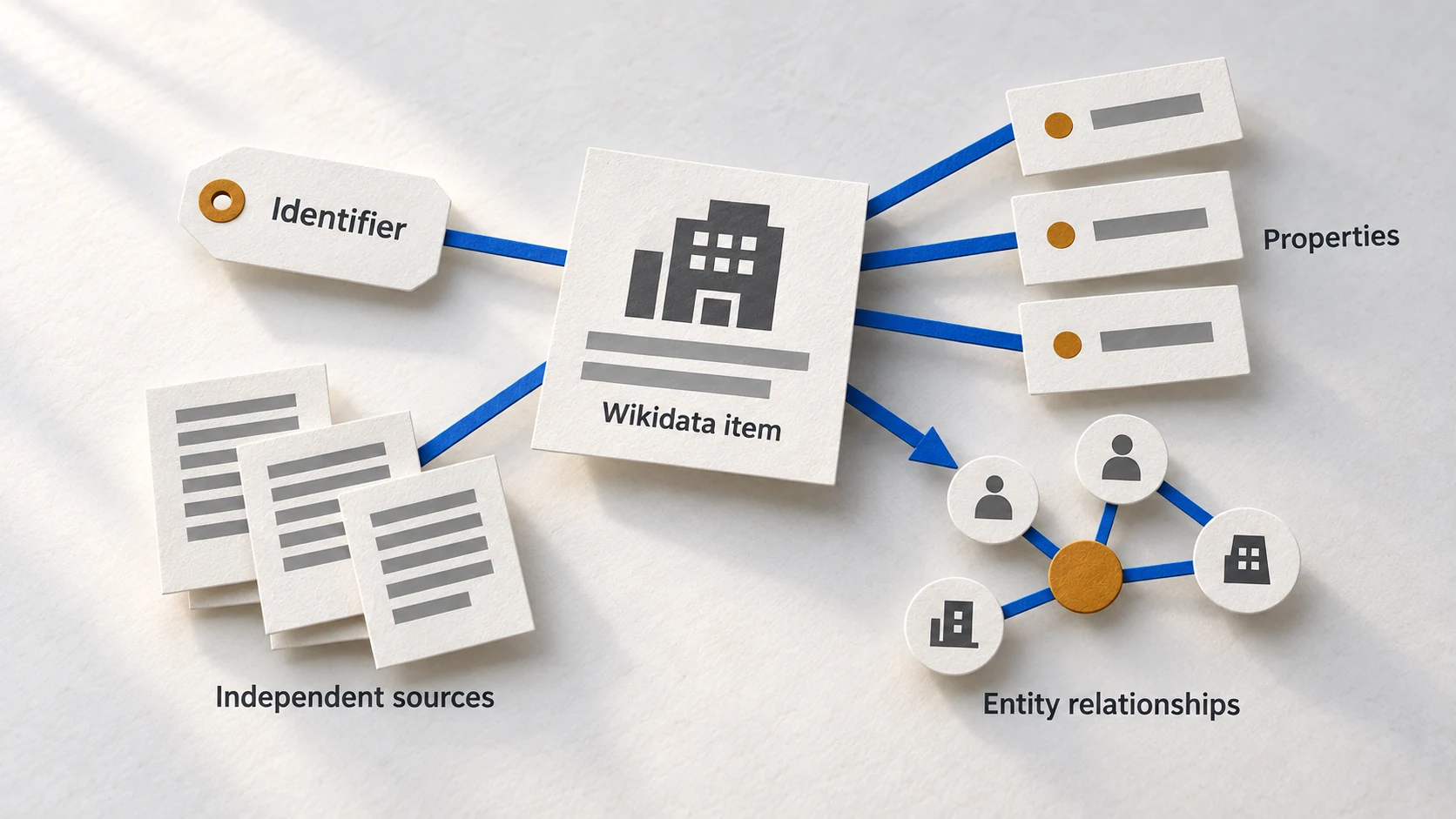
Wikidata is a structured, machine-readable database that feeds Google's Knowledge Graph and AI platforms. Unlike Wikipedia, Wikidata has lower notability barriers-your business qualifies if you have verifiable information from independent sources like news coverage, industry databases, or government registries. A Wikidata entry helps search engines and AI platforms recognize your brand as a distinct, verified entity. Creating one involves adding your business name, description, industry, founding date, headquarters, and official website with proper citations from independent sources.
You've tried to create a Wikipedia page for your business. Maybe you succeeded. More likely, it got flagged for "notability concerns" and deleted within days. Wikipedia's notability requirements are famously strict-most small and mid-sized businesses don't qualify.
But Wikipedia has a sibling that most businesses don't know about. It's called Wikidata, and it's arguably more important for AI visibility than Wikipedia itself.
While Wikipedia is written for humans, Wikidata is written for machines. It's the structured database that feeds Google's Knowledge Graph, powers voice assistants, and helps AI systems understand what your business actually is. And it's significantly more accessible than Wikipedia-with lower notability barriers and a clearer path to entry.
What Is Wikidata?
According to the Wikidata documentation, Wikidata is "a free, open, structured knowledge base" that stores data about entities-people, companies, places, products-in a format machines can read and understand.
Wikidata at a Glance
Purpose
A machine-readable database of entities with structured properties (founding date, headquarters, industry, founders) that search engines and AI can parse directly.
Format
Property-value pairs (e.g., "instance of: company", "headquarters location: San Francisco", "founded: 2015") rather than narrative text.
Unique Identifier
Every Wikidata entity gets a Q-ID (like Q312)-a universal identifier that connects your brand across platforms and knowledge graphs.
What Uses It
Google's Knowledge Graph, Apple Siri, Amazon Alexa, Microsoft Bing/Cortana, and AI systems like ChatGPT and Perplexity all reference Wikidata.
When you search for a well-known company and see a knowledge panel with founding date, headquarters, CEO, and stock ticker-that information likely came from or was verified against Wikidata. It's the structured backbone behind much of what search engines "know" about entities.
Wikidata vs Wikipedia: Which Matters for AI?
Most businesses focus on Wikipedia because it's the more famous platform. But according to TreDigital research, Wikidata typically has "more direct influence on AI visibility because large language models prioritize structured data."
| Aspect | Wikipedia | Wikidata |
|---|---|---|
| Audience | Humans | Machines, AI, search engines |
| Format | Narrative articles with prose | Structured property-value pairs |
| Notability Bar | Very high-requires significant press coverage | Lower-verifiable sources + external identifiers |
| AI Impact | Helps E-E-A-T and credibility signals | Direct feed to knowledge graphs and AI |
| Creation Difficulty | Often rejected for small/medium businesses | Achievable for most legitimate businesses |
The key insight: Wikipedia builds human credibility. Wikidata builds machine understanding. For AI visibility, Wikidata is often the higher-impact starting point-especially since most businesses can get a Wikidata entry but struggle to get a Wikipedia article.
Notability Requirements: Can Your Brand Qualify?
Wikidata's notability requirements are more permissive than Wikipedia's-but they're not nonexistent. According to the official Wikidata notability guidelines, an item is acceptable if it meets at least one of three criteria:
Three Paths to Wikidata Notability
Present in Another Wikimedia Project
If your business has a Wikipedia article, Wikimedia Commons images, or entries in other Wikimedia projects, you automatically qualify for Wikidata.
This is the easiest path if you already have Wikipedia presence.
Clearly Identifiable Concept
Your entity must be clearly identifiable with external identifiers-like a company registration number, industry database listing, or authoritative third-party profile (Crunchbase, Bloomberg, government registry).
This is how most businesses qualify: through verifiable external identifiers.
Structural Purpose
The item serves a structural need within Wikidata-connecting other items or filling gaps in the knowledge graph.
This rarely applies to business entries.
106M+
items in Wikidata
Wikidata contains over 106 million items-entities ranging from global corporations to small nonprofits. The bar for inclusion is lower than you think.
Source: Wikidata Stats →Q-ID
Universal entity identifier
Every Wikidata entry gets a unique Q-ID (like Q312 for Apple Inc.). This identifier connects your entity across Google's Knowledge Graph and AI systems.
For businesses, the practical requirement comes down to this: verifiable information from independent sources. You need at least one of these:
How to Create a Wikidata Entry for Your Brand
Creating a Wikidata entry involves adding structured facts about your business with proper citations. Here's the step-by-step process:
Step 1
Search for Existing Entries
Before creating anything, search wikidata.org for your business name. You may already have an entry (especially if you've been covered in press), or there may be a disambiguation issue to resolve.
Duplicate entries violate Wikidata policy and can get both entries flagged for review.
Step 2
Create a New Item
Click "Create a new item" and add the basic identifiers:
- Label: Your official business name
- Description: Brief description (e.g., "American software company")
- Aliases: Alternate names, abbreviations, or common misspellings
Step 3
Add Core Properties
Add the essential statements (property-value pairs) that define your entity:
- instance of (P31): "business" or more specific type like "software company"
- official website (P856): Your company URL
- inception (P571): Founding date
- headquarters location (P159): City/country of headquarters
- industry (P452): Your business sector
- founder (P112): Name of founder(s)
Each statement must be backed by a reference-add citations from news articles, your official website, or authoritative databases.
Step 4
Add External Identifiers
Connect your entry to other authoritative databases. Common identifiers include:
- LinkedIn company ID
- Twitter/X username
- Crunchbase organization ID
- DUNS number
- SEC CIK (if publicly traded)
- Bloomberg company ID
External identifiers are key-they prove your entity exists beyond your own website.
Step 5
Link From Your Website
Once your Wikidata entry exists, add it to your Organization schema's sameAs property. This creates a bidirectional connection that strengthens both your entity recognition and the Wikidata entry's authority.
Your Wikidata Q-ID becomes a universal identifier you can reference across all your structured data.
How Wikidata Affects AI Search Visibility
Wikidata's impact on AI visibility comes from its role as a foundational data source for knowledge graphs and AI systems. Here's what happens when your business has a Wikidata entry:
Knowledge Panel Eligibility
Wikidata is one of Google's primary sources for Knowledge Panel information. Having a Wikidata entry significantly increases your chances of triggering a branded knowledge panel in search results.
Voice Assistant Recognition
Siri, Alexa, and Google Assistant pull entity data from Wikidata. A properly structured entry helps voice assistants correctly understand and represent your business when users ask questions.
AI Citation Context
When AI platforms like Perplexity or ChatGPT verify entity information, Wikidata provides structured context. This helps AI understand your business category, location, and relationships to other entities.
Entity Disambiguation
If multiple businesses share similar names, Wikidata's unique Q-ID helps search engines and AI distinguish your entity from others-reducing cases where AI confuses you with a competitor.
Important caveat: Wikidata alone doesn't guarantee AI citations or knowledge panels. It's one piece of the entity establishment puzzle-working alongside your Entity Home, Organization schema, and third-party corroboration. But without Wikidata, you're missing a key signal that AI systems use to verify entity legitimacy.
FAQ
Do I need a Wikipedia page to have a Wikidata entry?
What happens if I create a Wikidata entry for my business and it gets deleted?
How long does it take for a Wikidata entry to affect my AI visibility?
Can I hire someone to create my Wikidata entry?
Ready to Get Your Brand Into Wikidata?
Wikidata is the structured foundation AI needs to recognize your entity.
Learn the full entity establishment strategy: from About page optimization to schema markup to knowledge graph inclusion.
Take the GEO Readiness Quiz →60 seconds · Personalized report · Free
Continue Learning
Dive deeper into AI search with these related articles:
The Entity Home Concept: Your About Page as GEO Foundation
Your Entity Home is the single page Google trusts most for understanding who you are. Learn why your About page should become your GEO foundation.
Organization Schema: The Foundation of Entity Establishment
Learn how Organization schema creates machine-readable entity profiles that AI engines use when deciding which brands to cite and recommend.
The Complete Schema Markup Guide for GEO
Master schema markup for AI visibility. Essential types, implementation strategy, and common mistakes.