GEO & AI Search
Person Schema: Building Author Authority for AI Citations
Quick Answer
Person schema is structured data that identifies content authors with verifiable credentials, expertise signals, and linked profiles. It's the authorship layer that tells AI who wrote your content and why they're qualified to write it. Implement Person schema on author profile pages and nest it within Article schema on every blog post to establish the author-content relationship AI platforms verify before deciding whether to cite your content.
You've written expert content. Your research is thorough. Your insights are original. But your author bio says "Marketing Team" with no photo and no credentials. When AI evaluates whether to cite you, it finds no evidence that a real, qualified person wrote this.
This authorship gap is why generic content rarely gets cited. AI platforms don't just evaluate content quality-they evaluate author credibility. Is this person real? What's their expertise? Can their credentials be verified across the web? Without Person schema, you're asking AI to trust anonymous content.
Person schema is how you prove authorship. It connects your content to a verifiable person with credentials AI can cross-reference and trust.
What Is Person Schema?
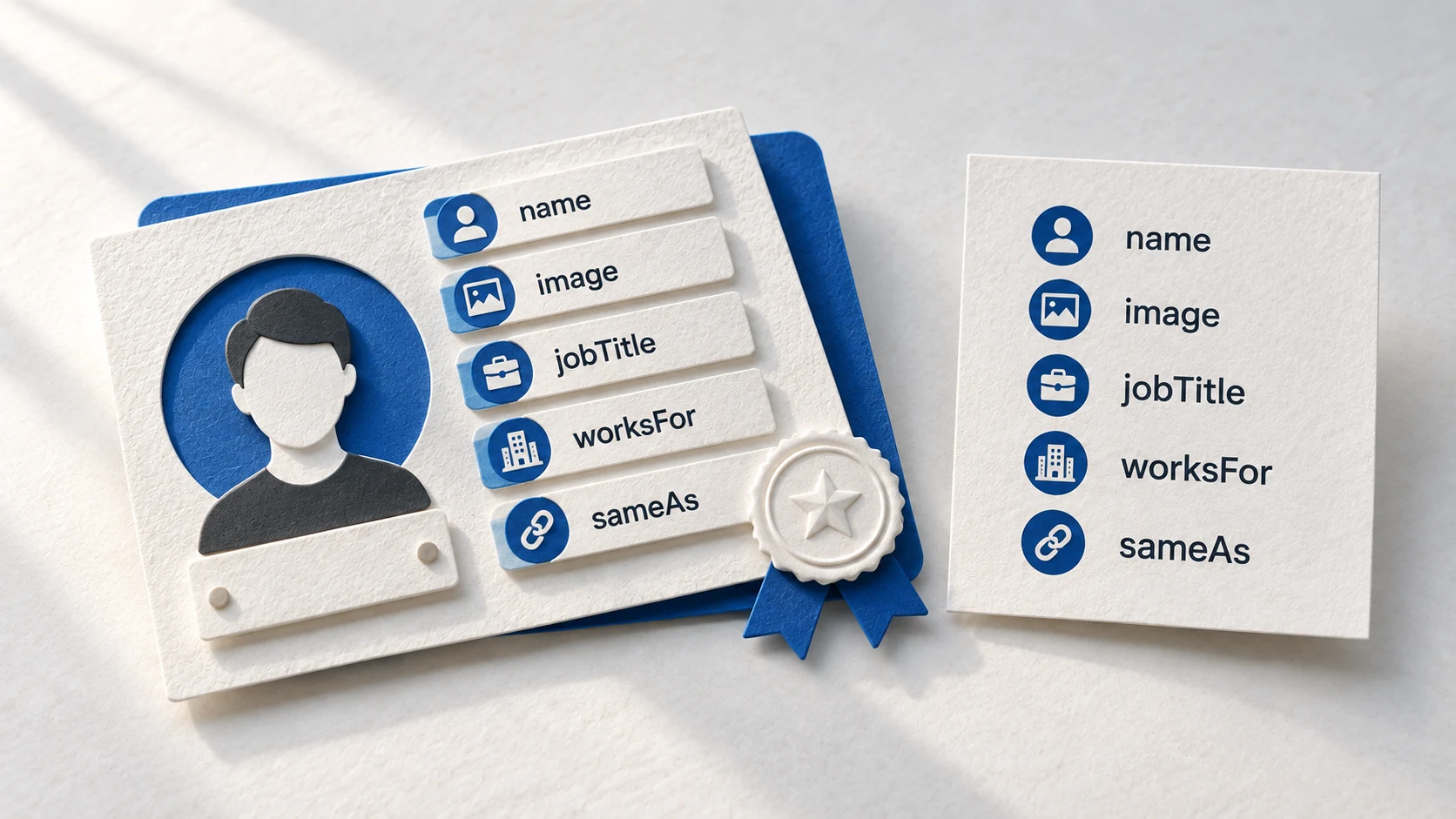
Person schema is structured data markup that identifies individuals-specifically content authors-with properties like name, job title, employer, education, social profiles, and expertise areas. It's the machine-readable version of an author bio.
Core Person Schema Properties for Authors
name
Author's full name (as it appears professionally).
Use consistent name across all platforms-AI checks for matches.
url
Link to author's profile page on your website.
This becomes the author's canonical entity home.
image
Professional headshot (real photo, not stock or avatar).
Human faces signal real authorship-AI can detect stock photos.
jobTitle
Current professional role that establishes topical expertise.
"SEO Director" is more credible than "Marketing Specialist" for SEO content.
sameAs
Array of URLs to verified profiles (LinkedIn, Twitter, GitHub, etc.).
Critical for AI verification-links person to broader web identity.
worksFor / hasOccupation
Links author to Organization schema, showing institutional affiliation.
Employment verification strengthens expertise claims.
According to Google's Article schema documentation, adding author information helps Google understand who created the content and what their qualifications are-a signal increasingly important as AI-generated content proliferates.
Why Authorship Matters to AI Engines
AI platforms face a fundamental problem: determining content trustworthiness at scale. With billions of pages to evaluate, verifiable authorship becomes a filtering mechanism. Content with structured, credentialed authors gets prioritized over anonymous content.
48%
of ChatGPT citations go to Wikipedia
Wikipedia's author verification and editorial oversight make it AI's most-cited source-author credibility drives citations.
Source: TryProfound →85%
of AI-cited sources show E-E-A-T signals
AI-cited content exhibits 3+ of 4 E-E-A-T signals, with author expertise being the most verifiable dimension.
Source: Agenxus →Research from Conductor shows that verified authorship, citations from credible studies, and visible credentials help AI distinguish trustworthy sources from generic content. Without structured Person data, your author is indistinguishable from AI-generated or low-quality content.
The key insight: AI doesn't trust content-it trusts authors. Person schema is the verification layer that proves a real, qualified person stands behind your claims. No schema = no verifiable authorship = lower citation likelihood.
The E-E-A-T Connection
Google's E-E-A-T framework (Experience, Expertise, Authoritativeness, Trustworthiness) has become even more critical with AI search. Person schema directly addresses three of the four dimensions.
Experience
First-Hand Knowledge Verification
AI looks for evidence that the author has direct experience with the topic. Person schema properties like worksFor (showing employment in relevant industry), alumniOf (education credentials), and hasOccupation (professional role) provide machine-readable proof.
Example: An author with jobTitle: "SEO Director" and worksFor: "Digital Agency" has verifiable experience writing about SEO.
Expertise
Credential Cross-Referencing
The sameAs property lets AI verify author credentials across platforms. If your schema links to a LinkedIn profile showing 10 years of SEO experience, a university alumni page confirming education, and a conference speaker listing, AI can corroborate expertise claims.
According to Hill Web Creations, linking to talks, GitHub contributions, and led projects with real photos (not stock) helps Google verify the author is the same person across platforms.
Authoritativeness
Publication History & Recognition
AI checks if the author has published elsewhere, spoken at events, or been cited by others. While not a direct Person schema property, linking to author archives (via url to profile page) where AI can see publication history establishes authority.
An author profile showing 50+ published articles on the same topic signals sustained expertise more credibly than a single post.
How to Implement Person Schema
Person schema appears in two places: on the author's profile page (standalone) and nested within Article/BlogPosting schema on every piece of content they write.
Implementation #1: Author Profile Page
<script type="application/ld+json">
{
  "@context": "https://schema.org",
  "@type": "Person",
  "name": "Jane Smith",
  "url": "https://www.yoursite.com/author/jane-smith",
  "image": "https://www.yoursite.com/images/jane-smith.jpg",
  "jobTitle": "Senior SEO Strategist",
  "worksFor": {
    "@type": "Organization",
    "name": "Digital Marketing Agency"
  },
  "alumniOf": {
    "@type": "EducationalOrganization",
    "name": "University of Marketing"
  },
  "description": "Jane has 12 years of experience in technical SEO, specializing in enterprise-level optimizations. She's spoken at MozCon, BrightonSEO, and contributed to Search Engine Land.",
  "sameAs": [
    "https://www.linkedin.com/in/janesmith",
    "https://twitter.com/janesmith",
    "https://github.com/janesmith"
  ],
  "knowsAbout": ["SEO", "Technical SEO", "Content Strategy", "GEO"]
}
</script>
Implementation #2: Nested Within Article Schema
<script type="application/ld+json">
{
  "@context": "https://schema.org",
  "@type": "Article",
  "headline": "How to Build Backlinks in 2025",
  "datePublished": "2025-12-16",
  "author": {
    "@type": "Person",
    "name": "Jane Smith",
    "url": "https://www.yoursite.com/author/jane-smith",
    "sameAs": [
      "https://www.linkedin.com/in/janesmith",
      "https://twitter.com/janesmith"
    ]
  },
  "publisher": {
    "@type": "Organization",
    "name": "Your Company",
    "logo": {
      "@type": "ImageObject",
      "url": "https://www.yoursite.com/logo.png"
    }
  }
}
</script>
Building Citation-Worthy Author Profiles
An author profile page isn't just a bio-it's the entity home for that person. AI platforms use it to verify credentials and assess expertise breadth.
Citation-Worthy Profile Elements
Professional Headshot
Real photo, not stock. AI can detect stock images and discounts them as trust signals.
Verifiable Job Title & Employer
Should match LinkedIn. If schema says "SEO Director at XYZ Corp" but LinkedIn says "Marketing Manager," AI sees inconsistency.
Education & Certifications
Degrees, professional certifications (Google Analytics, HubSpot, etc.), relevant training.
Publication Archive
List of all articles by this author on your site, showing expertise depth across time.
External Mentions
Guest posts, conference talks, podcast appearances, third-party citations-evidence of broader recognition.
Social Proof Links (sameAs)
LinkedIn, Twitter, GitHub, personal website-anywhere AI can verify the person exists beyond your site.
According to Aubrey Yung's analysis, creating dedicated pages for each author with unique URLs and implementing Person markup ensures AI can distinguish between contributors and evaluate individual expertise independently.
What Breaks Author Authority
Generic "Content Team" Attribution
AI sees no verifiable person. Use individual author names or create detailed Team Person schema with collective credentials.
Missing or Broken sameAs Links
If your schema links to LinkedIn but the profile is private or deleted, AI can't verify. Test all sameAs URLs regularly.
Stock Photos or No Photos
AI detects stock images. No photo = lower trust signal. Use real headshots, even if informal.
Job Title Doesn't Match Content Topic
A "Social Media Manager" writing about technical SEO lacks topical authority. Either adjust attribution or build expertise evidence.
Definition
Person Schema
Structured data markup (schema.org/Person) that identifies content authors with verifiable properties like name, jobTitle, worksFor, sameAs, and credentials-creating a machine-readable author identity that AI platforms can verify before citing.
FAQ
Does every blog post need Person schema?
What if I use a pen name or team attribution?
How detailed should my author profile be?
Can I use the same Person schema for multiple authors?
Ready to Build Verifiable Author Authority?
Person schema turns authors into recognized experts.
Discover how to structure author credentials that AI platforms trust enough to cite.
Take the GEO Readiness Quiz →60 seconds · Personalized report · Free
Continue Learning
Dive deeper into AI search with these related articles:
Organization Schema: The Foundation of Entity Establishment
Learn how Organization schema creates machine-readable entity profiles that AI engines use when deciding which brands to cite and recommend.
Author Bio Optimization for AI Citation: A Complete Guide
AI engines verify author credibility before citing content. Learn how to optimize your author bio.
E-E-A-T in the AI Era: How to Build Machine Trust
85% of AI-cited sources show strong E-E-A-T signals. Learn how to build Experience, Expertise, Authoritativeness, and Trust that AI engines recognize.