GEO & AI Search
The New SEO Metrics That Matter in AI Search: Beyond Traffic and Rankings
Quick Answer
Traditional metrics like traffic volume and keyword rankings no longer predict business success in the AI search era. The new metrics that matter: AI Citation Frequency (how often AI tools cite you), Share of Model Visibility (your brand's presence in AI answers), AI Referral Conversion Rate (the quality of AI-referred traffic), and Zero-Click Brand Mentions (visibility without clicks).
Your dashboard shows green. Rankings are stable. Keyword positions look great.
But when you ask ChatGPT about your industry, your brand is nowhere.
Your traditional SEO metrics say you're winning. Your revenue says otherwise. The metrics you've relied on for years are measuring the wrong game.
Why Traditional Metrics Are Misleading You
For two decades, SEO success was measured the same way:
The Old Success Formula
✓ Rank on page one for target keywords
✓ Drive more organic traffic month-over-month
✓ Improve click-through rate from SERPs
✓ Build backlinks from authoritative sites
This formula worked when search meant blue links and clicks.
But AI search fundamentally changed the cause-and-effect relationship:
What Used to Be True
→ Rank higher = More clicks
→ More clicks = More traffic
→ More traffic = More revenue
Linear relationship
What's True Now
→ Rank higher ≠ AI citation
→ More traffic ≠ More revenue
→ #1 position ≠ Visibility
Relationship broken
You can rank #1 for "best project management software" and still be invisible when someone asks ChatGPT the same question.
Key Insight
The metrics that predict revenue today are completely different from the metrics that predicted revenue in 2023. If your dashboard hasn't evolved, you're flying blind.
The Dashboard-Revenue Disconnect: A Scenario
Picture this: You're a marketing director for a B2B software company. Your monthly SEO report lands in your inbox-and it's glowing.
Your Dashboard Shows:
↑ 12%
Organic Traffic
#2
Main Keyword Position
+15
New Backlinks
But when you walk into the quarterly business review, the CFO has different numbers:
Revenue Reality:
↓ 8%
Inbound Demo Requests
↓ 23%
Organic-Attributed Pipeline
0
ChatGPT Citations
What happened? Your traffic went up because your existing rankings attracted more impressions. But when prospects asked ChatGPT or Perplexity "best project management software for remote teams"-where 47% of business buyers now start their research-your brand wasn't mentioned. Not once.
Your competitors who invested in Generative Engine Optimization (GEO) captured that traffic instead. And because AI-referred visitors convert at 3x-5x higher rates (for B2B and services businesses), even a small shift in discovery patterns caused a massive revenue impact.
The Mindset Shift You Need
The 7 Metrics That Actually Matter Now
Here are the metrics you should be tracking-and why each one matters:
Metric #1
AI Citation Frequency
What it is: How often AI tools cite your content when answering questions in your domain.
Why it matters: Citations drive 3x-5x higher conversion rates than traditional organic traffic (strongest for B2B and services). One citation can be worth 100 uncited page-one rankings.
How to track: Manually test 10-15 key queries weekly in ChatGPT, Perplexity, Claude, and Google AI Overviews. Document when you appear and in what context.
Example: If you sell CRM software, test "best CRM for small business," "CRM with email integration," "affordable CRM tools" across all platforms.
Metric #2
Share of Model Visibility
What it is: Your brand's frequency in AI responses compared to competitors. If ChatGPT answers 100 CRM questions and mentions you 23 times, your share is 23%.
Why it matters: This is the new "market share." In traditional SEO, you tracked SERP share. Now you track AI answer share-the percentage of AI-generated recommendations where your brand appears.
How to track: Test a standardized set of 20-50 queries monthly. Calculate: (Your citations ÷ Total tests) × 100.
Goal: Track this over time. Increasing share of visibility = growing AI presence in your category.
Metric #3
AI Referral Traffic Volume
What it is: Traffic coming from AI platforms (chat.openai.com, perplexity.ai, claude.ai, etc.).
Why it matters: This traffic converts differently than organic. You need to segment it separately in analytics to understand its true value.
How to track: In Google Analytics, create a custom segment filtering for referrers containing "chat.openai.com", "perplexity.ai", "claude.ai", "gemini.google.com".
Watch for: Even small volumes (50-100 visits/month) can signal emerging AI visibility worth nurturing.
3x–5x
AI Traffic Conversion Lift (Industry-Dependent)
AI-referred visitors convert 3x-5x better than organic traffic for B2B and services businesses. E-commerce results are more mixed.
Source: Semrush / Microsoft ClarityMetric #4
AI Referral Conversion Rate
What it is: Conversion rate specifically for AI-referred traffic, tracked separately from overall organic.
Why it matters: AI traffic converts at higher rates because visitors are pre-qualified. But if YOUR AI traffic isn't converting well, it signals a mismatch between AI context and landing page experience.
How to track: In your analytics platform, create a goal completion report filtered to AI referral sources only. Compare against traditional organic conversion rate.
Benchmark: AI traffic should convert at 3-5x your organic rate. If it's not, optimize your landing pages for high-intent visitors.
Metric #5
Zero-Click Brand Mentions
What it is: How often your brand appears in AI answers even when users don't click through to your site.
Why it matters: Not all AI visibility drives clicks-and that's okay. Brand mentions in AI responses build awareness, establish authority, and influence future purchase decisions even without immediate traffic.
How to track: Same manual testing as Metric #1, but track ALL mentions (cited or uncited, linked or unlinked). Ask: "Is my brand name appearing in the answer?"
Think of it like billboards: You don't track billboard clicks, but you know they influence brand recognition.
Metric #6
Entity Recognition Score
What it is: Whether AI understands who you are, what you do, and how you're connected to related concepts.
Why it matters: AI tools cite entities they recognize and trust. If ChatGPT doesn't understand that "Acme Corp" is a CRM provider, it won't cite you for CRM questions.
How to track: Ask AI tools direct questions about your brand: "What is [Your Company]?" "Who founded [Your Company]?" "What does [Your Company] do?" Score based on accuracy and completeness.
Scale: 0 = "I don't have information about that company" → 5 = Accurate, comprehensive understanding with correct connections.
Metric #7
Content Citation Depth
What it is: Which specific pieces of content get cited, and for what types of queries.
Why it matters: Not all content earns citations equally. Understanding which pages AI favors helps you create more citation-worthy content.
How to track: When you find a citation, document: (1) Which page was cited, (2) For what query, (3) In what context. Build a citation map over time.
Pattern to watch: Pages with clear definitions, data tables, step-by-step guides, and expert quotes tend to earn more citations.
Pro Tip
If you can only track one new metric, start with AI Citation Frequency. Test 10 queries weekly across ChatGPT and Perplexity. Document when you appear and who appears instead. This single data point will reveal more about your AI visibility than any traditional SEO report.
How to Build Your New Metrics Dashboard
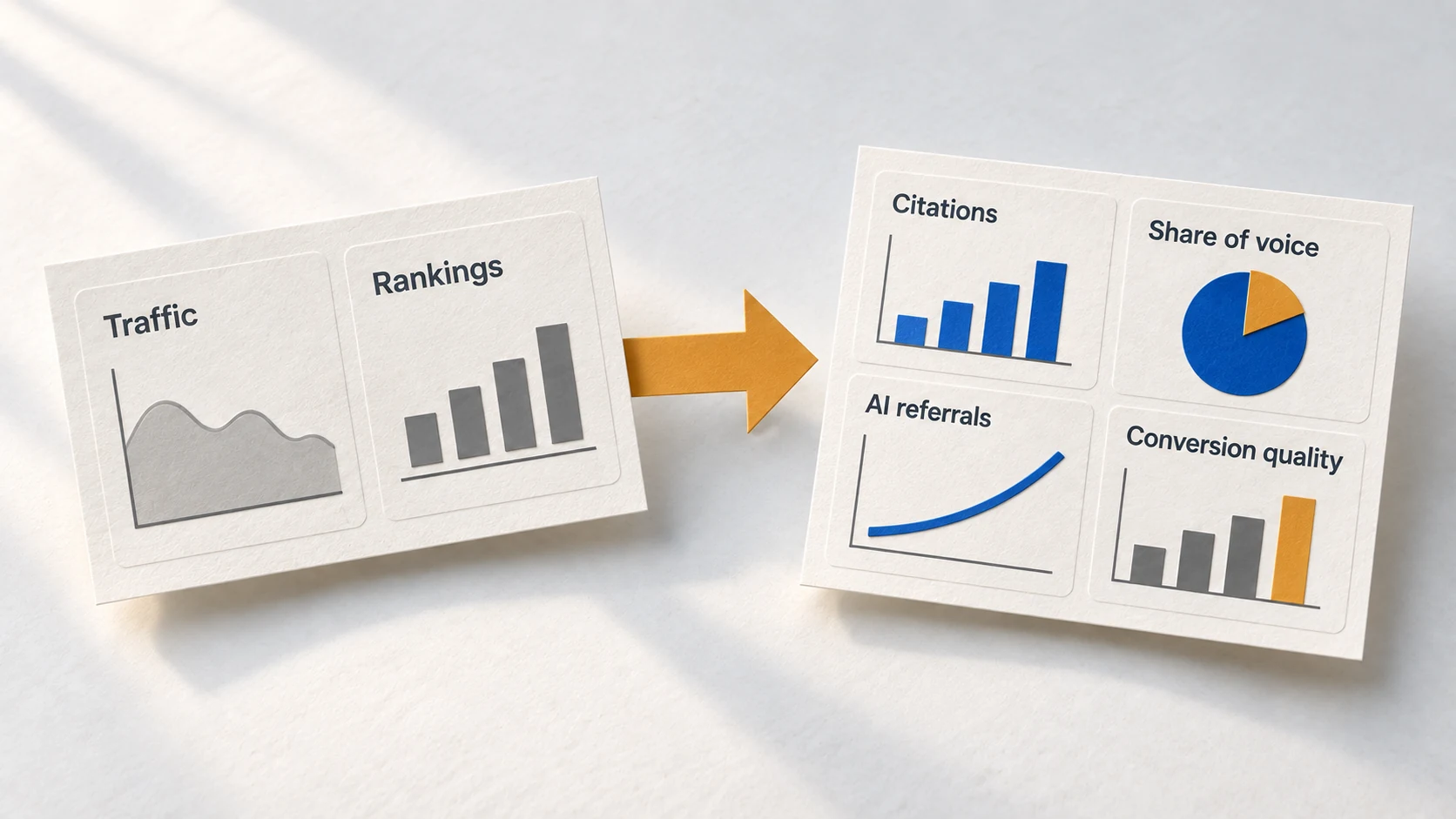
Here's how to implement these metrics in practice:
Step 1: Define Your Testing Queries
Create a list of 20-30 queries that represent how your ideal customers ask questions. Include:
- • 5-10 broad category queries ("best CRM", "top project management tools")
- • 10-15 specific use-case queries ("CRM with Gmail integration", "project management for remote teams")
- • 5 direct brand queries ("What is [Your Company]?", "Who uses [Your Product]?")
Step 2: Set Up Weekly Testing
Every Monday (or choose your day), run your testing queries across ChatGPT, Perplexity, Claude, and Google AI Overviews. Document results in a spreadsheet:
Query | Platform | Your Brand Mentioned? | Cited? | Position | Competitor Mentions
Step 3: Configure Analytics Tracking
In Google Analytics (or your analytics platform):
- • Create custom segment for AI referrers
- • Set up conversion tracking for AI traffic specifically
- • Build a custom dashboard showing AI metrics vs traditional organic
Step 4: Monthly Reporting Rhythm
On the last Friday of each month, compile your GEO report:
- • AI Citation Frequency (total citations this month vs last month)
- • Share of Model Visibility (% trend)
- • AI Referral Traffic (volume and conversion rate)
- • Entity Recognition Score (improvement or decline)
- • Top cited content (which pages are working)
Traditional SEO Metrics vs. New AI Search Metrics
| Category | Traditional SEO Metrics | New AI Search Metrics |
|---|---|---|
| Visibility | Keyword rankings (positions 1-10) | AI Citation Frequency |
| Traffic | Organic traffic volume | AI Referral Traffic + Quality |
| Authority | Domain Authority / Backlinks | Entity Recognition Score |
| Market Position | SERP Share of Voice | Share of Model Visibility |
| Content Success | Pageviews per article | Citations per article |
| Business Impact | Traffic → Leads | Conversion Rate by Source |
| Brand Awareness | Impressions | Zero-Click Brand Mentions |
Platform-Specific Tracking: What Each AI Gets Wrong
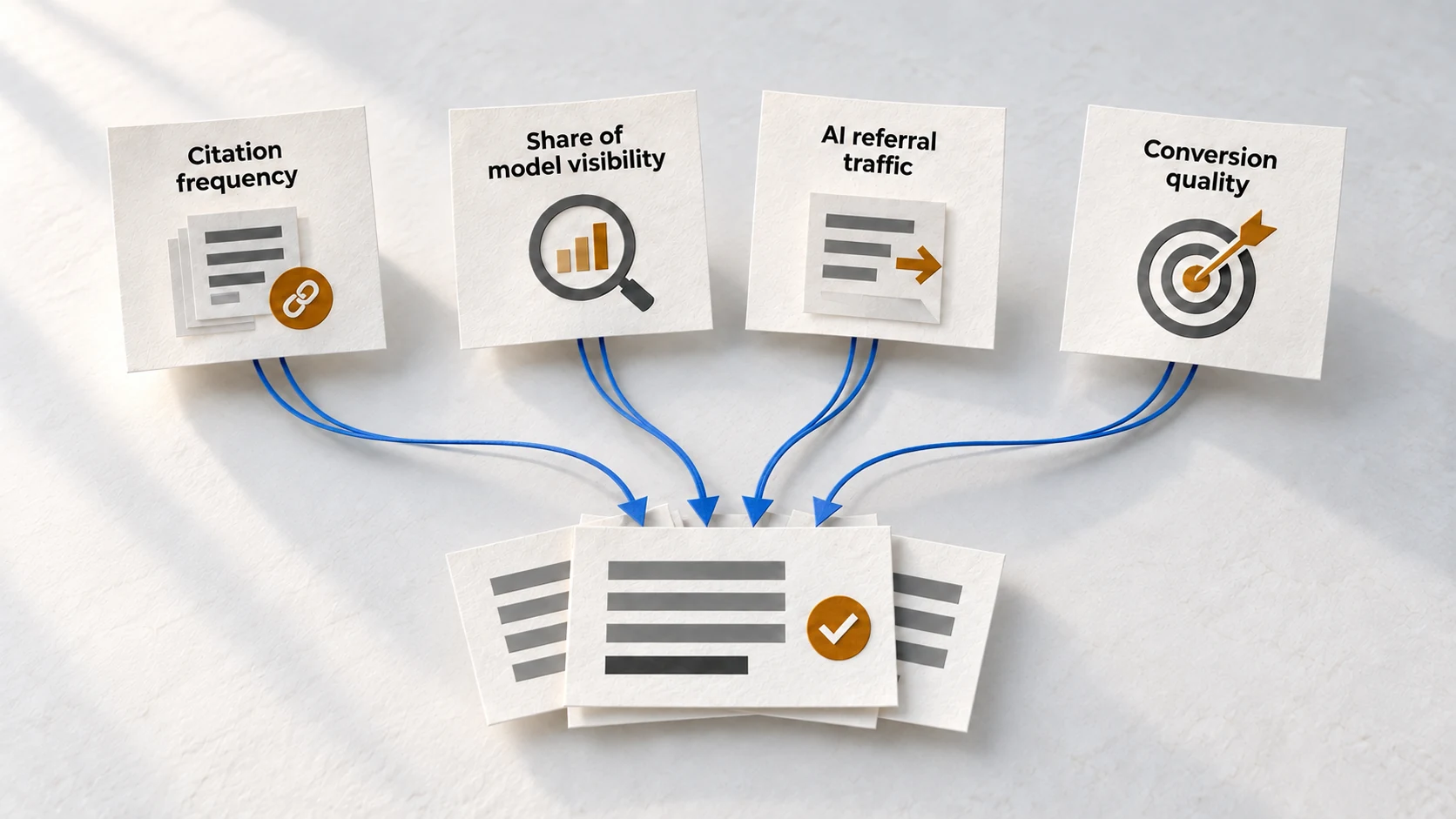
Not all AI platforms behave the same way. Each has quirks that affect how you test and what results mean. Here's what to know:
ChatGPT (chat.openai.com)
Citation behavior: ChatGPT often synthesizes information without citing sources, especially for general knowledge queries. When it does cite, it tends to favor high-authority sources like Wikipedia, major publications, and established brands.
Testing quirk: Responses vary significantly between sessions. The same query asked twice may cite different sources. Test multiple times to identify patterns, not one-off results.
What this means: If ChatGPT doesn't cite you consistently, focus on entity establishment first. Build your presence in authoritative sources that ChatGPT already trusts-then citations will follow.
Perplexity (perplexity.ai)
Citation behavior: Perplexity is the most transparent about sources-it shows numbered citations in real-time. It heavily favors recently-published content and gives weight to content freshness.
Testing quirk: Perplexity uses web search in real-time, so results change frequently. Monday's test may differ from Friday's. Your recent content updates have faster impact here than on ChatGPT.
What this means: Perplexity is your leading indicator. If you're cited here but not ChatGPT, your content is strong-give ChatGPT time to catch up. If you're not cited in Perplexity, that's your immediate optimization target.
Google AI Overviews
Citation behavior: Google AI Overviews draw heavily from their existing search index. 76% of citations come from pages ranking in the top 10. Your SEO rankings matter here more than on independent AI tools.
Testing quirk: AI Overviews appear for about 47% of Google searches, skewing toward informational queries. They rarely appear for transactional or navigational queries. Test informational variations of your keywords.
What this means: For Google AI Overviews, traditional SEO and GEO work together. Rank well first, then optimize content structure for citation. You can't skip the SEO step here.
Claude (claude.ai)
Citation behavior: Claude tends to be more cautious about citing external sources and often acknowledges uncertainty. It favors well-established, authoritative content and academic-style references.
Testing quirk: Claude's training data cutoff means it may not know about your brand if you're newer or smaller. Test with questions about your specific expertise areas, not just brand name recognition.
What this means: Claude rewards depth and expertise over recency. If Claude doesn't recognize your brand but ChatGPT does, focus on getting featured in authoritative industry publications that Claude's training data likely includes.
Cross-Platform Testing Strategy
Test your 20-30 core queries across all four platforms monthly. Build a spreadsheet tracking:
- • Which platforms cite you most consistently (your strongest visibility)
- • Which platforms cite competitors but not you (your gap analysis)
- • Which queries work on Perplexity but not ChatGPT (your growth indicators)
The pattern across platforms tells you more than any single platform alone.
What Success Looks Like: Real Examples
Let's look at what "good" metrics look like in practice:
Example: B2B SaaS Company (Series A, 50 employees)
TRADITIONAL METRICS
- → Organic traffic: 45K/month
- → #1 rankings: 23 keywords
- → Domain Authority: 52
NEW METRICS
- → AI citations: 18/month
- → Share of visibility: 12%
- → AI referral conversions: 11.2%
Result: 35% of new customers now cite "ChatGPT recommended you" as discovery source.
Example: Local Service Business (HVAC company, 12 employees)
TRADITIONAL METRICS
- → Organic traffic: 2.1K/month
- → #1 rankings: 8 local keywords
- → Google Business Profile: 4.8★
NEW METRICS
- → AI citations: 3-5/month
- → Entity recognition: 4/5
- → Zero-click mentions: 12/month
Result: When locals ask "best HVAC company in [city]", company appears in Perplexity and Google AI Overviews.
Example: D2C E-commerce Brand (Sustainable home goods, 25 employees)
TRADITIONAL METRICS
- → Organic traffic: 28K/month
- → Product page rankings: 150+ SKUs ranking
- → Domain Authority: 41
- → Average order value: $65
NEW METRICS
- → AI citations: 8-12/month (product recommendations)
- → Share of visibility: 7% (in "eco-friendly home" category)
- → AI referral conversion: 8.3% (vs 2.1% organic)
- → AI-referred AOV: $89 (+37% vs average)
Result: When shoppers ask "best sustainable dish soap" or "eco-friendly cleaning products," this brand appears in AI recommendations. AI-referred customers not only convert at 4x the rate-they spend more per order because they arrive pre-sold on the brand's values.
Notice the pattern across all three examples: traditional metrics didn't go away-they just stopped predicting revenue. The businesses that win are tracking both, but making decisions based on the new metrics that correlate with actual business outcomes.
Common Mistakes When Tracking New Metrics
Mistake #1: Testing Only Once
AI responses are dynamic. A single test doesn't represent consistent visibility. Test the same queries weekly to identify trends.
Mistake #2: Ignoring Negative Results
When your brand doesn't appear, that's valuable data. Document WHO is being cited instead. Analyze what they're doing differently.
Mistake #3: Comparing to Old Benchmarks
"We used to get 50K organic visits" is irrelevant. If 5K AI-referred visitors convert better, that's the win. Compare value, not volume.
Mistake #4: Expecting Overnight Changes
AI citation authority builds over weeks and months, not days. Track monthly trends, not daily fluctuations.
Your Action Plan: Next 30 Days
Here's how to start tracking the metrics that matter:
Week 1: Establish Your Baseline
Define your 20-30 testing queries. Run them across all four platforms (ChatGPT, Perplexity, Claude, Google AI Overviews). Document current state.
Expected time: 3-4 hours for initial testing
Week 2: Set Up Analytics Tracking
Create AI referrer segments in Google Analytics. Build a custom dashboard showing AI traffic separately from organic. Verify data is collecting correctly.
Expected time: 2 hours for setup
Week 3: First Optimization Pass
Based on Week 1 results, identify your biggest visibility gaps. Which queries should cite you but don't? Create content to address those gaps.
Expected time: Varies by content volume
Week 4: Re-Test and Report
Run your testing queries again. Compare to Week 1 baseline. Create your first monthly GEO report. Share with stakeholders.
Expected time: 2 hours for testing + reporting
FAQ
What are AI citation metrics and why do they matter?
Should I stop tracking traditional SEO metrics?
How do I track AI citation frequency?
Ready to Track What Actually Matters?
You now know the 7 metrics that predict revenue in the AI search era.
The next step is building the systems to improve them.
Take the GEO Readiness Quiz →60 seconds · Personalized report · Free
Continue Learning
Dive deeper into AI search with these related articles:
AI Citation Frequency: What It Is and How to Track It
Citation frequency measures how often AI models reference your content. Learn what it is and how to track it.
Share of Model Visibility: The New Market Share Metric
Share of Model Visibility measures your brand's presence in AI answers versus competitors.
The GEO Dashboard: What to Track and How to Report
Build a GEO dashboard that tracks citation frequency, brand visibility, share of voice, and AI referral traffic.