GEO & AI Search
AI Citation Frequency: What It Is and How to Track It
Quick Answer
AI citation frequency measures how often your content gets cited in AI-generated responses. It's the GEO equivalent of earning a backlink-only it directly shapes what millions see. Track it by testing target queries across ChatGPT, Perplexity, Claude, and Gemini, then monitoring whether your content appears in responses. Specialized tools automate this at scale, tracking trends across platforms and alerting you to changes.
You ask ChatGPT about a topic in your expertise. It gives a detailed answer, cites three sources. None of them are you. You ask again with different phrasing. Same result. Your content exists, your Google rankings are solid, but AI doesn't know you exist.
This gap between SEO performance and AI visibility is where citation frequency becomes critical. It measures whether AI models actually reference your content when answering relevant questions-not whether your content exists, but whether AI knows it exists.
With ChatGPT processing 1 billion+ queries daily (confirmed as of March 2026) and 73% of AI users taking action within 24 hours of recommendations, citation frequency directly impacts business outcomes.
What Is AI Citation Frequency?
Definition
AI Citation Frequency
The rate at which AI models (ChatGPT, Perplexity, Claude, Gemini) reference your content in their responses. Measured by tracking how often your brand, domain, or specific pages appear when users ask questions in your topic area.
Think of citation frequency like this: if someone asks ChatGPT a question you've written about, does it mention you? Does it link to you? How often? That's what we're measuring-not whether your content exists, but whether AI engines notice it exists.
Key Citation Metrics
URL Citation Rate
The percentage of AI answers that cite specific URLs from your domain.
Formula: (AI answers citing your URL ÷ Total AI answers sampled) × 100
Brand Mention Rate
How often your brand name appears in AI responses, with or without a link.
Some citations mention brand without linking-both indicate visibility.
Query Coverage
What percentage of your target queries return responses that cite you.
Tracks visibility breadth, not just depth on individual queries.
Unlike traditional SEO metrics, citation frequency isn't binary (ranked or not ranked). You might be cited for some queries but not others, first-position in some responses and lower in others, or mentioned by name without a clickable link. Each variation tells you something different about your AI visibility.
Why Citation Frequency Is the New Ranking
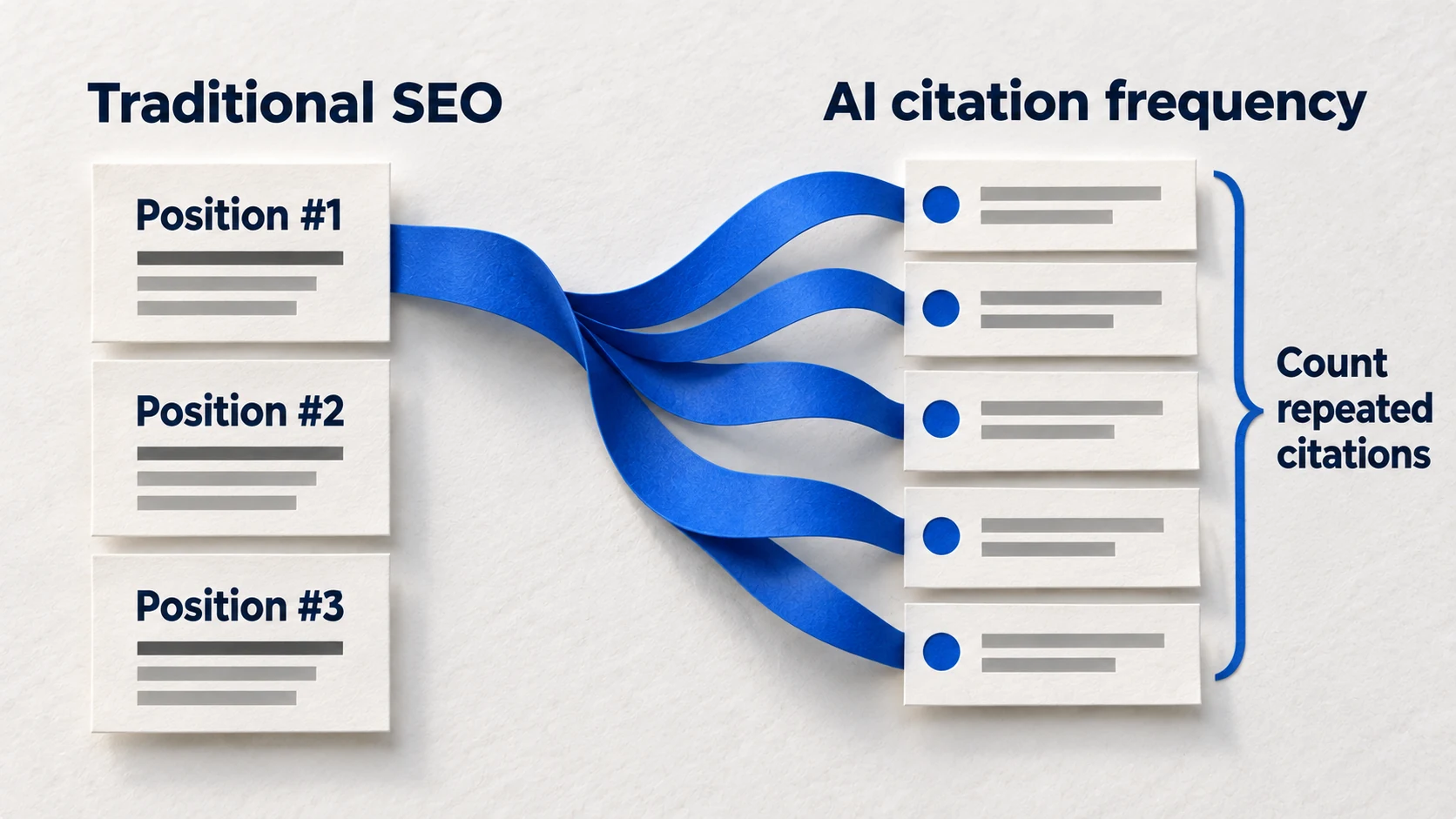
In traditional SEO, rankings determined visibility. In AI search, citations determine visibility. The mechanics are different, but the business impact is the same: if you're not cited, you're invisible. This is one of several new metrics replacing traditional SEO measurements.
4.4x
Higher conversion rate from AI referrals
LLM visitors convert 4.4x better than traditional organic search visitors.
70%+
of searches end without a click
Users get answers directly from AI. If you're not cited, you're invisible to most.
According to Search Engine Land, the goal of GEO is to be cited as a source within generative responses. High citation frequency equates to what Position 1 rankings meant for traditional SEO-it's the primary visibility indicator.
The key insight: Citation frequency measures actual influence, not potential reach. A page can rank #1 on Google but never be cited by AI. Citation frequency tells you whether AI models consider your content authoritative enough to reference.
How to Track Your Citation Frequency
Tracking citation frequency requires systematic testing across multiple AI platforms. Here's how to set up monitoring:
Manual Tracking Process (Free)
Create your query list (25-50 questions)
Focus on questions your content definitively answers. Include comparison queries ("X vs Y"), solution queries ("how to solve X"), and category queries ("best tools for X").
Test across platforms
Query each question on ChatGPT, Perplexity, Claude, Gemini, and Copilot. Record whether you're cited, your position, competitors cited, and response sentiment.
Document systematically
Use a spreadsheet tracking: query, platform, cited (yes/no), position, competitors, context, date. Screenshots provide evidence and help identify patterns.
Repeat weekly
AI responses change as models update. Weekly testing catches drops early and identifies successful patterns to replicate.
Time requirement: ~6 hours weekly for 30 queries across 6 platforms.
Manual tracking works for smaller query sets and provides hands-on learning about AI citation behavior. But as your monitoring needs grow, automated tools become essential.
Tools for AI Citation Monitoring
Specialized GEO monitoring tools automate citation tracking across platforms, provide trend analysis, and alert you to changes. Here's what's available:
| Tool | Starting Price | Platforms Tracked | Key Strength |
|---|---|---|---|
| Otterly.AI | $49/month | 6 platforms | Award-winning, 15K+ users, GEO auditing |
| Peec AI | €90/month | 5 platforms | First-mention tracking, GDPR-compliant |
| Keyword.com | $55/month | 5 platforms | SEO tool integration, familiar interface |
| Trackerly.ai | $27/month | 5 platforms | Budget-friendly, bulk prompt tracking |
| Rank Prompt | Contact for pricing | 5+ platforms | Real-time scanning, emerging LLM support |
Most tools offer similar core functionality: multi-platform tracking, competitive analysis, and trend reporting. Choose based on your platform priorities, budget, and whether you need integration with existing SEO tools. These tools complement your GEO dashboard by adding the AI-specific metrics traditional SEO tools can't capture.
What These Tools Track
What Good Citation Frequency Looks Like
Citation benchmarks vary significantly by industry, competition level, and query type. Rather than chasing arbitrary numbers, focus on these principles:
Citation Frequency Framework
Baseline establishment
Test your current citation rate before optimizing. What percentage of target queries cite you now? This is your starting point.
Competitive positioning
Track competitor citations for the same queries. Your goal isn't an absolute number-it's appearing more frequently than competitors for your target topics.
Improvement trajectory
According to industry benchmarks, successful GEO implementations achieve 25%+ citation rate improvement within six months for target queries.
Early research shows that companies tracking AI visibility from early 2025 have 3x higher citation rates than those who started later. The visibility gap compounds over time as AI models reinforce citation patterns. Related metrics like share of model visibility help you understand your competitive position.
30-Day Citation Tracking Implementation
Setup & baseline
Select tool or manual process. Define 25-50 target queries. Document current visibility across all platforms.
Content optimization
Update FAQ pages. Add schema markup. Optimize for Bing (87% of ChatGPT citations match Bing top results).
Authority building
Generate reviews (target 70%+ average rating). Build Reddit/Quora presence for Perplexity visibility.
Measure & iterate
Compare results to baseline. Identify highest-impact changes. Establish ongoing monitoring cadence.
FAQ
What's a good citation frequency benchmark?
How often should I check my citation frequency?
Can I track citations manually without paid tools?
Does citation frequency correlate with traffic?
How Often Do AI Models Cite YOU?
Citation frequency is the new ranking. Find out whether you're visible-or invisible-to ChatGPT, Claude, and Perplexity.
Get your AI visibility score in 60 seconds.
Take the GEO Readiness Quiz →60 seconds · Personalized report · Free
Continue Learning
Dive deeper into AI search with these related articles:
The New SEO Metrics That Matter in AI Search
Traditional SEO metrics are failing. Learn the new metrics that actually matter: AI Citation Frequency, Share of Model Visibility, and more.
Claude, Gemini, and Beyond: Multi-Model Visibility
Visibility on one AI platform doesn't guarantee visibility on others. Build a multi-model strategy.
How ChatGPT, Claude, and Perplexity Actually Find and Cite Content
Each AI platform works differently. Learn the mechanics behind how ChatGPT, Claude, and Perplexity discover and cite your content.