GEO & AI Search
How to Write Headlines That AI Engines Understand
Quick Answer
AI engines use headlines to understand content structure, match user intent, and identify citation-worthy passages. Effective AI headlines place the primary keyword early, clearly state the content's topic, and use question-based formats that mirror how users query AI platforms. Unlike clickbait headlines that create curiosity gaps, AI-optimized headlines communicate value directly.
Your SEO headline skills taught you to balance keywords with click appeal. "7 Surprising Secrets to Boost Your Traffic" worked because it triggered curiosity. Users clicked to find out what the secrets were.
AI engines don't click. They extract.
When ChatGPT, Perplexity, or Google AI Overviews analyze your headline, they're determining whether the content answers a specific user query. "7 Surprising Secrets" tells AI nothing about what the content actually covers. "7 Content Marketing Strategies That Increase Organic Traffic" tells AI exactly what to expect-and makes the headline itself useful context for extracting and citing the content below.
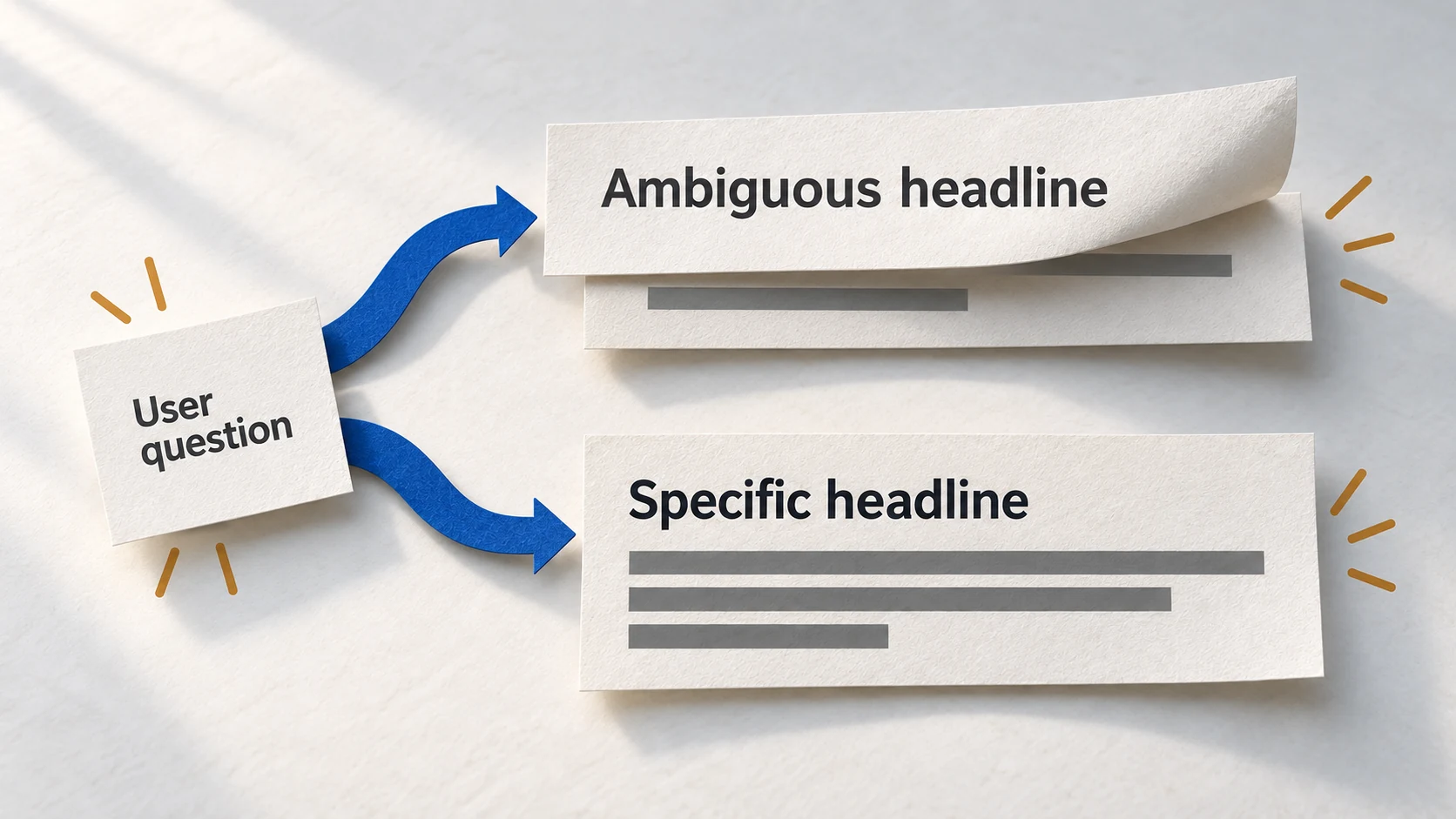
How AI Engines Process Headlines
AI engines use headlines differently than traditional search engines. While Google uses headlines as ranking signals, AI engines use them as content indexing and extraction guides. This integrates with the broader answer-first content framework.
Intent matching
AI engines match user queries to headlines to identify relevant content sections. A user asking "What is GEO?" is matched to an H2 that reads "What Is GEO?" far more reliably than to an H2 reading "Understanding the Basics."
Content structure mapping
AI engines use header hierarchy (H1, H2, H3) to understand how content is organized. Clear hierarchical headlines help AI extract the right section for a given query rather than pulling irrelevant passages.
Extraction context
When AI cites content, the headline provides context for the extracted passage. "According to the section on 'How FAQ Schema Improves Visibility'..." makes more sense than "According to the section on 'Why This Matters'..."
Key Insight
AI analyzes semantic meaning, not just keywords
According to Surfer SEO research, nearly 86% of AI Overviews don't include the exact query phrase from the user. AI prioritizes semantic meaning over literal keyword matching-headlines must communicate topic relevance, not just contain target keywords.
Headline Structure Principles
Effective AI headlines follow structural principles that maximize both understanding and citation potential.
Lead with the primary keyword
Place the most important concept at the beginning of headlines. AI engines weight early words more heavily.
✓ Good: "Schema Markup: The Complete Implementation Guide"
✗ Avoid: "The Complete Guide to Implementing Schema Markup"
State the content type
Include format signals: guide, checklist, framework, comparison, case study. This helps AI match content format to user intent.
✓ Good: "AI Search Optimization Checklist for 2025"
✗ Avoid: "Everything You Need to Know About AI Search"
Be specific, not clever
AI can't interpret wordplay, puns, or cultural references. Clear, direct headlines outperform creative ones.
✓ Good: "5 Content Structures That Get Cited by ChatGPT"
✗ Avoid: "The ChatGPT Whisperer's Secret Playbook"
Match headline to first paragraph
The content immediately following a headline should directly address that headline's topic. Mismatches confuse AI extraction.
Rule: If the headline is a question, the first paragraph should contain the answer. No "Let's explore..." intros.
Traditional SEO vs. AI-Optimized Headlines
| Approach | Traditional SEO | AI-Optimized |
|---|---|---|
| Primary goal | Generate clicks | Communicate content |
| Curiosity gaps | Encouraged (drives clicks) | Avoided (blocks understanding) |
| Keyword placement | Natural fit | Front-loaded |
| Creative wordplay | Asset (memorable) | Liability (confusing) |
| Success metric | Click-through rate | Citation frequency |
Question-Based Headlines for AI
Definition
Semantic Headline Optimization
Crafting headlines that communicate meaning directly to AI systems rather than triggering human curiosity. Instead of hinting at value ('The Secret to...'), semantic headlines state what the content delivers ('How to Structure Content for AI Citations'). This approach prioritizes understanding over intrigue.
Question-based headlines create direct semantic alignment with user queries. When someone asks ChatGPT "What is GEO?", a headline reading "What Is GEO?" provides exact intent matching.
Why Question Headlines Work for AI
Direct query matching: Users ask questions; question headlines match those queries exactly.
Clear extraction context: AI can cite "According to [source]'s answer to 'What is GEO?'..." with confidence.
Answer expectation: Question headlines signal that an answer follows immediately-exactly what AI engines look for.
Effective Question Headlines
- • "What Is Generative Engine Optimization?"
- • "How Does ChatGPT Decide What to Cite?"
- • "Why Do AI Engines Prefer FAQ Sections?"
- • "When Should You Use FAQ Schema Markup?"
- • "How Many Words Should a Meta Description Be?"
Clear intent, answerable, matches natural queries
Weak Question Headlines
- • "What Is This All About?"
- • "How Can You Make It Work?"
- • "Why Does It Matter?"
- • "What Should You Know?"
- • "Is It Really That Simple?"
Vague references, no specific subject, unclear intent
Use question headlines for definitional content, how-to explanations, and FAQ-style sections. For lists, comparisons, and frameworks, statement headlines often work better.
Semantic Signal Optimization
Beyond structure, headlines must contain semantic signals that help AI understand content relevance and authority.
Include entity names
Name specific tools, platforms, or concepts rather than generic references. "ChatGPT Citation Patterns" is more citable than "AI Citation Patterns" because it names a specific entity AI can verify.
Add temporal context
Include year references for time-sensitive content: "GEO Best Practices 2025" or "Schema Markup Guide (December 2025)." This signals freshness and helps AI determine content relevance.
Use specific numbers
"5 Schema Types for AI Visibility" outperforms "Schema Types for AI Visibility." Numbers signal concrete, structured content-exactly what AI engines prefer to cite.
Signal expertise level
Include audience signals where relevant: "Beginner's Guide," "Advanced Strategies," "Enterprise Implementation." This helps AI match content to appropriate user intent.
According to Search Engine Land research, 53% of Gen Z and Millennial users prefer direct answers from AI rather than scrolling search results. Headlines that clearly communicate content value-not curiosity gaps-serve these users best.
The H1-H3 Hierarchy for AI
AI engines use header hierarchy to understand content organization. A clear H1 → H2 → H3 structure helps AI extract the right section for any given query.
Header Hierarchy Best Practices
H1: Page Topic Declaration
One per page. States the overall content topic. Should match title tag.
"The Complete Guide to FAQ Schema for AI Visibility"
H2: Major Section Headings
Primary content divisions. Each H2 should be independently citable.
"What Is FAQ Schema?" / "How to Implement FAQPage Markup" / "FAQ Schema Best Practices"
H3: Subsection Headings
Breaks within H2 sections. Provides additional structure for complex topics.
Under "How to Implement": "Step 1: Create the JSON-LD" / "Step 2: Add to Your Page" / "Step 3: Validate the Markup"
Hierarchy Rules for AI
- • Never skip levels: Don't jump from H1 to H3 without H2. This breaks AI's understanding of content structure.
- • Keep hierarchy consistent: If one section uses H2 → H3, all sections should follow the same pattern.
- • H2s should work independently: Each H2 section should make sense if extracted without the other H2s.
- • Don't use headers for styling: Only use H1-H3 for actual content hierarchy, not to make text larger.
Headlines serve as both navigation aids and extraction contexts for AI engines. Clear, specific headlines that state content topics directly-rather than creating curiosity gaps-give AI the semantic signals needed to match your content to user queries and cite it with confidence.
Start by auditing your existing headlines. Replace vague references with specific entities, convert clever wordplay to direct statements, and ensure your H1-H2-H3 hierarchy provides clear content organization. The same changes that help AI understand your content also help human readers scan and navigate.
FAQ
Should I still optimize headlines for clicks?
How long should AI-optimized headlines be?
Do I need different headlines for different AI platforms?
Should all my H2s be questions?
Want AI to Find Your Content?
Headlines are the entry point. Learn the complete optimization framework.
Master all the techniques that get your content cited by AI.
Take the GEO Readiness Quiz →60 seconds · Personalized report · Free
Continue Learning
Dive deeper into AI search with these related articles:
The Content Marketer's Guide to Getting Cited by AI
72.4% of AI-cited content includes answer capsules. Learn the content traits that make AI engines cite your work.
Answer-First Writing: How to Structure Content AI Wants to Cite
72.4% of AI-cited blog posts use answer capsules. Learn the answer-first writing structure.
The Perfect FAQ Section for AI Visibility
Pages with FAQ schema are 3.2x more likely to appear in AI Overviews.