GEO & AI Search
Getting Listed: Authoritative Directories for AI Citation
Quick Answer
Directory listings account for 48.7% of ChatGPT citations according to Yext's 2025 research. AI systems use directories to verify business information, extract contact details, and validate entity legitimacy. Yelp appears in 33% of AI searches. ChatGPT sources 60-70% of local results from Foursquare's database. Google Business Profile is prioritized by Google's AI models. For AI visibility, maintain perfect NAP consistency (Name, Address, Phone) across all listings-inconsistencies reduce citation probability by 67%. Prioritize directories AI actually cites: Yelp, Google Business Profile, industry-specific directories, and data aggregators like Foursquare and Data Axle.
You've claimed your Google Business Profile. Maybe Yelp too. Your directory work is "done." But when someone asks an AI assistant to recommend businesses in your category, you're invisible.
Traditional directory strategy focused on building citations for local SEO. AI-era directory strategy focuses on being present where AI systems look when answering questions-which isn't always where Google looks.
Directory listings aren't just about search rankings anymore. They're one of the primary data sources AI uses to answer questions about businesses, verify entity information, and make recommendations.
Why Directories Matter More for AI Than Traditional SEO
For traditional SEO, directories provide backlinks and NAP signals. For AI search, directories serve as authoritative data sources that AI systems query directly when answering user questions.
How AI Uses Directory Data
When you ask ChatGPT "best dentists near me" or Perplexity "recommended lawyers in [city]," the AI doesn't just search the web. It queries structured data sources-directories-to compile accurate, current business information.
AI systems use directories for three purposes: verifying business existence and legitimacy, extracting accurate contact information, and aggregating customer reviews to form recommendations.
42%
of AI citations come from directory listings
Yext's analysis of 6.8 million AI citations found listings are the second-largest source after first-party websites (44%). In healthcare, listings account for 52.6% of citations.
Source: Yext Research →33%
of AI searches cite Yelp as a source
BrightLocal found Yelp appears across every industry investigated, used for extracting business information and summarizing customer reviews. Perplexity cites Yelp particularly heavily.
Source: BrightLocal →The key insight: 86% of AI citations come from sources brands already control-websites and listings. Directory presence isn't optional for AI visibility; it's foundational. The same listings that helped local SEO now determine whether AI recommends your business.
Types of Directories That AI Actually Cites
Not all directories carry equal weight with AI systems. Different AI models show distinct preferences, and industry-specific directories often outperform general listings for specialized queries.
1. Data Aggregators (Foundation Layer)
Data aggregators like Foursquare, Data Axle, and Neustar feed information to other directories and AI systems. ChatGPT sources 60-70% of local results from Foursquare's database. Getting listed with aggregators ensures data flows correctly to downstream sources.
Priority: Submit directly to Foursquare, Data Axle, and Neustar. These are upstream sources-accuracy here cascades downstream.
2. Major Consumer Platforms
Yelp, Google Business Profile, and Apple Maps are the most frequently cited consumer directories. Yelp appears in 33% of AI searches. Google Business Profile is prioritized by all Google AI products. Apple Maps connects to Siri and Apple Intelligence.
Priority: These are non-negotiable. Claim, verify, and optimize all three immediately.
3. Industry-Specific Directories
AI systems show strong preferences for industry directories in specialized queries. ChatGPT exclusively sources dental information from dental directories. Perplexity cites Superlawyers.com and Findlaw.com for legal queries. These targeted directories carry more weight than general listings for niche searches.
Priority: Identify the 3-5 most prominent directories in your industry. These often outperform general directories for AI visibility.
4. Social and Review Platforms
Instagram, Facebook, and YouTube are cited as sources across various AI platforms. Reviews and social content account for 8% of overall AI citations but rise to 13.3% for food service businesses. These platforms provide social proof signals AI uses when making recommendations.
Priority: Maintain accurate business information on social profiles. AI systems cross-reference this data.
AI Model Directory Preferences
| AI Model | Primary Sources | Citation Pattern |
|---|---|---|
| ChatGPT | Foursquare, industry directories, listings | 48.7% from listings; trusts "internet consensus" |
| Gemini | Google Business Profile, websites | 52.1% from websites; trusts brand-owned sources |
| Perplexity | Yelp, MapQuest, TripAdvisor | Diversified; trusts reviews and industry experts |
| Google AI Overviews | Google Business Profile, MapQuest | 40.2% of local searches; GBP prioritized |
Source: Yext (6.8M citations) and BrightLocal AI search research.
NAP Consistency: The Foundation of AI Trust
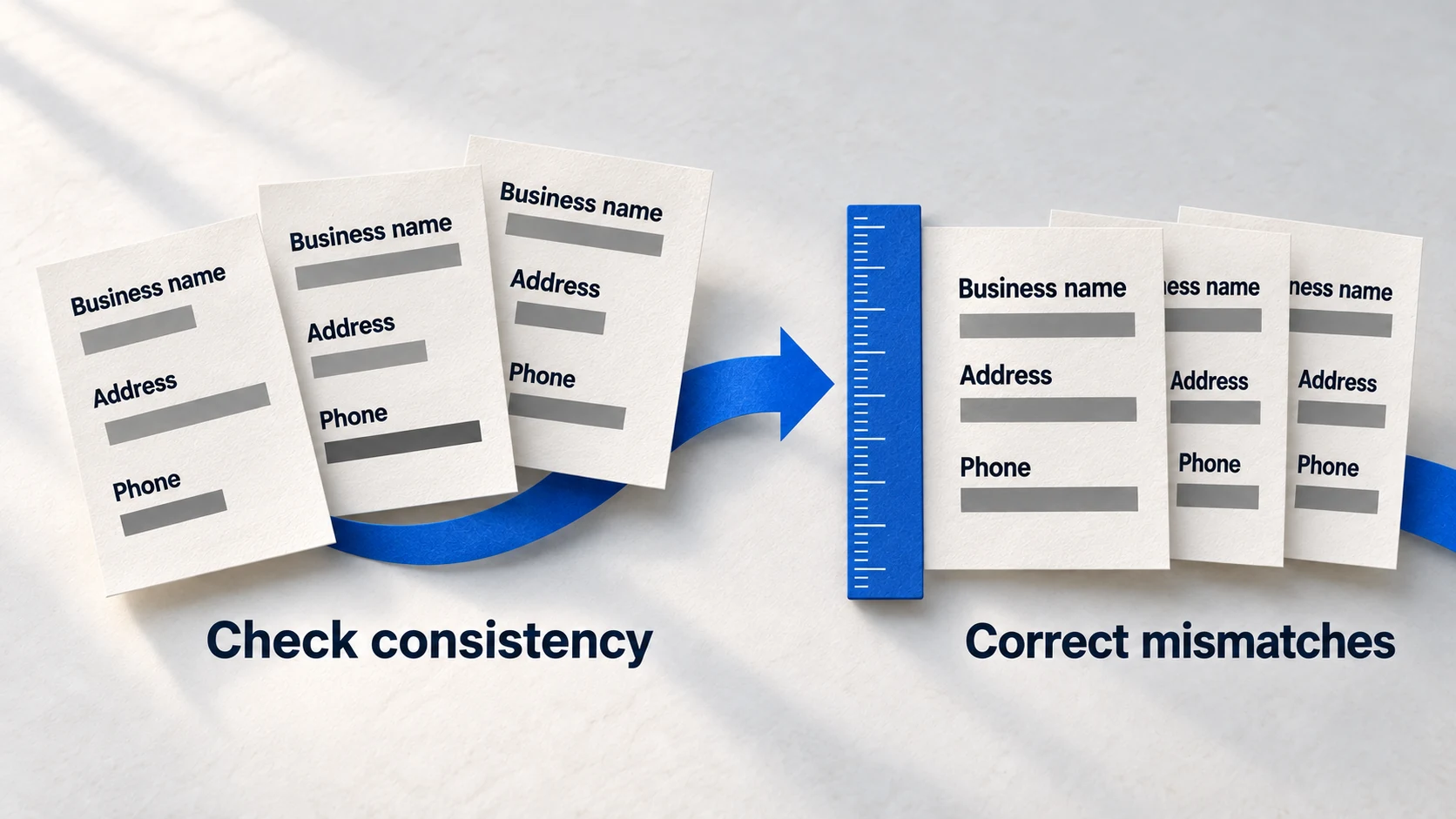
NAP-Name, Address, Phone-is how AI systems verify business identity. When your information varies across directories, AI systems can't confidently recommend you because they can't confirm you're a legitimate entity.
67%
reduction in AI citation probability with inconsistent NAP
Birdeye's 2025 State of Google Business Profiles report found inconsistent data dramatically reduces AI visibility. AI systems treat data consistency as a core trust signal.
350%
more likely to rank in local search with consistent NAP
Businesses with identical NAP across all directories see dramatically better search performance. The same principle applies to AI recommendations.
Common NAP Inconsistencies That Break AI Trust
Business Name Variations
- • "ABC Company" vs "ABC Company, Inc."
- • "ABC Company LLC" vs "ABC Co."
- • Including/excluding DBA names
Address Format Issues
- • "Street" vs "St." vs "St"
- • Suite numbers missing or formatted differently
- • "Road" vs "Rd." inconsistencies
Phone Number Formats
- • (555) 123-4567 vs 555-123-4567
- • Including/excluding country codes
- • Different tracking numbers across listings
Outdated Information
- • Old addresses after a move
- • Disconnected phone numbers
- • Former business names still listed
The consistency principle: Pick one exact format for your business name, one exact address format, and one primary phone number. Use these identically across every single directory. AI systems cross-reference multiple sources-any variation creates doubt about entity legitimacy.
Which Directories to Prioritize
You can't be on every directory, and you don't need to be. Focus resources on directories that AI actually cites, starting with the highest-impact platforms.
Tier 1: Non-Negotiable (Do First)
- • Google Business Profile - Prioritized by all Google AI products; 40.2% of local AI searches cite GBP
- • Yelp - Appears in 33% of AI searches; critical for reviews and recommendations
- • Apple Business Connect - Feeds Apple Maps, Siri, and Apple Intelligence
- • Foursquare - ChatGPT sources 60-70% of local data from Foursquare's database
Tier 2: Important (Do Next)
- • Data Axle - Major data aggregator that feeds downstream directories
- • Neustar Localeze - Aggregator for major platforms and AI systems
- • Bing Places - Powers Microsoft Copilot and Bing AI
- • Facebook Business - Cited across AI platforms for business verification
Tier 3: Industry-Specific (Customize)
Healthcare
WebMD, Vitals, Healthgrades, Zocdoc
Legal
SuperLawyers, FindLaw, Avvo, Martindale
Dental
Toprateddentist.com, DentalPlans
Hospitality
TripAdvisor, MapQuest, OpenTable
The 10-15 Directory Strategy
Research shows businesses on 30+ directories see 136% more consumer actions. But for AI visibility specifically, being on 10-15 high-quality, AI-cited directories with perfect NAP consistency outperforms being on 50 low-quality listings with scattered information. Quality and consistency beat volume.
Directory Mistakes That Kill AI Citations
Most businesses approach directories with a "set and forget" mentality. For AI visibility, this approach creates invisible citations and missed opportunities.
Ignoring Data Aggregators
Claiming Yelp and Google Business Profile while ignoring upstream aggregators like Foursquare and Data Axle. ChatGPT pulls 60-70% of local data from Foursquare-if you're not there, you're invisible to ChatGPT regardless of other listings.
Fix: Start with data aggregators. Their data flows downstream to consumer platforms and AI systems.
Inconsistent NAP Across Listings
Different name formats, address variations, or phone numbers across directories. AI systems cross-reference multiple sources to verify entity legitimacy. Inconsistencies signal unreliable data and reduce citation probability by 67%. (See our brand consistency audit guide.)
Fix: Audit all listings. Standardize to one exact format for name, address, and phone number.
Skipping Industry Directories
Focusing only on general directories while ignoring industry-specific platforms. ChatGPT exclusively sources dental queries from dental directories. Legal queries pull from SuperLawyers and FindLaw. General directories don't appear in specialized searches.
Fix: Identify the top 3-5 directories in your industry. These often carry more AI weight than general listings.
Outdated Information
Old addresses, disconnected phone numbers, or outdated business hours. AI systems can detect data staleness. Listings that haven't been updated in months signal abandoned or unreliable business information.
Fix: Set quarterly reminders to audit and update all listings. Update immediately after any business changes.
Ignoring Reviews Integration
Treating directories as static listings rather than review platforms. Reviews and social content account for 8-13% of AI citations. AI systems summarize reviews when making recommendations-no reviews means limited context for AI to cite.
Fix: Actively request reviews on AI-cited platforms like Yelp and Google Business Profile.
The AI Directory Audit Checklist
- ☐ Claimed and verified on all Tier 1 directories (GBP, Yelp, Apple, Foursquare)
- ☐ Submitted to data aggregators (Data Axle, Neustar)
- ☐ Listed on top 3-5 industry-specific directories
- ☐ NAP format identical across all listings (exact same characters)
- ☐ Business hours current on all platforms
- ☐ Recent reviews present on Yelp and Google
- ☐ Quarterly audit scheduled for ongoing maintenance
FAQ
How many directories should a business be listed on?
Do AI systems cite Yelp and Google Business Profile?
What is NAP consistency and why does it matter for AI?
Are industry-specific directories more valuable than general directories?
Ready to Build AI-Visible Directory Presence?
Directory optimization is one of the highest-ROI GEO strategies.
86% of AI citations come from brand-managed sources like listings.
Take the GEO Readiness Quiz →60 seconds · Personalized report · Free
Continue Learning
Dive deeper into AI search with these related articles:
Entity Optimization Masterclass: AI Brand Recognition
Master the complete framework for establishing your brand as a recognized entity in AI systems. From Entity Homes to Wikidata to knowledge panels.
Brand Consistency Audit: Finding and Fixing Entity Confusion
Learn how to audit your brand's online presence for entity confusion issues. Step-by-step guide to identifying and fixing the inconsistencies that prevent AI citations.
The sameAs Property: Connecting Your Digital Identity
Learn how the sameAs schema property connects your online presences for AI recognition. Step-by-step implementation guide with best practices.