GEO & AI Search
Brand Consistency Audit: Finding and Fixing Entity Confusion
Quick Answer
A brand consistency audit identifies mismatches in how your business appears across the web-different names, addresses, descriptions, or founding dates that confuse AI systems. Entity confusion occurs when search engines and AI platforms can't confidently determine that all your online mentions refer to the same organization. To fix it, create a single source of truth (your Entity Home), then systematically update all external sources to match. NAP consistency alone can improve local search rankings by up to 16%.
Your website says "Founded in 2015." Your LinkedIn says "Founded in 2014." Your Crunchbase profile says "2016." Google Business Profile shows a different address than your About page. Your industry directory listing uses your old company name.
Each inconsistency seems minor. But to AI systems, they're not minor at all. When conflicting information appears across sources, AI platforms face a choice: trust uncertain data, or cite a competitor with cleaner signals. They choose the competitor.
This guide shows you how to find every inconsistency in your brand's digital presence and fix them systematically. Entity confusion is fixable-but only if you know where to look.
What Is Entity Confusion?
Entity confusion occurs when AI systems and knowledge graphs encounter conflicting information about your brand, making them uncertain whether different online mentions refer to the same organization.
How AI Sees Inconsistent Brands
When your homepage says one thing, your LinkedIn says another, and your business directory page seems to describe a different company entirely, AI sees these contradictions and decides it's safer not to reference you at all.
The result: Your brand receives "implicit mentions" instead of direct citations. AI platforms may understand your product or expertise but cannot confidently attribute it to your brand-so they mention the concept without naming you.
Entity Disambiguation
The process AI uses to distinguish between multiple entities sharing the same name. "Paris" could mean the city or the person-context and signals determine which entity is referenced.
Entity Consolidation
Merging multiple perceived entities into one. If Google thinks "Acme Inc." and "Acme Incorporated" are separate companies, consolidation connects them as one entity.
Why Brand Consistency Matters for AI
AI platforms prioritize verifiable information. Verification requires consistency-the same facts stated across multiple authoritative sources. Inconsistency breaks verification.
16%
local ranking improvement from NAP consistency
When Name, Address, and Phone match across all sources, local search rankings improve significantly. The same principle applies to AI visibility.
Source: WP Maps →57%
faster traffic growth with topical authority
Brands with higher topical authority gain traffic faster-and consistent entity signals are the foundation of topical authority in AI search.
Source: Search Engine Land →The trust equation: Inconsistency can lead to what AI models call "hallucinations"-misrepresenting your brand because they're getting conflicting signals. You might show up, but you'll be associated with irrelevant information or, worse, your competitors.
The Brand Consistency Audit Checklist
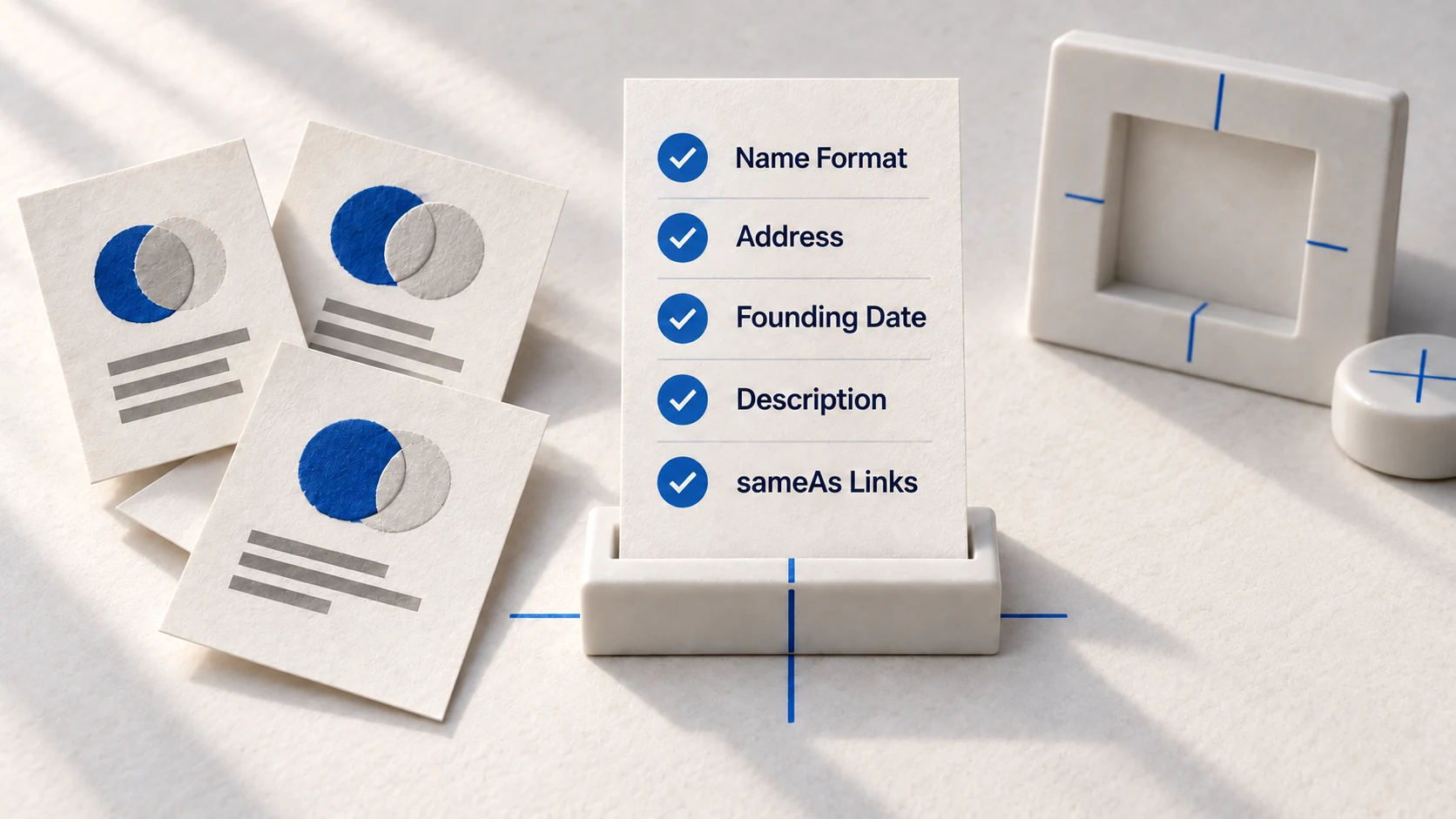
A thorough audit examines every place your brand appears online. Here's the systematic checklist.
1 Core Identity Elements
□ Official business name (exact format)
□ Legal entity type (Inc., LLC, Ltd.)
□ Founding date/year
□ Founder name(s)
□ Headquarters address
□ Phone number (format)
□ Industry/sector classification
□ Company description (first sentence)
2 Owned Properties (Check First)
□ Schema markup (Organization)
□ Press/media kit
□ Team/leadership pages
□ Legal pages (Terms, Privacy)
3 Third-Party Profiles
□ Google Business Profile
□ LinkedIn Company Page
□ Crunchbase
□ Wikidata entry
□ Industry directories
□ Review sites (Yelp, G2, Capterra)
□ Social profiles (Twitter/X, Facebook)
□ Wikipedia (if applicable)
4 Schema Markup Verification
□ Organization name matches Entity Home
□ sameAs links point to correct profiles
□ Address in schema matches visible address
□ foundingDate is accurate
□ Logo URL is current
□ No broken sameAs links
Document every inconsistency you find. The goal is a complete inventory before you start fixing-this prevents the common mistake of fixing some issues while accidentally creating new ones.
Common Entity Confusion Issues
These are the inconsistencies that most frequently cause entity confusion in AI systems.
Name Variations
"Acme Inc." vs "Acme, Inc." vs "Acme Incorporated" vs "ACME" vs "The Acme Company"
Fix: Choose one official format. Use it everywhere. Include variations in schema (alternateName property).
Address Format Mismatches
"123 Main St." vs "123 Main Street" vs "123 Main St, Suite 100" vs missing suite numbers
Fix: Standardize to USPS format. Include suite/floor consistently. Same format on all sources.
Founding Date Conflicts
Different years across LinkedIn, Crunchbase, About page, and press mentions
Fix: Determine the legally correct date (incorporation documents). Update all sources. Add historical context if needed ("Operating since X, incorporated Y").
Old Brand Names
Former company name still appearing on directories, old press releases, industry databases
Fix: Update controllable sources. Add "formerly X" where relevant. Use schema alternateName for old name.
Description Inconsistencies
Different industry classifications, service descriptions, or company positioning across sources
Fix: Create a canonical one-sentence description. Use it as the opening line everywhere.
Broken sameAs Links
Schema pointing to deleted social profiles, old URLs, or incorrect Wikidata entries
Fix: Audit all sameAs URLs quarterly. Remove dead links. Update to current profile URLs.
The compounding problem: Each individual inconsistency might seem tolerable. But inconsistencies compound. Five minor variations create exponential confusion for AI systems trying to determine if "Acme" on Site A is the same entity as "ACME Inc." on Site B. The safest AI response? Don't cite either.
How to Fix Brand Inconsistencies
Fixing entity confusion requires a systematic approach. Random corrections can create new inconsistencies.
The Correction Sequence
Create Your Reference Document
Define the canonical version of every fact: official name, address format, founding date, description, social URLs. This becomes your single source of truth for all updates.
Update Your Entity Home First
Your About page (Entity Home) is the authoritative source. Update it to match your reference document perfectly. Add Organization schema with all correct properties.
Update High-Authority Sources
Google Business Profile, LinkedIn, Wikidata, Crunchbase-in that order. These are the sources Google trusts most for entity verification.
Update Secondary Sources
Industry directories, review sites, social profiles. Work through your audit list systematically. Track each update.
Verify Schema Connections
Ensure sameAs properties in your schema link to all updated profiles. Test with Google's Rich Results Test to confirm no errors.
Sources You Can't Edit
Some mentions (old news articles, third-party blog posts) can't be updated. For these:
- • Focus on making your owned sources authoritative-they'll outweigh scattered inconsistencies
- • Create enough consistent signals that AI prioritizes your verified information
- • For major incorrect sources, contact editors with correction requests (low success rate but worth trying)
- • Use schema alternateName to acknowledge legitimate historical variations
FAQ
How often should I run a brand consistency audit?
What if my business name has legitimately changed?
Should I correct minor variations like 'Inc.' vs 'Incorporated'?
How do I fix inconsistencies on sites I don't control?
Ready to Eliminate Entity Confusion?
Consistency is the foundation of entity recognition.
Audit your brand's digital presence and fix the inconsistencies blocking your AI visibility.
Take the GEO Readiness Quiz →60 seconds · Personalized report · Free
Continue Learning
Dive deeper into AI search with these related articles:
Entity Optimization Masterclass: AI Brand Recognition
Master the complete framework for establishing your brand as a recognized entity in AI systems. From Entity Homes to Wikidata to knowledge panels.
Google Knowledge Panel: How to Get One and Optimize It
Learn how to earn a Google Knowledge Panel for your business or personal brand. Step-by-step process from entity establishment to panel optimization.
Organization Schema: The Foundation of Entity Establishment
Learn how Organization schema creates machine-readable entity profiles that AI engines use when deciding which brands to cite and recommend.