GEO & AI Search
Claude, Gemini, and Beyond: Multi-Model Visibility
Quick Answer
Optimizing for ChatGPT alone leaves you invisible on other AI platforms. Research analyzing 6.8 million AI citations found each model has distinct preferences: Gemini favors brand websites (52%), ChatGPT relies on third-party directories (49%), and Perplexity trusts niche expert sources (24% for subjective queries). Claude delivers the highest session value ($4.56) despite minimal traffic. Multi-model visibility requires a coordinated strategy across all platforms.
You check your AI visibility. ChatGPT cites you. Good news. Then you test Claude-nothing. Gemini-nothing. Perplexity-maybe, depending on the query. Your "AI-optimized" content is visible on exactly one platform.
This isn't unusual. Yext's 2025 study of 6.8 million AI citations reveals that each platform has fundamentally different citation preferences. Visibility on one doesn't transfer to others.
The good news: 86% of citations come from sources you already control. The challenge is understanding what each platform wants-and building a strategy that works across all of them.
The Multi-Model Visibility Problem
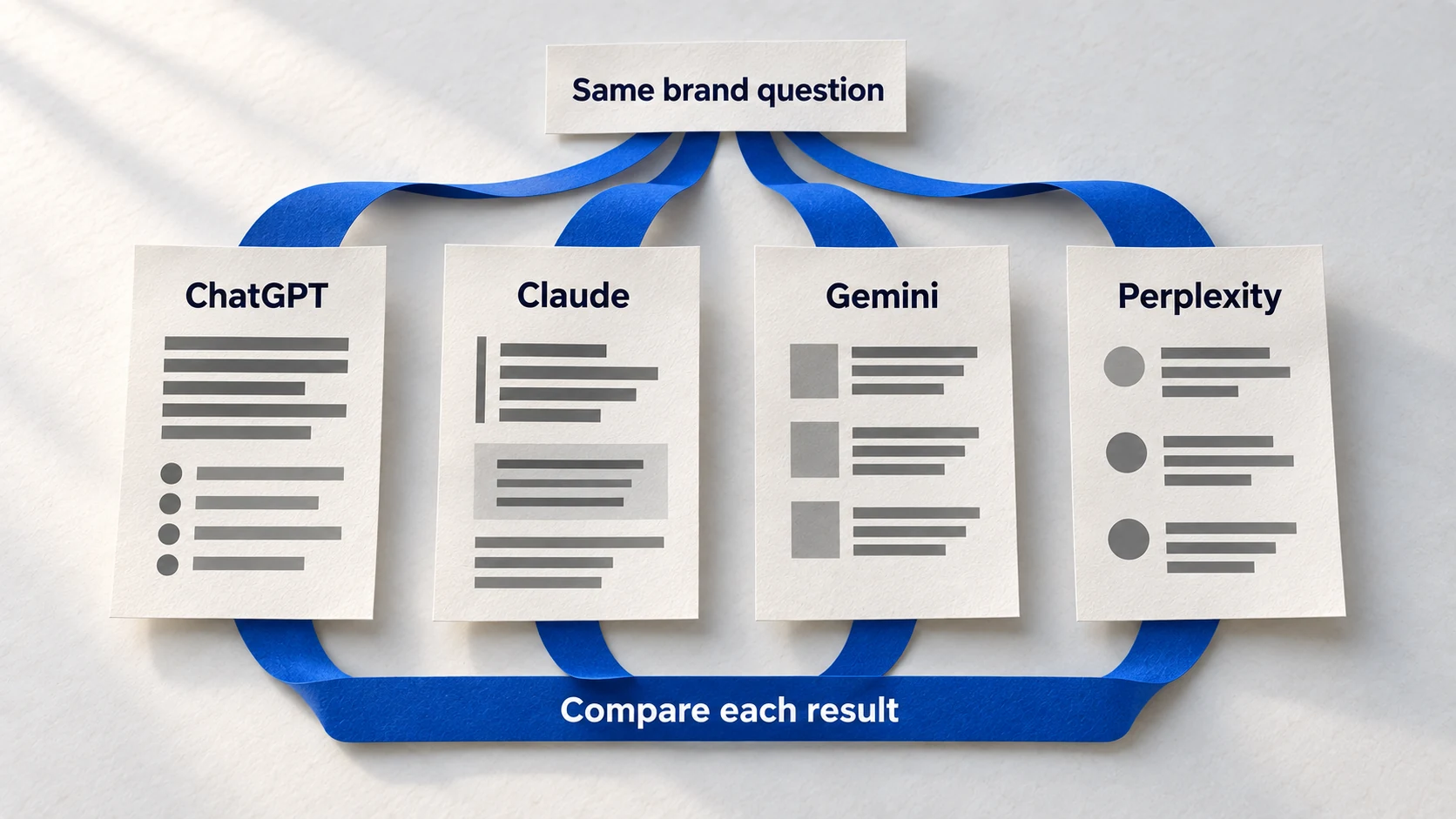
Consumers don't stick to one AI assistant. They move fluidly between ChatGPT for explanations, Gemini for quick facts, Claude for complex reasoning, and Perplexity for research with citations. Your visibility strategy needs to match their behavior.
Research Finding
AI referral traffic grew 527% in early 2025 - and the trend continues
Between January and May 2025, AI-referred sessions jumped from 17,076 to 107,100-a 527% increase across 400+ sites analyzed (Jan–May 2025 data). Gemini referrals alone grew +388% YoY from 2025 to 2026, confirming continued acceleration. But this traffic isn't distributed evenly across platforms.
Source: Superprompt Research 2025
| Platform | Traffic Share | Session Value | Key Strength |
|---|---|---|---|
| ChatGPT | 40-60% | $2.34 | Dominates all verticals |
| Perplexity | 15-25% | $3.12 | Finance & legal focus |
| Microsoft Copilot | 10-20% | $2.89 | Enterprise & legal |
| Google Gemini | 8-15% | $1.98 | Tech & education |
| Claude | <0.001% | $4.56 | Highest per-session value |
Notice the pattern: ChatGPT dominates volume, but Claude delivers nearly double the session value. A multi-model strategy isn't just about being everywhere-it's about being in the right places for your specific goals.
How Each AI Model Cites Differently
The Yext study crystallizes each platform's citation philosophy in a single sentence:
Gemini
"Trusts what your brand says"
52% of citations from brand websites
ChatGPT
"Trusts what the internet agrees on"
49% from third-party directories
Perplexity
"Trusts industry experts and reviews"
24% from niche sources
These aren't subtle differences. They represent fundamentally different approaches to determining what's trustworthy. Content that performs well for Gemini may be invisible to ChatGPT, and vice versa.
The core insight: 86% of AI citations come from sources brands can directly control or influence-websites, listings, and reviews. The difference is which source type each platform prioritizes.
Claude: High Value, Low Volume
Claude presents a unique visibility challenge. Its traffic share is essentially zero (under 0.001%), but its session value ($4.56) is the highest of any AI platform. For certain businesses, those visitors may be worth more than all other AI traffic combined.
According to Search Engine Land, Claude added web search capabilities in 2025, operating in two modes: model-native (from training data) and retrieval-augmented (live search). This hybrid approach means your content can surface either way.
Optimizing for Claude
- 1. Technical depth matters. Claude users skew toward complex reasoning tasks. Comprehensive, technically accurate content performs better.
- 2. Structure for synthesis. Claude excels at analyzing and combining information. Well-organized content with clear sections helps.
- 3. Be findable via traditional SEO. Claude's search uses multiple providers. Strong Google rankings increase Claude citation likelihood.
- 4. Focus on B2B and technical topics. Claude's user base skews toward developers, researchers, and enterprise users.
The question for your business: Is Claude's high-value, low-volume traffic worth specific optimization? For B2B SaaS, technical products, and professional services-probably yes. For consumer brands-probably not as a priority.
Gemini: Schema-First, Brand-Trusting
Gemini's integration with Google's search infrastructure creates distinct optimization opportunities. Unlike ChatGPT, which relies heavily on third-party validation, Gemini favors brand-controlled sources.
Gemini Citation Source
52.15%
of citations from brand-owned websites
Technical Requirements
Schema markup, local landing pages, consistent subdomains, and structured factual content drive Gemini citations.
This brand-trusting approach has implications: If your website has strong technical SEO and comprehensive schema markup, you're already positioned for Gemini visibility. The platform rewards what you control directly.
Optimizing for Gemini
Implement comprehensive schema markup
Organization, LocalBusiness, Product, Article, FAQPage-Gemini heavily weights structured data in citation decisions.
Optimize Google Business Profile
Gemini incorporates GBP data even when it doesn't cite the source directly. Complete, accurate profiles improve visibility.
Build strong local landing pages
Location-specific content with schema performs exceptionally well for Gemini's local queries.
Maintain subdomain consistency
Consistent naming conventions across subdomains help Gemini understand and trust your site structure.
Building a Multi-Model Visibility Strategy
The good news: You don't need completely separate strategies for each platform. Core best practices help across all of them. Platform-specific tactics layer on top.
Cross-Platform Research (2026)
Brands on 4+ AI platforms see 2.8x higher citation likelihood
Multi-source consensus is a strong signal: when you appear consistently across ChatGPT, Perplexity, Gemini, and Claude, each platform's model treats your brand as a validated authority. Presence compounds-it's not additive, it's multiplicative.
Universal Foundation (All Platforms)
Strong traditional SEO
77% of AI visibility comes from traditional SEO foundation. Sites in Google's top 10 are significantly more likely to be cited.
Structured content
H2→H3→bullet structures are 40% more likely to be cited across all platforms.
Content freshness
Content updated within 30 days gets 3.2x more citations regardless of platform.
Original data
Pages with data tables and original research get 4.1x more citations.
Once your foundation is solid, layer platform-specific optimizations based on your priorities:
| Priority | Add This Layer | Best For |
|---|---|---|
| ChatGPT | Directory listings, third-party reviews, encyclopedic depth | Consumer brands, broad reach |
| Gemini | Schema markup, GBP optimization, local pages | Local businesses, technical SEO strength |
| Perplexity | Reddit presence, niche directories, recent content | Finance, legal, expert niches |
| Claude | Technical depth, comprehensive analysis | B2B, developers, researchers |
Start with the platform that best matches your current strengths and audience. Once you're visible there, expand to others. Trying to optimize for all platforms simultaneously dilutes focus and delays results.
The pattern I've seen work best: pick two platforms to optimize aggressively, then let the universal foundation (strong SEO, structured content, fresh updates) handle the rest. Most businesses find that ChatGPT plus one other platform-Gemini for local, Perplexity for finance, Claude for B2B-covers 80% of their AI visibility opportunity.
FAQ
Should I optimize for all AI models equally?
How do I know which AI platforms my audience uses?
Does optimizing for one platform hurt visibility on others?
Is Claude worth optimizing for given its low traffic share?
Are You Visible Across ALL AI Platforms?
ChatGPT might cite you. But what about Claude, Gemini, and Perplexity? Find out where you stand-and where you're invisible.
Get your personalized multi-model visibility report in 60 seconds.
Take the GEO Readiness Quiz →60 seconds · Personalized report · Free
Continue Learning
Dive deeper into AI search with these related articles:
Perplexity vs ChatGPT: Different Engines, Different Optimization
Perplexity cites Reddit 46.7% of the time. ChatGPT cites Wikipedia 47.9%. Learn platform-specific strategies.
How ChatGPT, Claude, and Perplexity Actually Find and Cite Content
Each AI platform works differently. Learn the mechanics behind how ChatGPT, Claude, and Perplexity discover and cite your content.
Google AI Overviews: What Gets Featured and Why
AI Overviews appear in 15-16% of all searches—but 80% of cited sources don't rank in the top 3.