GEO & AI Search
How to Explain Traffic Decline to Your Boss (Template + Script)
Quick Answer
When explaining traffic decline to your boss, frame it as an industry-wide shift to zero-click and AI-generated search, not a performance failure. Lead with business metrics (conversions, revenue per visitor) instead of traffic volume, use comparative data to show your competitors face the same decline, and present a strategic adaptation plan. Reframe "why is traffic down?" into "here's how we stay competitive."
You open Slack. There's a message from your boss: "Can we talk about the traffic numbers?"
Your stomach drops. You know what's coming.
The monthly report shows traffic down 30%. Maybe 40%. Rankings are stable. Your SEO work hasn't changed. But the graph is pointing the wrong direction.
You need a way to explain this that doesn't sound like making excuses. You need data. You need context. You need a script that reframes panic into strategy.
This post gives you that script.
Why This Conversation Is So Hard
For years, the equation was simple: more traffic = better SEO performance = happy stakeholders.
That equation just broke.
80%
Zero-Click Searches
Bain research shows 80% of searches now end without any click to a website
Source: Bain Insights67%
AI Overviews in B2B
Google's AI-powered results appear in 67% of B2B-related queries in 2025
Source: KEO MarketingYour boss doesn't know these numbers yet. They're looking at your analytics dashboard and seeing a red line trending down.
Without context, it looks like failure. With context, it's an industry-wide shift that requires strategic adaptation.
Your job in this conversation isn't to defend. It's to educate and lead.
Pro Tip
The most successful conversations happen when you position traffic decline as a strategic pivot point. Your boss is worried about failure; show them leadership instead. 'We're ahead of competitors who haven't adapted yet' beats 'everyone's traffic is down' every time.
Before the Meeting: Preparation Checklist
- Pull exact traffic decline numbers (%, month-over-month, year-over-year)
- Document stable or improving keyword rankings as evidence SEO work is solid
- Research 3 industry stats proving this is widespread (Bain, KEO, Digital Bloom)
- Calculate current conversion rate and revenue per visitor
- Draft your 30/90/180-day strategic adaptation plan with specific milestones
- Define 3-5 new KPIs you'll report monthly (business outcomes, not vanity metrics)
The Conversation Template (Copy This)
This is the exact structure to use when you have that meeting. Adapt the specifics to your situation, but follow this framework:
Step 1
Acknowledge the Data
"You're right-traffic is down. Here's what the data shows..."
- Metric 1: Organic traffic declined X% month-over-month
- Metric 2: Year-over-year comparison shows similar trend
- Important context: Rankings for our target keywords are stable or improving
Why this works:
You're not defensive. You're presenting facts. This builds credibility before you introduce the context.
Step 2
Provide Industry Context
"This isn't happening to us in isolation. Here's what's happening across our industry..."
- Bain research shows 80% of searches now end without a click (up from 50% in 2019)
- Google's AI Overviews appear in 67% of B2B queries
- The median publisher saw a 10% year-over-year decline in H1 2025
- When AI Overviews appear, click-through rates drop to 8% from 15% (a 46.7% reduction)
Why this works:
You're shifting the narrative from "we failed" to "the landscape changed." Your boss now understands this is strategic, not operational.
Step 3
Reframe Success Metrics
"Traffic is a means to an end. What actually matters for the business is..."
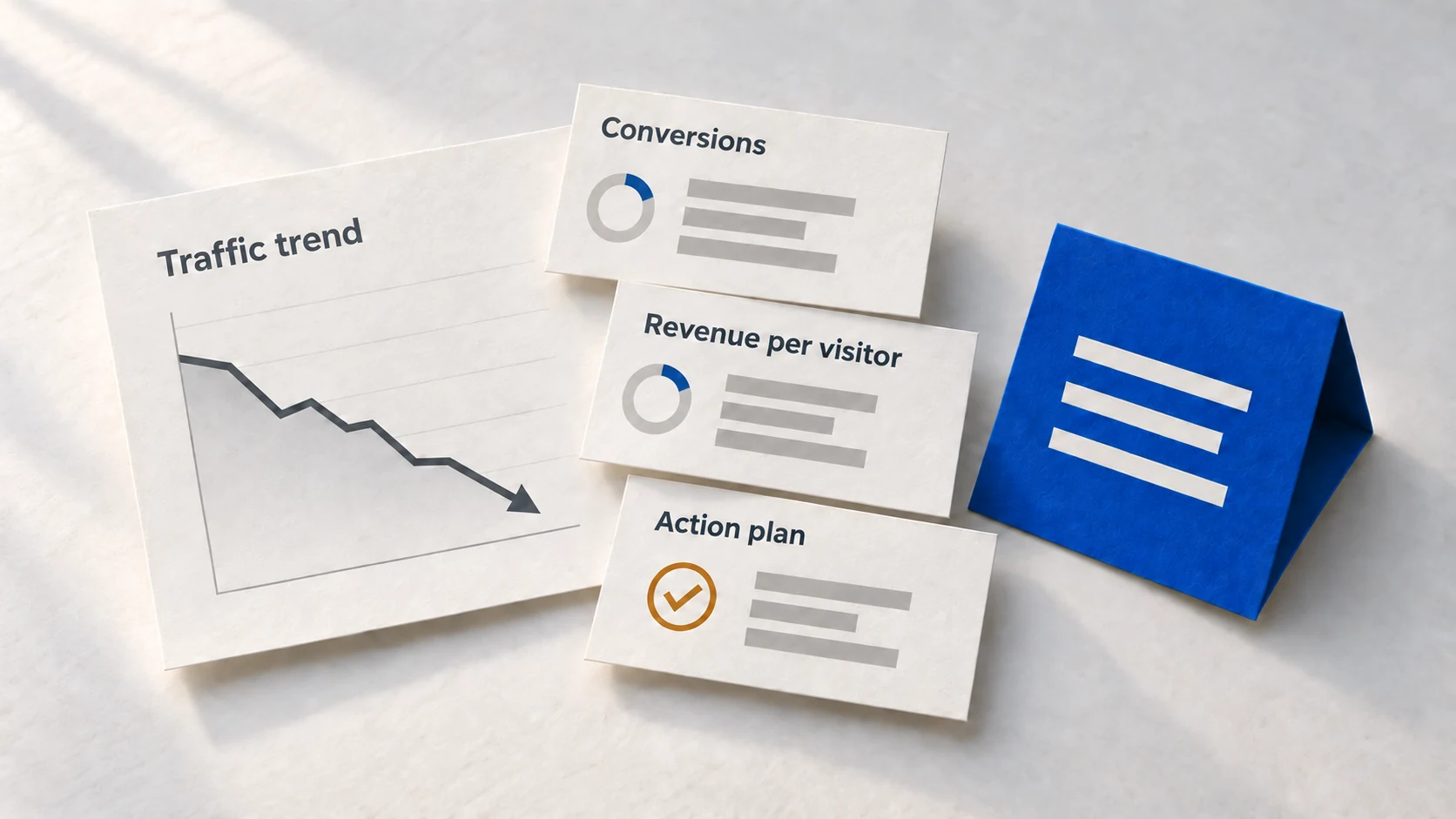
Old Metrics
• Total traffic volume
• Pageviews
• Bounce rate
• Session duration
Vanity metrics
Business Metrics
• Conversion rate
• Cost per acquisition
• Revenue per visitor
• Qualified leads generated
Outcomes that matter
Real example to use:
"NerdWallet lost 20% of their traffic in Q4 2024. They grew revenue 37% in the same period. Less traffic, better traffic."
Step 4
Present the Strategic Plan
"Here's our three-phase plan to adapt..."
- → Immediate (Next 30 days): Audit conversion funnel, optimize for high-intent keywords, begin AI visibility optimization (GEO)
- → Short-term (90 days): Build brand authority, diversify traffic sources beyond Google organic, implement Answer Engine Optimization
- → Long-term (6-12 months): Establish ourselves as a cited authority in AI search results, measure success by revenue impact instead of traffic volume
Why this works:
You're moving the conversation from problem to solution. Your boss now sees a leader, not someone making excuses.
Step 5
Define Success Going Forward
"Here's what I'll report monthly to show we're on track..."
- Business Metrics: Conversion rate, cost per lead, revenue attribution
- Visibility: Search impressions, branded search volume, AI citation tracking
- Competitive Context: Our performance vs. industry benchmarks
- Strategic Progress: Milestones achieved in 30/90/180-day plan
Why this works:
You're setting new expectations. Next month's report won't be "traffic is still down" - it'll be "here's our progress on the strategic plan."
The Follow-Up Email (Send This After the Meeting)
After the meeting, send this email to reinforce the plan and document next steps:
Subject: Traffic Decline Discussion - Action Plan Summary
Hi [Boss Name],
Thanks for the conversation today about our organic traffic trends. I wanted to summarize what we discussed and confirm next steps.
Current Situation:
- • Organic traffic down X% month-over-month
- • Rankings stable/improving for target keywords
- • Conversion rate [up/stable] at X%
Industry Context:
- • 80% of searches now zero-click (Bain research)
- • 67% of B2B queries show AI Overviews (KEO Marketing)
- • Median publisher down 10% year-over-year (Digital Bloom)
Our Strategic Plan:
30 Days: Conversion funnel audit, begin GEO optimization
90 Days: Brand authority building, traffic diversification
6-12 Months: Become cited authority in AI search
New Reporting Metrics:
- • Conversion rate and cost per acquisition
- • Revenue per visitor and qualified leads
- • Search impressions and brand visibility
- • Progress against strategic milestones
I'll have the first progress update ready for our next meeting on [date]. Let me know if you need anything before then.
Best,
[Your Name]
This email accomplishes three things:
- → Documents the plan (so expectations are clear)
- → Reinforces your leadership (you're driving the solution)
- → Sets up your next report (no more "traffic is down" conversations)
What NOT to Say (Common Mistakes)
These phrases will make your boss lose confidence. Avoid them:
❌ "It's Google's fault"
Even if true, this sounds like blame-shifting. Frame it as "industry-wide shift" instead.
❌ "Everyone's traffic is down"
True, but without data this sounds defensive. Use: "The median publisher experienced a 10% decline per Digital Bloom research."
❌ "We need to wait and see what happens"
This signals passivity. Instead: "Here's our adaptation plan with specific milestones."
❌ "Traffic doesn't matter anyway"
This contradicts your previous reports. Say: "Traffic was the proxy we used. We can now track business outcomes directly."
❌ "This is just temporary"
Zero-click search isn't going back. Frame as: "This is a permanent shift that requires strategic adaptation."
The difference between keeping your job and losing it often comes down to how you frame the problem.
FAQ
How do I explain organic traffic decline to my boss?
Should I tell my boss traffic is down because of AI?
What metrics should I show instead of traffic?
Ready to Lead the Strategic Shift?
You have the template. You have the data. Now you need the complete strategy to optimize for AI search while maintaining stakeholder confidence.
I've built a system to help brands go from invisible to cited in AI responses. But before I share it with you, I want you to see exactly where you stand.
Take the GEO Readiness Quiz →60 seconds · Personalized report · Free
Continue Learning
Dive deeper into AI search with these related articles:
The Zero-Click Reality: Why Your Traffic Is Down 40%
80% of searches now end without a click. But traffic loss doesn't have to mean business loss. Here's how to adapt and thrive.
Case Study: How NerdWallet Grew Revenue 37% Despite Traffic Decline
NerdWallet lost 20% of organic traffic but grew revenue 37%. Here's exactly how they did it and what you can learn.
The Quality vs Quantity Shift: Why 200 AI Referrals Beat 1,000 Organic Visits
AI referral traffic converts 4.4x better than traditional organic. Learn why quality trumps quantity in AI search.