GEO & AI Search
ROI of GEO: Calculating the Value of an AI Citation
Quick Answer
Calculate AI citation value using this formula: (AI Referral Sessions × Conversion Rate × Customer Lifetime Value) + (Citation Impressions × Brand Lift Factor × Average Brand Touchpoint Value). The first component captures direct conversion value-AI referrals convert at 4.4x the rate of organic traffic. The second captures brand awareness value from citations that don't generate clicks. A typical citation is worth $15-50 for B2C and $150-500 for B2B, depending on industry and conversion metrics.
"What's the ROI of GEO?" It's the first question stakeholders ask and the hardest to answer. Unlike SEO where you can trace a keyword ranking to traffic to conversions, AI citations happen in zero-click environments where traditional attribution breaks down.
But the value is real. According to Semrush's 2025 study, AI referral visitors convert at 4.4x the rate of organic search visitors. Companies like Tally report that 25% of new users now come through GEO efforts, with over 2,000 sign-ups attributed to AI tool citations.
This guide provides a practical framework for calculating the dollar value of AI citations-both the direct conversion value and the harder-to-measure brand awareness value.
Why Traditional ROI Calculations Fail for GEO
The standard ROI formula-(Revenue - Cost) / Cost-doesn't work for GEO because AI citations create value in ways that traditional analytics can't capture.
Three Reasons GEO ROI Is Different
1. Zero-Click Value
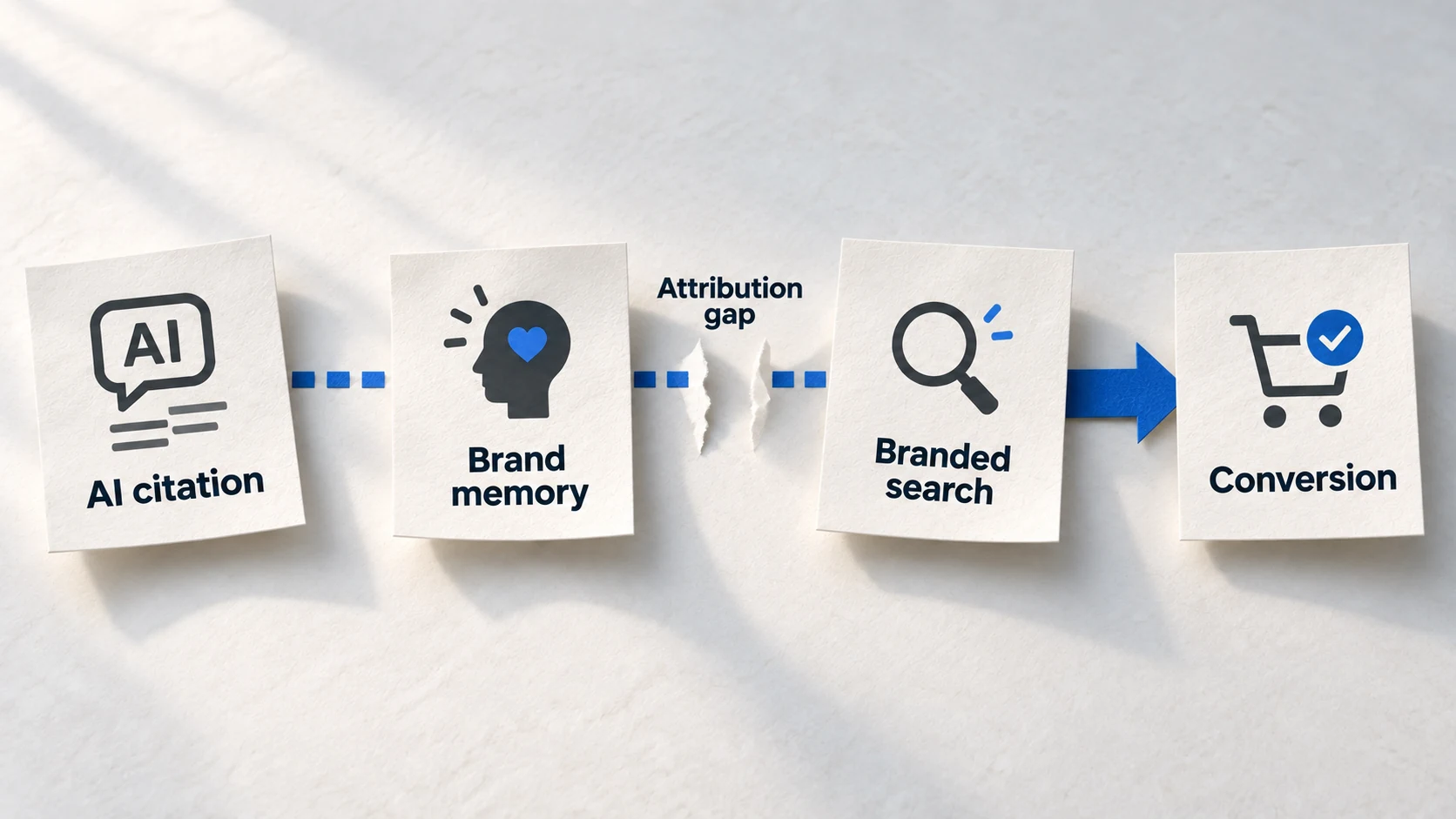
Most AI citations happen without clicks. A user asks ChatGPT for a recommendation, sees your brand cited, and later searches directly for your brand name. The citation generated value, but your analytics show it as "direct" traffic.
2. Multi-Touch Attribution
AI citations often serve as mid-funnel touchpoints. A prospect might see your brand in a ChatGPT response, then see it again in a Perplexity search, then click a Google ad. Which channel gets credit? All three contributed.
3. Compounding Returns
GEO investments compound over time. As AI models update, content that gets cited becomes more likely to be cited again. Early GEO investment creates a flywheel effect that traditional ROI snapshots miss.
The key insight: GEO ROI requires measuring both direct conversion value (traffic that does click through) and attributed brand value (awareness created by citations that don't click). Most companies only measure the first, dramatically understating GEO's true value.
The Citation Value Framework
A complete citation value framework captures both direct and indirect value. Here's how to think about each component.
Direct Conversion Value
Value from AI referral traffic that actually clicks through to your site.
Sessions × Conv. Rate × LTV
This is the easier component to measure. If you have 500 AI referral sessions at a 14% conversion rate and $200 LTV, direct value = $14,000.
Brand Awareness Value
Value from citations that build awareness without generating clicks.
Impressions × Brand Lift × TPV
Harder to measure but often larger. If 10,000 users see your brand cited, and 3% later search your brand, that's 300 branded searches you wouldn't have gotten.
What the Data Shows About AI Traffic Value
4.4x
Conversion rate lift vs. organic
Source: Semrush 2025 Study
14.2%
AI referral conversion rate
vs. 2.8% organic (Exposure Ninja)
25%
New users from GEO (Tally)
2,000+ sign-ups via AI tools
The 4.4x conversion lift makes intuitive sense: AI pre-qualifies visitors by only citing content relevant to their specific query. By the time someone clicks through from ChatGPT, they've already been told your content answers their question.
How to Calculate Your Citation Value
Follow this step-by-step process to calculate what each AI citation is worth to your business.
Citation Value Calculation
Gather Your Baseline Metrics
- • AI referral sessions (from GA4 custom channel)
- • Conversion rate for AI traffic specifically
- • Customer Lifetime Value (LTV) or Average Order Value
- • Estimated citation impressions (sessions × 10-20 for click-through rate estimate)
Calculate Direct Conversion Value
Direct Value = AI Sessions × Conversion Rate × LTV
Example: 500 sessions × 14% × $200 LTV = $14,000
Calculate Brand Awareness Value
Brand Value = Impressions × Brand Lift Rate × Touchpoint Value
Example: 10,000 impressions × 3% brand lift × $15 per branded search = $4,500
Sum Total Citation Value
Total Value = Direct Value + Brand Value
Example: $14,000 + $4,500 = $18,500 total citation value
Calculate Per-Citation Value
Per-Citation Value = Total Value ÷ Number of Citations
Example: $18,500 ÷ 150 citations = $123 per citation
Typical Citation Value Ranges by Industry
| Industry | LTV Range | Typical Citation Value |
|---|---|---|
| E-commerce (B2C) | $50-200 | $15-50 |
| SaaS (B2B) | $2,000-20,000 | $150-500 |
| Professional Services | $5,000-50,000 | $300-1,000 |
| Local Business | $100-500 | $25-75 |
These ranges assume 4.4x conversion lift and 3% brand lift rate. Adjust based on your actual data.
A Practical GEO ROI Model
According to research from HashMeta, GEO ROI should be calculated across three dimensions: direct revenue impact, operational efficiency gains, and brand value enhancement.
Three-Dimension ROI Model
Direct Revenue Impact
~63%
Traffic, conversions, and sales directly attributed to AI referrals. The most trackable component.
Efficiency Gains
~21%
Reduced customer acquisition costs, shorter sales cycles, less time explaining "what you do" because AI already did it.
Brand Value
~16%
Increased branded search, authority positioning, trust signals from AI endorsement.
Percentages based on HashMeta case study showing $940K total value from $85K investment.
Expected ROI Timeline
Foundation: 0-25% ROI
Setup, baseline measurement, initial optimizations
Optimization: 25-75% ROI
Citation growth begins, traffic increases measurably
Scaling: 75-150% ROI
Compounding effects kick in, brand lift measurable
Maturity: 150-300%+ ROI
Full flywheel effect, defensive moat established
Justifying GEO Investment to Stakeholders
Stakeholders understand SEO because they've seen rankings and traffic reports for years. GEO requires a different framing that connects AI visibility to business outcomes they care about.
Stakeholder Communication Framework
Frame 1: "Citations are the new rankings"
"Just as we track keyword rankings in Google, we now track citation frequency in ChatGPT, Perplexity, and other AI tools. Being cited is the AI equivalent of ranking #1."
Frame 2: "Higher quality traffic"
"AI referral visitors convert at 4.4x the rate of organic search visitors. Even small gains in AI visibility translate to outsized revenue impact."
Frame 3: "Competitive moat"
"Early investment in GEO creates a compounding advantage. As AI models learn which sources to trust, being cited now makes it more likely we'll be cited later."
Frame 4: "Risk mitigation"
"Search volume is declining 25% by 2026. Companies not building AI visibility now will face a traffic cliff while competitors who invested early capture the AI-driven audience."
The bottom line for stakeholders: GEO isn't an additional cost-it's an investment in the channel that will matter most as AI becomes the primary way people find information. The companies investing now will have a 12-24 month head start on those who wait.
Real-World ROI Calculation: Walking Through the Numbers
Theory is helpful. Seeing the actual math applied to a real scenario is better. Let me walk you through how a B2B SaaS company calculated their GEO ROI-and what they discovered.
Case: Mid-Market SaaS ($150 MRR Product)
Starting Point (Month 0)
- • AI referral sessions: 47/month (barely tracking)
- • Citation frequency: 2.1% across 50 tracked queries
- • GEO investment: $0 (not prioritized)
After 6 Months of GEO Work
- • AI referral sessions: 312/month
- • Citation frequency: 11.7% across 50 tracked queries
- • GEO investment: $8,500 (tools + content optimization)
ROI Calculation
- • New monthly sessions from AI: 265 (312 - 47)
- • Conversion rate (AI traffic): 14.2%
- • New monthly conversions: 37.6
- • LTV per customer: $1,800 (12-month average)
- • 6-month revenue attributed to GEO: $67,680
- • ROI: 696% (($67,680 - $8,500) / $8,500)
What made this work wasn't magic-it was consistent effort applied to a small number of high-value queries. They didn't try to rank for everything. They identified 15 queries where ChatGPT recommendations directly influenced buying decisions, then optimized aggressively for those specific queries.
The 4.4x conversion lift from AI traffic transformed what would have been 265 moderately valuable sessions into 37 high-intent conversions. That's the multiplier effect that makes GEO investment worthwhile-you're not just getting more traffic, you're getting traffic that's already been pre-qualified by AI.
The takeaway: GEO ROI isn't about reaching massive traffic numbers. It's about reaching the right traffic-visitors who arrive already knowing you're the answer to their question. That quality advantage compounds month over month.
FAQ
How do I value citations that don't generate clicks?
What if my AI referral traffic is too small to calculate meaningful ROI?
Should I count AI referrals differently in my attribution model?
How long before GEO investment shows positive ROI?
Ready to Calculate Your GEO ROI?
Understanding citation value is step one. Building the visibility to earn those citations is step two.
Discover the complete framework for AI search optimization.
Take the GEO Readiness Quiz →60 seconds · Personalized report · Free
Continue Learning
Dive deeper into AI search with these related articles:
The New SEO Metrics That Matter in AI Search
Traditional SEO metrics are failing. Learn the new metrics that actually matter: AI Citation Frequency, Share of Model Visibility, and more.
The GEO Dashboard: What to Track and How to Report
Build a GEO dashboard that tracks citation frequency, brand visibility, share of voice, and AI referral traffic.
AI Referral Traffic: Setting Up Tracking in Google Analytics
Learn how to track traffic from ChatGPT, Perplexity, Claude, and other AI tools in GA4.