GEO Fundamentals
LocalBusiness Schema: Essential for Location-Based Businesses
Quick Answer
LocalBusiness schema is structured data that tells AI engines your business name, address, phone number, hours, and geographic coordinates. It helps Google Maps, ChatGPT, Perplexity, and voice assistants understand your location-based services. Businesses with complete LocalBusiness schema see 40-60% better visibility in "near me" searches and local AI recommendations because AI systems can confidently present your details when users ask location-specific questions.
You have a physical location. Your Google Business Profile is claimed and optimized. Your NAP (name, address, phone) is consistent across directories. But when someone asks ChatGPT "best coffee shop near downtown Portland" or Perplexity "plumber open now in Austin," your business does not appear in the recommendations.
The issue is not your reputation or your online presence. The issue is that AI engines cannot reliably extract your location data from unstructured text. They see your address mentioned on your About page, but they cannot be certain whether you serve customers at that location, whether you are open today, or what your service area covers.
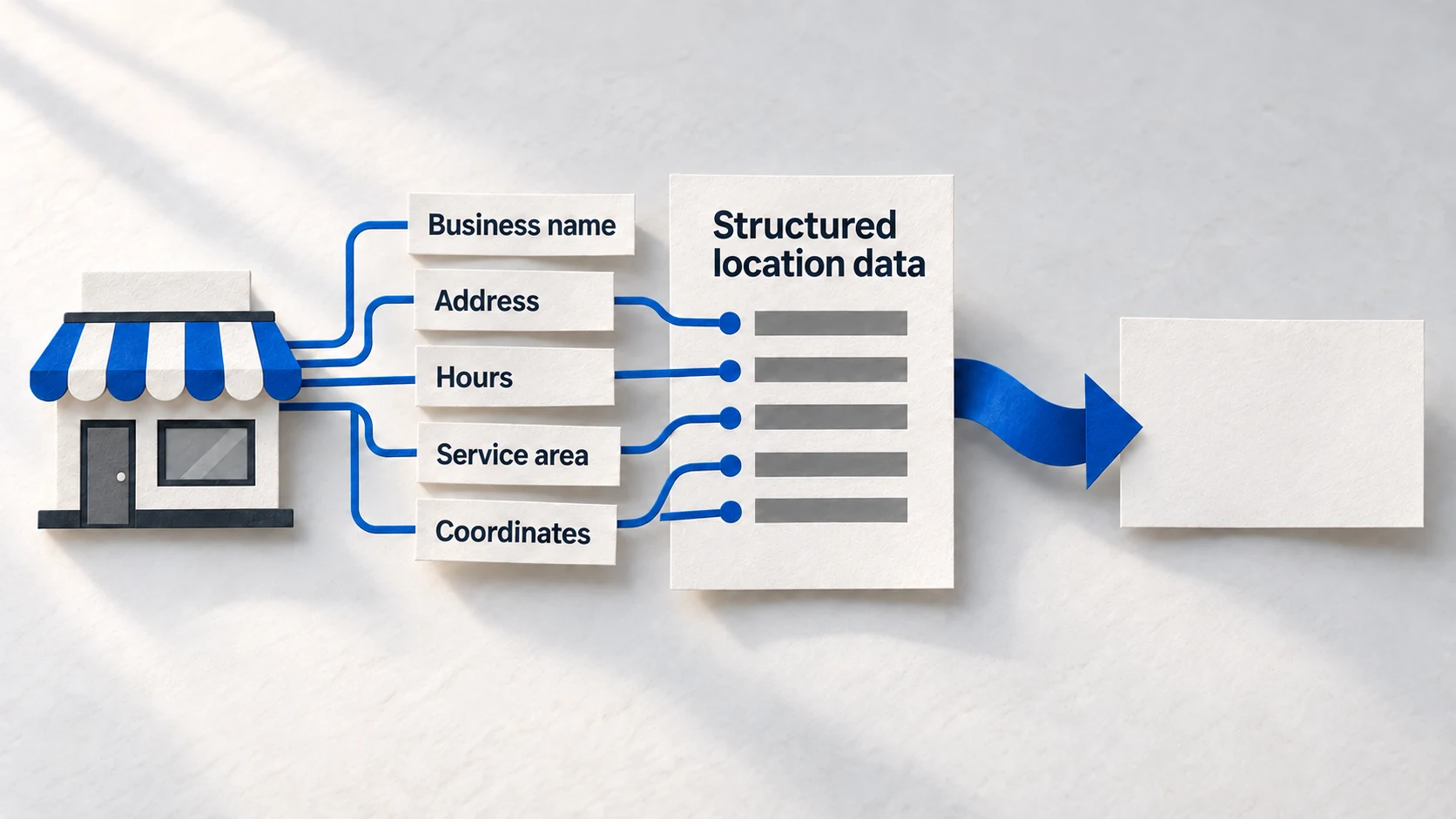
LocalBusiness schema solves this by providing machine-readable location details. It tells AI systems exactly where you are, what you offer, when you are available, and how customers can reach you.
What Is LocalBusiness Schema?
LocalBusiness schema is a type of structured data specifically designed for businesses with physical locations or defined service areas. It is part of the Schema.org vocabulary and includes subtypes for specific industries: Restaurant, Dentist, Plumber, Store, Hotel, and dozens more.
Think of it this way: Without LocalBusiness schema, your location information is scattered across your website-address in the footer, phone in the header, hours on the contact page. AI has to piece together these fragments and hope they are current. With LocalBusiness schema, all location details exist in one structured format that AI can read instantly and trust as authoritative.
Google's official LocalBusiness documentation confirms that this schema type directly influences local search features: knowledge panels, map packs, and "near me" results. But its importance extends beyond Google. ChatGPT, Perplexity, voice assistants, and other AI platforms use LocalBusiness schema to answer location-based queries confidently.
When someone asks "Italian restaurant open now near me," AI systems prioritize businesses with LocalBusiness schema because the data is structured, verified, and includes critical details like current operating hours and precise coordinates.
Definition
LocalBusiness Schema
Structured data markup that provides machine-readable information about a physical business location-including address, coordinates, operating hours, contact details, and service area-enabling AI engines to confidently recommend your business for location-based queries.
Why Location Matters to AI Engines
Location-based queries represent a massive portion of AI search volume. People ask AI where to eat, which services are nearby, and which businesses are open right now. These queries require precise, structured data-unstructured text is insufficient.
Research analyzing 6.8 million AI citations found that Gemini, ChatGPT, and Perplexity overwhelmingly prefer brand-managed sources for local business information. Your website with LocalBusiness schema is a brand-managed source. A random blog post mentioning your address is not.
Why It Matters 1
"Near Me" Query Explosion
Voice assistants and AI chatbots handle millions of "near me" queries daily. "Coffee shop near me," "urgent care open now," "hardware store in zip code 78701." These queries require geographic precision that unstructured text cannot provide.
LocalBusiness schema includes geo-coordinates (latitude and longitude) that AI systems use to calculate distance, determine proximity, and rank results by relevance to the user's location. Without coordinates, AI cannot confidently recommend your business even if you are the closest option.
Why It Matters 2
Operating Hours Verification
AI systems prioritize businesses that are currently open. When someone asks "pizza delivery open now," AI checks operating hours before making recommendations. If your hours are only mentioned in paragraph text on your contact page, AI may skip your business entirely to avoid recommending a closed location.
LocalBusiness schema includes structured openingHoursSpecification that AI can parse instantly. It knows you are open Monday-Friday 9am-5pm, closed weekends, and have special holiday hours. This real-time availability data significantly increases citation probability for time-sensitive queries.
Why It Matters 3
Service Area Clarity
If you are a plumber serving a 30-mile radius or a delivery restaurant covering three zip codes, AI needs to know your service boundaries. LocalBusiness schema includes areaServed property that defines which locations you serve.
This prevents AI from recommending your business to users outside your service area and ensures you appear for queries within your coverage zone. Local SEO schema best practices emphasize that service area businesses benefit even more from LocalBusiness schema than storefront businesses because the geographic boundaries are otherwise ambiguous.
Essential Properties for Local Visibility
LocalBusiness schema includes dozens of possible properties, but some are critical for AI visibility while others are optional enhancements.
Required Properties (Must Include)
Specific business type
Use the most specific subtype: Restaurant, Dentist, Plumber, Store, etc. Avoid generic "LocalBusiness" if a subtype fits.
Official business name
Exact name as it appears on signage, legal documents, and Google Business Profile
PostalAddress object
streetAddress, addressLocality, addressRegion, postalCode, addressCountry
Primary phone number
Include country code: +1-555-123-4567
Strongly Recommended Properties
GeoCoordinates object
latitude and longitude for precise map placement
Operating hours by day
dayOfWeek array with opens and closes times in HH:MM format
Official website URL
Homepage or primary landing page
Cost indicator
$, $$, $$$, or $$$$ (or currency range like "$10-$50")
Business photo URL
Storefront, logo, or representative image
The more properties you include, the more confident AI systems become in recommending your business. A LocalBusiness schema with name and address is minimal. One with geo-coordinates, hours, reviews, and service area is comprehensive and significantly more likely to appear in AI-generated local recommendations.
Implementation Walkthrough
Implementation best practices for AI search optimization recommend JSON-LD format because it is easier to maintain, does not interfere with HTML structure, and is explicitly preferred by Google and most AI platforms.
Gather Your Information
Collect the following details before generating schema:
- • Official business name (exact match to Google Business Profile)
- • Complete address (street, city, state, zip, country)
- • Phone number with country code
- • Website URL
- • Operating hours for each day of the week
- • Latitude and longitude (use Google Maps: right-click location, copy coordinates)
- • Business category (Restaurant, Dentist, Plumber, etc.)
- • Service area (if applicable)
Generate Schema with AI
Use ChatGPT or Claude with this prompt:
The AI will generate properly formatted JSON-LD code with all required and recommended properties filled in.
Add Schema to Your Website
Place the JSON-LD code inside a <script type="application/ld+json"> tag in your website's <head> section or just before the closing </body> tag.
For WordPress users, plugins like Rank Math SEO, Yoast Local SEO, or Schema Pro allow you to add LocalBusiness schema without editing code. Enter your business details in the plugin settings and it generates the schema automatically.
If you have multiple locations, add LocalBusiness schema to each location page, not just the homepage. Each location should have its own schema block with unique address and coordinates.
Validate Your Implementation
Use Google's Rich Results Test to validate your schema. Paste your page URL or HTML code. Google will show any errors or warnings.
Common errors include missing required properties, incorrect coordinate format, or mismatched business name between schema and visible content. Fix all errors before going live.
Multi-Location Businesses
If your business operates in multiple locations, LocalBusiness schema becomes even more critical. AI systems need to distinguish between your different locations to provide accurate recommendations based on the user's proximity.
The rule: Each physical location must have its own LocalBusiness schema block with unique address and geo-coordinates. Do not create a single schema block listing all locations-AI systems cannot parse multi-location data from a single schema object.
Best practice is to create individual landing pages for each location (example.com/locations/austin, example.com/locations/dallas) and add location-specific LocalBusiness schema to each page. This ensures AI engines can confidently recommend the correct location based on user proximity.
For franchise or chain businesses with dozens or hundreds of locations, manually creating schema for each location is impractical. In these cases, use a programmatic approach: generate LocalBusiness schema dynamically from a database of location details, or use enterprise schema management tools that automate multi-location markup.
Multi-location schema implementation guides recommend maintaining consistency across all location pages: same business name format, same phone number structure, same operating hours presentation. Consistency signals trust to AI systems-inconsistent data creates doubt and reduces citation probability.
Going Beyond LocalBusiness Schema
LocalBusiness schema is foundational, but local businesses benefit from layering additional schema types to maximize AI visibility.
Service Schema for Service Offerings
If you offer specific services (plumbing repair, roof replacement, teeth whitening), add Service schema to describe each offering. This helps AI answer queries like "dentist that does teeth whitening near me."
Review Schema for Social Proof
AggregateRating schema displays your average rating and review count. AI systems use ratings as trust signals when deciding which businesses to recommend. A 4.8-star rating with 200 reviews significantly boosts citation probability.
FAQPage Schema for Common Questions
Local businesses get asked the same questions repeatedly: "Do you accept walk-ins?" "What insurance do you take?" "Is parking available?" Adding FAQ schema with these answers increases the chance AI will cite you when users ask similar questions.
Event Schema for Promotions
If you host events, sales, or time-limited promotions, Event schema helps AI recommend your business for time-sensitive queries. "Restaurant with live music tonight" becomes answerable when your Event schema includes performance schedules.
Geo-targeted schema strategies beyond LocalBusiness emphasize that comprehensive schema coverage creates competitive advantage. Most local businesses implement only basic LocalBusiness schema. Adding Service, Review, FAQ, and Event schema differentiates you and increases AI citation frequency across diverse query types.
Validation and Monitoring
LocalBusiness schema requires ongoing maintenance. Your hours change for holidays, your phone number updates, you expand your service area. Outdated schema is worse than no schema-AI systems lose trust when structured data contradicts visible content.
Validation and Maintenance Checklist
Quarterly schema audit: Verify address, phone, hours are current
Holiday hours updates: Add special openingHoursSpecification for holidays
Google Rich Results Test: Run validation after every schema update
Cross-platform consistency: Ensure schema matches Google Business Profile
AI visibility testing: Ask ChatGPT and Perplexity local queries to check citations
Monitor your AI visibility by periodically searching for your business type and location in ChatGPT, Perplexity, and voice assistants. If you are not appearing in recommendations despite having LocalBusiness schema, check for data inconsistencies, missing properties, or schema validation errors.
FAQ
What's the difference between LocalBusiness and Organization schema?
Do I need LocalBusiness schema if I have a Google Business Profile?
How do I handle seasonal or holiday hours in schema?
Should service-area businesses use LocalBusiness schema?
Ready to Dominate Local AI Recommendations?
LocalBusiness schema is the foundation for appearing in 'near me' searches across ChatGPT, Perplexity, and voice assistants.
I've built a system to help brands go from invisible to cited in AI responses. But before I share it with you, I want you to see exactly where you stand.
Take the GEO Readiness Quiz →60 seconds · Personalized report · Free
Continue Learning
Dive deeper into AI search with these related articles:
The Complete Schema Markup Guide for GEO
Master schema markup for AI visibility. Essential types, implementation strategy, and common mistakes.
Organization Schema: The Foundation of Entity Establishment
Learn how Organization schema creates machine-readable entity profiles that AI engines use when deciding which brands to cite and recommend.
Google AI Overviews: What Gets Featured and Why
AI Overviews appear in 15-16% of all searches—but 80% of cited sources don't rank in the top 3.