GEO & AI Search
GEO Toolkit Category 2: Content Structuring Prompts (Complete Collection)
Quick Answer
Content Structuring prompts transform existing content into AI-citation-ready format. This category includes 10 prompts: Answer-First Transformer, FAQ Section Generator, Heading Structure Optimizer, List Format Converter, Table Data Extractor, Paragraph Length Optimizer, Semantic Clarity Checker, Citation Block Creator, Content Freshness Updater, and AI Citation Prediction. AI platforms don't read like humans-they extract. These prompts restructure content for extraction.
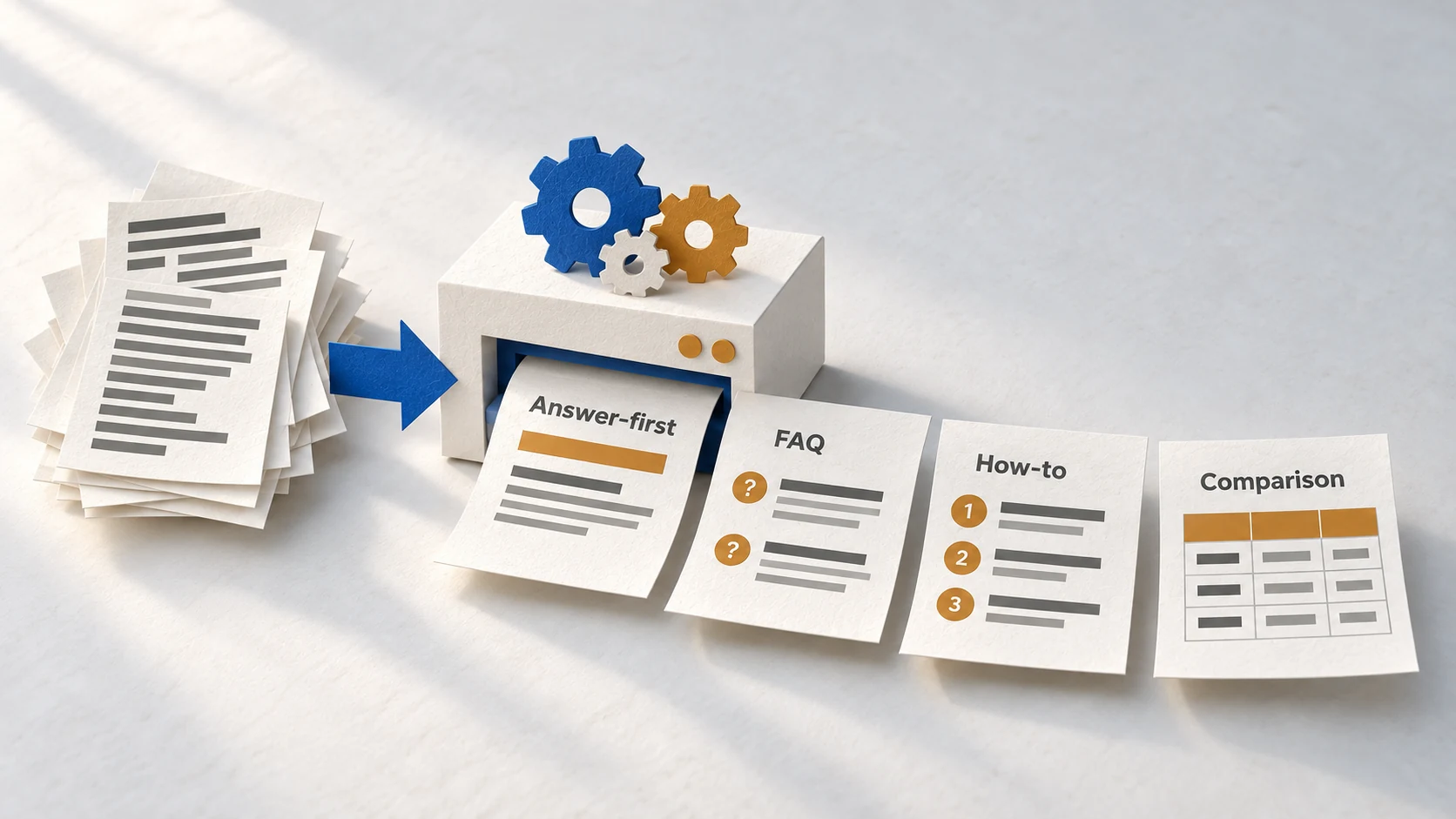
Your content might be comprehensive, well-researched, and genuinely helpful-but buried answers don't get cited. AI platforms extract from specific positions: first paragraphs, heading responses, list items, and table cells. If your answer is in paragraph five, it's invisible.
Content Structuring prompts solve this by transforming how your content is organized without changing what it says. You're not rewriting-you're restructuring. Moving key answers to extractable positions, converting prose to lists where appropriate, and ensuring every section leads with its core insight.
These 10 prompts cover the full restructuring workflow: answer extraction, heading optimization, format conversion, and citation prediction. Each produces specific, actionable outputs you can implement immediately.
Why Structure Matters for AI Citations
AI platforms process content differently than humans. When you read a blog post, you might skim the intro and jump to the section that interests you. When AI extracts content for citations, it follows predictable patterns-and those patterns favor certain structures.
72.4%
of AI-cited blog posts have identifiable answer capsules (Confirmed March 2026)
An answer capsule is a self-contained response immediately following a question-based heading. Content without this structure gets cited less than half as often as content with it. This benchmark has remained stable as of March 2026.
Source: Search Engine LandHuman Reading vs AI Extraction
| Behavior | Human Reader | AI Extractor |
|---|---|---|
| Starting Point | May skip to any section | Prioritizes first 500-1000 chars |
| Tolerance for Prose | Scans for key points | Prefers structured formats |
| Context Retention | Builds understanding over time | Extracts discrete snippets |
| Answer Location | Can find buried answers | Misses content not in extractable positions |
| Format Preference | Flexible | Lists, tables, direct answers |
Definition
Answer Capsule
A self-contained answer of 40-80 words that immediately follows a question-based heading. The capsule answers the question directly without requiring additional context. AI platforms can extract and cite this independently of the surrounding content.
The goal of content structuring isn't to dumb down your content-it's to make your best insights extractable. You're keeping the depth while improving the accessibility.
Answer Extraction Prompts
These prompts identify buried answers in your content and restructure them for extraction. The core principle: lead with your answer, then provide supporting detail.
Prompt #21: Answer-First Transformer
What it does: Analyzes your content to find where the key answer is currently located, then restructures it to lead with that answer. AI platforms don't read to the end-they extract from the top. This prompt ensures your best insight isn't trapped in paragraph five.
Your input: Complete blog post or article content.
Expected output: Identified key answer, new answer-first opening paragraph, and suggested restructure for remaining content.
What to do next: Replace your current intro with the new answer-first opening. Keep the rest as supporting detail-you're reorganizing, not rewriting.
Copy this prompt:
You are a GEO content optimizer specializing in answer-first transformation.

Analyze the following content and:
1. Identify the single most important insight/answer this content provides
2. Locate where that answer currently appears (quote the paragraph)
3. Write a new opening paragraph (40-60 words) that leads with this answer
4. Suggest how to restructure remaining content as supporting detail

Rules for the answer-first paragraph:
- No "In this article" or "Let's explore" openings
- Direct answer in first sentence
- One supporting fact in second sentence
- Context or qualifier in third sentence (optional)

The goal: AI should be able to extract your opening paragraph and cite it without needing any other context.

Content to transform:
[PASTE YOUR CONTENT HERE]
Prompt #22: FAQ Section Generator
What it does: Extracts implicit questions your content already answers and formats them as explicit FAQ entries. Pages with FAQ sections are 3.2x more likely to appear in AI Overviews-this prompt creates those sections from your existing content.
Your input: Complete blog post or article.
Expected output: 5-8 FAQ entries with properly formatted questions and 40-80 word answers, plus FAQPage schema markup.
What to do next: Add the FAQ section to your content. Implement the FAQPage schema. Test with Google's Rich Results Test.
Copy this prompt:
You are a GEO content strategist. Extract FAQ content from the following article.

Instructions:
1. Identify 5-8 questions this content implicitly answers
2. Format questions as users would naturally ask them (conversational, specific)
3. Write answers of 40-80 words each that:
   - Answer directly in first sentence
   - Provide essential supporting detail
   - Stand alone without needing context from the question

Also provide:
- FAQPage schema markup for the generated FAQs
- Priority ranking of which FAQs are most likely to trigger AI citations

Format each FAQ as:
**Q: [Question]**
A: [Answer]

Content to extract FAQs from:
[PASTE YOUR CONTENT HERE]
Prompt #23: Citation Block Creator
What it does: Creates standalone "citation blocks"-self-contained text segments designed specifically for AI extraction. These blocks summarize key insights in a format that can be quoted directly without additional context.
Your input: Article content with 3-5 key insights you want AI to cite.
Expected output: Citation-ready blocks for each insight, formatted for easy integration into your content.
What to do next: Insert blocks at relevant points in your content. Each block should follow its related heading or section introduction.
Copy this prompt:
You are a GEO citation specialist. Create citation blocks for the following content.

A citation block is a self-contained text segment (40-80 words) that:
- Can be quoted by AI without additional context
- Leads with the key insight
- Includes one supporting data point or example
- Uses specific language (no vague "it" or "they")
- Ends with a clear takeaway

Analyze the content and identify 3-5 key insights that should be citation-ready.

For each insight, create:
1. The insight in one sentence
2. A citation block (40-80 words) formatted for extraction
3. Recommended placement in the content (after which heading/section)

Content to analyze:
[PASTE YOUR CONTENT HERE]

Key insights to prioritize (optional - leave blank for AI to identify):
[LIST SPECIFIC INSIGHTS YOU WANT CITED, OR LEAVE BLANK]
Answer-First Transformation Example
Warning
Research shows 91% of AI-cited content blocks contain zero links. When creating citation blocks, keep them link-free. Links interrupt extraction and reduce citation probability. Add links in supporting content, not in the citation block itself.
Heading Structure Prompts
Headings are extraction signals. AI platforms use heading text to understand what each section contains. Question-based headings followed by direct answers are particularly effective-they mirror how users query AI.
87%
of ChatGPT-cited pages have a single H1
Compared to only 64% of pages in Google SERPs. Clean heading hierarchy signals content quality and makes extraction easier for AI platforms.
Source: AirOps ResearchPrompt #24: Heading Structure Optimizer
What it does: Audits your current heading structure and optimizes it for AI extraction. Checks for single H1, sequential hierarchy (no skipped levels), question-based H2s where appropriate, and descriptive clarity.
Your input: Your current article with all headings.
Expected output: Heading structure audit, optimized heading rewrites, and implementation recommendations.
What to do next: Replace headings with optimized versions. Ensure H1 is unique and H2s are sequential. Add question-format H2s where the content answers a specific question.
Copy this prompt:
You are a heading structure specialist for GEO. Audit and optimize the following content's heading structure.

Audit criteria:
1. Single H1: Only one H1 per page?
2. Sequential hierarchy: H1 → H2 → H3 (no skipped levels)?
3. Descriptive H2s: Do H2s clearly describe section content?
4. Question format: Are any H2s question-based (good for AI extraction)?
5. Keyword alignment: Do headings include target keywords naturally?
6. Length: Are headings 5-10 words (optimal for extraction)?

For the provided content:

1. Current Heading Structure
   List all headings with their levels (H1, H2, H3, etc.)

2. Structure Audit
   Score each criterion (1-5) with explanation

3. Optimized Headings
   Rewrite each heading for AI optimization:
   - Original: [heading]
   - Optimized: [new heading]
   - Reason: [why this is better]

4. Question-Format Opportunities
   Which H2s should be converted to question format?
   Example: "Benefits of GEO" → "What Are the Benefits of GEO?"

5. Priority Changes
   Top 3 heading changes with highest impact

Content to audit:
[PASTE YOUR CONTENT WITH HEADINGS HERE]
Prompt #25: Semantic Clarity Checker
What it does: AI platforms struggle with ambiguous pronouns and vague references. "It," "they," "this," and "that" often refer to unclear antecedents. This prompt identifies semantic ambiguity and provides specific rewrites.
Your input: Content to check for semantic clarity.
Expected output: Ambiguity report with specific instances and rewrites that replace vague pronouns with explicit nouns.
What to do next: Replace flagged instances with clearer language. Focus on the first paragraph of each section (highest extraction priority).
Copy this prompt:
You are a semantic clarity specialist. Audit the following content for ambiguous language that hurts AI extraction.

AI platforms extract content in snippets. If a snippet uses "it" or "they" without clear context, the extraction is useless. Identify and fix:

1. Pronoun Ambiguity
   - Flag every "it," "they," "this," "that," "these," "those" where the antecedent isn't immediately clear
   - Provide rewrite with explicit noun

2. Vague References
   - "The process" (which process?)
   - "The tool" (which tool?)
   - "The approach" (what approach?)

3. Implicit Subjects
   - Sentences that assume context from previous paragraphs
   - Each paragraph should be semi-independent

Format your response as:

AMBIGUITY REPORT:

1. [Quote the problematic sentence]
   - Issue: [What's unclear]
   - Rewrite: [Clear version]

2. [Next instance]
   ...

PRIORITY FIXES:
List the 5 most important clarity improvements (focus on first paragraphs of sections)

Content to audit:
[PASTE YOUR CONTENT HERE]
Format Optimization Prompts
Lists and tables are AI-extraction gold. Research shows 79% of ChatGPT-cited pages contain HTML lists, compared to only 28.6% of typical Google SERP results. These prompts help you identify prose that should be formatted as lists or tables.
Prompt #26: List Format Converter
What it does: Identifies prose that would be more extractable as lists. Not all content should be lists-but sequential steps, feature comparisons, and enumerated items are far more citable when formatted properly.
Your input: Content to analyze for list opportunities.
Expected output: Specific prose passages identified, converted list versions, and recommendations for list type (bullet, numbered, definition).
What to do next: Replace identified prose with list format. Use numbered lists for steps/sequences, bullets for features/benefits, definition lists for term explanations.
Copy this prompt:
You are a content format optimizer. Identify prose in the following content that should be converted to list format for AI extraction.

List conversion candidates:
- Sequential steps ("First... then... finally...")
- Enumerated items ("There are three main types...")
- Feature lists ("It includes X, Y, and Z")
- Pro/con discussions ("On one hand... on the other...")
- Definitions or explanations of multiple terms

For each identified passage:

1. Original Prose
   [Quote the paragraph]

2. List Type Recommendation
   - Numbered list (for sequences, ranked items)
   - Bullet list (for non-sequential features)
   - Definition list (for term explanations)

3. Converted Format
   [The content as a list]

4. Why This Helps
   [Brief explanation of extraction benefit]

Do NOT convert:
- Narrative content that flows naturally as prose
- Single-item mentions
- Content that would become awkwardly choppy

Content to analyze:
[PASTE YOUR CONTENT HERE]
Prompt #27: Table Data Extractor
What it does: Identifies comparison data, statistics, or structured information that should be formatted as tables. Tables are cited 2.5x more than equivalent prose content. This prompt finds table opportunities and creates the table structure.
Your input: Content with comparison data, statistics, or structured information.
Expected output: Table opportunities identified, HTML/Markdown table markup, and placement recommendations.
What to do next: Implement tables where recommended. Keep tables simple (3-5 columns max). Ensure table headers are descriptive.
Copy this prompt:
You are a data structuring specialist. Identify content that should be formatted as tables for AI extraction.

Table candidates:
- Comparisons between 2+ items
- Statistics with multiple data points
- Feature/benefit matrices
- Pricing or specification data
- Before/after comparisons
- Tool or product comparisons

For each identified opportunity:

1. Original Content
   [Quote the relevant passage]

2. Table Structure
   | Column 1 | Column 2 | Column 3 |
   |----------|----------|----------|
   | Data     | Data     | Data     |

3. Table Type
   - Comparison table
   - Data table
   - Feature matrix
   - Specification table

4. Extraction Benefit
   Why this table format helps AI citation

5. Placement Recommendation
   Where should this table appear relative to existing content?

Guidelines:
- Maximum 5 columns for readability
- Clear, descriptive headers
- Consistent data format within columns
- No empty cells if possible

Content to analyze:
[PASTE YOUR CONTENT HERE]
Prompt #28: Paragraph Length Optimizer
What it does: AI platforms prefer shorter, focused paragraphs. Long paragraphs (200+ words) are harder to extract from. This prompt identifies overly long paragraphs and suggests break points that maintain meaning while improving extractability.
Your input: Content with paragraphs to optimize.
Expected output: Long paragraph flags, suggested break points, and rewritten paragraph versions.
What to do next: Split flagged paragraphs at recommended points. Aim for 50-100 words per paragraph. Ensure each paragraph has one main idea.
Copy this prompt:
You are a paragraph structure optimizer for AI readability.

Long paragraphs hurt AI extraction because:
- AI may extract only part of the paragraph
- Key insights get buried
- Context switching within paragraphs confuses extraction

Analyze the following content and:

1. Flag Long Paragraphs
   Mark any paragraph over 100 words with word count

2. Identify Break Points
   For each long paragraph, identify natural break points:
   - Topic shifts
   - New examples or evidence
   - Contrasting points
   - Conclusion transitions

3. Provide Optimized Versions
   Rewrite flagged paragraphs as 2-3 shorter paragraphs (50-100 words each)

4. One-Idea Rule Check
   Does each paragraph focus on a single main idea? Flag violations.

Format as:

PARAGRAPH ANALYSIS:

Paragraph 1: [First 10 words...]
Word count: [X]
Status: [OK / TOO LONG]
Break recommendation: [If needed]
Optimized version: [If needed]

...continue for all paragraphs

Content to analyze:
[PASTE YOUR CONTENT HERE]
Prompt #29: Content Freshness Updater
What it does: AI platforms favor fresh content-76.4% of ChatGPT-cited pages were updated in the last 30 days. This prompt identifies outdated elements in your content and provides updates that signal freshness without major rewrites.
Your input: Content with its original publication date.
Expected output: Outdated element flags, freshness updates, and recommendations for ongoing freshness signals.
What to do next: Implement updates, add "Last updated" date, and schedule quarterly freshness reviews for high-priority content.
Copy this prompt:
You are a content freshness specialist. Audit the following content for elements that signal outdated information.

Freshness signals AI platforms look for:
- Publication/update dates
- Current year references
- Recent statistics (within 12 months)
- Current tool versions
- Active links (not 404s)
- Present-tense language (not "will be" for past events)

For the provided content:

1. Outdated Element Flags
   - Statistics from 2+ years ago
   - References to past years as current ("In 2023...")
   - Deprecated tools or features
   - Predictions that have already occurred
   - "New" features that are now standard

2. Freshness Updates
   For each flagged element, provide:
   - Original: [outdated text]
   - Updated: [fresh version]
   - Note: [If new data needed, indicate what to research]

3. Structural Freshness Signals
   - Add "Last Updated: [Date]" recommendation
   - Suggest sections that need periodic review
   - Recommend internal links to newer content

4. Freshness Score
   Rate 1-10 how current this content appears

Original publication date: [YOUR CONTENT'S PUB DATE]
Content to audit:
[PASTE YOUR CONTENT HERE]
Prompt #30: AI Citation Prediction
What it does: Predicts the probability that your content will be cited by AI platforms based on structural analysis. This is your before/after comparison tool-run it pre-optimization and post-optimization to measure improvement.
Your input: Content to evaluate for citation probability.
Expected output: Citation probability score, structural strengths, gaps to address, and specific recommendations.
What to do next: Address the gaps identified. Re-run after implementing changes to measure improvement. Target 70%+ citation probability score.
Copy this prompt:
You are an AI citation probability predictor. Analyze the following content and estimate its likelihood of being cited by AI platforms.

Evaluation criteria (score each 1-10):

1. Answer-First Structure
   Does content lead with key answers? Is the first 100 words extraction-ready?

2. Heading Optimization
   Single H1? Sequential hierarchy? Question-format headings?

3. List & Table Usage
   Are appropriate elements formatted as lists/tables?

4. Semantic Clarity
   Minimal pronoun ambiguity? Each paragraph focused on one idea?

5. FAQ Section
   Is there an FAQ section with FAQPage schema?

6. Freshness Signals
   Updated date visible? Current year references? Recent statistics?

7. Answer Capsules
   Self-contained, quotable blocks of 40-80 words?

8. Entity Signals
   Author attribution? Organization schema? E-E-A-T indicators?

CITATION PROBABILITY ASSESSMENT:

Overall Score: [X/80]
Citation Probability: [Low/Medium/High] ([X]%)

Strengths:
- [What this content does well]

Critical Gaps:
- [What most hurts citation probability]

Top 3 Improvements:
1. [Highest impact change]
2. [Second priority]
3. [Third priority]

Expected Probability After Fixes: [X]%

Content to evaluate:
[PASTE YOUR CONTENT HERE]
Implementation Workflow
Content structuring works best as a systematic workflow, not random optimization. Here's the recommended sequence for transforming existing content:
Content Structuring Implementation Order
- 1
Baseline (#30)
Run AI Citation Prediction to understand current state
- 2
Answer Extraction (#21-23)
Transform to answer-first, create citation blocks, generate FAQ
- 3
Structure (#24-25)
Optimize headings and fix semantic clarity issues
- 4
Format (#26-28)
Convert to lists/tables, optimize paragraph length
- 5
Freshness (#29)
Update outdated elements and add freshness signals
- 6
Validate (#30)
Re-run Citation Prediction to measure improvement
Content Structuring Completion Checklist
- Answer-first opening paragraph (40-60 words)
- FAQ section with 5-8 questions and FAQPage schema
- Single H1, sequential H2/H3 hierarchy
- Question-format headings where appropriate
- No ambiguous pronouns in extraction zones
- Lists used for sequential/enumerated content
- Tables used for comparison data
- Paragraphs under 100 words each
- Last Updated date visible
- Citation Probability Score 70%+
FAQ
Should I restructure all my existing content or just new content?
How do I know if my content structure is working?
Can I use these prompts on content written by other team members?
What's the minimum word count for effective content structuring?
Do these prompts work for all content types?
Want the Complete 100-Prompt Toolkit?
This post covers Category 2 (prompts 21-30). The full GEO Accelerator Toolkit includes 100 prompts across 6 categories.
The complete toolkit is available in the GEO Accelerator Course.
Take the GEO Readiness Quiz →60 seconds · Personalized report · Free
Continue Learning
Dive deeper into AI search with these related articles:
The GEO Accelerator Toolkit: AI Prompts for Every Stage of Optimization
100 copy-paste AI prompts organized into 6 categories covering entity building, content structuring, AI platform optimization, digital PR, and measurement. Sample prompts from each category included.
Content Structuring for AI Consumption: The Answer-First Framework
Master the complete framework for structuring content that AI systems cite. Lists, tables, modular blocks, and answer-first formatting for GEO success.
Answer-First Writing: How to Structure Content AI Wants to Cite
72.4% of AI-cited blog posts use answer capsules. Learn the answer-first writing structure.