GEO & AI Search
The GEO Accelerator Toolkit: AI Prompts for Every Stage of Optimization
Quick Answer
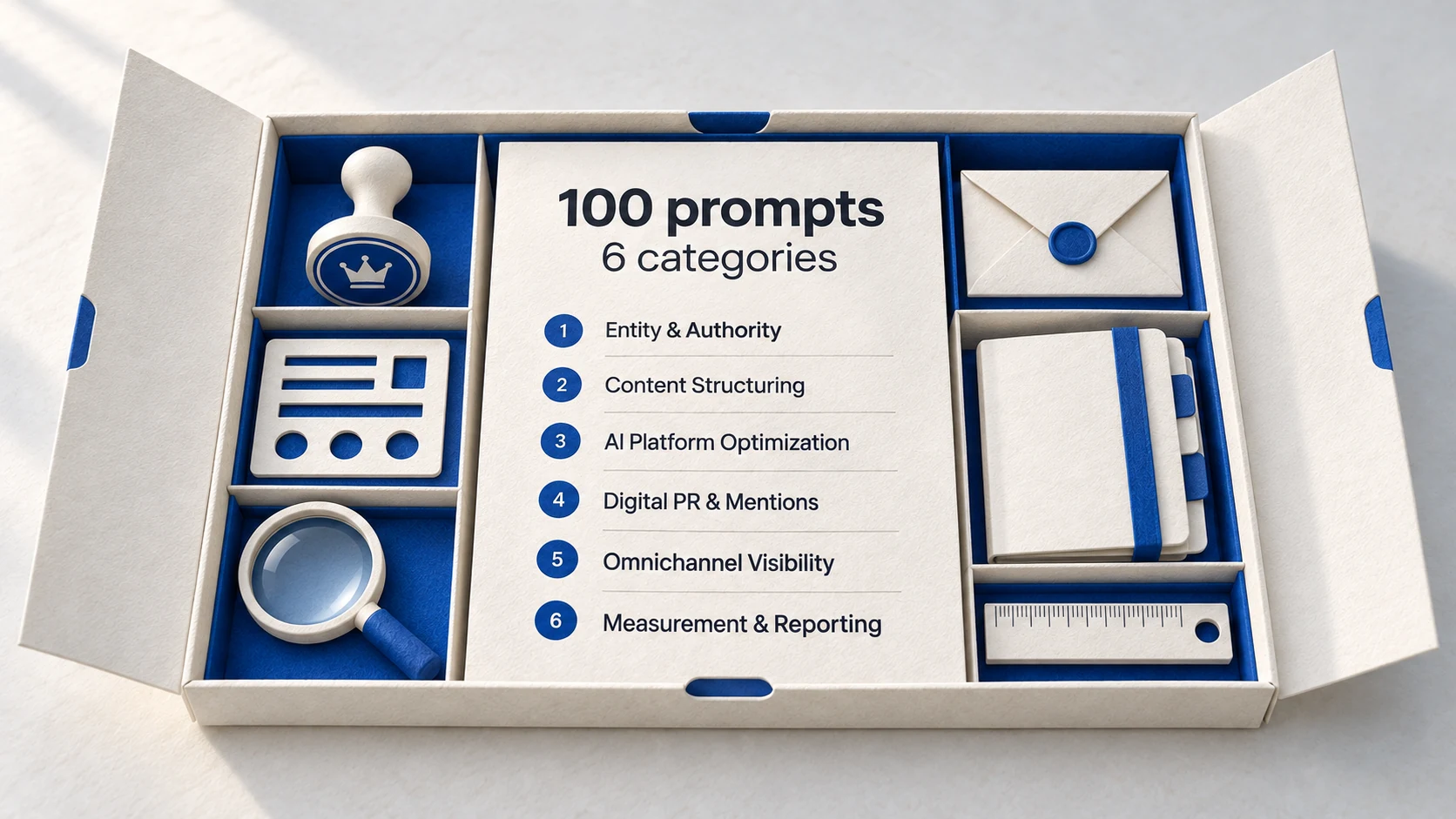
The GEO Accelerator Toolkit is a collection of 100 AI prompts organized into 6 categories: Entity & Authority, Content Structuring, AI Platform Optimization, Digital PR & Mentions, Omnichannel Visibility, and Measurement & Reporting. Each prompt is designed to produce actionable outputs-not vague advice. This post previews sample prompts from each category so you can start optimizing immediately while understanding the full toolkit's scope.
The irony of GEO optimization: the same AI platforms you're trying to get cited by can help you optimize for citations. But only if you know what to ask.
Most people open ChatGPT, type "help me optimize my content for AI search," and get back generic advice they could have Googled. The problem isn't the AI-it's the prompt. Vague questions produce vague answers. Specific, structured prompts produce specific, actionable analysis.
The GEO Accelerator Toolkit solves this with 100 ready-to-use prompts covering every aspect of AI search optimization. Each prompt is designed for a specific task, formatted to request concrete outputs, and organized so you know exactly which to use when. This post previews the toolkit with sample prompts from each category.
100
prompts in the complete toolkit
Covering every stage from entity building to measurement and reporting.
6
organized categories
Entity, Content, Platform, PR, Omnichannel, Measurement.
12
sample prompts in this preview
Two from each major category-enough to start optimizing today.
How the GEO Accelerator Toolkit Works
The toolkit is organized as a progression. You don't need all 100 prompts on day one-you need the right prompts for your current stage. Start with entity assessment, move to content optimization, then build external signals. Measurement prompts help you track progress throughout.
GEO Toolkit Implementation Progression
Prompts 1-20: Assess and strengthen your brand's AI-recognizable identity
Prompts 21-40: Structure content for AI extraction and citation
Prompts 41-55: Optimize for specific AI platforms (ChatGPT, Perplexity, etc.)
Prompts 56-85: Digital PR, third-party mentions, omnichannel presence
Prompts 86-100: Track citations, report progress, identify opportunities
-
Prompts 1-20: Assess and strengthen your brand's AI-recognizable identity
-
Prompts 21-40: Structure content for AI extraction and citation
-
Prompts 41-55: Optimize for specific AI platforms (ChatGPT, Perplexity, etc.)
-
Prompts 56-85: Digital PR, third-party mentions, omnichannel presence
-
Prompts 86-100: Track citations, report progress, identify opportunities
Toolkit Categories at a Glance
| Category | Prompt Range | When to Use |
|---|---|---|
| Entity & Authority | 1-20 | Foundation building, About page optimization, schema planning |
| Content Structuring | 21-40 | New content creation, existing content transformation |
| AI Platform Optimization | 41-55 | Platform-specific targeting, algorithm updates |
| Digital PR & Mentions | 56-70 | Third-party visibility, listicle outreach, HARO |
| Omnichannel Visibility | 71-85 | Social profiles, directory listings, multi-platform strategy |
| Measurement & Reporting | 86-100 | Tracking progress, client reports, opportunity identification |
Warning
Don't jump to Platform Optimization (Category 3) before completing Entity Foundation (Category 1). AI platforms verify who you are before deciding whether to cite you. Foundation first, optimization second.
Category 1: Entity & Authority Prompts (Sample)
Entity prompts help you assess and strengthen your brand's AI-recognizable identity. Before AI platforms cite you, they need to understand who you are. These prompts analyze your current entity signals and identify gaps.
Prompt #1: Entity Readiness Audit
What it does: Analyzes your brand's entity signals across the factors AI platforms use for recognition-schema markup, About page quality, third-party mentions, and cross-platform consistency. Think of it as a diagnostic that tells you exactly where your entity is strong and where it's invisible.
Your input: Your website's About page URL + homepage URL. The AI will analyze visible content and infer entity signals.
Expected output: A 5-dimension scorecard with specific gaps identified and priority fixes ranked by impact.
What to do next: Focus on the highest-impact gap first. If schema is missing, add it before worrying about third-party mentions. Foundation before amplification.
Copy this prompt:
You are a GEO (Generative Engine Optimization) specialist. Analyze the following website for entity recognition by AI platforms.

Evaluate these 5 entity dimensions (score 1-5 each):
1. About Page Quality: Does the page clearly establish who the brand/person is, what they do, and why they're credible?
2. Schema Signals: Is Organization/Person schema likely present? Are sameAs links connecting to other platforms?
3. Author Attribution: Is content attributed to named individuals with credentials visible?
4. Third-Party Validation: Based on the claims made, is there evidence of external validation (awards, media mentions, industry recognition)?
5. Cross-Platform Consistency: Does the brand present consistently across visible platforms?

For each dimension:
- Score 1-5
- Identify the specific gap
- Provide one concrete fix

End with an Entity Readiness Score (out of 25) and the single highest-priority improvement.

Website to analyze:
[PASTE YOUR ABOUT PAGE URL AND HOMEPAGE URL HERE]
Prompt #2: About Page Optimization Generator
What it does: Takes your current About page content and rewrites it using the Entity Home framework-the structure that tells AI platforms exactly who you are, what you do, and why you're credible. No fluff, just the signals AI needs to verify your identity.
Your input: Your current About page text. Include everything visible on the page.
Expected output: A rewritten About page with clear entity statement, credentials summary, topic expertise areas, and social proof structured for AI extraction.
What to do next: Compare the output to your current page. Implement the structural changes while maintaining your brand voice. Add the recommended schema markup.
Copy this prompt:
You are a GEO content strategist. Rewrite the following About page using the Entity Home framework for maximum AI recognition.

The Entity Home framework requires:
1. Entity Statement: One clear sentence defining who/what this brand is
2. Credibility Signals: Specific achievements, credentials, or recognition (not generic claims)
3. Topic Expertise: Explicit list of areas this brand has authority to speak on
4. Social Proof: Named clients, publications, awards, or metrics that verify claims
5. Contact & Verification: Clear ways AI can verify this entity exists

Rewrite the About page to include all 5 elements. Maintain brand voice but prioritize clarity over creativity.

After the rewrite, provide:
- Organization schema markup for this entity
- 3 sameAs URLs that should be linked (infer from content)
- The single most important credibility signal to add if missing

Current About page content:
[PASTE YOUR ABOUT PAGE CONTENT HERE]
85%
of AI brand mentions come from third-party sources
Entity prompts help you establish who you are so third-party mentions can be connected to your brand. Without clear entity signals, AI platforms can't connect external mentions to your website.
Source: AirOps ResearchCategory 2: Content Structuring Prompts (Sample)
Content structuring prompts transform existing content into AI-citation-ready format. They analyze structure, identify buried answers, and provide specific rewrites that move key information to extractable positions.
Prompt #21: Answer-First Transformer
What it does: Analyzes your content to find where the key answer is currently buried, then restructures it to lead with that answer. AI platforms don't read to the end-they extract from the top. This prompt ensures your best insight isn't trapped in paragraph five.
Your input: Complete blog post or article content. Works best with content that answers a specific question.
Expected output: Identified key answer, new answer-first opening paragraph, and suggested restructure for the rest of the content.
What to do next: Replace your current intro with the new answer-first opening. Keep the rest of your content as supporting detail-you're reorganizing, not rewriting.
Copy this prompt:
You are a GEO content optimizer specializing in answer-first transformation.

Analyze the following content and:
1. Identify the single most important insight/answer this content provides
2. Locate where that answer currently appears (quote the paragraph)
3. Write a new opening paragraph (40-60 words) that leads with this answer
4. Suggest how to restructure remaining content as supporting detail

Rules for the answer-first paragraph:
- No "In this article" or "Let's explore" openings
- Direct answer in first sentence
- One supporting fact in second sentence
- Context or qualifier in third sentence (optional)

The goal: AI should be able to extract your opening paragraph and cite it without needing any other context.

Content to transform:
[PASTE YOUR CONTENT HERE]
Prompt #25: FAQ Section Generator
What it does: Extracts implicit questions your content already answers and formats them as explicit FAQ entries with proper structure. Pages with FAQ schema are 3.2x more likely to appear in AI Overviews-this prompt creates those sections from your existing content.
Your input: Complete blog post or article. The more comprehensive your content, the more questions can be extracted.
Expected output: 5-8 FAQ entries with questions formatted as users would ask them and answers written for direct AI extraction (40-80 words each).
What to do next: Add the generated FAQ section to your content. Implement FAQPage schema using the provided template. Validate with Google's Rich Results Test.
Copy this prompt:
You are a GEO content strategist. Extract FAQ content from the following article.

Instructions:
1. Identify 5-8 questions this content implicitly answers
2. Format questions as users would naturally ask them (conversational, specific)
3. Write answers of 40-80 words each that:
   - Answer directly in first sentence
   - Provide essential supporting detail
   - Stand alone without needing context from the question

Also provide:
- FAQPage schema markup for the generated FAQs
- Priority ranking of which FAQs are most likely to trigger AI citations

Format each FAQ as:
**Q: [Question]**
A: [Answer]

Content to extract FAQs from:
[PASTE YOUR CONTENT HERE]
Answer-First Transformation Example
Category 3: Measurement & Tracking Prompts (Sample)
Measurement prompts help you track AI visibility, analyze citation patterns, and build reports that demonstrate GEO progress. Unlike traditional SEO metrics, GEO measurement requires new approaches-these prompts define what to track and how to interpret results.
Prompt #86: AI Visibility Baseline Assessment
What it does: Creates a systematic framework for testing your current visibility across AI platforms. You can't measure improvement without a baseline-this prompt helps you establish one by testing queries across ChatGPT, Perplexity, Claude, and Google AI Overviews.
Your input: Your brand name, primary topic, and 5-10 queries relevant to your expertise.
Expected output: A testing protocol with specific queries to run, a spreadsheet structure for recording results, and benchmarks for what "good" visibility looks like.
What to do next: Run the queries manually across all platforms. Record results in the suggested format. Set a calendar reminder to repeat monthly.
Copy this prompt:
You are a GEO measurement specialist. Create a visibility baseline assessment protocol for the following brand.

Brand: [YOUR BRAND NAME]
Primary Topic: [YOUR MAIN EXPERTISE AREA]
Relevant Queries: [LIST 5-10 QUERIES YOUR IDEAL CUSTOMERS WOULD ASK AI]

Create:
1. A testing protocol with:
   - 10 specific queries to test (include the ones provided + suggested additions)
   - Platforms to test (ChatGPT, Perplexity, Claude, Google AI Overview)
   - What to record for each query (mention Y/N, citation Y/N, position, sentiment)

2. A tracking spreadsheet structure with columns for:
   - Query, Platform, Date, Mentioned (Y/N), Cited (Y/N), Position (1-5), Competitor Mentioned, Notes

3. Benchmarks:
   - What does "good" look like for a brand at this stage?
   - What citation rate should trigger action?
   - When should baseline be re-measured?

Include interpretation guidance: How to read the results and prioritize improvements.
Prompt #92: GEO Progress Report Generator
What it does: Transforms raw tracking data into a stakeholder-friendly report that demonstrates GEO progress. Whether reporting to clients, executives, or yourself-this prompt structures the narrative around what matters: visibility changes, citation wins, and next steps.
Your input: Your baseline data from Prompt #86 and current tracking data. Include dates, platforms, and citation results.
Expected output: A structured progress report with executive summary, visibility metrics, notable citations, competitor comparison, and recommended next actions.
What to do next: Customize the report for your audience. Add screenshots of actual citations. Use monthly for ongoing GEO programs.
Copy this prompt:
You are a GEO reporting specialist. Create a progress report from the following tracking data.

Baseline Data (from [DATE]):
[PASTE BASELINE RESULTS]

Current Data (from [DATE]):
[PASTE CURRENT RESULTS]

Generate a GEO Progress Report with:

1. Executive Summary (3-4 sentences)
   - Overall visibility change
   - Most significant win
   - Key recommendation

2. Visibility Metrics
   - Mention rate change (baseline vs current)
   - Citation rate change
   - Platform-by-platform breakdown

3. Notable Citations
   - List any new citations with query, platform, and context
   - Highlight particularly valuable citations (high-traffic queries, competitor displacement)

4. Competitor Movement
   - Any competitors gaining or losing visibility?
   - Opportunities to capture

5. Recommended Next Actions
   - 3 specific actions for the next reporting period
   - Priority ranking with rationale

Format for non-technical stakeholders. Use percentages and concrete examples, not jargon.
Category 4: Digital PR & Mentions Prompts (Sample)
Digital PR prompts help you identify and secure third-party mentions-the external validation AI platforms prioritize. From listicle inclusion to HARO responses, these prompts systematize outreach that builds citation authority.
Prompt #56: Listicle Opportunity Finder
What it does: Identifies "best of" listicles and comparison articles in your space where you should be included but aren't. Nearly 90% of AI citations from third-party sources come from list-style content-this prompt finds the lists that matter and prioritizes outreach targets.
Your input: Your product/service category, 3-5 competitor names, and your key differentiators.
Expected output: Search queries to find listicles, criteria for prioritizing outreach, and a pitch angle based on your differentiators.
What to do next: Run the suggested searches. Build a target list. Prioritize listicles that already rank for queries you care about. Begin outreach with the suggested angle.
Copy this prompt:
You are a Digital PR strategist specializing in GEO. Create a listicle opportunity identification strategy.

Category: [YOUR PRODUCT/SERVICE CATEGORY]
Competitors: [3-5 COMPETITOR NAMES]
Key Differentiators: [WHAT MAKES YOU DIFFERENT FROM THOSE COMPETITORS]

Create:
1. Search Queries to Find Listicles
   - 10 Google search queries that will find "best of" lists in this category
   - Focus on queries that include competitor names, "best [category]," "top [category] tools/services"

2. Prioritization Criteria
   - How to rank which listicles to target first (domain authority, publish date, author activity, etc.)
   - Red flags that indicate an author won't respond

3. Pitch Angle
   - One unique value proposition based on the differentiators
   - A hook that makes the author want to add you (not just "please add us")
   - Data points or proof that support inclusion

4. Outreach Template Skeleton
   - Subject line formula
   - Key elements to include
   - What NOT to include (common mistakes)
Prompt #62: HARO Response Optimizer
What it does: Takes a journalist request and crafts a response optimized for selection. HARO responses that get quoted are concise, specific, and lead with expertise signals-this prompt structures responses that stand out from the dozens of generic replies journalists receive.
Your input: The journalist's query, your expertise relevant to the query, and your credentials/title.
Expected output: A structured HARO response with a lead paragraph, 2-3 key points, a quotable soundbite, and a credentials sign-off.
What to do next: Personalize the output with your actual experience. Send promptly (within 24 hours of the request). Track which responses get picked up.
Copy this prompt:
You are a PR response specialist. Craft a HARO response optimized for journalist selection.

Journalist Query: [PASTE THE FULL QUERY]
My Relevant Expertise: [YOUR BACKGROUND RELATED TO THIS QUERY]
My Credentials: [TITLE, COMPANY, RELEVANT ACHIEVEMENTS]

Create a HARO response with:
1. Lead Paragraph (2-3 sentences)
   - Establish expertise immediately
   - Signal that you understand what they're looking for
   - Hint at the unique angle you'll provide

2. Key Points (2-3 bullet points)
   - Specific, actionable insights (not generic advice)
   - Include one data point or example if possible
   - Each point should be independently quotable

3. Quotable Soundbite (1 sentence)
   - A memorable statement that encapsulates your perspective
   - Formatted so they can copy-paste directly into the article
   - Avoid jargon-write for their readers, not your industry

4. Credentials Sign-off
   - Name, title, company
   - One sentence of relevant background
   - Link to bio or website

Keep total response under 300 words. Journalists receive dozens of responses-brevity wins.
90%
of third-party AI citations from listicles and comparisons
List-style content dominates AI citations. The Digital PR prompts focus on getting you included in the content formats that actually get cited.
Source: AirOps ResearchRecommended Implementation Workflow
The toolkit is designed for progressive implementation. Here's the recommended sequence for new GEO optimization efforts:
GEO Toolkit Implementation Sequence
- 1
Week 1: Entity Audit
Run Prompts #1-5 to assess your foundation. Fix critical gaps before proceeding.
- 2
Week 2: Content Transformation
Apply Prompts #21-30 to your top 5-10 pages. Implement answer-first structure.
- 3
Week 3: Measurement Setup
Use Prompts #86-90 to establish baseline. Record current visibility across platforms.
- 4
Week 4+: Authority Building
Begin Digital PR with Prompts #56-70. Ongoing outreach for third-party mentions.
Weekly Prompt Usage Schedule
- Monday: Run visibility tracking (Prompt #86) to monitor changes
- Tuesday-Wednesday: Apply content prompts (#21-40) to new or updated content
- Thursday: Review and respond to HARO/journalist queries (Prompt #62)
- Friday: Identify and prioritize listicle opportunities (Prompt #56)
- Monthly: Generate progress report (Prompt #92) and update entity audit (#1)
FAQ
How many prompts are in the complete GEO Accelerator Toolkit?
Can I use these prompts with Claude or other AI models, not just ChatGPT?
What order should I use the prompts in?
How often should I run these prompts?
What if the AI gives generic advice instead of specific recommendations?
Can I automate these prompts for batch processing?
Ready for the Complete Toolkit?
This post previews 12 prompts from the 100-prompt toolkit. Each category has detailed prompts for every scenario you'll encounter.
The full GEO Accelerator Toolkit is available in the GEO Accelerator Course.
Take the GEO Readiness Quiz →60 seconds · Personalized report · Free
Continue Learning
Dive deeper into AI search with these related articles:
ChatGPT for GEO: The Essential Prompts
10 copy-paste ChatGPT prompts to audit, optimize, and track your content for AI search visibility. Content audit, competitor analysis, entity building, and tracking prompts you can use today.
Your First ChatGPT Citation in 30 Days: Quick-Start GEO Guide
A week-by-week implementation plan to achieve your first AI citation. From visibility audit to schema markup to content optimization—the complete 30-day GEO quick-start guide.
Measuring GEO Success: Complete Analytics Framework
The definitive guide to GEO measurement. Track AI citations, measure Share of Voice, calculate ROI, and build dashboards that prove AI visibility impact.